
This site is supported by our readers. We may earn a commission, at no cost to you, if you purchase through links.

Most ducks keep a low profile—muted browns, quiet quacks, quick retreats into open water. The black-bellied whistling duck didn’t get that memo.
This species shows up in flooded rice paddies and shallow wetlands across the Americas, wearing a chestnut back, a bold black belly patch, and a pink bill that looks almost deliberately out of place, like nature ran out of subtlety halfway through.
It whistles instead of quacks, nests in tree cavities instead of ground scrapes, and feeds just as readily after dark as before noon.
Understanding how this duck lives, where it goes, and why it thrives tells you something useful about wetland ecology that most field guides only hint at.
Table Of Contents
- Key Takeaways
- Black-Bellied Whistling Duck Identification
- Range and Habitat
- Diet and Foraging Habits
- Nesting and Reproduction
- Behavior, Calls, and Conservation
- Frequently Asked Questions (FAQs)
- How long do black-bellied whistling ducks live?
- Are black-bellied whistling ducks monogamous?
- What predators do black-bellied whistling ducks face?
- Can black-bellied whistling ducks interbreed with other species?
- Do black-bellied whistling ducks migrate seasonally?
- Can black-bellied whistling ducks live with other species?
- How do predators threaten black-bellied whistling ducks?
- What is their typical daily activity schedule?
- Do they swim differently than other dabbling ducks?
- How long do mated pairs stay together?
- Conclusion
Key Takeaways
- The black-bellied whistling duck stands out instantly in the field thanks to its chestnut back, bold black belly, bright pink bill, and wide white wing stripe — a combination you won’t confuse with any other duck.
- Unlike most dabbling ducks, it nests in tree cavities and nest boxes rather than on the ground, and it’ll forage just as actively after dark as it does at sunrise.
- Its diet and habitat flexibility — moving fluidly between flooded rice paddies, freshwater marshes, and harvested farm fields — is a big reason it’s thriving while many wetland species aren’t.
- With a global population estimated between 1.1 and 2 million and an IUCN status of Least Concern, this species is a rare conservation win, though wetland loss and brood parasitism in crowded nest boxes remain real risks worth watching.
Black-Bellied Whistling Duck Identification
Once you spot a Black-Bellied Whistling Duck, you won’t mistake it for anything else. This species has a combination of features that make it genuinely easy to recognize in the field.
Their distinctive whistling calls are just as recognizable as their looks—explore black-bellied whistling duck vocalizations and behavior patterns to sharpen your identification skills even further.
Here’s what to look for.
Plumage and Coloration
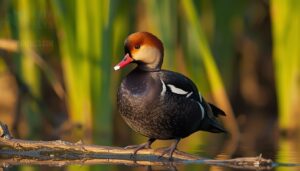
When you spot a Black-Bellied Whistling Duck, its plumage characteristics hit you in layers.
Here’s what defines the color pattern:
- rich chestnut crown and back contrast sharply against a large black belly patch
- neck gradient contrast shifts gradually from dark brown to soft gray toward the breast
- broad white wing stripe at rest and an iridescent wing sheen with speculum bluish hue on secondaries
- Facial plumage stays pale gray, framing the eye cleanly
- Juvenile dullness is obvious — muted gray-brown tones, less gloss, reduced contrast throughout
Seasonal molt changes sharpen these features noticeably in adults. Research shows that habitat openness influences contrast in avian plumage.
Bill, Legs, and Body Shape
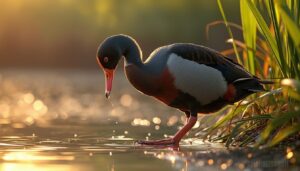
Beyond the plumage, structure tells its own story. That bright pink bill has a slight downward curve — built for skimming seeds and probing mud cleanly. The large pink feet and partial leg webbing handle both wading and land with ease.
| Feature | Description | Function |
|---|---|---|
| Bill curvature | Slightly decurved, stout bill | Grazes vegetation, probes mud |
| Leg webbing | Partial, rough-textured | Wading and land movement |
| Body buoyancy | Rounded chest, low center | Stable in irregular wetlands |
That long slender neck and short tail complete a silhouette built for wetland life.
Size, Wingspan, and Weight
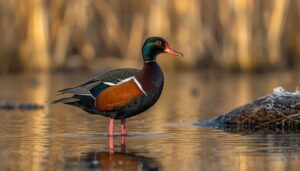
Size puts this duck in solid mid-range waterfowl territory. Adults measure 18–22 inches in length, with a wingspan around 2 ft 6 in and weight between 1 lb 7 oz–2 lb 4 oz.
Sexual dimorphism is minimal — males run slightly heavier. Seasonal weight changes reflect fat reserves during movement periods.
Key field measurements:
- Body length: 47–56 cm
- Wingspan: 76–94 cm average
- Weight: 652–1,020 g adults
- Regional wingspan variation: up to several centimeters across populations
Adult Versus Juvenile Differences
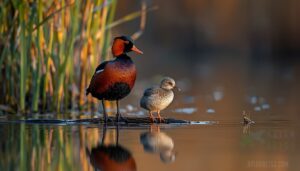
Once you know the adult’s size, telling ages apart gets easier.
That’s why brushing up on black vulture size and physical traits can give you a reliable baseline before you start guessing at age.
Adults show crisp adult plumage — chestnut back, black belly, and a sharp Eye Ring Distinction — while juvenile plumage stays mottled brown with a diffuse face and no black belly.
Feather Molt Schedule fills in that contrast gradually.
Body Posture Differences and Flight Capability sharpen with age, as does Vocalization Maturity.
Range and Habitat

The black-bellied whistling duck isn’t picky about where it sets up home — but it does have some clear favorites. From coastal wetlands to flooded farm fields, this species turns up in a surprisingly wide range of places across the Americas.
Here’s a look at the key habitats where you’re most likely to spot one.
Native Distribution in The Americas
This duck’s distribution range stretches from Southern Texas through Central America into Venezuela and Colombia — a wide geographic footprint shaped by wetland connectivity and climate influence. Subspecies overlap occurs along transitional zones, while urban edge presence has expanded its North America distribution in recent decades.
Seasonal range expansion into the United States continues as climate influence pushes suitable habitat northward across South America distribution zones.
Freshwater Wetlands and Marshes
Freshwater wetlands and marshes sit at the center of this duck’s habitat preferences. These environments offer hydroperiod variability that keeps water levels shifting just enough to expose seeds and submerged vegetation.
Plant community structure here is dense with grasses and sedges, while soil redox conditions support rich invertebrate life below. Sediment trapping and water quality filtering make these wetland habitats especially productive foraging grounds.
Rice Fields, Ponds, and Reservoirs
Rice fields, shallow ponds, and reservoirs rank among the species’ most productive habitat preferences. These agricultural wetlands offer water storage efficiency that stabilizes year-round foraging conditions.
Ponds double as aquatic biodiversity support zones, enabling nutrient cycling that keeps food resources consistent. Reservoirs and cultivated land together buffer climate resilience gaps during dry spells — exactly why you’ll find these ducks thriving where freshwater wetlands meet working farmland.
Tree Roosts and Nesting Sites
These birds are practically built for life in the trees. Black-bellied whistling ducks rely on specific riparian tree selection and roost height preference to stay safe and productive throughout the season:
- Mature trees near wetland edges support natural nesting behavior and predator avoidance strategies.
- Tree cavity nesting birds favor hollows 4–20 ft above water.
- Artificial nest sites and nest boxes supplement scarce natural cavities.
- Seasonal roost shifts track food and water availability.
- Nest site selection criteria prioritize concealment, canopy cover, and proximity to water.
Diet and Foraging Habits
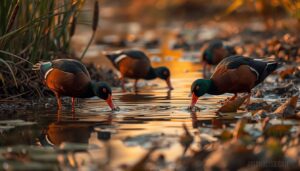
The black-bellied whistling duck isn’t picky — it’ll eat what’s available and go wherever the food is. Its foraging habits are surprisingly flexible, shifting between land and water depending on the season and what’s nearby.
Here’s a closer look at what fuels this adaptable bird.
Seeds, Grains, and Aquatic Plants
The Black-Bellied Whistling Duck’s grain and seed diet is surprisingly well-matched to its wetland habitat.
Its foraging behavior centers on seeds with high starch utilization—rice, smartweed, and aquatic plants whose mucilaginous seed coatings aid water absorption and dispersal. Seed nutrient composition, including stored proteins and carbohydrates, fuels this aquatic bird year-round.
Grain storage moisture levels in harvested fields also influence where flocks concentrate seasonally.
Grazing on Land and in Water
What makes this duck truly adaptable is its ability to move seamlessly between land and water when foraging. Its long legs — built for wading — double as an adaptation for terrestrial grazing across flooded fields and irrigated pastures.
dietary flexibility drives impressive ecological benefits:
- Creates edge habitat through selective vegetation trimming
- Promotes sediment redistribution along shorelines
- Contributes to nutrient cycling via waste deposition
- Maintains varied vegetation structure across wetland margins
Daytime and Nighttime Feeding
Unlike most dabbling ducks, Black-Bellied Whistling Ducks stay active day and night — a feeding habit that maintains their energy balance across wetland ecosystems. Daytime brings grassland foraging and seed diet staples from aquatic grasses. After dark, moonlight feeding takes over near illuminated water edges.
This temporal food shift isn’t random — it’s predator avoidance shaping when and where they eat.
Feeding in Agricultural Areas
Agricultural landscapes act as a second pantry for these ducks.
Rice paddies provide foraging opportunities naturally—flooded rice paddies mimic wetland conditions perfectly, while irrigation ditch feeding supplies seeds and invertebrates along productive margins.
Crop residue grazing pulls them into harvested agricultural fields after harvest, and farm pond usage stays consistent year-round.
Artificial wetland attractors draw flocks reliably, with grain and insects rounding out their diet.
Nesting and Reproduction
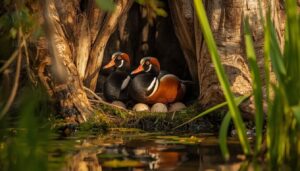
Regarding raising a family, the black-bellied whistling duck doesn’t leave much to chance. These birds are surprisingly deliberate about where and how they nest, and their reproductive habits are more complex than you might expect.
Here’s a closer look at what makes their nesting and breeding behavior so distinctive.
Tree Cavities and Nest Boxes
When nest sites are scarce, these ducks don’t hesitate — they’ll claim whatever cavity works. Tree cavities and nest boxes both serve well, though design details matter:
- Entrance Dimensions of 4–6 cm and Cavity Depth of 15–40 cm improve fit
- Insulation Materials like cedar stabilize interior temperatures
- Placement Height of 2–6 m with proper Ventilation Design reduces moisture and predation
Nest box programs in Texas have meaningfully boosted local populations.
Clutch Size and Incubation Period
Once a nest box is secured, a female usually lays 12–16 eggs, though food resource influence and microclimate temperature can shift that number.
Incubation runs 25–30 days, with both partners sharing parental energy allocation.
Egg size variability affects hatch timing, while predation risk tradeoff shapes how attentively the pair tends the nest throughout this critical window.
Brood Parasitism and Dump Nests
Black-bellied Whistling Ducks practice facultative brood parasitism, meaning females sometimes deposit eggs into neighboring nests rather than their own. This dump nest dynamics behavior can result in clutches exceeding 100 eggs — far beyond what one pair can incubate.
Black-bellied Whistling Ducks sometimes lay eggs in neighboring nests, creating clutches of over 100 eggs — far beyond any pair’s ability to incubate
Reproductive success impact is significant, as overcrowded nests often fail.
Nest boxes, while boosting populations, can concentrate this nesting behavior and reproductive biology of Black-bellied Whistling Ducks in ways that intensify parasitic pressure.
Duckling Growth and Family Care
Once hatched, ducklings enter a critical imprinting period within the first two days, bonding closely with both parents. Parental warmth keeps the brood stable while down feather development progresses over four to six weeks into juvenile plumage.
Foraging skill acquisition happens quickly — ducklings mimic adult feeding behavior almost immediately. Predator vigilance remains high throughout, with parents guiding the brood until independence around eight weeks.
Behavior, Calls, and Conservation
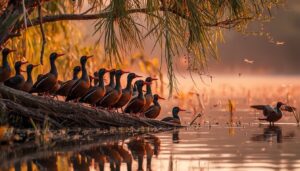
The black-bellied whistling duck is as lively as it looks — and once you know what to listen for, you’ll recognize it instantly. Its social habits, distinctive calls, and shifting range all tell a bigger story about how this species is doing in the wild.
Here’s what you need to know about its behavior, sounds, and conservation standing.
Whistling Calls and Flight Sounds
You can often hear a black-bellied whistling duck before you see it. Its soft, high whistling noise and sharp yip flight call cut clearly across open wetlands.
Wing whistling mechanics kick in during rapid takeoff — specialized feathers generate acoustic alarm signals that help nearby birds respond in sync.
Seasonal whistle variation means calls grow more intense at dawn and dusk during breeding months, while human noise impact can disrupt these natural avian vocalizations.
Flocking and Roosting Behavior
These ducks are deeply sociable — night roost clustering in trees above wetlands isn’t just habit, it’s survival. Habitat-driven aggregation pulls flocks together wherever shallow water meets food. Watch for three key behaviors:
- Predation avoidance — more eyes, faster escape
- Leadership dynamics — older birds initiate direct flight between sites
- Social cohesion mechanisms — vocal exchanges maintain formation integrity during low-light movement
Seasonal Movement and Migration Patterns
Rainfall migration drives most of their movement — when wetlands dry up, these ducks follow the water. Seasonal movement patterns shift with precipitation gradients and temperature cues, triggering northward range expansion into the United States each spring.
Flyway connectivity links breeding and wintering grounds across river corridors, while altitudinal shifts help flocks avoid freezing temps.
Stopover habitat like rice fields and irrigation ponds keeps migration timing on track.
Population Trends and Conservation Status
Population monitoring through programs like the Christmas Bird Count confirms what field data has long suggested — this species is holding its own. The IUCN Status sits at Least Concern, with global numbers estimated between 1.1 and 2 million.
Climate impact and habitat loss remain areas of active threat assessment, though conservation actions tied to wetland protection and the Migratory Bird Treaty Act help. Data gaps persist in remote regions, but population trends and conservation status of Black-bellied Whistling-Duck remain cautiously stable.
Frequently Asked Questions (FAQs)
How long do black-bellied whistling ducks live?
Wild lifespan generally runs 6–8 years, though survival milestones and longevity trends vary. Captive longevity often exceeds ten years, with age-related mortality reduced by stable food and veterinary care.
Are black-bellied whistling ducks monogamous?
Yes, they’re monogamous.
Pair bond dynamics are built to last — mate fidelity often spans multiple breeding seasons, with cooperative parental care and nest site fidelity reinforcing a remarkably stable monogamous mating system year after year.
What predators do black-bellied whistling ducks face?
Raccoon predation, snake egg attacks, opossum nest raids, raptor adult hunting, and heron duckling predation all threaten these birds.
Nest boxes and wetland conservation help offset losses and support stable population trends.
Can black-bellied whistling ducks interbreed with other species?
Hybridization potential exists, though reproductive barriers like monogamy and species-specific mate recognition limit it. Genetic compatibility varies, and hybrid offspring traits often blend parental features.
Hybrid monitoring helps track any impacts on population integrity.
Do black-bellied whistling ducks migrate seasonally?
Not exactly globe-trotters — these birds are largely nonmigratory, with seasonal movement tied to local resource shifts, climate range shifts, and wintering agricultural use rather than any fixed migration patterns.
Can black-bellied whistling ducks live with other species?
They do well alongside other species.
Inter-species nest sharing, cross-species foraging, and mixed-species predator avoidance are all common behaviors — making them genuinely cooperative residents of shared wetland ecosystems supporting waterfowl communities.
How do predators threaten black-bellied whistling ducks?
Egg predation and nest raiding by raccoons, snakes, and corvids peak during early nesting.
Raptor attacks and juvenile vulnerability remain constant threats, increasing predator exposure across wetland and agricultural foraging sites.
What is their typical daily activity schedule?
Their day follows a steady rhythm: morning activity peaks at dawn with foraging, midday rest in shaded perches, afternoon foraging resumes, then evening migration to roost sites, as nighttime vigilance keeps the flock safe.
Do they swim differently than other dabbling ducks?
Yes and no — same water, different rhythm.
Their paddling cadence stays calm and deliberate, favoring surface propulsion with minimal splash reduction, which facilitates group coordination and energy efficiency during shallow-water foraging.
How long do mated pairs stay together?
Pair bond duration in this species reflects lifetime monogamy — mated pairs generally stay together year after year.
Seasonal fidelity is strong, with mate retention remaining consistent across breeding cycles and divorce frequency staying remarkably low.
Conclusion
The black-bellied whistling duck doesn’t simply exist in a wetland—it animates it. Where others blend in, this bird stakes its claim openly: whistling at dusk, roosting high in tree cavities, foraging well past sundown.
Spend time observing one, and you start reading the marsh differently. Water, vegetation, and light all carry new meaning.
This duck isn’t just a species to identify—it’s a lens for understanding exactly how resilient, complex ecosystems quietly hold themselves together.


Tommie Calfee
March 24, 2025 at 09:30 PM
The Black-bellied Whistling Tree Ducks are a delight to watch and hear. Today I witnessed some of them resting in shallow water flicking their wings as if trying to cool off. Is that a mating behavior or trying to cool the eggs?