This site is supported by our readers. We may earn a commission, at no cost to you, if you purchase through links.
 You keep seeing a black bird-like figure every day because several factors likely converge in your environment. Common species like crows, ravens, and grackles adapt well to residential areas, drawn by reliable food sources and nesting opportunities. Environmental factors such as seasonal migration, urban adaptation, and available resources create a consistent black bird presence.
Your brain’s pattern recognition system heightens awareness once you’ve noticed these encounters, creating selective attention that makes subsequent sightings more prominent. Stress or heightened emotional states can intensify your awareness of symbolic imagery.
Cultural associations with black birds as messengers or omens may also influence your perception of these encounters, making them feel more significant than random wildlife sightings. The intersection of psychology, environment, and perhaps spiritual symbolism creates this recurring experience.
Table Of Contents
- Key Takeaways
- Black Bird Sightings: Common Species and Identification
- Why Black Birds Frequent Residential Areas
- Spiritual Meanings Behind Recurring Black Bird Encounters
- Psychological Aspects of Noticing Black Bird Figures
- Environmental Factors Attracting Black Birds Daily
- Coexisting With Black Birds in Your Environment
- Frequently Asked Questions (FAQs)
- Why do people see black birds?
- What does it mean if you see a blackbird?
- What does a black bird symbolize?
- What does it mean if you see a lone Blackbird?
- What does it mean if you see multiple black birds?
- Why should you have black birds in your home?
- Why are there more blackbirds around my home?
- Why are blackbirds attracted to my yard?
- What is the spiritual meaning of black birds flying around you?
- What does it mean when you keep seeing a blackbird?
- Conclusion
Key Takeaways
- Your brain’s selective attention makes black birds more noticeable once you’ve spotted them, creating a psychological loop where you’ll keep seeing what you’re primed to notice.
- Environmental factors like reliable food sources, nesting sites, and seasonal migration patterns naturally draw black birds to residential areas, making daily sightings common.
- Stress and anxiety heighten your awareness of symbolic imagery, causing you to interpret shadows, shapes, or actual birds as more meaningful than random wildlife encounters.
- Cultural associations with black birds as spiritual messengers or omens can make these sightings feel significant, even when they’re simply common urban-adapted species going about their daily routines.
Black Bird Sightings: Common Species and Identification
You’ll encounter several black bird species in residential areas, each with distinct characteristics that help with proper identification. Common culprits include crows, ravens, blackbirds, grackles, starlings, and cowbirds, all of which have adapted well to urban environments and frequent yards for food and shelter.
Crows and Ravens
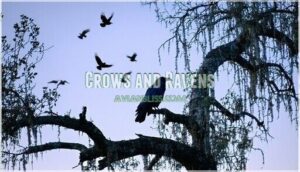
The corvid family delivers nature’s most intelligent black birdlike figures through crows and ravens. Ravens showcase wedge-shaped tails and larger frames, while crows display square tails and exceptional crow behavior adaptability.
Both species carry deep cultural significance across mythology connections, with raven symbolism representing wisdom and transformation. Their corvid intelligence makes daily sightings memorable, often triggering personal interpretation of these encounters as meaningful personal symbolism.
Blackbirds and Grackles
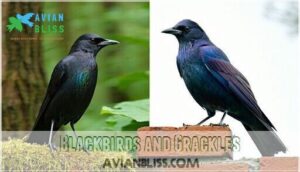
While blackbirds and grackles share similar dark plumage, blackbird behavior differs markedly from grackles’ more social nature. True blackbirds prefer quieter territories, while grackles form noisy flocks with distinctive vocalizations – think squeaky gate sounds versus melodic songs.
Regional differences affect your daily sightings: grackles dominate urban areas, creating habitat overlap that influences personal interpretation of these encounters’ spiritual significance.
Starlings and Cowbirds
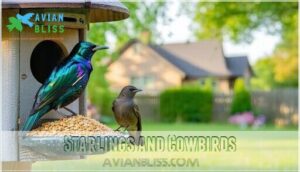
You’ll recognize starlings by their iridescent feathers that shimmer purple and green in sunlight, plus their chattering calls and flocking behavior. These invasive species often dominate feeders in large groups.
Cowbirds practice parasitism, laying eggs in other birds’ nests rather than building their own.
Both species show notable urban adaptation, making daily sightings common in residential areas.
Other Dark-colored Bird Species
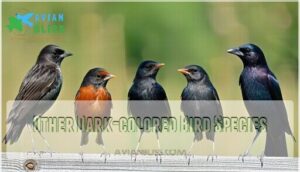
Beyond common species, you’ll encounter darker birds that might fool you. Species misidentification happens when plumage variations create confusion—juvenile red-winged blackbirds lack distinctive markings, while brown-headed cowbirds appear nearly black in certain lighting.
Here are five frequently misidentified dark species:
- Juvenile Red-winged Blackbirds – Streaky brown females often appear black from a distance
- Brown-headed Cowbirds – Males’ dark bodies create black bird sightings confusion
- Rusty Blackbirds – Glossy black plumage with subtle iridescence causes habitat overlap issues
- Boat-tailed Grackles – Large size and dark coloring lead to recurring black bird encounters
- Hybridization variants – Mixed species offspring display unexpected dark plumage patterns
These conservation status variations affect local populations, making accurate identification essential for understanding your daily black bird encounters.
Why Black Birds Frequent Residential Areas
Understanding why you keep spotting those black bird sightings becomes clearer when you examine what draws these creatures to residential neighborhoods. Your suburban environment offers everything black birds need to thrive, creating the perfect storm for recurring black bird encounters.
Urban food sources play a major role in attracting these adaptable species. Black birds feast on everything from dropped seeds at bird feeders to insects in your lawn, garbage scraps, and even pet food left outside. They’ve mastered urban adaptation, learning that human settlements provide reliable meals year-round. Bird feeding can also substantially affect urban bird behavior.
Here are three key factors that make your neighborhood irresistible:
- Abundant shelter options – Trees, rooflines, and building ledges offer prime nesting site availability
- Consistent water source access – Sprinklers, bird baths, and drainage areas provide essential hydration
- Reduced predator presence – Urban environments often have fewer natural threats than wild habitats
Climate change impact has also pushed many species toward cities, where temperatures stay warmer and food remains accessible during harsh seasons. These intelligent birds recognize a good deal when they see it.
Spiritual Meanings Behind Recurring Black Bird Encounters
Your repeated sightings of black bird-like figures might carry deeper spiritual significance that connects you to ancient wisdom traditions and personal transformation.
Many cultures view these encounters as meaningful messages from the spiritual dimension, inviting you to pay attention to your inner guidance and upcoming life changes.
Symbolism in Various Cultures and Beliefs
Across cultures, black birds carry powerful Cultural Bird Meanings that shape Spiritual Interpretations. Blackbird Mythology spans from Celtic death omens to Norse wisdom symbols like Odin’s ravens.
Cultural Beliefs position them as Spiritual Messengers bridging earthly and divine realms. Native American traditions view them as sacred Omens and Signs of transformation, while Christian symbolism sees them as tests of faith with redemptive Spiritual Meaning.
In Hinduism, they can symbolize community, but also represent elements of caution.
Interpretations of Black Birds as Messengers
When different cultures recognize these dark-winged visitors, they often interpret them as divine messengers carrying spiritual guidance from realms beyond our everyday experience. These symbolic encounters aren’t just coincidences—they’re believed to deliver instinctual messages that can awaken your inner wisdom during critical life moments.
Consider these spiritual meanings when you spot these mysterious messengers:
- Divine communication flows through their presence, offering comfort during uncertainty
- Spiritual guidance manifests when you’re facing important decisions or crossroads
- Inner messages arrive through their timing, encouraging you to trust your gut feelings
- Symbolic encounters remind you that you’re connected to something greater than yourself
Black bird symbolism suggests these creatures serve as bridges between the physical and spiritual worlds. Their repeated appearances might signal that spiritual messages are waiting for your attention, urging you to pause and listen to what your soul already knows.
Black Birds as Omens or Signs
Black birds carry powerful omens across cultures. Their Cultural Interpretations range from Celtic prophecy to Native American protection signs. In Native American culture, they’re often seen as protective spirit animals.
Large flocks signal major Change Symbolism, while single birds invite Personal Omens for reflection. When you encounter these Black Bird Encounters, they’re often Spiritual Messages urging you to Instinct Trust during life transitions. The Black Bird Symbolism represents transformation ahead, making their Spiritual Meaning deeply personal.
Personal Significance and Introspection
While interpreting omens offers one perspective, your personal connection to these sightings matters most. Your Inner Voice and Intuition Guidance shape how you process these encounters, creating a unique Symbolic Interpretation for your Life Journeys.
- Personal symbolism emerges from your individual experiences and memories
- Spiritual meanings develop through your soul’s journey and spiritual growth
- Embrace Change by trusting what these personal experiences reveal about your path
Psychological Aspects of Noticing Black Bird Figures
Your mind might be playing tricks on you in regards to spotting that mysterious black bird figure every day. Once you notice something specific like a dark bird-like shape, your brain becomes wired to seek out similar patterns, creating a psychological loop where you’re more likely to spot these figures whether they’re actual birds or just shadows and shapes your mind interprets as familiar forms.
Selective Attention and Confirmation Bias
Attention mechanisms in your brain create a cognitive spotlight, making black birds impossible to ignore once they’re on your radar. Confirmation bias reinforces this pattern—you unconsciously seek evidence supporting your belief about recurring black bird encounters. Perceptual filters enhance these sightings while dismissing contradictory observations.
| Cognitive Process | How It Works | Impact on Bird Sightings |
|---|---|---|
| Selective Attention | Brain focuses on specific stimuli | Notices black birds more frequently |
| Pattern Recognition | Identifies familiar shapes/behaviors | Interprets ambiguous figures as birds |
| Confirmation Bias | Seeks supporting evidence | Remembers bird encounters, forgets absences |
| Belief Reinforcement | Strengthens existing assumptions | Creates cycle of increased awareness |
Subconscious Focus on Symbolic Imagery
Your mind naturally gravitates toward archetypal figures that carry deep personal symbolism, making black birds impossible to ignore. When your unconscious mind connects these creatures to meaningful experiences or beliefs, you’ll notice them everywhere through heightened psychological aspects.
Your subconscious draws you to black bird imagery through various pathways:
- Personal symbolism from childhood memories where ravens appeared during significant moments
- Dream interpretation revealing black birds as guides through shadow work and self-discovery
- Spiritual meanings absorbed from cultural backgrounds linking these birds to instinctual guidance
- Archetypal figures representing transformation that your psyche recognizes as personally relevant
- Dream analysis showing repeated black bird encounters reflecting your inner emotional landscape
This selective focus isn’t coincidence—it’s your mind’s way of processing deeper psychological material through everyday observations.
Stress, Anxiety, and Heightened Awareness
When you’re experiencing stress or anxiety, your mind shifts into hypervigilance mode, creating anxiety amplification that makes you hyper-aware of everything around you. This perceptual distortion acts like a mental magnifying glass, causing stress manifestation through heightened pattern recognition.
| Stress Triggers | Physical Symptoms | Cognitive Effects |
|---|---|---|
| Work pressure | Increased heart rate | Cognitive overload |
| Relationship issues | Muscle tension | Racing thoughts |
| Financial worries | Sleep disruption | Poor concentration |
| Health concerns | Fatigue | Memory problems |
| Daily uncertainties | Headaches | Decision paralysis |
These psychological aspects create a perfect storm where your brain’s threat-detection system stays switched on, making black bird sightings feel more significant than they actually are.
Pattern Recognition and Meaning-making
Your brain’s pattern recognition system constantly searches for meaning in everyday sights. When you spot black birds repeatedly, cognitive biases kick in, creating symbolic interpretation through personal associations and emotional influence. Your mind uses predictive processing to connect these recurring patterns with personal experiences, forming an instinctual connection that may lead to spiritual practices.
- Personal associations from childhood memories or significant life events
- Cognitive biases that make you notice black birds more frequently
- Emotional influence from current stress levels or major life changes
- Symbolic interpretation shaped by cultural beliefs and stories you’ve heard
- Predictive processing where your brain expects to see what it’s seen before
Environmental Factors Attracting Black Birds Daily
Your backyard might be a black bird magnet due to specific environmental factors that make it an ideal habitat.
These intelligent birds are drawn to reliable food sources, suitable nesting sites, and favorable conditions that meet their daily survival needs.
Food Sources in Your Yard
Your yard’s buffet attracts black birds through specific food sources. Birdseed types, fruit availability from trees, insect populations, water sources, and garden scraps create environmental factors that encourage black bird encounters. Understanding these elements helps explain urban adaptation patterns.
To attract a variety of birds, consider offering black oil sunflower seeds.
| Food Source | Attraction Level | Common Species |
|---|---|---|
| Birdseed/feeders | High | Crows, grackles |
| Fruit trees | Medium | Blackbirds, starlings |
| Insects/scraps | High | All black birds |
Nesting and Roosting Opportunities
Something’s drawing birds to your property beyond just food – nesting and roosting opportunities create irresistible real estate. Dense shrubs, mature trees, and even urban roosting sites like building eaves provide predator-safe havens where birds establish social behavior patterns.
Your birdfriendly habitat offers nesting material availability and human impact reduction, making environmental factors perfect for urban adaptation. Consider adding safe nesting locations to encourage birds.
Seasonal Migration Patterns
Seasonal migration dramatically impacts when you’ll spot black birds around your home. Migration triggers like daylight changes and temperature shifts prompt massive movements along established flyway routes. Climate impacts increasingly alter traditional timing, with some species arriving weeks earlier than historical records show. Many black birds use your area as a rest stop while traveling to distant breeding grounds.
Here’s when to expect peak activity:
- Spring surges occur March through May as birds head north seeking ideal nesting territories
- Fall flocks appear September through November during southward journeys to warmer climates
- Weather delays can concentrate thousands of birds in small areas during storms
Conservation efforts now track these seasonal migration patterns more precisely, helping create bird-friendly habitat corridors. Your consistent black bird sightings likely coincide with these ancient travel schedules that’ve guided generations of birds across continents.
Urban Adaptation of Black Bird Species
Urban adaptation has turned black birds into city champions! They’ve mastered exploiting city food sources, from dumpsters to sidewalk scraps, while building nesting sites on skyscrapers and bridges. Noise pollution impact doesn’t faze them—they’ve learned to communicate over traffic.
These urban migration shifts mean you’re witnessing nature’s supreme survivors thriving in your bird friendly habitat.
Coexisting With Black Birds in Your Environment

Once you understand why black birds visit your space, you can learn to peacefully share your environment with these intelligent creatures.
Whether you want to welcome them or gently discourage visits, the key lies in making informed choices that respect both your needs and their natural behaviors.
Creating a Bird-friendly Habitat
When you decide to welcome black bird encounters, establishing a bird friendly habitat transforms your space into their preferred destination.
Install feeding stations with seeds, plant native plants for natural food sources, and provide water sources like shallow dishes.
Create shelter options using dense shrubs, ensuring a safe environment that promotes urban adaptation and seasonal migration patterns while addressing key environmental factors.
Humane Deterrent Methods
Why resort to harsh measures when humane deterrent methods can effectively discourage black bird visits? These bird-safe deterrents work without causing harm while respecting wildlife.
Visual scare tactics and auditory deterrents create an unwelcome environment through habitat modification:
- Reflective tape that dances in sunlight, creating disorienting flashes
- Predator decoys like realistic owl statues that suggest danger
- Motion-activated sprinklers delivering surprise water bursts when birds approach
- Strategic repellent application using natural scents birds find unpleasant
These environmental factors help establish boundaries while maintaining your yard’s appeal. You can find a variety of effective bird deterrents online.
Observing and Appreciating Black Birds
Instead of viewing black birds as nuisances, embrace the birdwatching benefits they offer right outside your window. Through careful observation, you’ll discover their unique birdsong identification patterns and appreciate their aesthetic appreciation value.
These recurring black bird encounters reveal fascinating ecological roles – from seed dispersal to pest control. Their interactions often involve complex vocalizations and songs.
Your daily black bird sightings become opportunities to support conservation efforts while enjoying nature’s intelligence up close.
Addressing Concerns and Misconceptions
Frequently, people develop bird phobias based on misidentification causes and cultural myths about black birds. Debunking myths is essential for addressing fears about these harmless creatures. When you’re seeing a black birdlike figure every day, consider these facts:
- Optical illusion and pareidolia often create bird-like shapes from shadows or objects
- Psychological reasons behind heightened visual perception include stress and pattern recognition
- Most black birds are intelligent, social species seeking food and shelter, not supernatural omens
Understanding the science behind your sightings helps separate reality from misconception.
Frequently Asked Questions (FAQs)
Why do people see black birds?
You see black birds due to pattern recognition, where your brain interprets shadows, movement, or shapes as familiar bird-like figures, especially when you’re primed to notice them through attention bias.
What does it mean if you see a blackbird?
Seeing a blackbird can symbolize transformation, change, or spiritual messages across many cultures. You’re likely noticing environmental factors, experiencing pareidolia, or your brain’s recognizing meaningful patterns during significant life moments.
What does a black bird symbolize?
While some folks blame every mysterious sighting on their morning coffee, black birds actually carry rich symbolic meaning across cultures.
They usually represent transformation, wisdom, and spiritual messages, though interpretations vary from protective omens to harbingers of change.
What does it mean if you see a lone Blackbird?
A lone blackbird usually represents personal transformation, introspection, or spiritual messages.
You’re likely encountering a moment when change approaches, requiring trust in your instincts and attention to inner wisdom during life transitions.
What does it mean if you see multiple black birds?
When flocks of blackbirds appear, you’re witnessing nature’s collective wisdom in action.
Multiple black birds suggest amplified transformation, heightened spiritual messages, or environmental factors like abundant food sources attracting larger groups to your area.
Why should you have black birds in your home?
You shouldn’t keep live black birds in your home as pets since most species require specialized care, proper permits, and aren’t domesticated.
Wild birds belong outdoors where they can thrive naturally and safely.
Why are there more blackbirds around my home?
Why do blackbirds flock to your yard like iron filings to a magnet? You’ve likely created an attractive habitat with food sources, water features, and suitable nesting spots that draw these adaptable urban birds to your property consistently.
Why are blackbirds attracted to my yard?
Food availability draws them to your yard – think insects, berries, seeds from bird feeders, and pet food left outside.
Trees, shrubs, and shelter spots make perfect nesting areas for these adaptable birds.
What is the spiritual meaning of black birds flying around you?
Black birds circling you spiritually represent transformation, divine messages, and upcoming life changes.
They’re considered messengers from spiritual realms, urging you to trust your intuition and embrace personal growth opportunities ahead.
What does it mean when you keep seeing a blackbird?
Repeated blackbird sightings often stem from psychological pattern recognition, where your brain notices familiar shapes more frequently.
Environmental factors like food sources, nesting sites, and seasonal migration patterns also influence bird presence in your area.
Conclusion
Persistent patterns permeate your perception when you keep asking, "why do i keep seeing a black bird like figure everyday." Your brain’s selective attention mechanism amplifies awareness once you’ve noticed these encounters, making subsequent sightings feel more significant.
Environmental factors like reliable food sources, nesting sites, and seasonal patterns create consistent black bird presence in residential areas.
Cultural symbolism surrounding black birds as messengers or omens adds psychological weight to these experiences. Understanding this combination of biology, psychology, and environment helps explain your recurring observations.
- https://theworldsrarestbirds.com/why-do-i-keep-seeing-a-black-bird-like-figure-everyday/
- https://naturewithbirds.com/what-does-it-mean-when-black-birds-are-in-your-yard/
- https://hellofearless.com/blogs/blog/blackbird-spiritual-meaning-dream-meaning-symbolism-more
- https://www.earthofbirds.com/2-black-birds-spiritual-meaning-christianity/
- https://www.wellandgood.com/health/what-does-synchronicity-mean-spiritually