This site is supported by our readers. We may earn a commission, at no cost to you, if you purchase through links.
That black bird pecking at your lawn might be smarter than your dog. American Crows recognize human faces, hold grudges, and even teach their young which people to distrust. The bird you just shooed away probably filed you under "threat."
But crows are only the beginning. North America hosts dozens of types of black birds — from the 200-million-strong European Starling to the massive California Condor, whose wingspan stretches wider than most people are tall. Each species behaves differently, eats differently, and sounds nothing like the others.
Knowing who’s who turns a confusing flock into a fascinating story.
Table Of Contents
- Key Takeaways
- Common Types of Black Birds
- Large Black Birds to Identify
- Small Black Birds in Backyards
- How to Identify Black Birds
- Black Bird Habitats and Behavior
- Frequently Asked Questions (FAQs)
- What are the most common black birds?
- What are these black birds in my yard?
- Do birds wake up at night?
- What are the names of the black birds?
- What are the different types of blackbirds?
- Where do black birds live?
- What does a blackbird look like?
- What are black birds?
- What birds look like blackbirds?
- What are the most fascinating black birds in the United States?
- Conclusion
Key Takeaways
- American Crows can recognize individual human faces, hold grudges, and actively teach their young which people to avoid — making them one of the most cognitively sophisticated backyard birds you’ll encounter.
- Size, beak shape, tail silhouette, and habitat together form a reliable four-clue system for telling apart North America’s many look-alike black bird species.
- The European Starling, introduced to New York in 1890, has exploded to over 200 million individuals across the continent, outcompeting native cavity-nesting birds along the way.
- The California Condor — with a wingspan of nearly 10.5 feet — was pulled back from just 22 wild individuals through captive breeding, yet lead poisoning from ammunition still threatens its recovery today.
Common Types of Black Birds
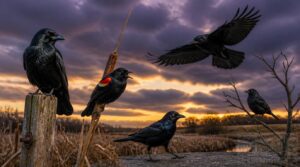
Not all black birds are created equal — some are clever enough to recognize your face, while others have been ruling North American skies for thousands of years.
Telling them apart gets even trickier in the field, which is why a guide to black birds in Pennsylvania can help you spot the subtle differences that really matter.
Whether you’re seeing them at your feeder, in a parking lot, or soaring overhead, knowing who’s who makes all the difference. Here are five of the most common black birds you’re likely to encounter.
American Crow
The American Crow is one of the easiest black birds to recognize — 17 to 21 inches of glossy coal-black feathers, a sturdy bill, and a fan-shaped tail. That loud, familiar caw you hear? That’s social communication at work.
What makes crows truly special is their facial recognition ability. They remember individual humans, hold grudges, and even use tools while foraging. These birds are highly intelligent corvidae family members that demonstrate complex problem-solving skills.
Common Raven
If crows impressed you, the Common Raven takes things further. These birds measure up to 27 inches long with a wedge-shaped tail you’ll spot instantly in flight — bigger and bulkier than any crow.
Ravens are master mimics, cache food for later, and form social alliances within their flocks. That deep, rolling croak carries surprisingly far.
European Starling
Ravens get all the mystique, but the European Starling earns its own spotlight.
Introduced to New York in 1890, starlings now number over 200 million across North America — one of history’s most successful invasions.
- Glossy black plumage with purple-green iridescence
- White spots appear in winter, fading by spring
- Skilled mimics copying other birds’ songs
- Aggressive cavity nesters displacing native species
- Flock in massive, swirling winter roosts
Common Grackle
Starlings aren’t the only bold birds in the neighborhood. The Common Grackle gives them real competition.
Measuring 11 to 13 inches, grackles flash a glossy iridescent sheen — purple or blue depending on the light. They’ll eat almost anything, raid feeders without hesitation, and gather in massive winter flocks. That creaky, raspy call? Unmistakable once you’ve heard it.
Red-Winged Blackbird
That red flash is unmistakable. The Red-winged Blackbird wears jet-black plumage with scarlet epaulets he raises to warn rivals and attract mates.
- Length: 17–18 cm, compact with broad wings
- Epaulets signal dominance and mating readiness
- Females are streaked brown — built for camouflage
- Diet shifts from insects to seeds seasonally
- Nests sit 1–2 meters above marsh water
Large Black Birds to Identify

Some black birds are hard to miss — they’re simply built on a bigger scale. If you’ve ever spotted a massive dark silhouette circling overhead or perched along a shoreline, you’ve likely crossed paths with one of these larger species.
From breathtaking plunge-divers to soaring coastal giants, the large black birds of Hawaii include some of the Pacific’s most dramatic and recognizable species.
Here are five large black birds worth knowing how to identify.
Black Vulture
Stocky and black, this scavenger is built for efficiency. The Black Vulture has a bald gray head, pale wingtips, and grayish-white legs often stained from carrion.
| Feature | Detail |
|---|---|
| Head | Bald, gray skin |
| Wings | Pale outer primaries |
| Flight | Quick beats, long glides |
They roost in mixed-species groups and rely on sight — not smell — to locate food.
Turkey Vulture
The Turkey Vulture is nature’s cleanup crew. That bald red head isn’t just distinctive — it’s hygienic, keeping debris from sticking during feeding.
Spot one by its V-shaped wing posture and slow, tilting drift on thermals. It can smell carrion from 8 miles away. Juveniles show a gray head, not red — a handy ID trick.
California Condor
Few birds stop you cold like the California Condor does. With a wingspan stretching nearly 10.5 feet, it’s the largest land bird in North America — basically a flying door.
These scavengers hunt carrion across rugged canyon country. Pulled back from just 22 individuals, captive breeding programs saved the species. Today, over 500 exist. Lead poisoning from ammunition remains their biggest threat.
Double-Crested Cormorant
Spot a Double-Crested Cormorant perched with wings spread wide, and you’ve found one of nature’s more unusual sights. That pose isn’t laziness — their feathers aren’t fully waterproof, so drying is essential after diving.
They hunt by pursuit diving, chasing fish underwater with surprising agility. Wingspan reaches nearly 48 inches, and they nest in colonies near productive fishing grounds.
Anhinga
The Anhinga hunts like a living spear — that S-shaped neck snaps forward with lightning speed to impale fish underwater.
Like the Double-crested Cormorant before it, the Anhinga’s feathers aren’t waterproof, so you’ll often see it perched in wetlands, wings fanned wide in the sun. A striking water bird worth watching for.
Small Black Birds in Backyards
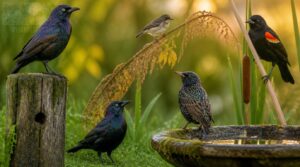
Not every backyard visitor is big and bold — some of the most interesting black birds are small enough to miss at first glance.
Learning to tell them apart takes a little practice, but a few key details make it easier than you’d think. Here are five small black birds you might spot near your yard.
Brown-Headed Cowbird
The Brown-headed Cowbird has a sneaky trick up its sleeve: brood parasitism. Instead of building its own nest, the female slips her egg into another bird’s nest and disappears. Her egg even mimics the host’s eggs in color and size. The unsuspecting parents raise the cowbird chick, which often outcompetes their own young.
The Brown-headed Cowbird never builds a nest — she simply slips her egg into a stranger’s and disappears
You’ll spot cowbirds foraging near cattle, chasing insects kicked up by hooves.
Brewer’s Blackbird
Unlike the cowbird’s sneaky parenting style, Brewer’s Blackbird is a straightforward, hard-working bird you’ll often spot walking along the ground, tilting its head with each deliberate step.
Males flash glossy purple-blue iridescence in sunlight — surprisingly striking for a "plain" black bird. Females are dull brownish-gray. Both are omnivores, eating insects, seeds, and grain. Watch for them in fields, parking lots, and farms.
Rusty Blackbird
The Rusty Blackbird wears two looks: bluish-black in summer, rusty-edged in winter — that’s how it got its name.
- Breeds in boreal wetlands across Canada and Alaska
- Eats aquatic insects, especially dragonfly larvae
- Forages by flipping leaves along water edges
- Declined ~85% in just 40 years
- Winters in southeastern U.S. bottomland forests
Black-Billed Magpie
From rusty edges to bold contrasts — meet the Black-billed Magpie, one of the most striking birds in western North America.
That black-and-white iridescent plumage shimmers blue-green in sunlight, and the long tail makes it unmistakable. At 50–60 cm, it’s hardly small, but backyards love it.
As a corvid family member, it’s sharp — problem-solving, vocal, and fiercely social.
Fish Crow
Meet the Fish Crow — a glossy, slender corvid common along eastern coasts and inland waterways.
Three quick ID clues:
- Its nasal "uh-uh" call — noticeably softer than an American Crow’s harsh caw
- Coastal foraging along piers, tidal flats, and shorelines
- Smaller bill, slimmer build overall
That voice is your sharpest tool for bird identification. It also drops mollusks for shell cracking — clever and practical.
How to Identify Black Birds
So you’ve spotted a black bird — now what? Identifying it comes down to a handful of reliable clues that work every time. Here’s what to look at first.
Size and Body Shape
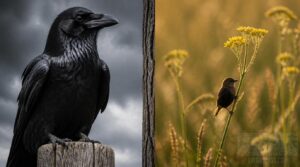
Size is your first clue when spotting a black bird. A Common Raven stretches 24–27 inches long with a nearly 5-foot wingspan, while a Brown-headed Cowbird barely hits 8 inches. That’s a dramatic difference.
Watch the silhouette — compact and rounded means a smaller species; broad-shouldered and long-necked points to something bigger. Body shape alone can crack the ID before color even registers.
Wing and Tail Markings
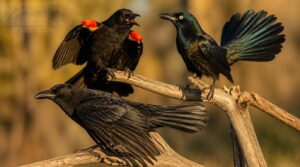
Look closely at the wings and tail — they tell a story size can’t. Wing bars, those light or dark stripes across folded wings, vary from two to four depending on species.
Some black birds flash a bold white tail tip, visible even in silhouette. Red-winged Blackbirds reveal scarlet shoulder patches only when they choose to show them.
Beak Shape
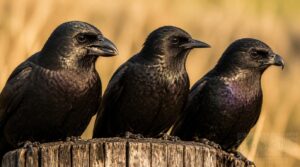
A beak is basically a built-in tool kit. Its shape tells you exactly what a bird eats.
Three shapes to learn for black birds:
- Conical bill — thick, short, seed-cracking power for birds like grackles
- Slender pointed beak — built for insect probing in tight crevices
- Hooked tip — tearing flesh, seen on vultures
Shorter, deeper beaks deliver the strongest bite force.
Calls and Songs
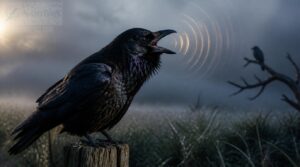
Sound is often your fastest ID tool. Birds produce calls through the syrinx, a vocal organ at the base of the windpipe — no throat cords needed. Crows give a flat caw; ravens drop a deep, hollow croak.
Alarm calls cut sharp and fast. Urban noise pushes some species to sing higher or earlier, often before dawn.
Habitat Clues
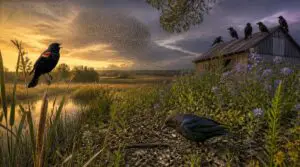
Where a bird shows up tells you almost as much as how it looks. Wetlands and marsh edges draw blackbirds and grackles; open grasslands pull in cowbirds and starlings.
- Edge habitats mix woodland and field — rich foraging ground
- Water availability signals cormorants and anhingas nearby
- Human structures attract crows and starlings year-round
Vegetation structure and landscape fragmentation quietly shape who’s home.
Black Bird Habitats and Behavior
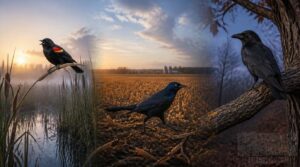
Where a black bird lives tells you a lot about who it is. Each species has carved out its own niche — from cattail marshes to open farm fields to dense forest edges. Here’s a look at the key habitats and behaviors that help define them.
Fields and Grasslands
Open fields are prime territory for blackbirds. Red-winged Blackbirds and Common Grackles love grasslands with native grasses like switchgrass, whose deep roots control erosion and store carbon in the soil.
Wildflower forbs attract insects — exactly what these birds hunt. Rotational grazing keeps grass healthy and patchy, creating the mixed cover blackbirds need to feed and nest successfully.
Wetlands and Coastlines
Move from fields to water’s edge and the cast changes fast. Coastal wetlands shelter Double-crested Cormorants, Anhingas, and Red-winged Blackbirds year-round.
These habitats do real work:
- Trap sediments to fight coastal erosion
- Sequester carbon in waterlogged soils
- Filter runoff before it reaches open water
- Support aquatic insects that fuel avian ecology
Salinity gradients shift which species you’ll spot where.
Forests and Open Woods
Step into the woods and the light changes everything. Open forest canopy lets 30–70% of sunlight reach the ground, fueling a rich understory of grasses, wildflowers, and forbs — prime foraging territory for American Crows and Common Ravens.
Fire keeps these woods open. Without it, woody midstory growth closes the canopy, reducing the ground-layer diversity that draws black birds down to forage.
Feeding Habits
What black birds eat changes with the season. Spring means insects; winter means seeds, grains, and whatever you left in the trash. Opportunistic scavenging is practically their superpower — crows, grackles, and starlings all exploit spilled grain, pet food, and garbage without hesitation.
Foraging in loose flocks helps, too. More eyes mean food gets found faster, and social foraging cuts individual search time considerably.
Nesting Behaviors
Nesting season reveals just how strategic blackbirds can be. Most build sturdy cups from twigs, grasses, and mud, then line them with feathers or hair for microclimate regulation — keeping eggs at stable temperatures.
European Starlings skip the effort entirely, stealing cavities other species worked hard to secure. Brown-headed Cowbirds go further: pure brood parasitism, dropping eggs into strangers’ nests and vanishing.
Frequently Asked Questions (FAQs)
What are the most common black birds?
The most common black birds you’ll spot are the American Crow, Common Raven, European Starling, Common Grackle, and Red-winged Blackbird — familiar faces in backyards, fields, and city parks across North America.
What are these black birds in my yard?
Like puzzle pieces scattered on your lawn, backyard black birds can be tricky to sort. You’re likely seeing a crow, starling, or grackle — three of the most frequent urban bird visitors across North America.
Do birds wake up at night?
Yes — most birds do wake briefly at night. They use unihemispheric sleep, keeping one brain hemisphere alert while the other rests. Artificial light and predator sounds can trigger short wake periods before they settle back down.
What are the names of the black birds?
Black birds wear many names — crow, raven, grackle, starling. You’ll also spot the Red-winged Blackbird, Anhinga, Brown-headed Cowbird, and vultures. Each name signals a distinct species with its own look and behavior.
What are the different types of blackbirds?
You’ll find dozens of black bird species across North America — from crows and ravens to grackles, starlings, and vultures. Each one differs in size, iridescent plumage, habitat, and behavior, making identification a genuinely rewarding skill.
Where do black birds live?
From bustling city parks to quiet cattail marshes, these birds turn up almost everywhere. You’ll spot them in urban nesting sites, wetlands, farms, and open forests — adapting to nearly any environment across the continent.
What does a blackbird look like?
Male blackbirds wear glossy black plumage that shimmers blue-green in sunlight, with a bright yellow bill and bold yellow eye ring. Females are softer brown, streaked at the breast, with a duller bill.
What are black birds?
Think of dark plumage as nature’s silent armor — rich with melanin pigment that absorbs light, deepens color, and signals strength to rivals. These black colored birds span dozens of wild avian species across North America.
What birds look like blackbirds?
Several common birds get mistaken for blackbirds. American Crows, Common Ravens, and European Starlings all wear dark plumage but differ in size, tail shape, and beak. Even grackles and Brewer’s Blackbirds fool beginners at first glance.
What are the most fascinating black birds in the United States?
Black birds are some of the most behaviorally complex birds in North America — from tool-using crows to vultures that can smell carrion miles away, they’re endlessly surprising for any bird watcher.
Conclusion
Black birds baffle beginners, but now you have the tools to tell them apart. Size, shape, beak, habitat — every clue stacks toward a confident ID. The sheer variety of types of black birds across North America isn’t overwhelming once you know what to look for.
A crow remembers your face. A vulture rides thermals for hours without a wingbeat. These birds aren’t just black. They’re truly special. Start watching closely — they already are.