This site is supported by our readers. We may earn a commission, at no cost to you, if you purchase through links.
A bird nest tucked under your eave sounds harmless—until the birds leave and their mites go looking for a new host. Ornithonyssus sylviarum, the northern fowl mite, can’t survive long on human blood, but it will bite while searching for a bird.
That search brings it straight into your living space.
Bird mites affecting humans are more common than most people expect, especially in late spring and summer when nests get abandoned. The good news: the problem is identifiable, treatable, and preventable once you know what you’re dealing with.
Table Of Contents
- Key Takeaways
- What Are Bird Mites?
- How Bird Mites Reach Humans
- Bird Mite Bite Symptoms
- Bird Mite Health Risks
- How Doctors Diagnose Bites
- Treating Bird Mite Bites
- Preventing Bird Mite Infestations
- Frequently Asked Questions (FAQs)
- What are the symptoms of bird mites on humans?
- How to get bird mites off your body?
- Can birds pass mites to humans?
- What are the symptoms of Cheyletiella mites in humans?
- Can bird mites survive in cold weather conditions?
- How long do bird mites live without hosts?
- Can bird mites spread between neighboring houses or apartments?
- Are bird mites visible on dark colored clothing?
- Can bird mites transmit diseases to humans?
- How long do bird mite infestations last?
- Conclusion
Key Takeaways
- Bird mites like Ornithonyssus sylviarum can’t complete their life cycle on human blood, but they will bite you when their bird host is gone — usually right after a nest is abandoned.
- Bites show up as small red bumps with intense itching, often on ankles, wrists, and neck, and scratching can lead to skin infections that need antibiotic treatment.
- The infestation ends when you remove the nest, seal all entry points like vents and wall gaps, and vacuum with a HEPA filter — without that, mites can survive indoors for up to two weeks.
- Bird mites don’t transmit diseases to humans, so your main risk is skin irritation and sleep disruption, both of which clear up within weeks once the source is eliminated.
What Are Bird Mites?
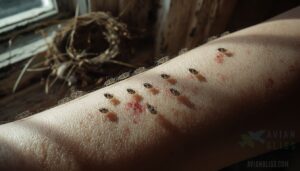
Bird mites are tiny parasites that most people never think about — until they’re suddenly itching and can’t figure out why. They’re more common than you’d expect, especially if birds nest near your home.
If you’re unsure what you’re dealing with, this guide on identifying bird mites can help you tell them apart from other common household pests.
Here’s what you need to know about them.
Common Species That Bite Humans
Three species are most likely to bite you. The Northern fowl mite (Ornithonyssus sylviarum) tops the list, followed by the Red chicken mite (Dermanyssus gallinae).
In warmer regions, the Tropical fowl mite (Ornithonyssus bursa) also bites humans when its bird hosts disappear.
All three normally feed on birds — you’re basically a backup meal when their usual host is gone.
Physical Traits and Size
These mites are tiny. Adult Ornithonyssus sylviarum and Dermanyssus gallinae measure around 0.8 mm — roughly the size of a pepper fleck.
Immature stages have six legs; adults have eight. Their mouthpart size is built for piercing skin, not biting.
After feeding, a reddish color shift makes them slightly more visible. Eggs are microscopic, so early infestations are easy to miss.
How Bird Mites Differ From Bedbugs
Size tells part of the story, but behavior tells more. Bird mites show strong host preference for birds, not people. Their habitat localization stays near nesting sites — attics, eaves, vents.
Bedbugs, by contrast, settle where you sleep. Feeding duration differs too: bird mites feed briefly and sporadically.
They thrive in bird mites prefer humid conditions, especially in late spring and summer.
Bedbugs attach longer and return nightly. Knowing these differences between bird mites and bedbugs helps you identify the real source fast.
Life Cycle and Feeding Habits
Bird mites follow a fast path: egg to larva to nymph to adult in roughly one week. Egg Deposition Sites are usually bird nests, where warmth and humidity support larval development duration and temperature-driven maturation.
Nymphal feeding frequency increases in warm conditions. Humidity-dependent survival keeps populations stable near active nests. Human blood sustains them only briefly — bird hosts remain essential.
Why Mites Usually Target Birds First
These are avian parasites by design. Their host blood preference is hardwired — bird hosts provide the specific proteins needed to complete the life cycle of avian mites.
Nest microclimate suitability keeps them close to their food source, with temperature-linked development accelerating in warm nests.
Reproductive bird dependence means without birds, populations collapse.
Host-driven migration to humans only happens when that primary source disappears.
How Bird Mites Reach Humans
Bird mites don’t just appear out of nowhere — they follow a path straight into your home. That path usually starts somewhere close by, often closer than you’d expect.
Here are the most common ways they make their way to you.
Bird Nests in Roofs and Eaves

Your roof eaves are prime nesting territory. Sparrows, starlings, and pigeons wedge nests into gaps near fascia boards and tile edges, causing Nest Material Accumulation that leads to Gutter Blockage Risks and Moisture Damage Pathways that threaten Structural Integrity Concerns over time.
Seasonal Nest Reuse compounds the problem each spring. That’s where bird mite populations quietly build — right above your living space.
Attics, Vents, and Wall Voids

Once mites reach your attic, they spread fast. Soffit Vent Positioning and Ridge Vent Performance matter here — gaps in these systems let mites travel freely through wall voids and into living spaces.
Poor Baffle Installation Practices and missing Penetration Air Barriers make it worse.
Seal cracks and crevices, close Wall Cavity Sealing gaps, and check all attic vents to help prevent bird mite infestations.
Abandoned Nests and Host Loss

When a bird leaves its nest for good, the mites don’t leave with it. The nest microclimate — warm, humid, sheltered — helps mite survival for weeks.
Human exposure timing matters most here: the days right after abandonment are highest-risk.
Watch for these risk factors for mite exposure:
- Nests left in place after birds depart
- Disturbed nest residue releasing mites onto surfaces
- Abandoned nests close to sleeping or resting areas
Seasonal Activity and Warm Weather Spikes

Spring and early summer mark the peak of seasonal activity of bird mites, especially in warm climates.
Temperature-driven biting intensifies as microclimate hotspots — your attic, wall voids, and eaves — trap heat and humidity. Ventilation patterns shift mites deeper indoors. Humidity influence keeps them viable longer.
Nighttime bite peaks happen when warmth lingers into evening, increasing your skin contact risk while you sleep.
Infestation Risks From Secondhand Furniture
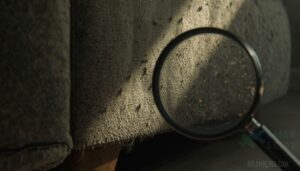
That secondhand couch could be hiding more than you think. Bird mites survive in upholstery creases, wood joint cracks, and drawer linings — sheltered spots that routine cleaning misses.
Transport contamination happens when items pass through storage areas near bird nesting debris. Even packaging wrappers can lock mites in place until you unwrap them indoors.
Always inspect and vacuum secondhand furniture before bringing it inside.
Bird Mite Bite Symptoms
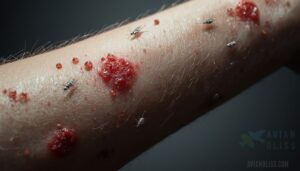
Bird mite bites don’t look the same on everyone, but there are clear signs to watch for.
Your skin usually reacts quickly, and the symptoms can range from mild irritation to something harder to ignore. Here’s what you might notice.
Intense Itching and Crawling Sensations
Scratching at skin that feels alive is one of the most unsettling bird mite bite symptoms you’ll experience. Mite saliva triggers histamine pathways, sending itch signals through nerve fiber types — both A and C fibers — straight to your brain. This produces true pruritus, not just mild skin irritation.
Bird mite saliva hijacks your nervous system, turning a simple bite into maddening, unstoppable pruritus
Watch for these formication triggers:
- A crawling sensation with no visible cause — classic formication
- Nighttime itch amplification that disrupts sleep
- Stress induced pruritus that worsens when anxiety runs high
- Allergic dermatitis flares from repeated exposure
Red Bumps and Papular Rash
That itch you feel often comes with a visible rash. Bird mite bites produce a papular rash — small red bumps called papules, generally under 1 cm wide.
Each one usually shows a central punctum sign, a tiny dot at the center. They appear in a clustered crop pattern with erythema surrounding each bump.
Severe cases may show pinpoint bleeding — a key severity indicator.
Common Bite Locations on Skin
Bird mite bites don’t land randomly. They follow patterns based on where your skin is exposed or compressed. The red marks and papular rash tend to cluster in predictable spots:
- Ankles & legs, hands & wrists, and face & neck — common during sleep
- Armpits & groin — warm, trapped areas mites favor
- Finger web spaces — a telltale sign of skin irritation
Scratching, Bleeding, and Irritation
Those red marks don’t stay simple for long. The itching triggers an inflammatory cycle that’s hard to break — you scratch, the skin barrier is disrupted, and friction aggravation from clothing keeps the area inflamed.
Pinpoint bleeding can appear where small vessels break. Repeated scratching causes skin thickening over time, raises infection susceptibility, and extends skin irritation well beyond the original bites.
Signs of Secondary Skin Infection
When scratching breaks the skin, bacteria can move in fast. Watch for these signs of secondary bacterial skin infection:
- Spreading redness that grows wider over hours
- Warm swelling that feels firm or tight
- Pus formation or yellow crusting on bite sites
- Foul odor from weeping lesions
- Fever streaks extending outward from the rash
See a doctor promptly if these appear.
Bird Mite Health Risks
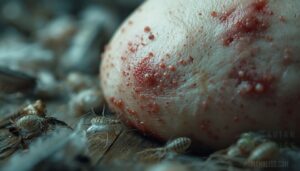
Bird mite bites don’t just itch and fade — they can cause real health problems if left unaddressed. The risks range from skin inflammation to sleep loss, and some effects can linger long after the bites are gone.
Here’s what you should watch for.
Skin Inflammation and Allergic Reactions
Your skin does more than just itch after a bird mite bite — it launches a full immune response. Mast cell activation triggers an inflammatory mediator cascade, flooding the bite site with histamine.
Repeated exposure can cause allergen sensitization, leading to T-cell mediated dermatitis and barrier dysfunction.
Topical steroids reduce local inflammation, while oral antihistamines help with itch relief from this ongoing allergic reaction.
Secondary Bacterial Infections
Scratching breaks your skin’s protective barrier, opening the door to bacterial superinfection.
Secondary bacterial infections from mite bites follow a clear pattern: impetigo development appears first as honey-crusted sores, then cellulitis progression spreads redness deeper into the tissue.
Furunculosis risk rises with repeated scratching, and lymphangitis signs — red streaking toward your body — signal serious spread.
Skin lesion management with antibiotic therapy is essential when infections worsen.
Sleep Disruption and Stress
Nighttime bites don’t just wake you up — they can trap you in a stress-sleep cycle that’s hard to break. Mite activity triggers stress-induced insomnia by disrupting your cortisol rhythm and fueling rumination before bed.
Sleep disturbance due to bites keeps your nervous system in hyperarousal, making rest feel impossible.
Improving sleep hygiene strategies can help interrupt this cycle while you address the infestation.
Hyperpigmentation and Lingering Marks
Even after the bites heal, your skin may hold onto the memory.
Melanin overproduction during the inflammatory timeline can leave flat, dark spots where pimple-like lesions once were — a process called hyperpigmentation. Skin tone susceptibility matters here; darker skin tones often see more pronounced discoloration.
Hypopigmentation, or lighter patches, can also occur.
Topical fading agents and sun protection strategies help, but marks may linger for months.
When Symptoms Need Medical Care
Most bird mite reactions stay mild — but some don’t.
Seek care right away if you notice any of these warning signs:
- Anaphylaxis Warning: Trouble breathing, dizziness, or throat swelling after bites signal a dangerous allergic reaction.
- Rapid Skin Spread: Expanding redness or blistering suggests worsening contact dermatitis or secondary bacterial infection.
- Fever with Infection: Warmth, pus, or red streaks near bites need same-day evaluation.
- Eye Mucosal Swelling: Swelling near eyes or mouth can threaten breathing and vision.
- Severe Pain Alerts: Pain that keeps worsening, beyond what the bite looks like, warrants prompt diagnosis of mite bites by healthcare providers for proper treatment of mite bites and to rule out serious human health risks from bird mites.
How Doctors Diagnose Bites

Bird mite bites look a lot like bites from other common pests, which makes getting the right diagnosis tricky. Your doctor will compare your symptoms against several other conditions before landing on an answer.
Here’s what that process usually involves.
Bird Mite Bites Vs Scabies
Both conditions look similar, but key differences set them apart.
Scabies mites use a burrow mechanism — they tunnel into your skin, causing intense nighttime itching. Bird mites don’t burrow; their saliva triggers the reaction.
Lesion distribution differs too: scabies favors wrist folds and web spaces, while bird mite bites appear on exposed areas.
Transmission mode also varies — scabies spreads person-to-person; bird mites come from nearby nests.
These diagnostic clues guide treatment differences.
Bird Mite Bites Vs Bedbug Bites
Bedbugs follow a predictable clustered pattern — bites appear in grouped lines near your sleeping area. Both share nighttime biting habits, but the blood source differs: bedbugs live in mattress seams, while mites migrate from nearby nests.
Bird mite bites scatter more randomly across exposed skin. Bird mites are microscopic in size, making them harder to spot.
Treatment contrast matters — bedbug control targets your bedroom; bird mite skin irritation requires locating and removing the nest first.
Bird Mite Bites Vs Lice or Ticks
Unlike lice or ticks, bird mites don’t stay on you. That host shift — from bird to human — is the key clue.
- Bite Clustering: Mites scatter bites randomly; lice target hair-bearing areas.
- Itch Timing: Bird mite bites flare overnight.
- Crawling Sensation: Unique to mite saliva injection.
- Visual Cues: Lice leave nits; ticks stay attached.
What to Tell a Healthcare Provider
Your doctor needs a clear picture fast. Share your exposure timeline — when symptoms started and where you’ve noticed skin irritation. Mention any nest proximity, like birds near eaves or vents.
| What to Share | Why It Matters | Example |
|---|---|---|
| Bite distribution | Guides diagnosis | Arms, neck, legs |
| Medication history | Avoids interactions | Antihistamines used |
| Allergy concerns | Shapes treatment | Steroid sensitivity |
This helps confirm bird mite bites and speeds relief.
When Lab Testing May Be Needed
Lab testing isn’t always necessary, but certain situations call for it. If you’re dealing with a persistent rash evaluation that won’t resolve, or if multiple neighbors report bites — triggering an outbreak investigation — testing confirms the source.
Key reasons your doctor may order lab work:
- Differential diagnosis confirmation when scabies or lice look identical
- Severe reaction assessment in immune-compromised cases
- bird mite infestations across shared building spaces
- Clinical diagnosis of mite bites when risk factors for mite exposure remain unclear
Treating Bird Mite Bites

Once you’ve confirmed bird mites are the problem, treatment is pretty straightforward. Your goal is to ease the itching, help your skin heal, and stop any infection before it starts.
Here’s what actually works.
Washing Skin to Remove Mites
Start with a hot shower rinse as soon as you notice bites. Use soap scrubbing and the washcloth technique on skin folds — wrists, ankles, and behind the knees. Don’t forget scalp washing along your hairline. Dry off with a clean towel immediately after.
This physically removes surface mites and reduces your chances of new bites while topical treatment begins.
Topical Corticosteroids for Itching
Hydrocortisone cream is your first line of defense against the itching and skin irritation caused by parasites like bird mites. Apply a thin layer directly to affected areas — that’s proper application technique.
- Potency selection: low-strength works for most areas
- Duration of use: limit to 1–2 weeks
- Facial skin considerations: avoid — skin is too thin
- Side effect management: watch for redness or thinning
Antihistamines for Symptom Relief
When bird mite bites trigger intense skin itching, oral antihistamine therapy can quiet the reaction. OTC availability makes options like cetirizine or loratadine easy to access — these second-generation choices carry a lower drowsiness risk than first-generation diphenhydramine (Benadryl). Onset duration varies by product, but most provide 24-hour relief.
Always check for drug interactions before combining antihistamines with sedatives or other medications.
Cool Compresses and Moisturizers
cool compresses offer quick, drug-free relief alongside topical corticosteroids and antihistamines. Apply cloth-wrapped cold compress — never bare ice — for 10–15 minutes at a time.
The cool compress temperature slows inflammation and numbs skin itching temporarily.
Afterward, seal in moisture with fragrance-free moisturizers containing humectants like glycerin. Barrier ointment application with petrolatum-based products helps protect damaged skin between treatments.
Antibiotics for Confirmed Infection
Most bird mite bites don’t need antibiotics — but scratching breaks the skin, raising your secondary infection risk. Watch for pus, spreading redness, or fever. When those signs appear, your doctor may start empiric antibiotic selection immediately, then adjust with culture-guided therapy if needed.
Key treatment steps:
- Oral medication works for most localized infections
- Oral vs intravenous choice depends on severity
- treatment duration guidelines — finish the full course
Preventing Bird Mite Infestations

Preventing bird mite infestations comes down to cutting off the problem at its source.
Once you know where mites come from, the steps to stop them are actually pretty straightforward. Here’s what you can do to protect your home and keep mites from moving in.
Removing Bird Nests Safely
Before you touch any nest, check your local rules — legal nest removal in Germany and across Europe requires wildlife authority coordination if birds are still active. Confirm the nest is empty first.
Wear gloves, a mask, and long sleeves for protective clothing for bird handlers. Bag the material immediately for sealed bag disposal, then disinfect the area with hot water above 60°C.
Sealing Cracks, Vents, and Gaps
Once nests are gone, seal every gap mites could use.
Use low-expansion foam for pipe penetrations and cracks in walls. Add vent underside weatherstripping where covers meet surfaces. Seal attic hatches with fitted covers or foam board. Inflatable flue balloons block unused chimney openings effectively.
These steps are key to preventing bird mite infestations from recurring.
Vacuuming and Home Sanitation
After sealing gaps, vacuum your carpet and all floor surfaces thoroughly. Use a HEPA vacuum — it traps fine particles instead of pushing them back into the air. Overlapping vacuum passes help catch mites hiding in fibers.
Bag vs bagless matters: sealed bags prevent re-release during disposal. Clean your nozzle and hose after use. Post-vacuum disinfection of surfaces completes your home sanitation to prevent mites.
Professional Pest Control Strategies
Sometimes home efforts aren’t enough. A licensed pest control professional brings tools you don’t have access to — Void Mapping to locate hidden harborages, Barrier Installation to block re-entry, and Targeted Residuals applied precisely where mites hide.
Debris Disposal is handled safely. Service Follow-ups confirm activity has stopped.
These integrated pest management strategies for bird mites guarantee the problem doesn’t quietly return.
Protective Clothing for Bird Handlers
If you handle birds or clean out nests regularly, protective clothing for bird handlers isn’t optional — it’s your first line of defense.
Wear impervious coveralls with a hood for eye protection coverage. Use glove boot integration and sealed cuffs at wrists and ankles to close every gap.
Follow a consistent donning doffing protocol so mites don’t hitch a ride indoors.
Frequently Asked Questions (FAQs)
What are the symptoms of bird mites on humans?
Bird mite bites cause intense itching, red welts, and pimple-like lesions on your skin. Nighttime itch peaks are common.
You may also notice skin swelling patterns, skin discoloration, and secondary infection indicators like oozing.
How to get bird mites off your body?
Start with a thorough soap-infused scrub and hot water rinse. Focus on skin folds and hairline brushing.
Strip off clothing, then run high-heat laundry. Protective garment removal keeps mites from spreading further.
Can birds pass mites to humans?
Yes, birds can pass mites to humans. Through host-switching dynamics, mites leave bird nests and bite nearby people.
This avian human transfer happens most during seasonal transmission surges, when nests are abandoned.
What are the symptoms of Cheyletiella mites in humans?
Think of it like a slow burn. Cheyletiella mites trigger intense nighttime itch, scaly dermatitis, dry flaky skin, and pimple-like lesions. Skin crusting and lingering discoloration may follow without treatment.
Can bird mites survive in cold weather conditions?
Cold slows bird mites down through metabolic slowdown, but it rarely kills them. Indoors, insulation effects keep wall voids warm enough for survival.
Temperature sensitivity matters less when heated shelters and humidity interaction extend their lifespan year-round.
How long do bird mites live without hosts?
Bird mites barely last without a blood meal. Most survive just 7 to 14 days without a host. Species variation, indoor conditions, and humidity influence how long they persist.
Can bird mites spread between neighboring houses or apartments?
Yes, they can.
Mites travel through Ventilation Duct Transfer, Roof Void Connectivity, and Shared Wall Gaps.
Inter‑unit Airflow and External Bird Carriers move them between units without any direct resident contact.
Are bird mites visible on dark colored clothing?
Yes — on dark fabric, contrast enhancement works in your favor. Mites appear as tiny moving specks, roughly 3–1 mm. Lighting conditions and movement observation help most. Use magnification techniques if unsure.
Can bird mites transmit diseases to humans?
Fortunately, vector competence evidence and pathogen detection studies show that bird mites pose minimal zoonotic transmission risk. Unlike ticks, they aren’t confirmed vectors for disease.
Your main public health risk remains skin irritation, not systemic infection.
How long do bird mite infestations last?
Without treatment, an infestation can last several weeks to months. Source removal speed is key. Indoor survival span runs 1–3 weeks, but humidity effect and temperature effect can extend that.
Conclusion
Bird mites affecting humans follow a predictable pattern—and that pattern works in your favor. Once the nest is gone and entry points are sealed, their life cycle collapses.
Treat the bites, clean the space, and block their path inside. You don’t need to fear something you understand. Most infestations resolve within weeks when handled correctly. Know the signs, act early, and you stay in control.
- https://study.com/academy/lesson/bird-mites-vs-bed-bugs.html
- https://www.oreateai.com/blog/tiny-terrors-unpacking-the-differences-between-bedbugs-and-bird-mites/224a84cf4572b4958e90604de4f12751
- https://extension.usu.edu/planthealth/ipm/notes_nuisance/bird-mites
- https://pestsense.cahnrs.wsu.edu/fact-sheet/bird-mites/
- https://academic.oup.com/auk/article/143/1/1/8237422