This site is supported by our readers. We may earn a commission, at no cost to you, if you purchase through links.

Most bird owners spend more time picking a cage than thinking about what goes inside it. That’s backwards.
The perch is where your bird spends nearly every waking hour—gripping, shifting, sleeping, playing—and the wrong one can quietly damage their feet, lungs, or worse.
A simple wooden dowel looks harmless, but uniform diameter means constant pressure on the same joints, day after day.
Safe bird cage perch options go far beyond material alone—diameter, placement, texture, and rotation all shape your bird’s long-term health.
Get these right, and your bird’s feet will thank you for years.
Table Of Contents
- Key Takeaways
- Safe Wood Perch Materials
- Choose The Right Perch Diameter
- Mix Shapes, Textures, and Heights
- Place Perches for Safe Movement
- Clean and Rotate Perches Often
- Unsafe Perch Types to Avoid
- Top 6 Safe Bird Perch Products
- Frequently Asked Questions (FAQs)
- What bird has the best personality?
- How do you discipline a parrot?
- How many perches should be in a birdcage?
- Can birds sleep comfortably on all perch types?
- How do perches affect bird posture and balance?
- What perch materials work best for molting birds?
- How can perches help with bird training sessions?
- Can birds share perches safely with other species?
- How often should perches be fully replaced?
- Do perches affect a birds mental health?
- Conclusion
Key Takeaways
- The perch your bird stands on all day matters more than the cage itself — get the material, diameter, and texture right, or you’re setting up quiet, long-term foot damage.
- Match perch diameter to your bird’s size so their toes wrap about three-quarters around — too thin or too thick, and joint strain builds up fast.
- Variety isn’t optional: mixing shapes, textures, and heights keeps your bird’s feet active, prevents pressure sores, and mimics what wild perching actually feels like.
- Ditch sand perches, uniform dowels, PVC, and anything painted or chemically treated — they look harmless but cause real harm over time.
Safe Wood Perch Materials
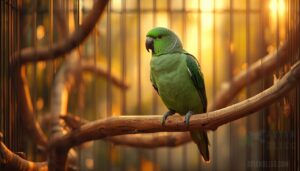
The wood you choose for your bird’s perch matters more than most people realize — it directly affects foot health, comfort, and how long the perch actually lasts.
Different woods vary widely in texture and durability, so it’s worth exploring types of bird perches and their benefits before you commit to one.
Not every wood is safe, and some common ones are outright toxic.
Here are the best natural wood options worth knowing about.
Benefits of Natural Wood Perches for Foot Health
Natural wood perches do something a smooth dowel never can — they keep your bird’s feet working. Irregular surfaces trigger constant Muscle Activation and Joint Flexibility as your bird shifts grip throughout the day.
That movement aids Circulation Enhancement, promotes Natural Nail Wear, and helps with Callus Prevention.
It’s the simplest defense against bumblefoot disease, and avian foot health really does start with perch texture impact on nail maintenance and perch diameter importance.
The hard dense Java wood also reduces pressure sore risk.
Manzanita, Grape Palm, Apple, and Ash Wood
Four woods stand out for natural wood perches: Manzanita tops the list for hardness levels and twisted branch flexibility — perfect grip variety.
Grape Palm offers dense grain texture that resists strong beaks. Apple wood’s fine, even grain texture keeps surfaces smooth on sensitive toes. Ash brings color aesthetics and dimensional stability.
All four support sustainable sourcing and long-term foot health.
Why Dense, Chew-safe Wood Lasts Longer
Dense wood isn’t just harder — it works smarter. Tight grain tightness limits splintering, while natural resin and oil sealing help minor bite marks close rather than spread. Higher cellular density slows moisture absorption, so the perch holds its shape longer.
For bird safe wood that truly lasts, hardwood wins every time. Your bird chews less damage into it daily.
Toxic Woods to Avoid: Cedar, Oak, Avocado, Alder
Even durable hardwoods have a dark side. Some species look beautiful but carry real bird health hazards you can’t ignore:
- Cedar – causes respiratory irritation from its natural oils
- Oak – produces carcinogenic dust that damages lungs over time
- Avocado – persin toxicity can kill birds within 48 hours
- Alder – linked to allergic skin reactions and breathing issues
Keep these out of your cage entirely.
Choosing Non-toxic, Untreated, Bird-safe Branches
Before you bring any branch indoors, make sure it checks every box: freshly cut, properly dried, and mold-free. Branch sourcing guidelines matter more than most people realize.
Stick to natural wood branches from untreated trees — no pesticides, no chemicals. Inspect for insect damage carefully.
Seasonal branch rotation keeps things fresh and stimulating. Choosing appropriate wood for bird perches and toys starts with identifying toxic woods for avian use and skipping them entirely.
Choose The Right Perch Diameter
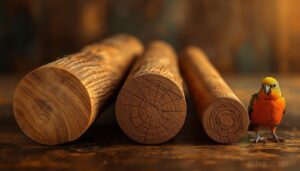
Perch diameter isn’t one-size-fits-all — a macaw’s foot and a finch’s foot have nothing in common.
Getting this wrong can lead to real foot problems over time, so the numbers actually matter.
Here’s a quick breakdown by bird size to help you get it right.
Finches and Canaries: 0.25–0.5 in Perches
Finches and canaries have tiny feet, so perch diameter guidelines really matter here. Stick to 0.25–0.5 inches for smaller birds like finches — that range promotes toe wrap comfort and healthy weight distribution across the foot.
Natural wood perches work best for foot health monitoring over time. Test different perch material options and maintain a regular perch rotation frequency to keep things fresh.
Cockatiels and Conures: 0.5–0.75 in Perches
Cockatiels and conures need perches between 0.5 and 0.75 inches — that range hits the sweet spot for toe wrap comfort and weight distribution benefits.
Here’s what good perch diameter does for foot health:
- Provides natural gripping without crowding the toes
- Encourages foot muscle development through varied grip tension
- Reduces pressure points during long standing periods
- Makes perch material testing easier across species-specific perch sizes
Stick with natural wood perches and follow a perch rotation schedule weekly.
African Greys and Amazons: 0.75–1.0 in Perches
African Greys and Amazons have big, powerful feet — and they need perches between 0.75 and 1.0 inches to match.
That perch diameter provides proper weight distribution and lets your bird’s toes wrap securely without strain.
Natural wood perches in this range also promote grip strength, healthy nail wear, and stress reduction.
Perch angle matters too, so mix orientations for the best bird foot health.
Macaws and Cockatoos: 1.0–1.5 in Perches
Macaws and cockatoos have feet built like vice grips — and they need perches that can handle it. For bigger birds like macaws, perch diameter should fall between 1.0 and 1.5 inches. Natural wood perches in this range support proper perch weight limits and encourage real perch grip training.
Here’s what matters most:
- Perch size and diameter guidelines — 1.0–1.5 in let toes wrap two-thirds around without splaying
- Perch material safety — dense hardwoods like Manzanita resist chewing and hold shape longer
- Quiet perches — smooth-grained wood reduces slipping and foot fatigue during long rest periods
- Perch attachment hardware — use stainless steel only; avoid painted or coated fittings
Matching Perch Size to Toe Wrap and Grip
The right perch diameter is really about toe wrap ratio. Your bird’s toes should circle about three-quarters of the perch — not flat on top, not squeezed underneath.
grip pressure distribution keeps foot health solid over time.
Think of perch diameter calibration as fine-tuning: use a caliper, check species grip mechanics, and watch how your bird actually stands.
Awkward shifting means it’s time to adjust.
Mix Shapes, Textures, and Heights
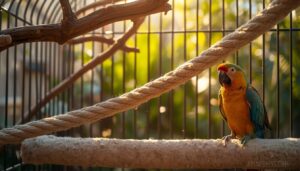
One perch size is never enough — your bird’s feet need variety to stay healthy. Changing up shapes, textures, and heights works the same way a good workout routine does: it keeps things interesting and prevents the same muscles from taking all the strain.
what to mix into your setup.
Why Multiple Perch Diameters Prevent Pressure Sores
Think of your bird’s feet like yours after standing all day in one pair of shoes.
Standing on the same perch all day strains a bird’s feet the same way one pair of shoes punishes yours
When every perch shares the same diameter, the same pressure points take a beating — every single day.
Varying perch diameter shifts the load through Pressure Distribution Mechanics and Joint Load Variation, changing toe grip flexibility and Friction Shear Balance, so foot health improves through natural foot remodeling in birds.
Twisted and Irregular Perches for Natural Climbing
Varying diameters help — but shape takes it further.
Natural wood branches with twists and irregular curves give your bird something closer to wild perching. Spiral Grip Dynamics and Twist-Induced Foot Rotation keep feet active with every shift in weight. That’s natural habitat mimicry at its best.
Enrichment benefits of irregularly shaped perches include:
- Adaptive Climbing Paths that build leg strength
- Irregular Texture Stimulation across toe pads
- Natural Branch Mimicry reducing boredom
- Varied perching surfaces preventing pressure points
Smooth, Rough, and Porous Textures for Foot Exercise
Shape variety sets the stage — but texture is what actually works your bird’s feet.
Smooth surfaces offer gentle rest, rough wood grain builds grip strength through active stepping, and porous branches support muscle conditioning by varying pressure with each shift.
Rotate these textures intentionally — texture rotation prevents overuse of one surface.
Monitor wear regularly, since surface longevity depends on catching cracks before they cause harm.
Horizontal, Diagonal, and Curved Perch Placement
Texture does the heavy lifting for foot health — but placement shape determines how your bird actually moves through the cage.
Horizontal perches support Visual Access Alignment to food and water while simplifying perch ergonomics.
Diagonal angles shift Weight Distribution Dynamics, reducing pressure sores.
Curved perches mimic real branches, promoting Angle Variation Benefits and natural grip.
Together, they enhance Cage Space Optimization through smart Perch Height Zoning.
Combining Wood, Rope, and Textured Surfaces Safely
Mix natural wood perches with rope sections, and you’ve got a setup that keeps feet genuinely busy. Wood supports the load — it won’t flatten or fray. Rope fills in softer Texture Change Zones between harder surfaces.
Hybrid Perch Safety, use Secure Attachment Methods with stainless‑steel hardware only.
Balanced Load Distribution across both materials cuts repetitive‑stress risk fast.
Place Perches for Safe Movement
Where you put each perch matters just as much as what it’s made of.
A well-arranged cage gives your bird room to move, climb, and rest without bumping into things or contaminating their food.
Here’s how to set up each level so your bird stays safe and comfortable.
Low, Middle, and High Perch Levels
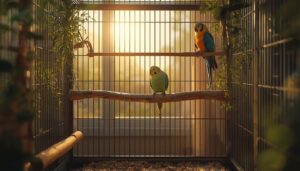
Think of your cage as a three-story home.
Low perches — 2 to 6 inches off the base — give younger or smaller birds a safe landing zone. Middle perches support daytime roosting and tiered activity patterns. High perches, set at 60–80% of cage height, serve as night roosts.
This cage tier hierarchy and altitude enrichment provides height-specific ergonomics and natural vertical flight zones.
Keeping Flight Paths Open Between Perches
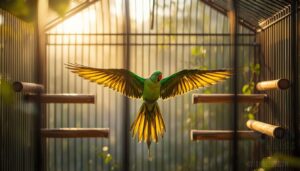
Your bird needs room to actually fly — not dodge obstacles mid‑flap. Strategic Perch Spacing means staging each perch so wings can fully extend between landing spots. Good bird cage layout planning keeps Unobstructed Flight Corridors intact:
- Leave 12+ inches between perches horizontally
- Maintain Vertical Clearance Zones of 8–10 inches
- Check Perch Alignment Flight paths from every angle
- Use Clear Wing Space as your non‑negotiable baseline
Positioning Perches Away From Food and Water
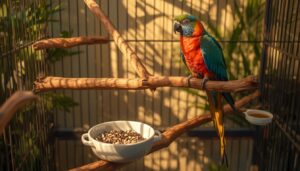
Droppings and dinner don’t mix. Keep a solid Dropping Buffer Zone by maintaining 6–12 inches of Perch‑Bowl Separation, depending on your cage size.
Vertical Offset Placement works well too — position perches so your bird approaches food from the side, not directly above. Try Rotating Bowl Locations periodically, then use Observation‑Based Adjustments to fine‑tune what’s actually working.
Avoiding Placement Directly Above Cage Bars

Bar Clearance matters more than most people realize. Perches placed directly over cage bars trap moisture, block airflow, and put extra stress on your bird’s toe joints — all things that add up fast. Moisture buildup gets even worse outdoors, so if your bird spends time on a balcony, pairing smart perch placement with a thermostat-controlled heated bird bath for balcony setups keeps conditions safer year-round.
- Dropping Prevention keeps the perch surface clean
- Airflow Optimization reduces fungal buildup on footpads
- Foot Pressure Reduction eases joint fatigue
- Stress Minimization improves your bird’s sense of security
- Perch placement height considerations support natural movement
Smart cage design considerations for ideal perch arrangement — and solid perch safety guidelines — make all the difference in your cage layout.
Adding a Thicker Sleep Perch for Nighttime Rest
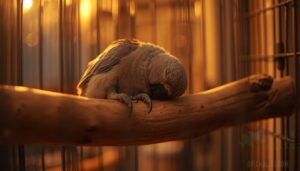
bird’s sleep perch deserves as much thought as the rest of the cage. thicker diameter — matched to your bird’s size — gives better weight distribution benefits and toe curl support through the night.
Natural wood perches in manzanita or apple hold up well and simplify your durability inspection routine.
Night rest stability, sleep angle optimization, and foot health all improve when you get that perch placement height and size exactly right.
Clean and Rotate Perches Often
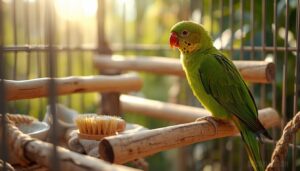
Clean perches aren’t just about appearances — they directly affect your bird’s health. Bacteria, mold, and hidden pests can build up faster than you’d think, especially on natural wood.
Here’s what you need to do to keep things safe and fresh.
Washing Branches Before Cage Use
Before that branch goes anywhere near your bird’s cage, it needs a proper wash. Surface dirt carries bacteria that your bird doesn’t need.
- Soap Selection: Use mild, fragrance-free soap — rinse thoroughly after.
- Rinse Technique: Flush under running water; scrub grooves with a soft brush.
- Drying Methods: Air-dry 24–48 hours on clean racks before cage use.
Baking Natural Branches to Remove Pests
Washing gets the surface clean — baking goes deeper. Heat sterilization of branches is your best defense against hidden pests and larvae.
Oven Temperature Settings by Branch Thickness Guidelines:
| Branch Size | Temperature | Time |
|---|---|---|
| Up to 1 inch | 170°C | 20 min |
| 1–2 inches | 180°C | 25–30 min |
| Over 2 inches | 190°C | 35+ min |
Follow these Pre‑Bake Preparation Steps first: wipe debris, strip leaves, and dry branches 24 hours beforehand. After baking, the Post‑Bake Cooling Protocol matters — cool on a clean rack away from humidity. For extra assurance, Complementary Heat Treatments, like freezing at -20°C for 48 hours, work well on smaller natural wood perches. That’s proper perch hygiene protocols done right.
Weekly Cleaning With Mild Soap and Warm Water
Once your branches are baked and cooled, keep them clean with a simple weekly routine.
Scrub each perch using a mild soap — dish soap works fine — and warm water. Warm water loosens buildup better than cold. Rinse thoroughly until no soap remains, then air-dry completely before returning them to the cage. That step alone does a lot for bacterial contamination prevention.
Rotating Perch Locations for Enrichment
Clean perches are a great start — but where you put them matters just as much.
Weekly Position Shifts keep your bird mentally engaged. Moving perches around mimics the unpredictability of a natural environment, which is one of the best practices for rotating bird perches.
Seasonal Layout Changes every few months, too. Even small rearrangements count as effective environmental enrichment strategies for reducing boredom in captive birds.
Inspecting for Cracks, Splinters, and Wear
Even a perch that looks fine on the outside can hide real problems.
Use a bright flashlight for crack detection tools — run it along the grain and across it. Tap the wood: a hollow sound signals internal decay signs.
For splinter removal techniques, sand anything that snags. Moisture impact assessment matters too — dark spots or soft patches mean it’s time to replace, not repair.
Unsafe Perch Types to Avoid

Not every perch sold in a pet store is actually safe for your bird. Some common options look fine at first glance, but can cause real harm over time.
Here are the ones worth knowing about before you buy.
Risks of Uniform Dowel Perches
That standard wooden dowel perch that came with your bird’s cage. It’s quietly working against foot health. Uniform diameter creates continuous load on the same pressure points — a recipe for bumblefoot disease over time.
- Slippery grip causes repeated stance corrections
- Toe mismatch from wrong diameter leads to joint strain
- Texture deficiency eliminates natural foot pad exercise
Swap it out.
Why Sand Perches Can Irritate Feet
Sand perches look harmless, but that gritty surface causes real problems. The abrasive friction creates micro abrasions on tender foot pads, while skin dryness accelerates cracking.
Particle irritation builds up as fine grains press between toes during gripping, creating uneven load on the same contact points.
Repeated pressure sores can develop quickly. Skip them as a primary perch.
Rope Perch Fraying and Ingestion Hazards
Rope perches feel cozy underfoot — until they start unraveling. Once fraying begins, the risks stack up fast:
- Frayed Fiber Ingestion can cause intestinal blockage in aggressive chewers
- Entanglement Risk increases as loose loops snag toes during landing
- Attachment Looseness accelerates fiber shedding near high‑tension ends
- Cleaning Fiber Harborage traps droppings deep in strands
- Visual Fray Indicators like puffiness, mean replace, not reuse
When Concrete Perches Should Be Used Sparingly
Concrete perches aren’t the villain — they’re just miscast in a starring role. A brief session helps with nail wear, but daily use raises foot heat and risks pressure sores.
Stick to adult parrots with healthy feet, limit use to a few days weekly, and always pair with softer wood perches for real bald foot syndrome prevention.
| Factor | Safe Use | Warning Sign |
|---|---|---|
| Session Length | Brief sessions only | All-day perching |
| Bird Type | Adult parrots | Juveniles or injured birds |
| Perch Placement | One spot in cage | Majority of perches |
| Foot Health | Monitor weekly | Redness or limping |
| Perch Variety | Mixed textures | Concrete alone |
Avoiding PVC, Painted, or Chemically Treated Materials
Some perch materials look fine but quietly poison your bird. PVC off-gassing concerns are real — plastics release fumes that harm sensitive respiratory systems. Painted perch hazards come from heavy metals in pigments. Chemical treatment residues linger even after drying.
Always choose nontoxic washed and disinfected wood with non-toxic material standards, and verify perch material safety for pet birds before buying. When in doubt, skip it.
Top 6 Safe Bird Perch Products
Now that you know what to avoid, let’s talk about what actually works. These six products cover different bird sizes, needs, and cage setups — so there’s something useful no matter what you’re working with.
Here’s a closer look at each one.
1. Natural Wood Bird Perch Set
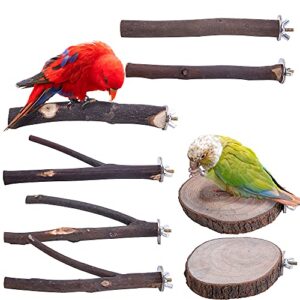
This 8-piece set is a solid starting point for small bird owners.
You get three hanging multi-branch perches, three wooden stands, and two flat platforms — all made from untreated hardwood with no chemicals or odors.
The varied diameters help prevent foot arthritis, and the soft wood lets budgies, cockatiels, and finches chew freely for beak conditioning.
Installation is tool-free thanks to built-in bolts and wing nuts.
Just note: the short 6.49-inch length makes this unsuitable for larger parrots.
| Best For | Small bird owners with budgies, cockatiels, finches, canaries, conures, or parrotlets who want an affordable, easy-to-install perch variety pack. |
|---|---|
| Bird Size Fit | Small birds only |
| Material | Untreated hardwood |
| Installation | Tool-free bolts |
| Foot Health | Varied diameters |
| Chew Safe | Yes |
| Pieces Included | 8 pieces |
| Additional Features |
|
- Eight pieces in one box — a solid mix of hanging perches, stands, and flat platforms for under $15.
- Untreated hardwood is safe to chew, which helps with beak conditioning and keeps small birds entertained.
- Tool-free installation with built-in bolts and wing nuts makes setup and rearranging the cage quick and painless.
- At just 6.49 inches, these are too short for larger parrots — not the right fit if you have a bigger bird.
- Some washers have oversized holes, which can make attachment feel wobbly until you swap them out.
- The softer wood can splinter or shed bark with heavy chewing, so you’ll want to check them regularly for wear.
2. Natural Wood Bird Perch Platform
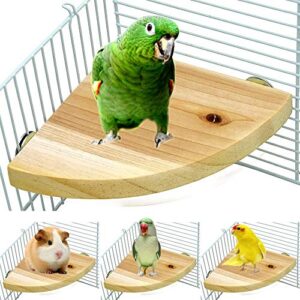
If your bird needs more than just somewhere to grip, this platform delivers. Made from 100% untreated fir wood, it measures about 7.28 × 7.28 inches — plenty of room for resting, foraging, or holding a small food dish.
The corner-mount design keeps central cage space open for flying. It’s compatible with parakeets, cockatiels, budgies, and lovebirds.
One heads-up: the porous wood absorbs droppings quickly, so plan on wiping it down every few days.
| Best For | Bird owners with parakeets, cockatiels, budgies, or lovebirds who want a safe, spacious resting spot that doubles as a foraging area. |
|---|---|
| Bird Size Fit | Small birds only |
| Material | Untreated fir wood |
| Installation | Torx screwdriver |
| Foot Health | Flat resting surface |
| Chew Safe | Yes |
| Pieces Included | 1 platform |
| Additional Features |
|
- 100% natural, untreated fir wood — no chemicals, no worries about your bird chewing on it
- Big enough (7.28 × 7.28 in) to hold a food dish or toys, making it a useful activity hub
- Corner-mount design keeps the center of the cage clear for flying and movement
- Porous wood soaks up droppings fast, so it needs frequent cleaning to stay hygienic
- You’ll need a Torx (star-head) screwdriver to install it, which not everyone has handy
- Heavy chewers can wear it down in around 6 months, so it’s not a forever perch
3. Natural Wood Bird Perch Stand
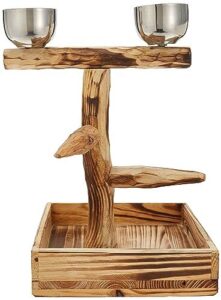
Want something your bird can use outside the cage too? This natural wood stand is built for tabletop play sessions.
It comes with two tapered branches — the main perch is 1 inch in diameter, while the side branches taper from 0.25 to 2 inches — so birds from parakeets to conures get a comfortable grip.
Two stainless-steel cups screw right onto the upper branch for food and water. The drop-tray base catches mess underneath, keeping cleanup simple.
| Best For | Bird owners with small to medium parakeets, cockatiels, lovebirds, conures, or parrotlets who want a portable tabletop perch for supervised out-of-cage playtime. |
|---|---|
| Bird Size Fit | Small to medium |
| Material | Natural wood |
| Installation | Tool-free assembly |
| Foot Health | Tapered branches |
| Chew Safe | Yes |
| Pieces Included | 1 stand + 2 cups |
| Additional Features |
|
- Tapered branches give birds a natural, varied grip — great for foot exercise and nail wear
- Two stainless-steel cups screw right on so food and water are always within reach
- Tool-free assembly and a built-in drop tray make setup and cleanup genuinely easy
- The 1-inch main perch may be too thick for the tiniest birds or those with clipped wings
- Deep cups can be awkward for very small species like parrotlets
- Some units have come with burnt cup marks or stray staples in the tray that need a little attention before use
4. Heated Bird Perch For Comfort
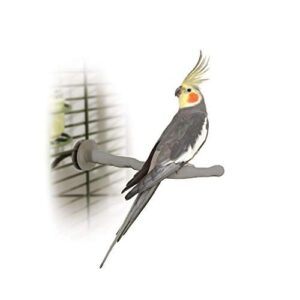
Cold drafts are tough on birds — especially older ones or those recovering from illness. That’s where a heated perch earns its place.
This one runs on 12V DC and has a gentle temperature gradient along its length, so your bird can scoot toward warmth or away from it as needed.
It comes in three sizes, with the small at 1-inch diameter. The irregular shape also helps reduce foot cramping.
Just check regularly that it stays pleasantly warm, not hot.
| Best For | Bird owners with older, sick, or cold-sensitive birds who need reliable warmth without constant manual heat adjustments. |
|---|---|
| Bird Size Fit | Small to medium |
| Material | Non-toxic plastic |
| Installation | Plug-in electric |
| Foot Health | Irregular shape |
| Chew Safe | Yes |
| Pieces Included | 1 heated perch |
| Additional Features |
|
- Temperature gradient lets your bird self-regulate — they move closer or farther depending on how warm they want to be.
- Irregular shape is genuinely useful for reducing foot cramping during long perching sessions.
- Low-voltage 12V power keeps things safe, and the non-toxic plastic holds up well against chewing and scratching.
- Overheating has been reported, so you’ll need to check it regularly to make sure it stays warm, not hot.
- The plastic attachment rod can snap under heavier birds, and the smooth surface gets slippery for tiny species like finches.
- Build quality has been inconsistent in recent units compared to older ones, which is worth keeping in mind.
5. Bird Shower And Window Perch
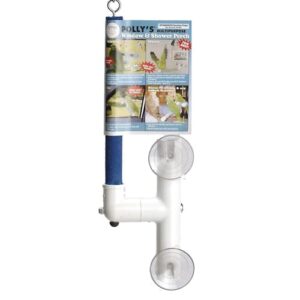
Some birds absolutely love a good shower — and this perch makes it easy to give them one. It mounts to any smooth surface using oversized suction cups, so you can stick it on a window, mirror, or shower wall in seconds.
The textured, sandpaper-style surface trims nails and beaks during use, which is a nice bonus.
It folds flat for travel and comes in two sizes: small (1 in diameter) and large (1.5 in diameter). Just inspect those suction cups weekly — birds will chew them if given the chance.
| Best For | Bird owners who want a simple, portable perch for bathing, sunbathing, or travel — especially those with small to medium-sized parrots. |
|---|---|
| Bird Size Fit | Small to medium |
| Material | Sandpaper-texture plastic |
| Installation | Suction cup mount |
| Foot Health | Textured surface |
| Chew Safe | No |
| Pieces Included | 1 perch |
| Additional Features |
|
- Sticks to windows, mirrors, and shower walls fast — no tools needed
- The sandpaper texture naturally trims nails and beaks over time
- Folds flat, so it’s easy to toss in a bag for travel or hotel stays
- Suction cups can lose grip on textured surfaces or if birds start chewing them
- The abrasive surface may be rough on sensitive feet with prolonged use
- The angle-adjustment knob isn’t the sturdiest, especially for bigger birds
6. Colorful Bird Rope Bungee Toys
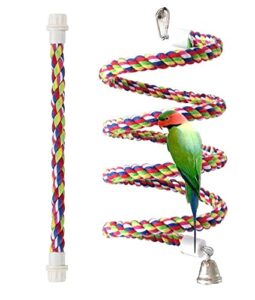
At $11.99, this colorful rope bungee toy punches well above its price. The 43-inch cotton rope twists, bounces, and swings — giving small-to-medium parrots like green-cheek conures and Senegals a built-in climbing gym.
You can hang it vertically, horizontally, or diagonally depending on your cage layout.
The metal spring adds just enough bounce to keep things interesting.
One thing to watch: inspect it weekly. Cotton frays fast with determined chewers, and loose threads are a real ingestion risk.
| Best For | Small-to-medium parrots like green-cheek conures, Senegals, and cockatoos whose owners want an affordable, versatile perch that doubles as a play gym. |
|---|---|
| Bird Size Fit | Small to medium |
| Material | 100% cotton rope |
| Installation | Easy-hang hooks |
| Foot Health | Dynamic movement |
| Chew Safe | Yes |
| Pieces Included | 1 perch + bell |
| Additional Features |
|
- 43 inches of flexible cotton rope that twists, swings, and bounces — keeps birds active and entertained
- Hangs vertically, horizontally, or diagonally, so it fits almost any cage setup
- At $11.99, it’s a genuinely good deal for what you get
- Cotton frays fast with heavy chewers — loose threads are a real ingestion hazard, so weekly checks are a must
- Cleaning is tough; if it gets too soiled or worn, you’re better off just replacing it
- Some birds won’t warm up to the wobbly feel right away, especially if they’re used to solid perches
Frequently Asked Questions (FAQs)
What bird has the best personality?
Personality-packed parrots like the African Grey and cockatiels top the list. They bond deeply, learn names, and seek daily interaction.
Cockatiels even nuzzle your hand like a tiny, feathered friend who never ignores you.
How do you discipline a parrot?
Forget punishment — it backfires with parrots. Instead, ignore unwanted behavior, redirect to safe alternatives, and reward what you want immediately.
Consistency and calm build trust far faster than scolding ever will.
How many perches should be in a birdcage?
Start with at least three perches. One for sleeping, one at mid-height, and one up high.
That gives your bird options to move, rest, and explore without crowding any single spot.
Can birds sleep comfortably on all perch types?
Not all perch types are equally comfortable for sleep. Birds rest best on natural wood perches sized to their feet.
Smooth dowels and sand perches can cause discomfort or pressure sores overnight.
How do perches affect bird posture and balance?
Think of it as "posture on a perch"—your bird’s balance depends entirely on toe wrap. The right diameter keeps weight evenly distributed, reducing strain and preventing slips.
What perch materials work best for molting birds?
During molt, soft tissue is more vulnerable, so go with manzanita, apple, or ash wood. They’re non-toxic, splinter-resistant, and give tired feet a steady, comfortable grip.
How can perches help with bird training sessions?
The right perch gives your bird a stable, confident place to land — and that security makes training click faster.
consistent grip means fewer slips, better focus, and cleaner responses to your cues.
Can birds share perches safely with other species?
Yes — but only if you set things up carefully. Compatible sizes, calm temperaments, and plenty of perches to go around make shared spaces work.
Watch closely for any bullying, and separate them fast if tensions rise.
How often should perches be fully replaced?
Replace wooden perches every 2–6 months, or sooner if you spot deep gouges or cracks. Concrete perches last 3–4 months. Wobbly perches? Swap them within two weeks.
Do perches affect a birds mental health?
Absolutely — perches can make or break a bird’s mental state. Birds without them show measurably more fear and anxiety.
A good perch setup keeps your bird calm, active, and genuinely content.
Conclusion
Back in the day, bird owners had one perch and called it done—but you know better now. Safe bird cage perch options aren’t just a checklist; they’re a commitment to your bird’s daily comfort and long-term health.
Vary the diameters. Mix the textures. Rotate often. Place them with intention.
Your bird can’t tell you when something hurts, but their feet will show it. Give them a setup worth gripping.
- https://vcahospitals.com/know-your-pet/perches-for-birds
- https://substack.freerangeparrots.org/p/ultimate-list-of-safe-and-toxic-plants-to-birds
- https://birdtricksstore.com/blogs/birdtricks-blog/why-your-parrot-needs-many-types-of-perches?srsltid=AfmBOorukVAkkXoIIWPQ_3JHt-aUElmwDVEa1QupTv9PvZsq-vGbPoqr
- https://www.parrots.org/ParrotsAtHome/YourFeatheredFriendsFeet.pdf
- https://www.facebook.com/myrightbird