This site is supported by our readers. We may earn a commission, at no cost to you, if you purchase through links.
 You’ll encounter impressive large birds in Colorado ranging from soaring raptors to massive waterfowl.
Bald Eagles with their iconic white heads patrol waterways, while Golden Eagles hunt across mountain terrain.
Trumpeter Swans – North America’s heaviest native birds – grace alpine lakes alongside American White Pelicans.
Great Blue Herons stalk wetland edges, and Sandhill Cranes pass through during epic migrations.
Great Horned Owls and Snowy Owls dominate nighttime hunting, while Turkey Vultures clean up the landscape.
Colorado’s diverse elevations create perfect conditions for spotting these magnificent giants year-round, though timing and location make all the difference for successful sightings.
Table Of Contents
- Key Takeaways
- Mute Swan
- Trumpeter Swan
- American White Pelican
- Bald Eagle
- Golden Eagle
- Sandhill Crane
- Great Blue Heron
- Snowy Owl
- Great Horned Owl
- Turkey Vulture
- Frequently Asked Questions (FAQs)
- What bird is mistaken for a hawk?
- What is the most common bird in Colorado?
- What are the top 5 biggest birds?
- What is the largest hawk in Colorado?
- What large birds migrate through Colorado seasonally?
- Which raptors hunt at night versus day?
- How do weather patterns affect large birds?
- What threats do Colorados large birds face?
- Where can visitors best spot large birds?
- Conclusion
Key Takeaways
- You’ll find Colorado’s largest birds include American White Pelicans with 9-foot wingspans, Trumpeter Swans weighing up to 25 pounds, and Golden Eagles with incredible mile-away vision across diverse elevations from plains to peaks.
- Timing’s crucial for spotting these giants – visit San Luis Valley during March-April for thousands of migrating Sandhill Cranes, winter months for Snowy Owls, and year-round for resident Bald Eagles and Great Blue Herons.
- Colorado’s varied habitats support different species – you’ll spot pelicans and swans on mountain lakes, eagles soaring over open terrain, herons stalking wetland edges, and owls hunting across forests and grasslands.
- Conservation success stories like Bald Eagles (from 3-4 nests in the 1970s to over 300 today) show how protection efforts work, though threats like habitat loss, lead poisoning, and climate change still challenge these magnificent birds.
Mute Swan
Colorado’s heaviest bird species, the Mute Swan, can tip the scales at over 26 pounds—making it a true heavyweight champion of local waterbirds.
You’ll find these non-native swans primarily in northern Colorado’s deeper lakes, where their distinctive orange bills and graceful S-shaped necks make identification easy.
Mute Swan Habitat centers around quiet waters with abundant submerged vegetation they love to munch.
Unlike migrating waterfowl, Swan Migration patterns show these birds stick around year-round, though cold snaps might send them south temporarily.
Their aggressive nature creates challenges for Waterfowl Management and Bird Conservation efforts, as they compete with native species for resources.
Swan Behavior includes territorial displays and silent swimming—despite their name, they’re not completely mute.
Careful monitoring helps protect Colorado’s wetland ecosystems from overgrazing by these large waterbirds.
When you’re exploring mountain lakes, keep an eye out for these impressive large bird species that’ve made Colorado home.
The survival of these birds is highly dependent on understanding baby swan development and behavior.
Trumpeter Swan
Across Colorado’s pristine waterways, you’ll encounter North America’s heaviest waterfowl—the magnificent Trumpeter Swan. These colorado bird species reach up to 25 pounds with six-foot wingspans, making them true giants among large waterbirds.
- Males produce territorial resonating calls, females offer softer notes during mating displays
- Winter in ice-free areas of the Pacific Northwest, Great Lakes, and eastern seaboard
- Create reverberations across wetlands with sonorous vocalizations audible for miles
- Recovered from near-extinction (endangered until 1975) to healthy populations through Swan Conservation
- Numbers continue improving via wetland protection and strict breeding regulations
These large bird species prefer shallow lakes and marshes for their Nesting Patterns. During Bird Migration, they’ll grace your bird watching colorado adventures with regal elegance. Their Swan Habitat requirements include open water for takeoffs—these Water Fowl need runway space like jumbo jets!
American White Pelican

You’ll spot Colorado’s largest bird soaring over lakes and rivers with its massive 9-foot wingspan that dwarfs even eagles.
These white giants with black wingtips and bright orange beaks weigh up to 20 pounds and work together in small groups to scoop fish from the water’s surface, demonstrating a unique form of cooperative hunting where they use their size and bright orange beaks to their advantage.
Size and Distribution
At 9-10 feet, the American White Pelican boasts Colorado’s widest wingspan among Large birds in Colorado.
These impressive birds showcase remarkable wingspan variance compared to other Colorado bird species, with some individuals reaching nearly 10 feet tip-to-tip.
You’ll spot them primarily in northern and central regions during bird migration seasons, creating spectacular large bird sightings over reservoirs and wetlands.
Their habitat range extends throughout Colorado’s major water bodies, contributing substantially to the state’s species diversity.
Population trends show increasing numbers as these massive birds expand their distribution.
Unlike ground-dwelling species, pelicans demonstrate exceptional soaring abilities, riding thermals hundreds of feet above their preferred bird habitats Colorado.
During peak migration, they share airspace with cranes and swans, offering birdwatchers incredible opportunities for bird size comparisons across multiple species in Colorado’s diverse ecosystems.
The conservation status of the American White Pelican is classified as Least Concern species due to its stable population.
Habitat and Behavior
You’ll find American white pelicans in Colorado’s shallow lakes and wetlands where fish swim near the surface.
These massive birds showcase fascinating flocking behavior, lining up like synchronized swimmers to herd fish into shallows.
Their nesting patterns favor isolated islands in reservoirs, building large mound-shaped nests colonially.
Watch their cooperative foraging strategies at colorado birding trails – they’ll dip their pouched bills simultaneously, creating quite the spectacle.
These roosting sites and migration routes make Colorado’s bird habitats prime locations for large bird sightings.
The presence of invasive species like Mute Swans can be a significant concern due to their ecological damage issues, affecting the overall ecological balance with their actions.
Bald Eagle

You’ll spot America’s national bird soaring over Colorado’s lakes and rivers, where its distinctive white head and tail make identification easy against its dark brown body.
Once nearly extinct in the state, bald eagles have made a remarkable comeback with over 300 nesting pairs now calling Colorado home.
Appearance and Distribution
Spotting these magnificent raptors across Colorado’s waterways, you’ll notice their unmistakable white heads contrasting sharply with chocolate-brown bodies.
Adult bald eagles display impressive wing spans reaching 91 inches, making them among Colorado’s most recognizable large birds in Colorado.
Their bright yellow beaks and talons stand out against dark feather colors, while their powerful build dominates habitat zones near rivers and reservoirs.
These Rocky Mountain birds prefer perching in towering cottonwoods, scanning for fish below with keen eyesight.
Conservation Status
Colorado’s bald eagles soared back from the brink after being removed from endangered species protection in 2007.
You’ll find over 300 nests statewide now, up from just 3-4 in the 1970s.
While habitat loss and lead poisoning still threaten these magnificent raptors, Colorado bird conservation efforts keep this success story alive through ongoing wildlife protection and ecosystem balance initiatives.
Conservation efforts rely on eagle conservation strategies to protect these birds.
Golden Eagle

You’ll recognize the Golden Eagle as Colorado’s most powerful raptor, with its massive 7-foot wingspan and incredible ability to spot prey from over a mile away in the state’s open landscapes.
This magnificent hunter weighs up to 16 pounds and commands respect as it soars through mountain valleys and high plains, making it one of the most impressive wildlife encounters you can have in Colorado, with its incredible ability to thrive in the state’s landscapes, and is known for being a powerful raptor.
Physical Features and Behavior
You’ll recognize a golden eagle by its impressive wingspan variations reaching up to seven feet across open colorado birds territory.
These magnificent bird species display distinctive feather colors—rich dark brown plumage contrasted by golden-bronze neck feathers that catch sunlight beautifully.
- Wingspan Variations: Spans 71-91 inches, perfect for effortless soaring over vast landscapes
- Feather Colors: Dark chocolate-brown body with signature golden head and neck plumage
- Beak Shapes: Powerful yellow hooked bill designed for tearing prey efficiently
- Nesting Habits: Builds massive stick nests on cliff faces, reusing sites annually
Their bird behavior colorado includes incredible eyesight—spotting rabbits from over a mile away.
Bird identification becomes easier when you notice their distinctive flight pattern and those telltale golden head feathers glinting in sunlight.
Habitat and Range
These magnificent raptors rule Colorado’s diverse landscapes year-round. You’ll find golden eagles thriving across grassland environments, mountain ecosystems, and shrublands statewide.
They favor western Colorado’s cliffs for breeding but hunt throughout the eastern plains too. Each pair claims hundreds of square miles as their territory—that’s serious real estate!
Their adaptability to forest ecology and river systems makes them true Colorado birds success stories. Unlike many rocky mountain birds with seasonal migrations, golden eagles stick around, expanding their ranges during winter months.
Golden eagles exhibit complex hunting behavior patterns that enable them to thrive in various environments.
Sandhill Crane
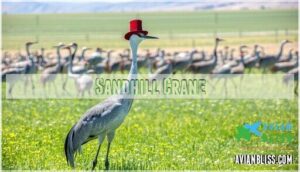
You’ll spot Sandhill Cranes by their impressive 4.5-foot height and distinctive red crown patch that looks like they’re wearing a fancy hat.
These pale gray giants put on quite the show during spring migration in the San Luis Valley, where thousands gather and perform their elaborate courtship dances.
Description and Behavior
When you encounter these majestic Colorado birds in the wild, you’ll notice their distinctive pale gray plumage and striking red crown patches that make identification easy.
Standing up to 4.5 feet tall, Sandhill Cranes display fascinating Social Behavior patterns that’ll captivate any birdwatcher.
Their complex behavioral repertoire includes:
- Coordinated dancing displays – elaborate courtship rituals with synchronized jumps and wing-flapping
- Distinctive bugle calls – rattling vocalizations audible over two miles away
- Family bonding – pairs mate for life and travel together during bird migration
- Feeding Patterns – omnivorous diet including insects, small mammals, and plant matter
- Habitat Selection – preferring wetlands, agricultural fields, and shallow marshes.
These large bird species demonstrate remarkable intelligence through their intricate social structures.
You’ll often spot them in small family groups, teaching young birds essential survival skills.
Their raptors-like vigilance and coordinated group movements showcase sophisticated bird behavior that’s evolved over millions of years.
Migration Patterns
Twice each year, thousands of Sandhill Cranes transform Colorado’s skies into a living migration highway. These ancient travelers follow established flyways from Canadian breeding grounds to southern wintering areas, creating one of North America’s most spectacular bird migration displays.
Sandhill Crane Migration Timeline
| Season | Location | Activity |
|---|---|---|
| Spring | San Luis Valley | Massive staging area |
| Summer | Northern regions | Breeding season |
| Fall | Statewide flyways | Southward journey |
You’ll witness peak numbers during March and April when cranes use Colorado’s wetlands as refueling stations. Bird tracking studies reveal these altitude shifts follow mountain corridors, with flocks reaching 13,000 feet.
Their seasonal moves depend on weather patterns and habitat use, making timing unpredictable but rewarding for patient observers. Colorado bird migration wouldn’t be complete without their trumpeting calls echoing across valleys, connecting generations through timeless bird species migration patterns.
Great Blue Heron
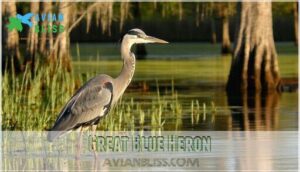
You’ll spot Great Blue Herons standing motionless like feathered statues along Colorado’s wetlands, where these patient hunters can reach nearly 4.5 feet tall.
Nature’s patient fisherman stands sentinel in Colorado’s waters, waiting to strike with prehistoric precision.
These impressive waders nest in colonies of up to 500 pairs, turning large trees into bustling heron neighborhoods during breeding season, which makes them a notable sight in their wetlands.
Identification and Habitat
When you spot Colorado’s Great Blue Heron (Ardea herodias), you’ll see nature’s patient fisherman. These bird species stand nearly five feet tall with distinctive blue-gray plumage and white crown patches.
During breeding season, shaggy plumes adorn their necks like feathered crowns. Great Blue Herons frequent diverse habitat types across Colorado:
- Shallow wetlands and marshes for prime hunting grounds
- Rivers and streams with slow-moving water
- Large bird nests built high in cottonwoods near water
- Bird habitats in Colorado including urban parks with ponds
- Colorado bird sanctuaries where they’re often protected
These adaptable hunters don’t follow traditional migration routes—they’re year-round residents when water stays open. Their nesting sites typically cluster in colonies called rookeries, sometimes housing dozens of pairs.
Conservation efforts help protect their wetland homes from development. You’ll recognize their prehistoric silhouette as they stand motionless, waiting to strike with lightning speed.
Feeding Habits
You’ll watch Great Blue Herons employ diverse hunting techniques across Colorado’s wetlands.
These skilled predators use patient stalking methods, standing motionless in shallow waters before striking with lightning-fast precision.
Their prey selection includes fish, frogs, small mammals, and aquatic insects.
Scavenging behavior supplements their diet when hunting proves challenging.
Their dietary adaptations allow them to thrive in various habitats, from mountain lakes to urban ponds.
Foraging strategies involve both active hunting and opportunistic feeding, making them highly successful colorado raptors among bird diets specialists.
The Great Blue Heron’s ability to adapt to different environments is influenced by their habitat conservation efforts and natural behavior, showcasing their ability to adapt and natural behavior in a variety of habitats with effective foraging strategies.
Snowy Owl
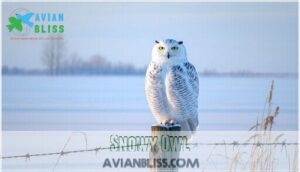
You’ll spot Snowy Owls during Colorado’s harsh winters when these Arctic visitors travel south in search of food.
These striking white owls with yellow eyes prefer open fields and prairies that remind them of their tundra homeland, which is a key factor in their survival during harsh winters.
Appearance and Range
Snowy owls transform Colorado’s winter landscape into something magical when these arctic visitors arrive.
These magnificent Colorado birds showcase impressive Bird Sizes, measuring 20-27 inches long with Wing Spans reaching 4-5 feet.
Their striking Feather Colors feature brilliant white plumage – males appear almost pure white while females display subtle dark barring.
You’ll notice their rounded facial discs, piercing yellow eyes, and feathered legs that look like fuzzy boots.
These large birds in Colorado prefer open Habitat Zones during winter months, including grasslands, prairies, and agricultural fields.
Unlike tree-dwelling owls, snowy owls choose ground perches or fence posts for hunting vantage points.
Their bird identification becomes easier when you spot their distinctive white coloring against snow-covered terrain.
Bird species like this demonstrate remarkable adaptation, with their arctic origins perfectly suiting Colorado’s harsh winter conditions.
Their bird ranges extend from northern tundra breeding grounds down through Colorado’s eastern plains.
This remarkable adaptation allows them to thrive in various environments, making them a unique sight in Colorado’s winter landscape.
Breeding and Migration
While their stunning white plumage catches your eye, understanding snowy owl breeding habits reveals fascinating Colorado bird species behavior.
These Arctic specialists showcase unique migration patterns when prey becomes scarce up north.
Here’s what drives their southward journeys:
- Nesting Habits – Ground nests with 3-11 eggs laid during brief Arctic summers
- Flock Migration – Irregular irruptive movements based on lemming population crashes
- Habitat Selection – Open fields and prairies mimicking their tundra homeland
Bird tracking data shows these owls don’t follow predictable bird migration patterns like other species.
Instead, they’re nomadic wanderers seeking survival opportunities.
Colorado bird conservation efforts now monitor these vulnerable visitors more closely, as climate change affects their traditional Arctic breeding grounds and alters established migration routes.
The snowy owl’s primary survival strategy relies on understanding their arctic habitat needs.
Great Horned Owl
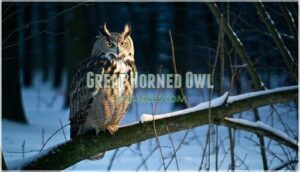
You’ll recognize this powerful owl by its distinctive "horns" – actually feather tufts – and piercing yellow eyes that seem to follow you through the forest.
Found across Colorado’s diverse habitats from plains to mountains, the Great Horned Owl hunts everything from rabbits to skunks with silent precision that would make any ninja jealous.
Physical Characteristics and Range
You’ll recognize the Great Horned Owl by its impressive 3-5 foot wingspan and distinctive "ear" tufts that aren’t actually ears.
Their powerful beak shapes enable crushing prey efficiently, and bird sizes range from 17-25 inches long, making them among Colorado’s largest owl species.
These Colorado wildlife residents display varied feather colors from rusty brown to gray, helping with bird identification across different habitats.
Habitat ranges span forests, deserts, wetlands, and urban areas – they’re incredibly adaptable, and bird species like this demonstrate remarkable wingspan variations within populations, showcasing nature’s flexibility in design.
Hunting and Diet
Great Horned Owls are nature’s silent assassins, hunting primarily at night with remarkable stealth.
These raptors use their exceptional low-light vision and virtually soundless flight to ambush unsuspecting prey.
Their predator prey relationships include rabbits, squirrels, skunks, and even other bird species.
With powerful talons delivering crushing force and razor-sharp beaks, they’re incredibly efficient killers.
Their hunting tactics involve patient observation from perches before swooping down for the kill.
These adaptable raptors don’t stick to one bird diet—they’ll take whatever’s available, from fish to insects.
Their diverse feeding habits and flexible foraging strategies make them successful across Colorado’s varied landscapes, earning them the nickname "winged tigers" with their ability to thrive in different environments due to their efficient hunting style.
Turkey Vulture

You’ll recognize turkey vultures by their distinctive red heads and impressive 6-foot wingspans as they soar effortlessly above Colorado’s landscapes from spring through fall.
These cleanup crews of the sky play a vital role in maintaining healthy ecosystems by efficiently disposing of carrion before it can spread disease, acting as a crucial part of the ecosystems.
Identification and Distribution
How do you spot Turkey Vultures across Colorado’s diverse landscapes? These impressive scavengers display distinctive broad wings and effortless soaring flight patterns that make bird identification straightforward.
You’ll find them throughout most of Colorado except high mountain peaks, where habitat maps show limited bird distribution. Their widespread presence supports bird species diversity in Colorado, from eastern plains to western valleys.
During migration patterns, Turkey Vultures concentrate along thermal corridors, creating excellent opportunities for colorado bird identification. Conservation efforts monitor these essential scavengers across various nesting sites, ensuring healthy populations of this important bird species in Colorado.
Understanding local colorado birding habits is vital for effective conservation strategies.
Role in Ecosystem
Turkey vultures serve as nature’s cleanup crew, performing essential ecosystem maintenance across Colorado’s landscapes.
You’ll see these scavengers soaring overhead, using their exceptional sense of smell to locate carrion from miles away.
Their feeding exclusively on dead animals reduces disease risk while recycling nutrients back into the soil, supporting healthy ecosystems and biodiversity impact.
- Ecosystem Balance: Remove diseased carcasses that could spread pathogens to wildlife and livestock
- Predator Prey Dynamics: Compete with coyotes, ravens, and other scavengers for carrion resources
- Food Chains: Return essential nutrients from decomposing animals back to soil and plant communities
- Habitat Conservation: Indicate wildlife mortality patterns, helping biologists monitor ecosystem health
- Bird Species Diversity: Connect distant habitats through long-distance migration, transporting nutrients across ecosystems
Their unique adaptations make them irreplaceable contributors to bird ecology and habitat conservation efforts.
Frequently Asked Questions (FAQs)
What bird is mistaken for a hawk?
Turkey Vultures fool you constantly! These massive soaring birds circle overhead with their impressive six-foot wingspans, mimicking hawks perfectly.
You’ll spot their distinctive wobbling flight pattern and bare red heads up close, distinguishing them from true raptors like Red-tailed Hawks.
What is the most common bird in Colorado?
You’ll encounter Colorado’s answer to the urban bird kingdom: European Starling, boasting over 200 million individuals across North America.
These vocal mimics master twenty different bird calls, thriving everywhere from Denver’s streets to mountain towns with impressive adaptability.
What are the top 5 biggest birds?
You’ll find Colorado’s five biggest birds by wingspan: American White Pelican (over 9 feet), Bald and Golden Eagles (both 7+ feet), Turkey Vulture (6 feet), and Trumpeter Swan (nearly 6 feet wingspan).
What is the largest hawk in Colorado?
When you’re seeking Colorado’s heavyweight aerial hunter, the Ferruginous Hawk reigns supreme.
This magnificent raptor stretches its wings up to 60 inches wide and tips the scales at five pounds, making it North America’s largest hawk species.
What large birds migrate through Colorado seasonally?
You’ll spot massive seasonal travelers like Canada Geese, Swainson’s Thrushes, Bullock’s Orioles, and Western Tanagers during spring and fall migrations—nature’s own cross-country road trip happening overhead.
Which raptors hunt at night versus day?
You’ll hunt with predators as cunning as politicians making campaign promises—but at least these killers deliver results.
Great Horned Owls dominate darkness while Red-tailed Hawks rule daylight hours, each perfectly adapted for their hunting schedules.
How do weather patterns affect large birds?
Weather patterns dramatically reshape your large bird experiences.
You’ll notice fewer raptors during storms as they seek shelter, while migrations shift with temperature changes and wind patterns affecting their flight efficiency.
What threats do Colorados large birds face?
Like sitting ducks in a shooting gallery, you’ll find Colorado’s large birds battling habitat loss, climate change, power line collisions, lead poisoning, and human disturbance that disrupts their nesting cycles.
Where can visitors best spot large birds?
You’ll find Colorado’s giants at Rocky Mountain Arsenal for bald eagles, Barr Lake for pelicans and cranes, and San Luis Valley during spring migration when thousands of sandhill cranes gather.
Conclusion
Colorado’s theory that elevation creates diverse habitats proves accurate – you’ll find large birds in Colorado thriving from plains to peaks.
Whether you’re spotting Golden Eagles soaring above timberline or watching Trumpeter Swans on mountain lakes, timing matters most.
Pack binoculars, check seasonal patterns, and remember that patience rewards observers.
These magnificent species remind us why Colorado’s varied landscapes make it a premier birding destination for enthusiasts seeking unforgettable wildlife encounters.
- https://www.birdadvisors.com/large-birds-colorado/
- https://www.aspentimes.com/news/colorado-bald-eagle-population-increasing-colorado-parks-and-wildlife
- https://birdwatchinghq.com/birds-of-prey-in-colorado/
- https://www.animalspot.net/colorado-birds-of-prey
- https://www.colorado.com/articles/colorado-birdwatching-10-must-see-birds