This site is supported by our readers. We may earn a commission, at no cost to you, if you purchase through links.
 You’ll need more than field guides and binoculars to reach expert-level bird identification.
Master advanced techniques like analyzing feather microstructure, recognizing subtle sexual dimorphism in plumage, and understanding complex molting patterns that change throughout seasons.
Expert birders also rely on flight patterns, size comparisons, and behavioral cues that beginners often miss.
Modern tools like Merlin Bird ID and eBird provide powerful resources, but you’ll combine these with forensic-level observation skills.
Understanding raptor groupings, juvenile variations, and age-based plumage changes separates true experts from casual observers.
The most challenging identifications often come down to microscopic details that reveal a bird’s true identity.
Table Of Contents
- Key Takeaways
- Bird Identification Basics
- Raptor Identification Techniques
- Advanced Bird Identification
- Expert Birding Tips and Tools
- Frequently Asked Questions (FAQs)
- What are the 5 S’s of birding?
- Is the Audubon Bird Guide free?
- What are the 4 keys to bird identification?
- What’s the best bird field guide?
- How do hybrid birds affect identification accuracy?
- What role does molt timing play regionally?
- How do subspecies variations complicate field identification?
- When should DNA analysis be considered necessary?
- How do environmental factors alter bird appearance?
- Conclusion
Key Takeaways
- Master forensic-level observation skills by analyzing feather microstructure, barbule length, and pigment distribution under magnification to separate closely related species that basic field marks cannot distinguish.
- Understand complex age and seasonal variations since juvenile plumage often differs dramatically from that of adults – you’ll need to recognize that eagles take 5 years to mature while gulls require 4 years to reach full adult plumage.
- Combine traditional techniques with modern technology by using Merlin Bird ID for real-time sound identification and eBird’s community-verified photos to access millions of observations and regional dialect variations.
- Focus on raptor flight patterns and behavioral cues rather than just static features – you’ll identify species more accurately by observing wing shape, soaring versus flapping behaviors, and hunting patterns in different lighting conditions.
Bird Identification Basics
You’ll need to master the fundamentals before tackling advanced identification techniques that separate expert birders from casual observers.
These core skills—recognizing key traits, extended observation, quick reference guides, and sound identification—form the foundation for identifying even the most challenging species in the field, utilizing complete concepts to guide the process.
Recognizing Traits and Characteristics
You’ll master bird identification by recognizing key traits like plumage variations, behavioral patterns, and habitat clues.
Start with obvious field marks—wing bars, tail shapes, and bill types—then note how birds move and feed.
Regional differences affect appearance, while vocal dialects help distinguish similar species.
These bird identification techniques form your foundation for advanced birding skills.
Observing Birds for Detailed Identification
When tracking birds, extend your observation duration beyond quick glances.
Watch for behavioral cues like feeding patterns and territorial displays. Note habitat clues and lighting conditions that affect identification.
Take detailed notes on size, shape, and movement patterns. Patient observation reveals subtle field identification markers that separate similar species, building your bird ID skills through systematic study.
Utilizing a bird identification guide can further refine these skills, helping to improve bird ID skills and understand field identification.
Using Quick ID Guides for Common Birds
Quick ID guides serve as your field companion when you’ve gathered initial observations but need confirmation.
These pocket-sized references streamline identification by focusing on common species’ key features, reducing decision fatigue during active birding sessions.
However, guide limitations exist – regional variations and seasonal changes can challenge even updated editions.
Accuracy matters most when distinguishing similar species, as beginner mistakes often stem from relying solely on single field marks.
- Compare multiple bird guide reviews before selecting your primary reference to guarantee thorough coverage
- Test bird ID books in various lighting conditions since field visibility affects photo and illustration clarity
- Track guide evolution through revised editions that incorporate new research and taxonomy updates
- Consider future guides with digital integration for enhanced bird identification guide functionality
Learning Bird Songs and Calls for Enhanced Identification
While visual identification helps with common species, mastering bird songs and calls transforms you into a skilled birder.
Each species has unique vocalizations serving specific call functions, from territorial warnings to mating displays.
Regional song dialects create fascinating variations, while vocal mimicry by species like mockingbirds can cause aural misidentification.
Utilizing a reliable identifier tool can greatly assist in this process.
Sonogram analysis reveals subtle differences in bird sounds that human ears might miss during field identification.
Sonogram analysis reveals subtle differences in bird sounds that human ears might miss during field identification, highlighting the importance of reliable identifier tools in the process.
Raptor Identification Techniques
You’ll find that raptors become much easier to identify once you learn to group them by basic characteristics like wing shape and flight patterns.
Mastering raptor groups by wing shape and flight style unlocks identification success for even challenging species.
Juvenile Bald Eagles present particular challenges since they lack the distinctive white head feathers for their first few years, making proper identification essential for conservation tracking efforts.
Breaking Raptors Into Groups for Detailed ID

You’ll categorize raptors into three primary groups based on raptor morphology and hunting behavior.
Hawks feature broad wings for soaring, eagles display massive size with powerful builds, and falcons show pointed wings for speed.
Each group exhibits distinct flight styles and habitat preferences, making raptor identification more systematic.
Regional variations within these groups require careful attention to wing shape, tail length, and hunting patterns for accurate hawk identification, eagle identification, and falcon identification.
Identifying Juvenile Bald Eagles for Conservation

Five key features distinguish juvenile Bald Eagles from adults, preventing misidentification risks that harm conservation efforts.
You’ll spot mottled brown and white juvenile plumage instead of adult white heads. Age determination requires noting beak color changes from dark gray to yellow over five years.
Eagle habitats remain consistent between juveniles and adults, but juveniles show less hunting success.
Newly hatched eagles are covered in light gray down.
Accurate eagle identification supports critical population monitoring for bird conservation programs, which is essential for conservation efforts.
Understanding Contour Feathers for Taxa Differentiation

Mastering contour feathers transforms your bird identification skills from basic to forensic-level precision.
You’ll examine feather shape, barb arrangement, and color patterns to distinguish closely related species.
Feather length variations and microstructure analysis reveal taxonomic clues that separate similar birds.
- Feather Shape: Notice rounded versus pointed tips that indicate different feeding strategies and flight patterns
- Barb Arrangement: Examine how individual barbs connect to identify species-specific structural differences in bird plumage
- Color Patterns: Study subtle variations in banding, spots, and gradients that distinguish taxa within families
- Feather Length: Measure primary and secondary feather proportions for accurate bird taxonomy classification
- Microstructure Analysis: Use magnification to identify barbule density and pigment distribution in challenging identifications
Recognizing Age-Based Variation Challenges

While contour feathers reveal species differences, age-based variation presents unique challenges for bird identification experts.
Juvenile Plumage often confuses even experienced birders, as immature birds can look drastically different from adults.
Eagle Maturation spans five years, while Gull Aging takes four years to reach full adult plumage.
| Species Group | Maturation Time | Key Challenge |
|---|---|---|
| Large Gulls | 4 years | Complex molt sequences |
| Eagles | 5 years | Brown juvenile vs. adult white |
| Hawks | 1-2 years | Streaked immature plumage |
Age Complexity creates identification pitfalls when juvenile birds resemble entirely different species.
You’ll encounter Immature Identification challenges where young Bald Eagles sport brown heads, mimicking Golden Eagles.
Advanced birding techniques require recognizing these plumage variations across different age classes.
Advanced Bird Identification
You’ll move beyond basic field marks to examine microscopic feather details that separate closely related species.
These forensic-level techniques, combined with understanding sexual dimorphism and molting patterns, will sharpen your identification skills to expert level.
Feather Microstructure for Forensic-Level ID

You’ll uncover microscopic secrets when examining barbule length and pterylae distribution under high magnification.
These forensic ornithology techniques reveal species differentiation through pigment nodes and keratin patterns invisible to naked eyes.
Bird identification experts use scanning electron microscopy to analyze feather microstructure, creating definitive identification even from tiny fragments.
This forensic approach revolutionizes bird identification resources beyond traditional plumage variations.
Sexual Dimorphism in Plumage for Accurate ID

Sexual dimorphism creates plumage differences that can make sexing birds challenging yet rewarding.
Mastering bird identification rewards patience with breakthrough moments of clarity.
Over 90% of bird species show some form of sexual variation**, with males typically displaying brighter breeding plumage than females.
You’ll find extreme examples in species like Painted Buntings, where males and females appear almost like different bird species entirely, requiring careful attention to subtle bird traits for accurate female identification, which can be a rewarding experience.
Molting Patterns and Seasonal Changes
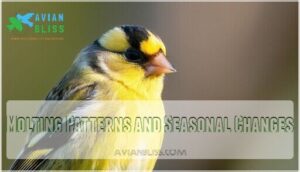
Plumage variation throws curveballs at even seasoned birders.
Seasonal molting transforms your familiar backyard birds into puzzling strangers, while molt timing shifts species identification windows.
American Goldfinches swap their bright breeding plumage for dull winter coats.
You’ll spot prebasic molts peaking July through September, creating temporary bird identification challenges until fresh feathers emerge, which can be a challenge due to plumage variation.
Flight Patterns and Size for Raptor Identification

While seasonal changes affect feather appearance, you’ll identify raptors most effectively by analyzing their flight patterns and size relationships.
Watch for soaring vs. flapping behaviors—hawks soar with steady wings while falcons show rapid wingbeats.
Compare wingspan against body size for silhouette identification.
Flight agility differs dramatically between species, with relative size helping distinguish similar raptors during challenging field conditions.
Consider that wing shape is essential for identifying raptor families.
Expert Birding Tips and Tools

You’ll discover that modern technology transforms bird identification from guesswork into precision science.
The Merlin Bird ID app and eBird platform provide expert-level tools that combine millions of observations with advanced algorithms to help you identify even the most challenging species.
Merlin Bird ID App for Enhanced Identification
Advanced identification techniques become even more powerful when paired with digital tools.
The Merlin Bird ID App transforms your smartphone into an expert-level identification companion, offering three distinct recognition methods that work seamlessly in the field.
You can even find Merlin Bird ID products to enhance your birding experience.
- Merlin Sound ID – Records and identifies bird calls in real-time using advanced audio analysis algorithms
- Photo ID Accuracy – Analyzes uploaded images with machine learning to suggest species matches
- Community Contributions – Leverages millions of observations from eBird’s global database for reliable identifications
- App Customization – Creates personalized species lists based on your location and seasonal bird activity
- Offline Functionality – Downloads regional bird packs for identification without internet connectivity
EBird for Community-Contributed Photos and Songs
While Merlin gets you started with bird identification, eBird takes your expertise to the next level through community-contributed photos and song recordings.
You’ll access thousands of bird sounds and bird photos verified through community vetting, ensuring photo quality and song accuracy meet scientific standards.
Regional dialects in bird recordings help you recognize local variations, while your data contribution to eBird’s global database advances bird identification research for everyone.
Understanding bird song structure can further refine your identification skills.
Custom Lists for Local Bird Exploration
Custom lists transform your Local Birding experience by filtering bird species data to match your specific exploration needs.
They help you create targeted Species Checklists for different Seasonal Variations, helping you focus on birds actually present in your area.
These customized Habitat Exploration tools highlight nearby Birding Hotspots, making your field guides more relevant and improving bird identification accuracy in familiar territories.
Enhance your experience using specialized birding lists for unique insights into your birding activities.
Tips and Tricks for Maximizing App Functionality
Optimizing your bird identification apps transforms casual observations into precise identifications.
These techniques maximize your app’s potential for expert-level birding success.
- Custom List Building – Filter species by location and season using eBird data to improve ID accuracy by over 40%
- Offline Functionality – Download regional packs to reduce data usage by 85% while maintaining identification precision in remote areas
- Sound ID Accuracy – Position your microphone closer to birds and minimize wind interference to boost accuracy by 30-40%
Frequently Asked Questions (FAQs)
What are the 5 S’s of birding?
Looking for the 5 S’s of birding? You’ll find Size, Shape, Silhouette, Sound, and Situation form the foundation of expert identification.
These elements help you quickly narrow down species before diving into detailed field marks, utilizing the 5 S’s to streamline the process.
Is the Audubon Bird Guide free?
Yes, the Audubon Bird Guide app is completely free . You’ll access over 800 North American bird species with photos, calls, and identification tools without paying anything.
What are the 4 keys to bird identification?
Like a detective gathering clues, you’ll master bird identification by focusing on four essential keys: size and shape, color patterns, behavior, and habitat preferences that distinguish each species.
What’s the best bird field guide?
For experts, the National Geographic Field Guide to Birds of North America (7th Edition) offers thorough coverage with detailed illustrations, taxonomic accuracy, and portable design for serious field identification.
How do hybrid birds affect identification accuracy?
Hybrid birds create identification nightmares by blending parent species’ traits unpredictably.
You’ll encounter intermediate features that don’t match field guides, making confident identification nearly impossible without genetic testing or expert consultation, which can be a nightmare.
What role does molt timing play regionally?
Regional molt timing dramatically transforms identification challenges—you’ll encounter completely different plumage phases across latitudes.
Making spring warblers in Texas unrecognizable compared to their northern counterparts still months away from breeding colors, due to the regional molt timing.
How do subspecies variations complicate field identification?
Subspecies variations create identification nightmares when you’re trying to pin down exact species in the field.
You’ll encounter different plumage patterns, size variations, and behavioral quirks that blur species boundaries and challenge even experienced birders’ skills, making identification a complex task.
When should DNA analysis be considered necessary?
Coincidentally, you’ll need DNA analysis when morphological features fail you completely.
Consider genetic testing for cryptic species, hybrid zones, vagrant birds outside normal ranges, or museum specimens lacking clear field marks, which can be crucial in DNA analysis.
How do environmental factors alter bird appearance?
Environmental factors substantially alter bird appearance through diet, UV exposure, and habitat wear.
You’ll notice faded colors from sun bleaching, abraded feathers from dense vegetation, and dietary changes affecting pigmentation intensity in field conditions.
Conclusion
Consider this: a single contour feather under magnification reveals hundreds of microscopic details that separate closely related species.
You’ve mastered the fundamental techniques in this bird identification guide for experts, from analyzing feather microstructure to recognizing subtle sexual dimorphism.
Now you’ll apply these forensic-level skills confidently in the field.
Remember that expert identification combines traditional observation with modern tools like Merlin Bird ID and eBird.
Your ability to spot juvenile variations and complex molting patterns will separate you from casual observers every time.