This site is supported by our readers. We may earn a commission, at no cost to you, if you purchase through links.
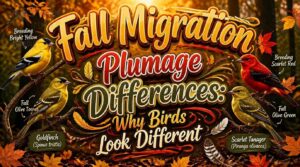
That bird you’re struggling to identify at the feeder—brown‑streaked, plain, almost forgettable—might be the same species that turned heads in your field guide with vivid yellow or scarlet plumage just months ago. Fall migration plumage differences can make experienced birders do a double‑take.
A male American Goldfinch trades his electric summer yellow for something closer to a dried‑grass drab. Scarlet Tanager becomes nearly unrecognizable.
These aren’t different species; they’re the same birds running a completely different biological program. Understanding what’s driving these changes—hormones, daylight, protein metabolism, feather architecture—turns confusion into one of fall birding’s most satisfying puzzles.
Table Of Contents
- Key Takeaways
- What Are Fall Plumage Differences?
- Why Birds Change Plumage in Fall
- Common Fall Molting Patterns
- Species With Noticeable Fall Changes
- Identifying Birds During Fall Migration
- Frequently Asked Questions (FAQs)
- What is fall migration?
- Do migratory birds fall?
- When do birds migrate?
- What is molt migration?
- What are the different types of plumage?
- Are bird migration patterns changing?
- What is the rarest plumage color in birds?
- Do urban birds molt differently than rural birds?
- Can feather damage affect a birds survival odds?
- Which species migrate without changing plumage at all?
- Conclusion
Key Takeaways
- Fall plumage isn’t a different bird — it’s the same species running a completely different biological program, triggered by shorter days, dropping hormones, and reduced carotenoid intake.
- Molting costs small birds up to 30% of their daily energy budget, because feathers hold roughly a quarter of a bird’s total protein — so diet quality in fall directly shapes how well a bird survives migration.
- Juveniles and adults standing side by side tell opposite stories: fresh juveniles carry crisp, softly fringed feathers built for camouflage, while worn adults show faded, matte plumage that’s been ground down by months of flight and UV exposure.
- Learning to read wing bars, feather wear, and molt stage gives you a reliable identification system when color cues disappear — which is exactly what fall migration demands.
What Are Fall Plumage Differences?
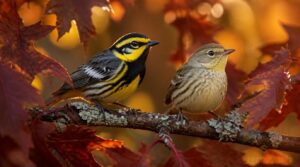
Fall is the season that humbles even experienced birders. The birds you knew all summer suddenly look like strangers — duller, streakier, and harder to name. Here’s what’s actually going on with fall plumage differences, and why they matter.
Understanding the biology behind these shifts — from molts triggered by hormones to the stress patterns that dull a feather’s sheen — makes these fall bird plumage changes suddenly click into place.
Breeding Versus Nonbreeding Plumage
Think of breeding plumage as a bird’s job interview outfit — worn hard, then swapped out. Sexual dichromatism peaks in spring when testosterone spikes, driving carotenoid deposition and iridescent structural colors.
By fall, those hormones drop, the molting cycle kicks in, and what you get is the bird’s understated, everyday look: functional, not flashy.
During fall, the bird adopts non‑breeding plumage characteristics, showing duller brown‑grey upperparts and white undersides.
Duller Autumn Colors
That shift from bold breeding colors to muted, earthy tones isn’t random. When carotenoid availability drops in autumn, birds simply can’t maintain vivid yellows and reds.
Pigment stability declines fast. Seasonal nutrient changes, drought stress, and reduced food quality all suppress carotenoid-dependent coloration, leaving behind the quiet olive-browns and gray-buffs that define fall’s understated palette — functional camouflage, not fashion.
Fresh Juvenile Feathers
While adults fade and molt into muted tones, juveniles bring something different to fall — fresh, newly grown feathers straight from the follicle. These feathers often appear fluffier, lighter in mass, and softer in texture because barbule interlocking density is lower than in adult plumage. That loose structure makes them more vulnerable to wear, but they’re crisp and clean at first.
Look closely at a juvenile’s wing coverts or underparts and you’ll notice cryptic streaking and mottling — patterns built for concealment during that vulnerable post-fledging dispersal window. The flexible rachis of juvenile primaries also bends more easily, which actually helps young birds through those early flight attempts before full keratinization completes.
Faded Adult Feathers
Contrast that with the bird standing next to it — the adult. Where juveniles look crisp, faded adult feathers tell a different story.
Months of flight, UV exposure, and preening gradually strip away gloss. Barbule alignment loosens, the surface turns matte, and edges round off. What you’re left with is softer, quieter plumage — worn, but still functional.
Camouflage During Migration
None of that wear is accidental. Dull tones, soft edges, and muted patterns are exactly what a bird needs when crossing unfamiliar terrain.
Texture matching lets plumage blend into bark, leaf litter, and tangled undergrowth.
In open fields, pale sandy hues dissolve silhouettes against dry grasses.
Behaviorally, birds freeze and orient toward light to eliminate shadows — camouflage adaptation working on two levels at once.
Why Birds Change Plumage in Fall
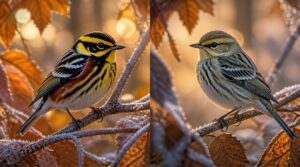
The color change you notice in fall birds isn’t random — there’s a precise biological sequence driving it. Daylight, hormones, and protein all play specific roles in what your field guide calls "basic plumage." Here’s exactly how that cascade works.
Shorter Daylight Triggers Molt
Every fall, your birds don’t just decide to molt — they’re responding to a precise biological clock. Day length reduction is the trigger. As summer fades, shorter days extend your birds’ melatonin increase at night, quietly signaling the body that winter’s coming.
- Shorter light windows reset seasonal timing
- Melatonin guides the photoperiodic shift
- Circadian rhythm links activate molting cycles
- Fall plumage differences begin here
Hormones and Feather Growth
Once melatonin sets the clock, hormones take over. Thyroid hormones convert T4 into active T3, directly stimulating feather follicle activity. Androgens sharpen pigmentation intensity, while estrogen shapes feather shaft length and morphology.
Wnt signaling coordinates follicle cell behavior, and nutrients like zinc and methionine boost every hormonal cue.
Chronic stress spikes corticosterone, disrupting this cascade and degrading feather quality.
Keratin and New Feathers
Keratin is the raw material of every new feather. During prebasic molt, follicle keratinocytes ramp up beta keratin synthesis fast, building a hierarchical lamellar structure of interlocking barbs and barbules. Disulfide bond stability locks the keratin matrix rigid. Fresh feathers are remarkably:
- Crisper and more vibrant
- Structurally tougher than worn ones
- Built to survive a full migration
Stress and Fault Bars
Not every new feather comes out perfect.
When a bird faces acute stress mid‑molt — a predator strike, extreme cold, or food scarcity — elevated corticosterone briefly shuts down keratin deposition in the growing follicle.
The result is a fault bar: a narrow, perpendicular break across the feather vane.
That structural gap weakens flight performance and can compromise camouflage exactly when migration demands both.
Energy Costs of Molting
Molting isn’t free. Feather replacement costs a small bird up to 30% of its daily metabolic budget at peak molt, and resting metabolic rate climbs 15–40% above baseline. On top of that, feathers contain roughly 25% of a bird’s protein, so the turnover demands are steep.
Molting costs small birds up to 30% of their daily energy, because feathers alone hold a quarter of their total protein
Skimp on diet now, and migration fitness suffers later.
Common Fall Molting Patterns
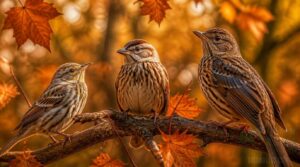
Not every bird experiences fall the same way — molt strategies vary more than most people expect. Some species swap out every single feather before migration, while others replace just a handful and call it done. Here are the main patterns you’ll run into when you’re out watching birds this fall.
Complete Prebasic Molt
The complete prebasic molt is the one annual reset that matters most. After breeding wraps up and daylight shortens, a bird replaces every body, wing, and tail feather in a head-to-tail sequence.
Flight feathers shed in a staged order, keeping the bird airborne throughout.
The result? A fresh, uniform nonbreeding plumage ready for migration.
Partial Feather Replacement
Not every bird goes all-in on a full reset. Some species practice partial feather replacement — swapping only select flight feathers, commonly in wing patches critical for aerodynamics.
Sparrows, finches, and warblers do this during stopovers, targeting worn primaries or secondaries. It’s a smart trade-off: restore what’s failing, preserve what still works, and keep flying.
Gradual Molt Strategies
Partial replacement is just one piece of the puzzle. Some birds spread molt even further, replacing small feather batches — often just one to three at a time — across weeks or months.
This is gradual molt, and it’s built around one priority: keep flying. By sequencing through predictable feather tracts, birds maintain aerodynamic balance throughout migration.
Synchronous Waterfowl Molt
Ducks play by different rules. While other birds molt a few feathers at a time, many waterfowl drop all flight feathers at once — a synchronous molt that leaves them temporarily grounded.
That’s a real risk, so birds gather at safe, food-rich wetlands where cover and calm water reduce predation pressure until fresh feathers grow back in.
Eclipse Plumage Explained
So what exactly is eclipse plumage? After breeding, male ducks shed their bright feathers and replace them with dull, female-like coloring — buying camouflage exactly when they need it most.
Flightless and vulnerable during prebasic molt, blending in isn’t optional.
Once new flight feathers grow, the seasonal plumage changes reverse and vivid breeding colors return.
Species With Noticeable Fall Changes
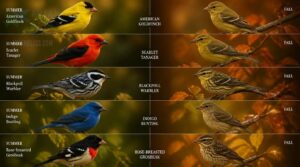
Some birds make the fall transformation so dramatic that even casual observers do a double-take. A few species stand out as the clearest examples of just how much a bird’s appearance can shift between seasons. Here are five worth knowing.
American Goldfinch Plumage
Few birds make fall’s color shift as obvious as the American Goldfinch. That vibrant lemon-yellow breeding male fades to olive-brown by September as dietary carotenoid intake drops. Here’s what to watch for:
- Seasonal color dimorphism shrinks — males and females look nearly identical
- White wing bar identification stays reliable year-round
- Juveniles show subtle plumage differences with softer yellow throats
- Juvenile bill vibrancy dims to pale pink
Mallard Eclipse Plumage
If you’ve ever spotted what looked like a female mallard and done a double-take, you may have been fooled by eclipse plumage. Male mallards shed their iridescent green heads after breeding, replacing them with streaky brown feathers that mimic females closely.
Bill color shifts to duller olive tones, and reduced flight maneuverability makes them temporarily vulnerable to predators.
Scarlet Tanager Colors
Few birds make fall identification as tricky as the Scarlet Tanager. That blazing scarlet-and-black male — unmistakable in May — becomes olive-yellow by September, nearly matching females.
Here’s what drives the shift:
- Carotenoid pigments fuel the red; diet limits replenishment in fall
- Melanin keeps wings and tail dark year-round
- Olive tones aid camouflage during migration
- Redness peaks in late spring, then fades
- Seasonal dimorphism reduces predator attention when courtship ends
Starling Feather Speckling
The European Starling pulls off a slow‑motion disguise every fall.
Fresh feathers grow in cream-tipped and speckled, blanketing dark melanin‑rich bases beneath. Daily wear grinds those pale tips away, and by late winter you’re looking at a glossy, near‑uniform bird.
Juveniles show the crispest speckles early in fall migration — a useful field identification clue worth noting.
Ptarmigan Winter Camouflage
Few birds nail winter camouflage quite like the Ptarmigan. Come late autumn, pigmentless barbs scatter light instead of absorbing it, producing pure white across the entire body. That’s bird coloration genetics doing the heavy lifting.
- Snow concealment from above
- Leg feather insulation against freezing ground
- Foraging stealth in shadowed snowfields
Identifying Birds During Fall Migration
Fall migration turns bird ID into a real puzzle — drab adults, fresh juveniles, and lookalike sexes all showing up at once. Knowing what to look for makes all the difference. Here are the key things to focus on when you’re trying to put a name to a bird this fall.
Adult Versus Juvenile Birds
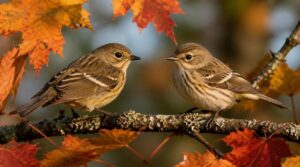
One of the trickiest parts of fall identification is telling adults from juveniles.
| Feature | Adult | Juvenile |
|---|---|---|
| Wing markings | Crisp, bold bars | Faint or absent |
| Underpart color | Uniform, mature tones | Streaked, mottled |
| Feather edges | Smooth, worn | Fresh, neatly fringed |
Adults show faded flight feathers while juveniles carry fresh, dense plumage — a reliable separation clue.
Male and Female Similarities
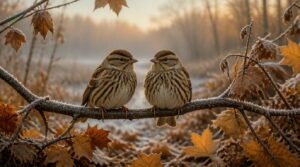
In fall, separating males from females gets harder than you’d expect. Both sexes shift into cryptic nonbreeding plumage — muted earth tones that prioritize survival over showmanship.
Carotenoid levels drop in both, dulling bright colors equally. Molt timing aligns closely too, so you’re often looking at near-identical seasonal coloration, making sex-based ID genuinely unreliable without other cues.
Warbler Identification Challenges
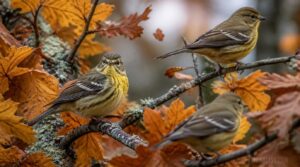
Warblers are the hardest group to nail down in fall. Sex-based cues mostly disappear — and now age, molt stage, and habitat throw extra variables at you.
- Subtle eye rings separate species when body color fails
- Wing bars persist even on heavily worn adults
- Canopy foraging habits limit your viewing window
- Flight calls cut through dense foliage confusion
- Habitat assemblages narrow candidates fast
Raptors and Staggered Molt

Raptors throw you a curveball compared to warblers. Instead of disappearing color cues, you’re reading wing feather symmetry and gaps.
Large raptors like Golden Eagles use Staffelmauser molt — replacing inner primaries first, then pausing. That staggered look, with uneven feather lengths across the wing, is actually your identification clue, not a flaw.
Best Fall Observation Clues
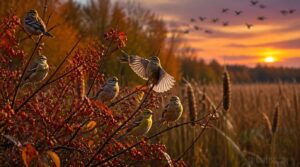
Pull it all together, and fall observation comes down to layers.
Check wing bar brightness first — songbirds often show crisper bars against duller body tones. Watch for frayed feather edges as migration progresses.
Near riparian berry patches, stopover feeders pile up fast. As days shorten, evening roosting flocks grow — that’s your timing signal right there.
Frequently Asked Questions (FAQs)
What is fall migration?
Every autumn, avian migration kicks off as cooling temps and shorter days push birds southward in waves — often at night — stopping along the way to rest and rebuild fat reserves for the journey.
Do migratory birds fall?
Yes, migratory birds do travel south each fall. Driven by shorter days and shifting food supplies, millions of birds move across continents — a seasonal movement shaped by instinct, energy demands, and survival.
When do birds migrate?
Like clockwork, most birds migrate between August and November. Shortening daylight triggers hormonal shifts, while cooling temperatures, fading insects, and shifting winds push species southward in regional waves timed to each bird’s biology.
What is molt migration?
Molt migration is when birds travel to a separate area specifically to replace worn feathers, optimizing flight efficiency before continuing south. It’s a strategic pit stop — feathers first, migration second.
What are the different types of plumage?
Birds wear many "outfits." Breeding plumage is bright and bold. Nonbreeding plumage runs dull and cryptic. Juvenile plumage is streaked. Subadult plumage bridges the gap. Adult plumage is the final, definitive form.
Are bird migration patterns changing?
Yes — migration patterns are shifting. Climate change is pushing many species to arrive earlier, alter routes, and face resource peak mismatches when food disappears before birds even land.
What is the rarest plumage color in birds?
Violet-blue plumage is the rarest color in birds, requiring precise structural nanoarchitecture rather than pigment. True red depends on carotenoid intake, making it surprisingly uncommon too.
Do urban birds molt differently than rural birds?
Yes, urban birds do molt differently. Artificial light at night suppresses melatonin, shifting molt onset earlier and stretching duration longer — while city diets and stress alter feather quality compared to rural birds.
Can feather damage affect a birds survival odds?
Absolutely — feather damage is survival-critical. Worn or broken feathers reduce flight efficiency, spike thermoregulation costs, and slow predator evasion. Even small gaps in wing feathers can compromise foraging enough to tip a bird toward starvation.
Which species migrate without changing plumage at all?
Some species — like American Crows and many sparrows — migrate wearing virtually the same feathers year-round. Their minimal seasonal shifts mean you’d never notice a change without examining individual molt limits up close.
Conclusion
The bird that looks least like itself is the one teaching you the most. Fall migration plumage differences don’t signal confusion—they signal mastery waiting to happen.
That drab streaked bird at your feeder carries the same biology as the showstopper you spotted in May; the colors just aren’t advertising anymore.
Learn to read molt patterns, feather wear, and seasonal cues, and you’ll stop second-guessing every mystery bird—and start recognizing exactly who’s passing through.
- https://pmc.ncbi.nlm.nih.gov/articles/PMC7487240
- https://www.birdboy.ca/bird-behaviour/idea-perplexing-plumage
- https://www.perkypet.com/articles/why-your-backyard-birds-look-different-in-late-summer
- https://swibirds.org/blog/2020/9/6/a-beginners-guide-to-fall-warblers
- https://jimblockphoto.com/2020/09/fall-plumage-birds