This site is supported by our readers. We may earn a commission, at no cost to you, if you purchase through links.
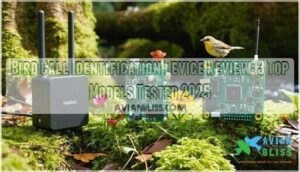 When testing top bird call identification devices, you’ll find the HaikuBox, BirdWeather PUC, and BirdNET-Pi each excel in different areas.
The HaikuBox offers the most user-friendly interface with reliable species detection, while the BirdWeather PUC provides superior community features for citizen science projects.
BirdNET-Pi delivers the best customization options for tech-savvy birders, and accuracy rates vary from 75-85% depending on environmental conditions and species complexity.
Your choice depends on whether you prioritize ease of use, community engagement, or technical control, and each device has quirks that can make or break your birding experience.
Table Of Contents
- Key Takeaways
- Bird Call Devices Compared
- Device Performance Metrics
- User Experience Factors
- Choosing Right Bird Identifier
- Future Device Developments
- Frequently Asked Questions (FAQs)
- What is bird identifier?
- Which bird ID app identifies the correct Birdsong?
- What is a good birding device?
- What are the best bioacoustic bird identification stations?
- What is Bird Sound ID?
- Which Birdnet device is best for bird sound monitoring?
- What is the best bird call identification app?
- What is the best way to identify bird calls?
- What is the best bird call identifier app for Reddit?
- What is the best way to record bird sounds?
- Conclusion
Key Takeaways
- You’ll get different strengths from each device – BirdWeather PUC delivers superior detection rates (80-100% higher than competitors), HaikuBox offers the most user-friendly setup, and BirdNET-Pi provides maximum customization for tech-savvy users.
- Accuracy varies significantly by conditions – Detection rates range from 75-85% depending on environmental noise, species complexity, and your device’s confidence threshold settings, with all devices struggling on similar-sounding calls.
- Your technical comfort level determines the best choice – BirdNET-Pi requires Linux knowledge but offers complete control, HaikuBox works plug-and-play style, while BirdWeather PUC balances ease of use with advanced features.
- Consider your birding goals before buying – Choose stationary monitoring (HaikuBox), portable field use (BirdWeather PUC), or deep customization (BirdNET-Pi) based on whether you want community features, technical control, or simple backyard observation.
Bird Call Devices Compared
You’ll find three standout bird identification devices that use AI to recognize calls: BirdNET-Pi, Haikubox, and BirdWeather PUC, each offering different strengths for various birding needs.
These devices transform your backyard into a smart monitoring station, automatically detecting and logging bird species 24/7 while you’re busy with other things, making them a great tool for birding.
BirdNET-Pi Features
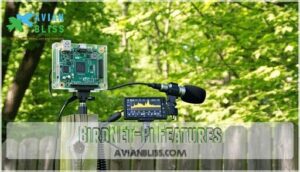
BirdNET-Pi transforms your Raspberry Pi into a powerful bird identification station, requiring some Linux knowledge for setup.
You’ll customize detection thresholds while monitoring real-time spectrograms through a web interface.
This machine learning powerhouse classifies over 3,000 species using BirdNET algorithms, making backyard monitoring incredibly detailed and technical.
The project utilizes AI for audio identification to monitor bird activity 24/7.
Haikubox Specifications
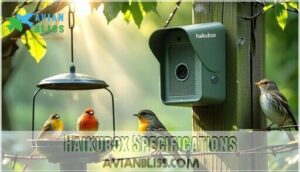
Through its weatherproof design, the HaikuBox delivers reliable bird call identification via high-quality microphone technology and AI-powered acoustic monitoring.
You’ll get continuous data storage for 30 days, though power consumption requires constant electrical connection.
Connectivity options include 2.4GHz WiFi networks exclusively.
The device uses a trained neural network to identify bird species.
This bird monitoring device handles temperatures from -40°F to 175°F, making it ideal for year-round acoustic monitoring devices installations.
BirdWeather PUC Capabilities
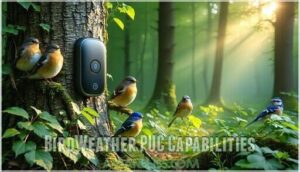
The BirdWeather PUC stands out among acoustic monitoring devices with its portable design and impressive Detection Accuracy rates.
This AI-powered acoustic monitoring system delivers sophisticated bird sound monitoring through advanced Real-time Analysis capabilities.
Key BirdWeather PUC features include:
- Mobile Integration – Seamless app connectivity for field use and data review
- Customization Options – Adjustable detection thresholds and species filtering
- Data Synchronization – Automatic cloud uploads when WiFi reconnects
- Extended recordings – Nine-second clips provide better verification than competitors
The device excels at bird monitoring with its dual microphones and environmental sensors, making it ideal for both casual backyard observation and serious research applications.
You can find the BirdWeather PUC price online.
Device Performance Metrics
When you’re shopping for a bird call identification device, the numbers tell the real story about which models actually work in your backyard.
BirdWeather PUC leads the pack with detection rates 80-100% higher than competitors, while Haikubox captures about 80% of what the top performer identifies, and BirdWeather PUC is the top performer.
BirdWeather PUC dominates detection rates, outperforming competitors by 80-100% in real-world backyard monitoring.
Detection Accuracy Rates
Accurate bird detection technology hinges on confidence thresholds that you’ll need to adjust based on environmental noise levels.
Detection accuracy ranges from 65-98% depending on recording quality and algorithm biases. You’ll find species differentiation challenging with similar calls, while background interference affects recognition rates.
For ideal clarity, consider the objective lens size to maximize light gathering. Bird sound detection accuracy improves when you fine-tune sensitivity settings for your specific monitoring environment to achieve detection accuracy.
Species Identification Capabilities
You’ll find that bird sound identification technology excels differently across devices.
BirdWeather PUC covers over 6,000 global bird species, while Haikubox handles 400+ species with solid regional accuracy.
Both struggle with the geese/finch issue—similar vocalizations confuse their models.
Real-time ID works best when dataset diversity matches your local birds, though model limitations persist with cryptic species.
False Positive Rates
While accurate detection matters, you’ll also need to understand how often these devices cry wolf.
False positives can frustrate your birding experience when environmental noise or algorithm bias triggers incorrect identifications.
- BirdNET-Pi: Higher false positive rates at lower confidence filtering thresholds, especially with rare species
- Haikubox: Fewer false alerts thanks to multiple detection requirements and fixed confidence levels
- BirdWeather PUC: Customizable threshold settings and eBird data validation reduce species confusion substantially
User Experience Factors
When you’re comparing bird call identification devices, the user experience often matters more than raw detection numbers.
You’ll want a system that’s actually enjoyable to use rather than one that turns bird watching into a technical headache.
Interface Design and Usability
You’ll find exploring these bird identification devices surprisingly intuitive.
Merlin Bird ID’s prominent Sound ID button offers instant App Navigation, while BirdNET-Pi’s tabbed web interface streamlines access to real-time Data Visualization.
Haikubox excels in Setup Simplicity with its user-friendly app.
Most platforms feature confidence ratings, audio tags, and spectrogram overlays that enhance the user interface experience, making Mobile Accessibility seamless for field work.
Many apps also offer offline species coverage for use in remote areas.
Customization Options and Limitations
Fine-tuning your bird identifier’s settings can make the difference between missing rare visitors and drowning in false alarms.
Each device offers different customization levels, from BirdNET-Pi’s granular Detection Thresholds to BirdWeather PUC’s probability filtering down to 0.1%. However, technical expertise requirements vary substantially across models.
- BirdNET-Pi: Complete control over confidence thresholds, Recording Length, and Species Filtering – but requires Linux knowledge
- BirdWeather PUC: Customizable probability settings and Data Export options with user-friendly interface experience
- Haikubox: Fixed confidence categories (low/medium/high) limit advanced customization for serious birders
- Gain Control: Only available on select models, affecting microphone sensitivity and notification settings accuracy
Mobile App Optimization
Mobile apps for bird identification devices vary substantially in optimization levels.
BirdWeather PUC delivers seamless bird call app review experiences with fast detection and intuitive data visualization.
Haikubox’s web portal lacks mobile optimization, making handheld reviews cumbersome, and offline functionality proves essential when you’re deep in nature without signal.
Notification settings, species filtering, and community sharing features enhance bird app user experience, though bird app performance depends heavily on responsive design and efficient bird app functionality across different screen sizes.
Choosing Right Bird Identifier
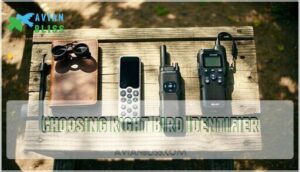
Selecting the right bird identifier depends on balancing your technical comfort level with your birding goals.
You’ll need to take into account sound recording quality, device portability, species database size, power requirements, and how much time you’re willing to invest in setup and maintenance, considering your overall technical comfort level.
Sound Quality and Clarity
High-quality microphones capture bird calls with excellent recording fidelity and frequency range coverage from 20 Hz to 20 kHz.
The sound quality directly affects your device’s bird sound analysis accuracy—clearer recordings mean better species identification and fewer false positives during bird audio recording sessions.
Noise reduction algorithms filter environmental interference like wind and traffic, while minimal audio compression preserves subtle vocal nuances.
Device Size and Portability
Size matters when you’re lugging birdwatching equipment through dense forests or scaling mountain trails.
Today’s handheld bird identifier options range from truly pocket-sized devices to backpack-friendly units that balance portability with performance.
Consider these key portability factors:
- Pocket-sized Devices – Ultra-compact models like the Audubon Bird Call fit in your palm
- Mounting Options – Lightweight units with clips or straps for hands-free operation
- Battery Life – Extended power for all-day birding adventures without frequent charging
- Ruggedness – Weather-resistant construction that survives drops and outdoor conditions
- Weight Distribution – Ergonomic designs that won’t strain your neck during long birding sessions
The BirdWeather PUC leads in true portability as a handheld unit, while Haikubox excels as stationary birdwatching equipment.
Many birders find a pocket bird identifier to be an essential tool.
Your choice depends on whether you need portable bird song ID for active birding or reliable birding gear for backyard monitoring.
Bird Species Coverage Range
BirdNET-Pi’s extensive global species coverage spans 6,000 species worldwide, while Haikubox targets North American markets with 400+ automatic bird identification capabilities.
BirdWeather PUC strikes a middle ground, supporting 1,000+ species through regional bird identification filters.
Your location dramatically affects rare bird detection success—devices excel with common backyard species but struggle with migratory species recognition and subtle calls.
Spotting a Red-tailed Hawk features can be easier in open country and woodlands, showcasing how habitat influences identification.
Power Source Options
Power options make or break your birdwatching experience.
External power sources offer unlimited operation, while rechargeable batteries provide flexibility for remote locations.
Solar options extend battery life substantially, though they’re weather-dependent.
Consider power consumption rates—some devices drain batteries within days, others last months.
Choose power sources matching your monitoring duration and location accessibility to ensure a successful birdwatching experience.
Learning Curve Considerations
Consider your technical comfort level before choosing any bird call identifier.
BirdNET-Pi demands setup difficulty with Raspberry Pi knowledge, while Haikubox offers superior user friendliness through simple app tutorials.
BirdWeather PUC strikes the middle ground, requiring minimal technical expertise.
Most birdwatching tips suggest starting with user-friendly bird identification tools to minimize your learning curve with these sophisticated bird call learning tools, using tools like BirdNET-Pi and Haikubox.
Future Device Developments

The bird call identification market continues evolving rapidly, with AI models becoming more accurate and thorough each year.
You’ll see expanding species libraries, enhanced hardware capabilities, and innovative monitoring features that’ll transform how you experience and document avian activity in your backyard, leveraging backyard observations.
Improving AI Models and Accuracy
Machine learning algorithms powering your bird call identifier are constantly evolving through advanced data augmentation techniques and sophisticated noise reduction methods.
Enhanced model training processes now incorporate regional variations, improving bird species detection across diverse habitats.
Algorithm refinement focuses on reducing false positives while boosting bird song recognition accuracy.
These improvements in AI-powered acoustic monitoring mean your device’s bird detection accuracy will continue improving automatically through software updates, utilizing advanced techniques for refinement.
Expanding Birdsongs Libraries and Datasets
Your recordings become building blocks for tomorrow’s smarter devices. Each citizen science contribution strengthens bird sound databases, while data collection methods capture regional song variations that improve recognition accuracy.
Your backyard becomes part of a living, growing intelligence that learns from every chirp and call.
- Your backyard recordings help scientists understand local dialects
- Every missed identification teaches algorithms to recognize tricky calls
- Seasonal migration data reveals changing patterns across continents
- Rare species audio fills critical gaps in bird call libraries
Dataset bias mitigation guarantees devices work everywhere, not just where researchers live. Bird audio analysis tools now incorporate accessibility improvements, making bird sound analysis tools more inclusive for diverse communities and environments.
Emerging Trends in Bird Monitoring Technology
Miniaturization efforts are reshaping bird identification technology as manufacturers pack AI advancements into increasingly compact devices.
You’ll see acoustic sensors becoming more sensitive while consuming less power, enabling months-long remote monitoring sessions.
Real-time analysis capabilities now rival laboratory equipment, with AI-powered acoustic monitoring delivering instant species detection.
These bird monitoring devices increasingly integrate cloud connectivity, allowing researchers to track migration patterns across continents through coordinated sensor networks.
Frequently Asked Questions (FAQs)
What is bird identifier?
Like a digital detective for nature’s orchestra, bird identifier devices use AI-powered microphones to recognize and classify bird species from their vocalizations.
They help you discover which feathered friends are singing nearby.
Which bird ID app identifies the correct Birdsong?
BirdWeather PUC and Merlin app achieve detection rates above 80% accuracy. You’ll find BirdWeather PUC outperforms competitors with customizable confidence thresholds, while Merlin leverages Cornell’s extensive bioacoustic database for reliable identification.
What is a good birding device?
The BirdWeather PUC excels with superior detection accuracy and nine-second recordings for verification. You’ll appreciate its customizable settings and intuitive app interface for serious birding adventures.
What are the best bioacoustic bird identification stations?
Transform your backyard into a symphony of discovery!
BirdWeather PUC leads with 80-100% higher detection rates than competitors, while Haikubox offers reliable set-and-forget monitoring.
Both use BirdNET’s advanced AI for accurate species identification.
What is Bird Sound ID?
Bird Sound ID technology uses AI-powered devices and apps to automatically identify bird species through acoustic analysis, helping you recognize birds by their calls and songs in real-time.
Which Birdnet device is best for bird sound monitoring?
Need the sharpest detection? BirdWeather PUC’s your ace in the hole, outperforming competitors with 80-100% higher detection rates, nine-second recordings, and customizable settings for serious monitoring.
What is the best bird call identification app?
Merlin app stands out as the top choice, delivering over 80% accuracy through Cornell Lab’s extensive database. You’ll find it reliable, free, and constantly improving with user contributions.
What is the best way to identify bird calls?
For accurate identification, you’ll want dedicated acoustic monitoring devices like BirdWeather PUC or Haikubox, which use BirdNET algorithms achieving 80%+ accuracy rates, outperforming basic smartphone apps.
What is the best bird call identifier app for Reddit?
Cornell’s Sound ID correctly identifies 80% of bird calls across 1,382 species. You’ll want either Merlin Bird ID or BirdNET Sound ID—both use Cornell’s powerful database.
What is the best way to record bird sounds?
Use a dedicated acoustic monitoring device like BirdWeather PUC or Haikubox for continuous recording.
These AI-powered units capture high-quality audio automatically, identify species in real-time, and sync data to apps for easy verification and sharing.
Conclusion
Your birding adventure deserves the right technological companion, and selecting the perfect bird call identification device review reveals three distinct paths forward.
BirdNET-Pi suits tech enthusiasts who crave customization, HaikuBox appeals to beginners seeking simplicity, and BirdWeather PUC connects community-minded birders.
Consider your experience level, budget constraints, and desired features carefully, as each device transforms outdoor experiences differently, so match your expectations with their strengths.
Remember, even the most sophisticated technology can’t replace your developing ear and field experience.
- https://indianaaudubon.org/2025/03/17/can-these-devices-help-you-identify-more-birds-a-real-world-test/
- https://pmc.ncbi.nlm.nih.gov/articles/PMC10575132/
- https://flyinglessons.us/2020/12/22/which-is-the-best-birdsong-id-app-we-tested-them-and-have-a-winner/
- https://www.sciencedirect.com/science/article/pii/S2053716625000088
- https://www.chuq.me/blog/review-haikubox-bird-identification-system