This site is supported by our readers. We may earn a commission, at no cost to you, if you purchase through links.
 You’ll find stunning rooster with long tail breeds like the legendary Onagadori, whose tail feathers can reach 20 feet, and the elegant Phoenix with its graceful cascade of plumage.
These magnificent birds aren’t just pretty faces – they’re genetic treasures that need special care.
Your rooster’s impressive tail requires spacious coops, high perches, and protein-rich diets to maintain those show-stopping feathers.
Popular long-tailed breeds include the Cubalaya, Sumatra, and Yokohama, each bringing unique beauty to your flock.
While they look delicate, these birds are surprisingly hardy when given proper housing and nutrition that prevents stress-induced molting.
Table Of Contents
- Key Takeaways
- Long-Tailed Chicken Breeds
- Tips for Raising Long-Tailed Chickens
- Roosters Vs. Hens: Behavior & Physical Differences
- Sexing Confusion Among Some Chicken Breeds
- How to Determine if Chicks Are Male or Female
- How to Tell Hens From Rooster in 8 Popular Chicken Breeds
- Raising Long Tail Chickens
- Frequently Asked Questions (FAQs)
- Conclusion
Key Takeaways
- You’ll need specialized housing – Provide a minimum of 6x6x8 feet coops with high perches and spacious runs (10+ square feet per bird) to prevent damage to those magnificent flowing tail feathers.
- Feed them a high-protein diet – Maintain 18-20% protein content with fish meal, meat meal, and biotin supplements to support healthy feather growth and prevent stress-induced molting.
- Choose your breed carefully – Consider Onagadori (30+ foot tails), Phoenix (elegant 18-inch saddles), or Cubalaya (4-foot tails) based on your space and commitment level to their special care requirements.
- Expect a longer identification process – You won’t be able to sex these birds until they are 12-16 weeks old, since their distinctive long tail feathers and other gender markers develop gradually compared to standard chicken breeds.
Long-Tailed Chicken Breeds
You’ll find several chicken breeds that develop exceptionally long tail feathers, with some reaching lengths of 10 feet or more.
These breeds include the rare Onagadori from Japan, the elegant Phoenix, and the Cuban Cubalaya, each requiring special care to maintain their stunning plumage.
Cubalaya

While the Cubalaya rooster breed steals hearts with its magnificent tail feathers flowing like liquid silk, this dual purpose Cuban beauty brings both elegance and practicality to your flock.
Their confinement adaptability makes them perfect for smaller spaces, though rooster aggression can surface during breeding season.
With proper care, these longtailed roosters reward you with stunning plumage and reliable egg laying from their hens.
- Watch those majestic tail length measurements grow season after season
- Feel pride knowing you’re preserving a rare Cuban heritage breed
- Experience the joy of their surprisingly gentle Cubalaya temperament with proper handling
- Celebrate their dual-purpose nature providing both beauty and productivity
Onagadori

The Onagadori rooster from Japan’s Tosa Province stands as the ultimate long-tailed champion.
The king of all roosters, flaunting tail feathers that make peacocks jealous and reach beyond 30 magnificent feet.
This Japanese National Treasure boasts tail feathers exceeding 10 meters thanks to rare Non-Molting Genes developed during the Tokugawa Shogunate era.
With only 250 birds remaining worldwide, Export Restrictions protect this endangered Japanese chicken breed.
Their Tail Length Standard requires minimum 1.5-meter tails for pure classification.
You’ll find their annual tail growth reaches an impressive 90 centimeters.
As a breed, they’re considered critically endangered, with few breeders found outside of Japan, making them a critically endangered species with a notable Tail Length Standard.
Phoenix

With German origins and Japanese ancestry, the Phoenix rooster captivates show chicken enthusiasts with its impressive long tail feathers and distinctive saddle plumage.
This ornamental chicken breed displays remarkable feather variations and meets strict show standards when properly maintained.
Phoenix temperament runs active and alert, requiring substantial space requirements to accommodate their energetic nature.
You’ll find these Japanese chicken breed descendants make stunning additions to spacious properties.
Sumatra

Those jet-black Sumatra roosters sport stunning feather iridescence that catches light like polished obsidian.
Their Sumatra temperament runs timid and standoffish, making them jump at sudden movements.
Originally bred for cockfighting history in Indonesia, these exotic plumage beauties need spacious coop needs with high perches to protect their flowing long tail feathers.
Broody hens make excellent mothers, while the Sumatra rooster displays graceful carriage rivaling any AsilAseel rooster.
Keep drafts away and provide plenty of room – these ornamental birds deserve royal treatment for their spectacular appearance.
Ohiki

Moving from Indonesia’s sleek Sumatra, Japan’s Ohiki Bantam brings friendly charm to your flock. This rare breed sports exotic plumage with stunning long tail feathers that make these ornamental chickens truly special.
Ohiki roosters display remarkable temperament despite their small stature. Their egg laying averages 60 lightly tinted eggs yearly.
These Japanese breeds need special care: Their distinct tail feathers can take up to two years to fully develop.
- Install extra roosting bars preventing feather damage
- Provide high-protein feed for lustrous plumage
- Monitor parasites frequently in small birds
- Offer sand baths keeping feathers pristine
- Separate youngsters preventing bullying from larger chickens
Yokohama
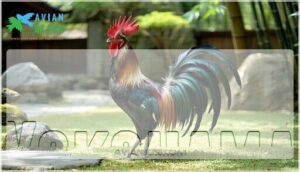
Picture yourself admiring a living work of art in your backyard – the magnificent Yokohama rooster commands attention with its flowing black body and dramatic dark red crest.
These feathered masterpieces transform ordinary backyards into galleries of living elegance and natural artistry.
This Japanese breed’s origins trace back centuries, producing show quality birds with ten to sixteen stunning long tail feathers.
Unlike the legendary Onagadori rooster or Phoenix rooster varieties, Yokohamas offer excellent temperament and rare colors.
Their breed standard demands spacious housing, but you’ll find these gentle giants worth every square foot of premium real estate.
Tips for Raising Long-Tailed Chickens
You’ll need to adjust your standard chicken care routine when raising these magnificent long-tailed breeds.
These birds require specific housing, diet, and management practices to keep their spectacular tail feathers healthy and intact.
Provide Perches

High perches keep your Onagadori rooster’s long tail feathers off the ground, preventing damage and dirt buildup.
Install perches at least 12 inches high using smooth, rounded materials like hardwood for comfortable perching.
Your Phoenix rooster and Yokohama rooster need adequate spacing between perches for tail protection.
Consider chicken perch options to find the best fit for your coop.
Proper perch design with coop integration supports natural roosting behaviors while maintaining those stunning flowing feathers that make these breeds so spectacular.
Make The Coop Spacious

Beyond proper perch placement, your rooster needs serious square footage to strut his stuff. Those magnificent long tail feathers demand spacious living that won’t cramp his style.
A cramped Phoenix rooster becomes a stressed bird with damaged plumage.
Essential coop dimensions for long-tailed breeds:
- Minimum 6x6x8 feet for single Yokohama rooster
- High ceilings preventing tail feather contact with roof
- Wide doorways allowing graceful entry without tail damage
- Multiple roosting levels providing roaming access within coop
Space requirements directly impact your bird’s health and that spectacular tail display you’re after. Consider also that proper coop sizes are essential for the bird’s well-being.
Let Them Roam

Your long tail feathers need room to shine, so give each rooster at least 10 square feet of roaming space.
Free-range benefits include natural foraging and reduced aggression, but watch for roaming dangers like tangled plumage.
Yokohama roosters, Phoenix roosters, and Sumatra roosters especially benefit from supervised foraging sessions.
To further enhance their environment, consider gardening with native plants to attract wild birds and insects.
Space requirements vary between breeds, so monitor their unique needs daily, ensuring supervised care and reduced aggression.
High Protein Diet

Your rooster’s magnificent tail feathers demand serious nutritional fuel. A high-protein diet with 18-20% protein content transforms ordinary birds into feathered royalty.
Essential protein sources include:
- Fish meal – packed with amino acids for keratin production
- Meat meal – supports robust feather development
- Legumes – natural protein powerhouses
- Supplemental biotin – enhances feather strength and shine
This nutritional foundation prevents molting while maximizing growth potential. Some farmers prefer to use specific fish meal products for superior results.
Keep Them From Molting
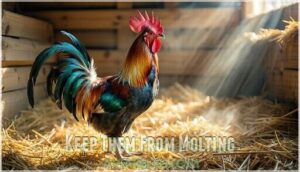
Molting disrupts your rooster’s magnificent tail feathers, but you can prevent this natural process.
Create stable conditions that keep your poultry comfortable and stress-free.
- Consistent Warmth: Maintain temperatures above 65°F to prevent premature feather loss
- Adequate Lighting: Provide steady illumination without sudden daylight changes
- Clean Environment: Keep coops sanitized for superior feather maintenance and health
Roosters Vs. Hens: Behavior & Physical Differences
You’ll notice clear differences between roosters and hens in both their looks and actions.
Roosters typically show larger combs, longer tail feathers, and more aggressive behavior, while hens have smaller features and calmer temperaments, which are key to understanding their differences.
Physical Characteristics of a Rooster
How can you spot a rooster from across the yard? Those magnificent tail feathers cascade like a waterfall, especially in long-tailed breeds where they sweep the ground majestically.
Roosters display vibrant feather colors ranging from deep reds to glossy blacks, while their physical characteristics include prominent combs and enlarged wattles that signal peak health and dominance.
| Feature | Rooster Characteristics |
|---|---|
| Comb Size | Large, upright, bright red |
| Wattle Size | Pronounced, fleshy, colorful |
| Spur Length | Sharp, curved, 1-2 inches |
| Body Weight | 6-15 pounds (varies by breed) |
Behavioral Characteristics of a Rooster
Understanding physical traits helps you recognize behavioral patterns that make roosters fascinating flock leaders.
Male chickens exhibit distinct behaviors rooted in their natural instincts.
Roosters command respect through complex dominance displays and territorial behavior.
Their aggressive nature protects the flock while establishing clear social hierarchy.
You’ll notice intense territoriality as they patrol their domain, ready to challenge intruders.
| Behavior Type | Description |
|---|---|
| Dominance displays | Wing flapping, chest puffing, aggressive posturing |
| Mating rituals | Elaborate dances, wing dragging, food offerings |
| Vocalizations | Dawn crowing, alarm calls, territorial warnings |
| Aggression levels | High during breeding season, protective instincts |
| Social hierarchy | Alpha positioning, subordinate management |
Their mating behavior involves sophisticated courtship rituals and protective instincts toward hens.
This behavior is a crucial part of their role as flock leaders, showcasing their ability to protect and lead the group with aggressive nature and intense territoriality.
Physical Characteristics of a Hen
Distinguishing female chickens from their male counterparts becomes straightforward once you know what to look for.
Hens typically display more subdued characteristics compared to roosters, making identification easier for backyard chicken keepers.
| Physical Characteristics | Hens | Roosters |
|---|---|---|
| Size and weight | Smaller, 4-6 lbs | Larger, 6-10 lbs |
| Comb variation | Smaller, less pronounced | Large, prominent |
| Hen plumage | Duller, earth-toned colors | Bright, iridescent feathers |
| Body shape | Rounded for egg laying | Angular, upright stance |
Their compact build supports broodiness and consistent egg production throughout the season, which is essential for backyard chicken keepers to understand, as it directly relates to the identification of hens and their ability to lay eggs.
Hen Feathers
Hen feathering differs dramatically from rooster tail feathers in both form and function.
While roosters sport elaborate plumage, hens develop practical, shorter feathers that won’t interfere with egg laying or chick care.
Their streamlined design helps with nesting and foraging.
| Feature | Hens | Roosters |
|---|---|---|
| Tail Length | Short, practical | Long tail feathers |
| Molting Patterns | Regular seasonal | Varies by breed |
| Feather Quality | Dense, protective | Ornamental, flowing |
| Broodiness Impact | Affects feather growth | Minimal effect |
Proper feather care requires quality nutrition and stress-free environments to maintain ideal feather growth.
Behavioral Characteristics of a Hen
Female chickens display distinct behavioral patterns that set them apart from roosters.
Their laying habits follow predictable cycles, while broodiness kicks in during nesting season.
Watch how social hierarchy shapes their daily interactions.
| Behavior | Description |
|---|---|
| Nesting Behavior | Seeks quiet, dark spaces for eggs |
| Maternal Instincts | Fiercely protects chicks from threats |
| Flock Mentality | Follows group decisions and movements |
| Aggression Levels | Shows minimal aggression except when brooding |
| Dominance Display | Establishes pecking order through subtle cues |
Unlike rooster behavior, hens prioritize group harmony over individual dominance.
Sexing Confusion Among Some Chicken Breeds

Long-tailed breeds throw a curveball in the context of chick identification. You’ll find yourself scratching your head trying to tell males from females in these stunning varieties.
Sexual dimorphism develops slowly, making early identification tricky even for experienced chicken keepers.
Here’s what makes breed variations so challenging:
- Cubalaya rooster chicks look nearly identical to females until 12-16 weeks old
- Ohiki rooster youngsters develop their signature long tail gradually over months
- Comb differences remain subtle in long-tailed breeds during early weeks
- Feather development patterns vary dramatically between individual birds
- Spur growth appears inconsistent across different long-tailed varieties
Traditional sexing methods fall short with these breeds. The rooster’s long tail doesn’t emerge immediately, and standard visual cues like comb size stay minimal for weeks.
You’re better off waiting until maturity or consulting experienced breeders who understand these breeds’ unique development patterns.
How to Determine if Chicks Are Male or Female

You can identify male and female chicks through several reliable methods, including checking feather patterns, examining coloration differences, and observing physical traits.
These techniques work best when you combine multiple approaches, since some long-tailed breeds don’t show clear sex differences until they’re older.
Auto-Sexing Through Coloration
Nature’s built-in gender reveal system makes identifying your chicks surprisingly straightforward through autosexing.
Color-Sexing Breeds rely on genetic basis differences that create distinct visual identification patterns right from hatching day.
- Barred Rock females display narrow, crisp black and white stripes
- Rhode Island Red roosters show lighter, more golden-red coloring
- Australorp hens present solid black plumage with subtle green sheen
- White Leghorn males feature pure white feathers with darker tail tips
- Cuckoo Marans females exhibit creamy base colors with defined barring
Hatchery practices achieve 95% accuracy rates using these reliable visual markers.
These patterns are examples of how bold markings vary across species.
Sex-Linked Coloration & Feather Growth
Sex-linked traits make identifying roosters easier through color-sexing genes and feather pigmentation patterns.
Male chicks often show darker wing feathers while females display lighter coloration.
Growth hormones affect feather development speed, with roosters developing tail feathers faster, which is influenced by genetic mutations.
Selective breeding enhances these genetic mutations, making gender identification more reliable before molting impact changes their appearance completely.
Vent Sexing
Vent sexing involves examining chick anatomy within hours of hatching. You’ll gently squeeze the chick’s vent to reveal internal structures.
Male chicks show a small rounded bump, while females display a flatter, more indented appearance. This breeder technique requires practice but offers impressive sexing accuracy when done correctly.
The genetic influence on vent shape makes gender differences visible even in day-old chicks, helping you identify your rooster prospects early.
Sexual Dimorphism
When examining sexual dimorphism in chickens, you’ll spot clear plumage differences between males and females.
Roosters develop larger comb size and pronounced wattle variation, while hens remain modest.
Spur development occurs exclusively in males, creating sharp leg weapons.
Behavioral display patterns differ too – roosters strut and crow, showing off their long tail feathers, while hens focus on nesting behaviors across all breeds.
How to Tell Hens From Rooster in 8 Popular Chicken Breeds

You can identify roosters from hens by looking at specific traits like comb size, tail feathers, and body structure across different breeds.
Each breed shows unique patterns in how males and females differ, making it easier to tell them apart once you know what to look for, based on these complete concepts.
Silkie Hen Vs Rooster
Distinguishing Silkie roosters from hens requires observing key physical traits and behaviors.
Silkie sexual dimorphism shows roosters have larger, more pointed combs compared to hens’ smaller, rounded versions.
Watch for Silkie crowing differences – roosters vocalize loudly while hens remain quieter.
Roosters display more aggressive, territorial temperament compared to docile hens.
Check feather shapes too: roosters sport pointed hackle feathers versus hens’ rounded plumage.
These poultry breeds weigh differently, with roosters about 30% heavier.
Silkie comb variations and temperament comparison make gender identification straightforward once you know what signals to watch.
The identification process relies on observing key physical traits and behaviors, making it easier to distinguish between Silkie roosters and hens with sexual dimorphism.
Barred Rock Rooster Vs Hen
You’ll spot the difference between Barred Rock roosters and hens pretty easily once you know what to look for.
Barred Rock sexing becomes straightforward around 10-12 weeks when plumage differences really show up. Roosters develop longer, pointed hackle and saddle feathers that curve dramatically, while hens keep their rounded, shorter feathers.
The rooster’s tail feathers arch upward with sharp points, contrasting the hen’s more modest tail. Temperament comparison reveals roosters as the bold protectors—crowing at dawn and strutting around like they own the place.
Hens focus on egg laying and quieter foraging. Roosters also sport larger, redder combs and wattles, making identification foolproof for poultry enthusiasts practicing proper Barred Rock care, which involves understanding the key differences and taking a strategic approach to their upkeep.
Rhode Island Red Rooster Vs Hen
Rhode Island Red roosters strut around with confidence you can’t miss. Their bright red plumage differences shine compared to hens’ duller brownish-red feathers.
Comb size tells the whole story – roosters sport larger, more prominent combs and wattles. Temperament variation becomes obvious when roosters act aggressive while hens stay calm.
You’ll notice pointed hackle feathers on males versus rounded ones on females. These chicken breeds make identifying roosters from hens straightforward once you know what to look for.
Notably, dominance struggles can occur if turkeys are present, leading to aggressive behavior and dominance issues, which require careful management to maintain harmony.
Ameraucana Rooster Vs Hen
After about four months, you’ll easily spot the differences in your Ameraucana flock.
Roosters develop larger pea combs and prominent hackle feathers around their necks, while hens maintain smaller combs with rounded body feathers.
The males strut with longer, curved tail feathers and show more vibrant plumage.
This Ameraucana sexual dimorphism becomes crystal clear as these chicken breeds mature, making identification straightforward for any poultry enthusiast.
Easter Egger Rooster Vs Hen
Easter Eggers throw experienced poultry keepers for a loop in regards to sexing. These mixed-breed chickens don’t follow typical rules, making Easter Egger Sexing more challenging than purebreds.
You’ll spot key differences by watching their development. Roosters develop larger, redder combs by 8-12 weeks, while hens keep smaller, paler versions. Rooster Aggression becomes obvious around 4-6 months – they’ll challenge other birds and crow loudly. Hens focus on Hen Egg Laying behaviors, scratching quietly for food.
Feather Differences emerge clearly during the Maturity Timeline. Roosters grow pointed hackle feathers around their necks and develop those signature long tail feathers that arch dramatically. Hens maintain rounded feathers throughout.
Watch for these telltale signs in your Easter Egger flock:
- Roosters strut with chest puffed out like tiny bodybuilders
- Hens squat down when you approach from above
- Male tail feathers curve like question marks
- Roosters crow at ungodly hours (your neighbors will remind you)
- Hens make soft, contented clucking sounds while foraging
Raising Long Tail Chickens

Long tail chickens need special attention to thrive. Your coop design ideas should include high perches and spacious quarters—at least 10 square feet per bird prevents those magnificent tail feathers from dragging.
Diet and molting go hand-in-hand; feed 20% protein to support healthy regrowth. For breed-specific needs, Onagadori roosters require extra care since their feathers don’t molt naturally.
Preventing feather damage means tying up extra-long tails with silk ribbons when necessary. Keep their environment warm and well-lit to avoid premature molting.
Tail feather care involves daily checks for tangles or breaks. An Ohiki rooster’s flowing plumage makes stunning yard art worth the effort, and with proper care, their magnificent tail feathers will remain healthy, and their overall well-being will be supported by a warm and well-lit environment.
Frequently Asked Questions (FAQs)
What roosters have long tails?
You’ll find several breeds sporting impressive tail feathers: Onagadori from Japan with 10+ meter tails, Phoenix roosters with 18-inch saddle feathers, Cubalaya with 4-foot tails.
Sumatra, and Ohiki bantams all showcase spectacular plumage.
What are Onagadori chickens used for?
These spectacular birds aren’t your typical backyard chickens.
You’ll find Onagadori chickens serve as living art pieces, prized for ornamental displays, cultural ceremonies, and preserving Japan’s ancient breeding traditions rather than practical purposes.
Long tails in birds can signal good breeding fitness to potential mates, which is a key aspect of their breeding traditions.
Are Phoenix roosters aggressive?
Phoenix roosters typically aren’t aggressive compared to other breeds.
You’ll find them more active and alert than hostile.
They’re generally calm, friendly birds that prefer free-ranging over fighting, making them suitable for most backyard flocks with a friendly nature.
What are Phoenix chickens used for?
Majestic as living art pieces, you’ll use Phoenix chickens primarily for ornamental purposes and exhibition shows.
They’re stunning display birds that’ll captivate audiences with their flowing eighteen-inch saddle feathers, making perfect conversation starters.
What is the average lifespan of long-tailed roosters?
You can expect your long-tailed roosters to live 6-7 years with proper care.
Some breeds like Onagadori may reach over 10 years.
Their lifespan depends on diet, housing, and regular veterinary check-ups.
Conclusion
Owning a rooster with long tail feathers is like having a living work of art in your backyard.
These magnificent breeds require dedicated care, but they’ll reward you with breathtaking beauty.
Remember to provide spacious coops, high perches, and protein-rich diets to keep those stunning plumes healthy.
Whether you choose an Onagadori or Phoenix, you’re preserving genetic treasures that showcase nature’s incredible artistry.
Your patience and proper care will guarantee these spectacular birds thrive for years.
- https://www.researchgate.net/publication/368609536_The_idiosyncratic_genome_of_Korean_long_tailed_Chicken_as_a_valuable_genetic_resource
- https://www.cell.com/iscience/fulltext/S2589-0042(23)00313-9
- https://www.sciencedirect.com/science/article/pii/S2589004223003139
- https://pmc.ncbi.nlm.nih.gov/articles/PMC10006692/
- https://onlinelibrary.wiley.com/doi/10.1155/2024/9985076