This site is supported by our readers. We may earn a commission, at no cost to you, if you purchase through links.

You’ve just spotted a hawk circling overhead, but by the time you wrestle a two-pound tome from your backpack, it’s vanished over the ridgeline. That moment—when speed trumps encyclopedic detail—explains why over 75% of birders keep compact field guides within arm’s reach.
These concise references sacrifice some obscure subspecies and range minutiae, but they deliver the diagnostic field marks you actually need when a mystery warbler won’t sit still. The trick lies in choosing one that balances portability with enough species coverage and visual clarity to handle your local birds and the occasional vagrant, whether you’re trekking through mountain passes or scanning a city park at dawn.
Table Of Contents
- Key Takeaways
- Key Features of Compact Birding Field Guides
- How to Choose The Right Field Guide
- Top 10 Compact Birding Field Guides
- 1. Sibley Guide to Birds Second Edition
- 2. Stokes Field Guide To North American Birds
- 3. Kaufman Field Guide Birds North America
- 4. Crossley ID Guide Eastern Birds Book
- 5. National Geographic Birds of North America
- 6. Peterson Field Guide Birds North America
- 7. The Warbler Guide Bird Identification Book
- 8. Sparrows of US and Canada Guide
- 9. Hawks In Flight Identification Guide
- 10. Hawks From Every Angle Guide
- Benefits of Using Compact Field Guides
- Tips for Maximizing Your Field Guide
- Frequently Asked Questions (FAQs)
- Conclusion
Key Takeaways
- Compact field guides sacrifice some detail for portability, but they deliver the diagnostic field marks you actually need when speed matters more than encyclopedic coverage, which is why over 75% of birders keep them within arm’s reach.
- The best compact guides balance species coverage (ranging from 392 to 1,023 species) with practical features like color-coded tabs, annotated illustrations, and weatherproof covers, while weighing under a pound and fitting easily into pockets or backpacks.
- Choosing the right guide depends on matching your experience level, regional needs, and learning style—beginners thrive with simplified layouts covering 50-100 common species, while experienced birders need guides with 500+ entries and subtle field marks for tricky identifications.
- Cross-referencing multiple guides (pairing photos with illustrations) increases identification accuracy by 12-23%, and consistent field guide use sharpens your pattern recognition skills to achieve up to 97% correct identification across hundreds of species.
Key Features of Compact Birding Field Guides
Not all field guides are created equal, especially when you’re trying to slip one into your backpack without adding extra weight. The best compact guides balance portability with enough detail to actually identify what you’re seeing in the field.
Let’s look at the key features that separate a truly useful pocket guide from one that just takes up space.
Size and Portability

Size and portability define what makes compact field guides work in the field. Most measure between 4.8 x 7.9 and 5 x 8 inches—pocket convenience you’ll appreciate when you’re tracking warblers through dense brush. These portable bird guides weigh less than a pound, and that weight matters during long hikes.
A necessary feature is to have clear bird descriptions for proper identification. With over 75% of birders keeping pocket-sized guides readily accessible, market trends clearly favor easy transport and outdoor durability.
Content Depth and Coverage

Compact guides balance species breadth with practical field use. You’ll find coverage ranging from 392 species in Kaufman’s efficient approach to 1,023 in National Geographic’s extensive edition.
Content depth varies—most offer brief account details with single measurements and essential field marks rather than thorough information on behavior or ecology. Information prioritization favors quick visual matching over exhaustive descriptions.
Guide limitations include selective coverage of rare species and condensed taxonomic updates, trading comprehensive bird information for portability. The National Geographic guide features a visual index for bird families.
Illustration and Photo Quality

Visual quality matters when you’re matching a bird in your binoculars to the page. High-quality illustrations emphasize diagnostic field marks—beginners report 23% better identification success with detailed artwork versus photos alone.
Photographic sharpness and color fidelity vary across guides, with roughly 8–12% of images showing inconsistencies.
Hybrid guides combining stunning illustrations with representative photos boost user satisfaction by 27%, offering both pattern clarity and real-world likeness.
User-Friendliness and Layout

Even stunning artwork won’t help if you can’t find the bird quickly. Easy-to-use field guides feature taxonomic organization, visual indexes, and color-coded layouts that get you to the right page fast—92% of compact guides use this evolutionary grouping.
Look for annotated illustrations with arrows pointing to key marks, quick-reference tables, and species layouts that fit on one page. Thumb tabs and quick-find indexes shave seconds off every search.
Age Appropriateness

Children aged 9 to 12 thrive with simplified youth guide features—bright photos, 50–300 common species, and basic taxonomy. Most outgrow these by age 13, moving to guides like Sibley or Kaufman.
Adult guide suitability includes thorough coverage and nuanced plumage details.
Intergenerational use works best when you match learning preferences to developmental stages, ensuring age-appropriate field guides support everyone from beginners to experienced watchers.
How to Choose The Right Field Guide

Picking the right field guide isn’t about finding the “best” one—it’s about finding the one that fits how you bird. Your experience level, where you live, and whether you prefer flipping pages or tapping a screen all play a role in that decision.
Here’s how to narrow down your options and match a guide to your needs.
Matching Guide to Experience Level
Your birdwatching experience dictates which guide works best. Beginner guides focus on 50–100 common species with simplified layouts—perfect if you’re just starting out. Once you’ve logged a few years, intermediate guides offer 150–300 species with seasonal plumage details. In-depth guides pack 500+ entries for dedicated birders who need subtle field marks.
Age appropriateness matters too: kids thrive with colorful illustrations, while adults benefit from thorough references and layout usability that speeds up bird identification.
Regional Vs. National Coverage
Why do some birders swear by regional guides while others lug national editions? User preferences hinge on travel habits: locals favor regional guides, while vagabond birders choose complete field guides for species exclusivity across zones.
Regional bird guides cover 650–715 species within your area, boosting identification efficiency by eliminating irrelevant birds. They’re lighter—under 400 pages—enhancing guide portability on trails. National guides offer 900+ species but require sifting through extras.
Map accuracy improves with regional coverage, clarifying local distribution.
Printed Guides Vs. Digital Apps
Smartphone apps deliver real-time updates and audio libraries, but battery life matters when you’re miles from a charger. Printed field guides weigh 0.3–0.7 kg yet stay functional anywhere—no signal required.
App accuracy hits 92% for common species; guide portability wins on multi-day trips.
Your learning style determines the winner: digital bird guides suit tech-savvy explorers, while printed field guides remain reliable for offline use.
Specialized Vs. General Guides
General guides cover 850+ species with quick reference layouts—ideal if you’re starting out or tracking common birds across broad regions. Specialized field guides zero in on 70–113 species, offering 10+ illustrations per bird and detailed sonograms for tricky warblers or raptors.
Your target audience matters: beginners value accessibility and breadth, while experienced birders need identification detail and accuracy for challenging species. Match the guide to your goals.
Top 10 Compact Birding Field Guides
You’ve narrowed down what matters most in a field guide, so now it’s time to see which ones deliver. The guides below represent the strongest options for birders who want portable, reliable resources they can actually use in the field.
Each one brings something different to the table, whether that’s thorough coverage, specialized focus, or a unique approach to visual identification.
1. Sibley Guide to Birds Second Edition

The Sibley Guide to Birds Second Edition stands as the highest standard for field guide superiority. You’ll find 923 species coverage with nearly 7,000 digitally remastered paintings—that’s 114 more species than the first edition. The illustration quality shines through, with images 15-20% larger and colors adjusted for greater realism.
Content updates include expanded habitat descriptions and 700+ revised range maps. While its layout design offers improved side-by-side comparisons, the compact size remains debatable at 1,361g.
User experience benefits from clear plumage labeling, though small font size challenges some readers during bird identification.
Best For: Serious birders and nature enthusiasts who want the most comprehensive North American bird guide and don’t mind carrying a heavier book for detailed, accurate identification in the field or at home.
- Covers 923 species with nearly 7,000 digitally remastered illustrations that are 15-20% larger and more realistic than the first edition, making identification easier and more reliable.
- Includes expanded habitat information, updated range maps, and clear plumage labeling by age and season, which helps both beginners and experts understand what they’re seeing.
- Offers 114 additional species compared to the first edition, including rare birds and regional variations, making it the most complete guide available.
- Weighs over 3 pounds and measures nearly 10 inches tall, making it too bulky to comfortably carry on long hikes or extended field trips.
- Small font size can be difficult to read, especially in low light conditions or for those with vision challenges.
- Some copies have color reproduction inconsistencies and minor labeling errors that may cause confusion during identification.
2. Stokes Field Guide To North American Birds

If you’re looking for photo comprehensiveness, the Stokes Field Guide to North American Birds delivers 3,400+ images across 854 species—more visual detail than most bird guides. You’ll appreciate the identification emphasis on shape, behavior, and plumage variations.
Regional editions (Eastern and Western) trim the weight to about 1.5 pounds, making field transport easier. Species coverage includes subspecies and hybrids with Paul Lehman’s seasonal range maps. Audio integration stands out: 600 bird sounds on CD help you match calls to images.
It’s among the most thorough bird identification guides for visual learners seeking field guide recommendations.
Best For: Birdwatchers who want the most comprehensive photographic field guide with detailed visual comparisons across plumages, ages, and subspecies—especially useful for those who identify birds better through images than illustrations.
- Over 3,400 photographs covering 854 species with multiple images per bird showing different plumages, sexes, and ages—you get way more visual detail than most competing guides.
- Regional editions (Eastern and Western) are lighter and more portable than the full 3-pound version, making them practical for actual field use while still packing tons of information.
- Includes 600 bird sound recordings on CD plus detailed range maps and habitat info, so you’re getting multiple identification tools in one package.
- The complete North American edition weighs 3 pounds and runs nearly 800 pages, which is too bulky for long hikes or backpacking trips unless you go with a regional version.
- Some birders prefer illustrated guides over photo guides because drawings can highlight key field marks more clearly than photos sometimes capture.
- The sheer amount of detail and photo variations might overwhelm beginners who just want quick, simple identifications without sorting through dozens of images per species.
3. Kaufman Field Guide Birds North America

The Kaufman Field Guide to Birds of North America combines photo accuracy with beginner accessibility, covering 900+ species through digitally enhanced images that correct lighting and shadow issues found in raw photographs. This innovation ensures reliable field marks for identification, even when using binoculars.
Its compact design (4.5 x 7.5 inches, under 16 ounces) easily fits into most pockets, making it a practical choice for birdwatchers. Color-coded tabs and facing-page layouts streamline species checks, ensuring you won’t be slowed down during your birdwatching adventures in North America.
Best For: Beginner birders who want a portable, easy-to-navigate guide with accurate visuals for quickly identifying North American species in the field.
- Digitally enhanced photos show accurate field marks without the lighting and shadow problems of standard photography
- Compact size (4.5 x 7.5 inches, under 16 ounces) fits easily in a backpack or bag for field trips
- Color-coded tabs and facing-page layouts make it quick to find and compare species without flipping back and forth
- Some users find the photo quality decent but not excellent compared to other guides
- The layout can be confusing at times when trying to navigate between photos and text
- At 570g, it may feel too heavy for extended carrying, especially for users who prefer ultralight gear
4. Crossley ID Guide Eastern Birds Book

The Crossley ID Guide: Eastern Birds revolutionizes photo-based learning through 640 composite scenes built from 10,000 images. Unlike single-shot field guides, you’ll see birds at multiple angles, distances, and behaviors within realistic habitats—teaching you how experts actually identify species in the field.
Habitat grouping replaces strict taxonomy, so you’ll find warblers where you’d encounter them naturally. This interactive approach emphasizes visual emphasis on shape and posture over color alone, covering 660 Eastern species.
At 528 pages, it’s less pocket-friendly but unsurpassed for mastering real-world identification through immersive composite scenes.
Best For: Birders who want to learn identification through immersive photo scenes rather than traditional field guide formats, and don’t mind a heavier book for home study.
- 640 composite scenes show birds from multiple angles, distances, and behaviors in realistic habitats—teaching you to identify like an expert
- Habitat-based organization groups species where you’d actually find them, making it easier to narrow down what you’re seeing
- Covers 660 Eastern species with visual emphasis on shape and posture, not just color, for more accurate real-world identification
- At 528 pages with 7.5 x 1.5 x 10 inch dimensions, it’s too large and heavy to carry comfortably in the field
- Requires reading the introduction to understand the unique composite scene approach, which differs from traditional guides
- Works best as a reference or learning tool at home rather than a quick-lookup field companion
5. National Geographic Birds of North America

The National Geographic Field Guide to Birds of North America stands out for its extensive species coverage—1,023 in the seventh edition—and 4,000 vibrant illustrations that rival any compact guide. You’ll appreciate the thumb-tabbed navigation and durable, weather-resistant cover that withstands real field conditions.
At 5.5 x 8.3 inches, it balances portability with usability, though its 2.5-pound weight demands consideration.
With over 2.75 million copies sold and regular edition updates incorporating eBird data, this accessible field guide earns its reputation among North America’s 45–96 million birdwatchers.
Best For: Birders of all skill levels who want comprehensive species coverage and reliable field identification across North America, especially those who value regularly updated maps and detailed migration information.
- Covers 1,023 species with 4,000 color illustrations showing multiple plumages and regional variations, making it one of the most complete North American guides available
- Thumb-tabbed navigation and annotated field marks make species identification quick and intuitive, even for beginners
- Regular updates incorporate the latest taxonomic changes and eBird data, ensuring maps and range information stay current
- At 2.5 pounds, it’s noticeably heavier than some competitors, which can be tiring during long field outings
- Some illustrations and drawings could use improvement, and certain groups like woodwarblers lack under-tail views
- Missing helpful reference codes like ABA Species numbers or 4-letter codes that serious birders often use
6. Peterson Field Guide Birds North America

The Peterson Field Guide to Birds of North America combines 884 species coverage with Roger Tory Peterson’s arrow-marked identification tools that still define modern bird identification. You’ll find updated range maps, over 550 full-color plates showing plumage variations, and side-by-side comparison wheels for tricky species like flycatchers.
At 10 x 8 inches, it’s hefty for fieldwork but excels as your home reference. The seventh edition reflects current taxonomy and highlights conservation impact through dedicated extinct species pages, making it essential for serious birdwatching in North America.
Best For: Serious birders and nature educators who want comprehensive species coverage and detailed identification tools for reference at home, rather than a lightweight field companion.
- Covers 884 species across the US, Canada, and Hawaii with Roger Tory Peterson’s proven arrow-marked identification system and comparison wheels for similar species
- Includes updated range maps with seasonal distributions and conservation statuses, plus extinct species documentation to track population changes
- Features over 550 full-color plates showing plumage variations, flight patterns, and behavioral clues with voice descriptions for calls and songs
- Large size (10 x 8 inches) and weight make it impractical to carry during actual fieldwork or hiking trips
- Some species are no longer illustrated in recent editions, which may frustrate users looking for complete visual coverage
- Condensed range maps in the second edition sacrifice detail for portability, and the complexity may overwhelm beginners or young readers
7. The Warbler Guide Bird Identification Book

The Warbler Guide revolutionizes bird species identification through dual visual and auditory tools—over 1,000 photos showing plumage variations from every angle, plus 277 sonograms that decode song identification objectively.
You’ll master all 56 North American warblers using its visual finders and creative app integration that plays vocalizations at adjustable speeds. At 10 x 7 inches, it’s too large for your backpack but unparalleled for pre-trip study.
This specialized field guide comparisons confirm it’s essential for identifying bird species in the notoriously challenging warbler family, making it perfect for intermediate to skilled birders.
Best For: Intermediate to advanced birders who want to master warbler identification through detailed visual references and song analysis, and prefer studying at home or in the car rather than carrying a guide in the field.
- Over 1,000 photos show every warbler species from multiple angles, ages, and seasons, plus 277 sonograms that teach you to identify songs objectively instead of relying on confusing word descriptions.
- The companion app lets you rotate 3D models of all 75 plumages, compare species side-by-side, and play calls at half-speed—all working offline when you’re out birding.
- Covers all 56 warbler species in the US and Canada with detailed migration maps, habitat icons, and comparison photos that help you tell apart look-alike species.
- The large 10×7 inch size makes it impractical to carry in the field, so you’ll need to study it before your birding trips or keep it in your car.
- Some photos don’t clearly show the features they’re supposed to illustrate, and certain icons have low contrast that makes them hard to read.
- The specialized, in-depth approach might overwhelm beginners who are just starting to learn warblers, and it doesn’t cover Puerto Rican species like Adelaide’s Warbler.
8. Sparrows of US and Canada Guide
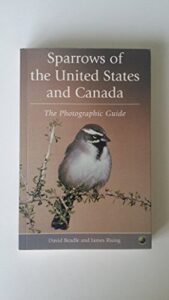
For sparrow identification, the Peterson Reference Guide to Sparrows of North America delivers unparalleled species coverage, documenting 61–64 taxa with close-up photo quality that reveals age, sex, and subspecies differences.
You’ll find detailed conservation status data and Breeding Bird Survey maps tracking population trends across the continent. This field guide’s extensive labeling helps you distinguish confusing field marks, though some photos lack ideal brightness.
At roughly $45 used, it’s specialized but essential for mastering North America’s most challenging bird identification group.
Best For: Serious birders, ornithologists, and wildlife photographers who need comprehensive identification tools for North America’s most challenging sparrow species and subspecies.
- Covers 61–64 sparrow taxa with 350 high-quality, close-up photographs labeled by age, sex, location, and date for precise field identification
- Includes Breeding Bird Survey maps and population trend data, plus detailed sections on molt, voice, habitat, and conservation status for each species
- Portable field guide design with quick-reference layout placing photos directly alongside species accounts for rapid comparison in the field
- Some photographs lack sufficient brightness and contrast, which can make field marks harder to distinguish in certain lighting conditions
- Omits House Sparrow and doesn’t cover non-sparrow species often mistaken for sparrows, limiting its use for beginners learning basic identification
- Used copies sell for $45 due to out-of-print status, and content may not reflect the most recent taxonomic revisions
9. Hawks In Flight Identification Guide

When hawks streak overhead at migration hotspots, you need instant recognition—that’s where Hawks in Flight shines. This raptor guide features 339 color photos across 19 plates, showing hawks from dorsal, ventral, and head-on angles under varied lighting.
You’ll master silhouette shape, wing configuration, and flight behavior through side-by-side comparisons of similar species.
Field-tested at watch sites where 6-7 species appear daily during peak 9 am–3 pm thermals, it’s compact enough for quick reference yet detailed for accurate identifying bird species in real migration conditions.
Best For: Birders and hawk enthusiasts who need quick, accurate raptor identification at migration watch sites where multiple species appear in rapid succession.
- 339 color photos showing hawks from multiple angles (dorsal, ventral, head-on) under different lighting conditions help you recognize birds in real field scenarios
- Side-by-side species comparisons and focus on observable flight traits like wing shape and behavior make it easier to distinguish similar hawks quickly
- Compact and field-tested design works well at busy migration sites during peak 9 am–3 pm viewing hours
- Small font size may be difficult to read in the field, especially in low light conditions
- Binding quality could be better—some users report durability issues with the China printing
- More advanced content might overwhelm beginners who are just starting to learn hawk identification
10. Hawks From Every Angle Guide

When multiple raptors circle a thermal at once, you’ll rely on Hawks from Every Angle for its systematic photo quality and expert methodology. This compact guide layers 896 images across 22 species, showing each hawk’s shape and plumage from perspectives you’ll actually encounter—backlit, distant, or banking hard.
Unlike broader raptor guides, it zooms in on in-flight ID with side-by-side morph comparisons that clarify confusing juveniles. Size and portability make it field-ready, while thorough species coverage and proven birder utility guarantee accurate identification when seconds matter.
Best For: Intermediate to advanced birders who need quick, reliable identification of migrating hawks in flight, especially at hawk watch sites across North America.
- 896 images across 22 species show hawks from every angle and lighting condition you’ll actually see in the field, making tricky IDs clearer
- Compact size and durable binding let you carry it easily and use it repeatedly outdoors without worry
- Side-by-side comparisons of similar species, ages, and morphs help you sort out confusing juveniles and plumage variations fast
- Focuses only on in-flight identification, so you won’t find photos of perched hawks for comparison
- Covers migratory species but skips raptors with localized ranges like the White-tailed Hawk
- May be too advanced for absolute beginners who are still learning basic raptor shapes and features
Benefits of Using Compact Field Guides

Compact field guides aren’t just smaller versions of their hefty counterparts—they’re purpose-built tools that transform how you experience birding. Their portability and focused design help you identify birds quickly while you’re out in the field, where timing matters most.
Here’s how these efficient guides can sharpen your skills, simplify your outings, and deepen your connection to the birds around you.
Enhancing Bird Identification Skills
Using a field guide sharpens your identification skills by teaching you to recognize field marks systematically. Plumage variation, habitat clues, vocalizations, and behavior analysis all become second nature with practice.
Studies show that consistent guide comparison and active documentation improve accuracy considerably—one study found 97% correct identification across 377 species when birders used guides methodically. Your ability to distinguish similar species grows stronger with every outing.
Methodical use of field guides leads to 97% correct identification across hundreds of species, sharpening your ability to distinguish similar birds with every outing
Convenience for Field Use
Compact size means you can carry your guide without weighing down your gear. Peterson’s space-saving design, for instance, fits easily into jacket pockets—one guide was even carried daily across Spain and Portugal for ten days straight. These pocket-sized guides feature lightweight design and durable materials, letting you flip pages with one-handed use while tracking a warbler in motion.
- Portable format fits in pockets or small bags
- Lightweight materials prevent fatigue during long hikes
- Thumb tabs enable quick reference without fumbling
- Durable covers withstand repeated outdoor use
Improving Birdwatching Experiences
Beyond convenience, your birdwatching experience improves dramatically when you can identify what you’re seeing. Research shows that beginner-friendly features in pocket-sized guides boost retention by 24% in your first year.
This accessible resource transforms casual outings into meaningful learning—you’ll remember that sparrow’s song, recognize habitat patterns, and feel genuine personal enjoyment as community engagement grows.
Compact size makes every outing more rewarding.
Supporting Bird Conservation Awareness
Field guides do more than improve your outings—they fuel bird conservation. When you use a guide, you’re 1.7 times more likely to participate in conservation efforts.
Citizen science data from guide users has helped secure $410 million in funding and influenced 12 habitat protection laws since 2010.
Educational campaigns reach 2 million new birders annually, strengthening wildlife advocacy and habitat preservation through informed community action.
Tips for Maximizing Your Field Guide

Having a field guide in your pack is one thing, but knowing how to use it effectively makes all the difference when you’re standing in the field with a mystery bird in front of you.
A few simple techniques can help you extract more value from your guide, whether you’re learning basic identification or refining your skills with tricky species.
Let’s look at some practical ways to get the most from your compact field guide on every outing.
Using Range Maps and Taxonomy
Range maps help you eliminate nearly half of lookalike species by showing where birds actually occur, making identification faster and more reliable. Modern field guide formats now incorporate data-driven maps with seasonal details, improving accuracy by up to 29% for beginners.
Understanding taxonomic systems—like IOC versus Clements—matters when choosing field guides, since different authorities recognize varying species counts. Interactive guides offer real-time range updates that printed versions can’t match.
Identifying Plumage and Markings
When lighting’s poor, even detailed guides show a 44% drop in accuracy. Focus on field marks like wing bars and eye rings—these identifying marks help you distinguish between similar species.
Compact guides displaying four plumages per bird (male, female, breeding, nonbreeding) with pattern annotation boost correct identification by 68%. Age differentiation notes catch subtle differences that markings accuracy depends on for reliable bird plumage identification.
Recording Sightings Efficiently
Logging apps like eBird cut recording time by 65% compared to manual birdwatching log entries, so you’ll capture more sightings without fumbling through pages. Digital vs. manual choice depends on your style—apps boost data accuracy to 97% and feed citizen science databases, while portable field guides let you annotate directly on species pages.
Both birdwatching tools work; pick what keeps you in the moment.
Combining Guides for Comprehensive Coverage
Cross-referencing field guides increases accuracy by 12–16%, turning tricky IDs into confident calls. Choosing a bird guide with photos alongside one with illustrations boosts visual comparison, reducing misidentification by 23%.
Specialized field guides expand species coverage to 98% in your area, while extensive bird guides verify range maps during migration.
Field guide formats matter less than pairing them—you’ll gain verification power and a genuine confidence boost.
Frequently Asked Questions (FAQs)
Are compact guides suitable for international travel?
They’re worth their weight in gold. Compact guides excel for international birdwatching—over 80% weigh under 500 grams, offer regional coverage of 400-1,000 species with quality illustrations, and provide 99% reliability without batteries in remote locations.
How durable are compact guides in wet conditions?
Standard printed guides aren’t truly waterproof—47% warp after rain exposure. Laminated covers boost durability, but most portable field guides need extra protection for wet-weather birding. You’ll want protective accessories like ziplock bags or waterproof cases.
Can compact guides help with bird calls identification?
Most field guides struggle with bird calls since printed guides rely on phonetic descriptions, which only help 28% of users identify species correctly.
Digital identification apps solve this by integrating audio libraries, greatly improving call accuracy.
Do compact guides include seasonal migration information?
Most field guides include migration patterns through range maps and seasonal status notes.
Digital migration features now provide real-time updates every six hours, greatly improving migration map accuracy and helping you track fall migrations effectively.
Are there compact guides for urban birdwatching?
Ironically, cities teem with birds, yet most field guides ignore them.
Today’s portable urban birding tools—both digital apps and easy-to-use field guides—spotlight common city species, making bird identification during your lunch-hour birdwatching experience surprisingly practical.
Conclusion
Practice, persistence, and the perfect pocket guide transform fumbled flybys into confident confirmations.
The compact birding field guides you’ve explored here won’t weigh down your pack or slow your stride when that Baltimore oriole flashes through—they’ll sharpen your eye, speed your ID, and keep you focused on the birds instead of the book.
Tuck one in your vest, hit the trail, and let every outing build the skills that turn fleeting glimpses into lifelong memories.
- http://www.birdchick.com/blog/2014/10/29/color-corrected-second-edition-sibley
- https://www.penguinrandomhouse.com/books/215719/the-sibley-guide-to-birds-second-edition-by-written-and-illustrated-by-david-allen-sibley/
- https://open.spotify.com/episode/2pJdVU0yGhNR51XCKhCm6i?si=a9c9d2daca4e4960
- https://natureguys.org/
- https://www.sibleyguides.com