
This site is supported by our readers. We may earn a commission, at no cost to you, if you purchase through links.

The Blackburnian Warbler doesn’t care that you drove three hours to find it. Standing at the trailhead with binoculars and a mediocre field guide, you’ll watch it vanish into the canopy without a confident ID.
Over 800 species move through the eastern US and Canada, and the difference between a satisfying day in the field and a frustrating one often comes down to the guide in your vest pocket. Not every book covers range maps, comparison plates, or subspecies variation equally well.
The right one sharpens your eye; the wrong one sends you home second-guessing every sparrow you saw.
Table Of Contents
- Key Takeaways
- Best Eastern US Field Guide Features
- Top 10 Eastern US Bird Guides
- 1. Sibley Guide to North American Birds
- 2. Stokes Birds of North America Guide
- 3. Kaufman North American Bird Field Guide
- 4. Crossley Eastern Birds Identification Guide
- 5. National Geographic Birds of North America Guide
- 6. Peterson North America Bird Field Guide
- 7. North American Warbler Identification Guide
- 8. Photographic Guide to North American Sparrows
- 9. Hawks In Flight Second Edition Guide
- 10. Hawks From Every Angle Identification Guide
- Illustration Versus Photo Guides
- Choosing Your Eastern Bird Guide
- Using Field Guides Effectively
- Frequently Asked Questions (FAQs)
- What is the difference between Sibley and Peterson bird guide?
- What is the best book for beginners birders?
- What is the best bird recognition app?
- What guides cover waterfowl in Eastern US?
- Are folding guides suitable for beginners?
- Do digital guides offer audio recordings?
- Can online guides help with warbler identification?
- Are photo-only guides useful for experts?
- Are waterproof field guides available?
- How often should I update my guide?
- Conclusion
Key Takeaways
- Range maps drawn from real eBird data, clear comparison plates, and coverage of 800-plus species are the features that separate a guide worth carrying from one that just takes up pocket space.
- Your skill level and birding style should drive the choice: beginners do better with illustrated guides like Kaufman, while serious listers and subspecies chasers need the depth of Sibley or National Geographic.
- Specialist guides — focused on warblers, sparrows, or raptors in flight — outperform general field guides when you’re targeting a single family and need plumage detail across every age and sex.
- Pairing any print guide with Merlin or eBird closes the gap between static pages and real-time sightings, giving you audio ID, live range maps, and updates that your book can’t provide.
Best Eastern US Field Guide Features

Not every field guide earns a spot in your vest pocket, and the eastern US establishes higher expectations pretty quickly.
The best ones share a handful of traits that actually matter when you’re squinting at a sparrow in bad light. Here’s what to look for.
A good beginner bird field guide makes all the difference when light is bad and the bird won’t cooperate.
Eastern Species Coverage
When a field guide covers the eastern United States and Canada properly, it changes how you bird entirely. Look for guides listing 800-plus species, with regional coverage that flags seasonal abundance trends, subspecies plumage variation, and rare regional taxa separately.
A proper eastern field guide doesn’t just list 800-plus species — it changes how you bird entirely
Endemic migratory patterns vary by state-level distribution, so bird identification depends on knowing which species actually show up where you’re standing.
Accurate Range Maps
Range maps make or break a guide. The best ones pull from citizen science data and the eBird database, using habitat suitability modeling to draw boundaries that reflect real ecology, not guesswork. Look for confidence intervals and edge uncertainty indicators along migration corridors.
Data-derived range maps tied to crowdsourced data and species distribution maps show you exactly where a bird belongs — and when.
Clear Comparison Plates
Maps narrow the field — plates close the deal. Good comparison plates use scaled reference lines and uniform cell dimensions to show species side by side without distortion.
Habitat symbol insets and high-contrast color swatches flag key marks fast.
Field guide illustrations on a glare-resistant matte finish stay readable in bright sun, making identification far less guesswork and far more confident.
Portable Field Size
A good compact field guide fits where you need it — backpack pocket, vest pocket, or dash compartment.
Look for handheld guidebook dimensions around 5 by 8 inches and a field guide weight that won’t drag you down after mile three.
Thumb tabs speed up lookup without fumbling.
Weather-resistant surfaces keep pages intact through morning dew and unexpected drizzle.
Beginner-friendly Layout
When you’re just starting out, layout matters more than you’d think. A well-designed structure ensures you can navigate without getting lost mid-trail.
Color-coded families and clear section headings provide immediate orientation, while Quick ID boxes deliver essential information at a glance. These features transform a dense guide into an intuitive tool.
Thumb tabs and a visual index streamline physical navigation, making flipping through pages fast and natural. Meanwhile, glossary shortcuts demystify jargon, ensuring accessibility and practicality for beginners.
Top 10 Eastern US Bird Guides
Picking the right field guide can make or break a morning in the field. Each of the ten guides below brings something different to the table — whether you’re sorting through confusing sparrows, tracking warbler migration, or just getting started.
Here’s what’s worth your time.
1. Sibley Guide to North American Birds

The Sibley Guide to North American Birds is the one most serious birders reach for first. It packs over 4,600 illustrations into a single flexibound volume, covering eastern and central species with paintings that show multiple poses, seasonal plumage, and age variations side by side.
The 15–20% enlarged illustrations and 700+ updated range maps make field identification genuinely faster. These features ensure the guide is both precise enough for experts and clear enough for anyone building real identification skills.
At around $27, it strikes a balance—thorough without being overwhelming. This makes it an ideal tool for birders at any skill level seeking reliable, efficient identification.
| Best For | Birders of all skill levels—from curious beginners to seasoned experts—who want a comprehensive, visually rich reference for identifying birds across the US and Canada. |
|---|---|
| Price | $27.18 |
| Page Count | 624 |
| Weight | 3 lb |
| Publisher | Knopf |
| Color Images | ~7,000 paintings |
| Range Maps | 700+ updated maps |
| Additional Features |
|
- Over 4,600 illustrations, enlarged 15–20%, make spotting key details quick and easy—even in the field
- 700 updated range maps cover seasonal movements, migrations, and rare occurrences all in one place
- Side-by-side species comparisons cut down on misidentifications without slowing you down
- At around 3 lbs, it’s more of a car or home reference than something you’ll want to carry on a long hike
- The small, narrow font can be tough on older eyes or anyone with vision sensitivity
- Some print runs have reported minor color inconsistencies and occasional labeling errors
2. Stokes Birds of North America Guide

Few photo-based guides match the Stokes for sheer visual depth. It covers 853 North American species with over 3,400 full-color photographs, showing multiple plumages, sexes, age classes, and flight shots on the same spread.
Range maps appear directly on each species page, marking winter, summer, year-round, and migration routes for quick reference.
At 3 lbs and 816 pages, it’s better suited for your car or base camp than a long trail.
Still, if you want the most complete photographic reference for eastern identification, this one delivers. The guide is also available as a trade paperback edition.
| Best For | Birders who do most of their watching from a car or base camp and want the most thorough photo reference available for North American species. |
|---|---|
| Price | $17.90 |
| Page Count | 816 |
| Weight | 3.05 lb |
| Publisher | Little, Brown and Company |
| Color Images | 3,400+ photos |
| Range Maps | Same-page maps |
| Additional Features |
|
- Over 3,400 photos covering multiple plumages, sexes, and age classes — hard to beat for visual depth
- Range maps sit right on the species page, so you’re not flipping back and forth
- Comes with a CD of 600 bird sounds, great for training your ear before heading out
- At 3 lbs and 816 pages, it’s too heavy to carry on a long hike
- Western species get less coverage than Eastern ones, which may frustrate birders out west
- Published in 2010, so newer taxonomic changes and range shifts aren’t reflected
3. Kaufman North American Bird Field Guide

For beginners who feel overwhelmed by thick, technical guides, the Kaufman North American Bird Field Guide is a reliable starting point. At $12.99 and roughly 392 pages, it won’t weigh down your pack or your wallet.
Common names come first, scientific names second — a small choice that speeds up field identification considerably.
Eastern habitats get solid coverage, with concise range notes and side-by-side plumage comparisons for similar species.
It pairs well with Merlin or similar apps if you want to go deeper.
| Best For | Beginners and families who want a simple, affordable guide they can actually carry into the field without feeling lost. |
|---|---|
| Price | $12.99 |
| Page Count | 392 |
| Weight | 1.04 lb |
| Publisher | Mariner Books |
| Color Images | Full-color plates |
| Range Maps | Included per species |
| Additional Features |
|
- At $12.99, it’s an easy buy — great value for a durable hardcover with 392 pages of coverage
- Common names lead the way, so finding a bird feels natural and fast, even with zero experience
- Pairs nicely with apps like Merlin, so you can use both together as your skills grow
- Serious birders will outgrow it quickly — it just doesn’t go deep enough on species detail
- The photo-to-text layout can feel a little disjointed, which gets frustrating mid-hike
- No recent taxonomic updates and spotty coverage of Mexican species, so it’s showing its age a bit
4. Crossley Eastern Birds Identification Guide

The Crossley Eastern Birds Identification Guide takes a different approach — instead of single static poses, it builds 640 full-page composite scenes from over 10,000 original photographs. Each scene layers 12 to 20 images, showing birds at varied distances, angles, and behaviors in real habitat. That’s close to how your eyes actually work in the field.
At $74.00 and 528 pages, it’s a desk reference more than a trail companion. However, for sharpening your identification instincts at home, it’s genuinely hard to beat.
| Best For | Birders of any skill level who want to sharpen their identification instincts at home using realistic, habitat-based visuals of Eastern North American species. |
|---|---|
| Price | $74.00 |
| Page Count | 528 |
| Weight | 3.75 lb |
| Publisher | Princeton University Press |
| Color Images | 640 composite scenes |
| Range Maps | Minimal maps |
| Additional Features |
|
- 640 full-page composite scenes built from 10,000 photos show birds the way you actually see them in the field — multiple angles, distances, and behaviors all at once.
- Covers five key ID cues (size, shape, behavior, probability, and color) in a single image, making it genuinely useful for building real recognition skills.
- Pairs with an online companion site for expanded captions and updates, so the learning doesn’t stop at page 528.
- At 3.75 lbs and 10 inches tall, this isn’t something you’re tucking into a jacket pocket — it’s a stay-at-home study guide.
- Only covers Eastern North America, so western birders or world travelers will need to look elsewhere.
- Range maps are thin, and the dense photo montages can feel like a lot to take in — best approached slowly and with intention.
5. National Geographic Birds of North America Guide

National Geographic’s field guide pulls serious weight for eastern birding. Its 576 pages cover 990 North American species, with dedicated range maps that separate spring and fall migration routes — a detail most guides skip.
Three-section species accounts break down description, voice, and range cleanly, so you’re never flipping around mid-sighting. At roughly $9.70, it’s hard to argue with the value.
Illustrations highlight key field marks directly on the plate, making plumage comparisons fast and practical whether you’re a weekend watcher or tracking a life list.
| Best For | Serious birders and students who want a thorough, no-nonsense reference for identifying and tracking North American species in the field. |
|---|---|
| Price | $9.70 |
| Page Count | 576 |
| Weight | 1.95 lb |
| Publisher | National Geographic |
| Color Images | Full-color illustrations |
| Range Maps | 941+ species maps |
| Additional Features |
|
- Covers 990 species with dedicated range maps that split spring and fall migration routes — a rare and genuinely useful detail
- Three-section species accounts (description, voice, range) keep things organized so you’re not scrambling mid-sighting
- Field marks are labeled right on the illustrations, making quick comparisons easy without digging through text
- At nearly 2 lbs and 576 pages, it’s a bit much to carry on a long hike
- Printed maps and taxonomy go stale over time as classifications and ranges shift
- No ABA species codes or four-letter banding codes, which is a real gap for list-keepers
6. Peterson North America Bird Field Guide

Peterson’s guide takes a different approach by combining eastern and western North America into one 527-page volume, covering 807 species. This is genuinely useful for birding across regions without needing to carry multiple books.
The Peterson Identification System employs arrows that point directly to key field marks on each plate, significantly reducing identification time. Range maps accompany every species entry, enhancing practicality in the field.
Despite its comprehensive content, the guide remains compact enough for a backpack. At around $7, it stands out as one of the better budget options available, balancing affordability with functionality.
| Best For | Birders who travel across both eastern and western North America and want one reliable, budget-friendly guide instead of two. |
|---|---|
| Price | $7.12 |
| Page Count | 527 |
| Weight | 2.55 lb |
| Publisher | Houghton Mifflin Harcourt |
| Color Images | 40+ new paintings |
| Range Maps | New maps every spread |
| Additional Features |
|
- Covers all of the US and Canada in a single 527-page volume — no more swapping between two books mid-trip.
- The Peterson arrow system points straight to key field marks, making quick ID in the field a lot easier.
- At around $7, it’s hard to beat the value, especially with range maps on every spread and bonus video podcasts included.
- At 2.55 lbs and 527 pages, it’s a bit chunky for long days out — not the lightest thing to haul around.
- Rare and vagrant species get less coverage here, so serious rare-bird chasers may find it lacking.
- Much of the artwork carries over from older editions, so if you were hoping for a fresh visual update, it’s not quite that.
7. North American Warbler Identification Guide

If warblers are your weak spot, this guide fixes that fast. It covers all 56 North American warbler species with over 1,000 full-color photos showing multiple plumage stages and angles — breeding, non-breeding, juvenile, hybrid.
The Quick Finder sections group birds by face pattern, undertail, and flight silhouette, so you’re not flipping blindly.
Sonograms and a step-by-step call ID system help you work through tricky songs visually.
At 560 pages, it’s better suited for car or camp than the trail.
| Best For | Birders who want a thorough at-home or in-car reference for cracking tough warbler IDs across all ages, sexes, and hybrids. |
|---|---|
| Price | $17.96 |
| Page Count | 560 |
| Weight | 2.06 lb |
| Publisher | Princeton University Press |
| Color Images | 1,000+ photos |
| Range Maps | Included per species |
| Additional Features |
|
- 1,000 photos covering every plumage stage, so you can ID birds that don’t look anything like the classic adult male.
- Quick Finder sections group species by visual field marks — way faster than flipping page by page.
- Sonograms and a step-by-step call ID system give you a visual way to work through tricky songs.
- At 2 lbs and 7×9 inches, it’s too bulky to haul on a long trail hike.
- Some habitat and range icons are hard to read, and a few photo choices don’t match the field marks being described.
- Species are listed alphabetically, not taxonomically — a little disorienting if you think in terms of bird families.
8. Photographic Guide to North American Sparrows
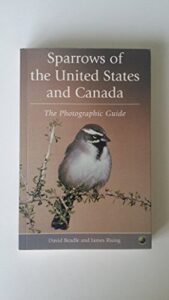
Sparrows are the real test. Most birders learn to spot a warbler faster than they can tell a Savannah from a Grasshopper Sparrow.
That’s where this Princeton University Press guide earns its place. Over 350 color photos cover all 64 sparrow taxa, with side-by-side plate comparisons that isolate crown streaks, eye rings, and breast patterns. Distribution maps and molt details support year-round ID.
It’s a specialist tool — slim, focused, and genuinely useful when the "little brown jobs" start blurring together.
| Best For | Birders, wildlife photographers, and students who need a focused, portable guide to telling North American sparrows apart in the field. |
|---|---|
| Price | Used ~$13 |
| Page Count | 328 |
| Weight | 1.31 lb |
| Publisher | Princeton University Press |
| Color Images | 350+ photos |
| Range Maps | Per species maps |
| Additional Features |
|
- 350 color photos covering all 64 sparrow taxa make side-by-side ID comparisons genuinely easy
- Distribution maps, molt info, and habitat notes give you the full picture, not just a pretty photo
- Slim and portable — built for the field, not the coffee table
- Some photos lack contrast, which is frustrating when you’re trying to spot subtle field marks
- Taxonomy is early-2000s, so recent splits and name changes won’t be here
- Very few flight shots, which leaves gaps for wing and tail identification
9. Hawks In Flight Second Edition Guide

From sparrows to raptors — the challenge shifts from tiny streaks to distant silhouettes. Hawks in Flight, Second Edition, addresses this challenge.
Published by Mariner Books, it covers seven hawk groups, including Buteos and Accipiters, using body shape, wing position, and flight mode rather than perched plumage.
Sutton and Liguori’s photos pair with pen-and-ink illustrations for layered comparison. At 352 pages, it’s field-ready and focused.
If hawks routinely confuse you at the hawkwatch, this guide cuts through the guesswork fast.
| Best For | Birders and raptor monitors—novice to intermediate—who want one solid, field-tested guide to identifying North American hawks, falcons, and vultures by shape and flight pattern. |
|---|---|
| Price | $13.78 |
| Page Count | 352 |
| Weight | 1.75 lb |
| Publisher | Mariner Books |
| Color Images | Full-color photos |
| Range Maps | Not specified |
| Additional Features |
|
- Covers all North American raptors, including regional species from Florida, the Southwest, and Texas
- Combines full-color photos with detailed pen-and-ink illustrations for a really useful side-by-side comparison
- Focuses on shape, posture, and flight mode—so you can ID birds at a distance without waiting for them to land
- Used copies can show wear, and some buyers report inconsistent print quality
- Small font is tough to read in low light or for anyone who struggles with fine print
- No digital version or app—it’s a physical book only, which adds weight on long hikes
10. Hawks From Every Angle Identification Guide

Nineteen species. That’s the focused scope of Hawks From Every Angle, and it’s exactly what makes it so effective. Princeton University Press designed this 129-page softcover around flight identification—dorsal, ventral, and profile views—using 339 color photographs across 68 plates. You won’t find perched raptor guidance here, but for migration watches where birds are distant and moving fast, that tradeoff pays off.
The quick-reference section alone makes it worth tucking into your pack.
| Best For | Intermediate-to-advanced birders and hawkwatch volunteers who need a fast, reliable way to ID raptors in flight during migration season. |
|---|---|
| Price | $14.22 |
| Page Count | 129 |
| Weight | 1 lb |
| Publisher | Princeton University Press |
| Color Images | 339 color photos |
| Range Maps | Migration-season info |
| Additional Features |
|
- 339 color photos organized by flight angle make it easy to nail an ID even when a bird is distant or only partially visible
- Side-by-side species comparisons cut down the guesswork on look-alikes
- Covers how light, molt, and aberrant plumage mess with visual cues—stuff most guides skip
- No perched raptor coverage, so it won’t help much on roadside or habitat-based outings
- Only 19 species—common vagrants and resident raptors aren’t in here
- Leans toward eastern North America, which means western observers may find it less relevant
Illustration Versus Photo Guides
Choosing between illustrated plates and photo guides comes down to how you actually learn birds in the field. Each format has real strengths that suit different situations, skill levels, and birding goals.
Here’s what you need to know before picking the right one.
Painted Plate Advantages

Illustrated guides hold a real edge over photos regarding clarity. Painted plates offer colorfast durability and a vibrant finish that highlights key field marks without the clutter of real-world lighting.
The annotated art style lets artists emphasize diagnostic features, while customizable designs can show multiple plumages side by side.
That consistency, plate after plate, makes pattern recognition faster in the field.
Habitat Photo Benefits

Photographic field guides bring something painted plates simply can’t — real context. Habitat photos show the actual reeds, bark, or understory where a species lives, providing critical Microhabitat Cues and Perch Selection details essential for field identification.
These images naturally convey Seasonal Context, Scale Reference against background trees, and insights into Human Impact, elements that illustrations often struggle to capture authentically.
By grounding illustration-vs-photo decisions in real-world observation, photo guides become genuinely practical tools for birders and naturalists alike.
Plumage Comparison Clarity

Regarding plumage comparison clarity, illustrated field guides have a real edge. Painted plates control Wing Bar Contrast, Crown Patch Visibility, and Structural Color Shifts deliberately — showing you exactly what matters. Photos can muddy these details with Lighting Influence or Molt Season Effects mid-frame.
Comparison charts in illustration vs. photo guides help track plumage variations across ages and seasons, sharpening identification skills considerably.
Flight View Usefulness

Flight views are where illustration vs photo field guide design truly diverges. Hawks from Every Angle and Crossley ID Guide Raptors nail this — painted plates standardize wing angle, contrast, and silhouette in ways photos rarely can.
- Dorsal and ventral spread views
- Altitude monitoring posture differences
- Route optimization across migration flyways
- Multi-device sync with visual index lookups
- Historical flight analysis by season
Best Format for Beginners

For beginners, illustrated guides beat photos almost every time. Clean plates, large icons, and simple keys cut through confusion fast. Here’s what matters most when you’re starting out:
| Feature | Why It Helps |
|---|---|
| Compact binding | Easy to carry one-handed |
| Clear typography | Faster reading in the field |
| Visual index | Find species without page-hunting |
An easy-to-carry paperback with a durable cover and beginner-friendly format makes beginner birdwatching feel possible, not overwhelming.
Choosing Your Eastern Bird Guide

The right guide depends less on what’s popular and more on how you actually bird. Your habits, your target species, and even your phone all play a role in the decision.
Match your style to the guide that’ll work hardest for you. Here’s how to align your approach with the guide that best fits your needs.
Backyard Birders
If your birding starts at the kitchen window, a regional field guide built for eastern species makes all the difference. Look for one covering feeder placement, native plantings, and winter water sources — details connecting what you see to why birds are there.
Strong citizen science integration and notes on predator protection help you observe more effectively, document real data, and grow your backyard birdwatching into a meaningful hobby.
Hiking and Travel
Hitting the trail shifts your priorities fast. Book portability matters — your guide needs to fit a 20-to-30-liter pack without eating space meant for rain shells or trail snacks. For birdwatching trips through eastern forests, regional bird guides sized around 5×8 inches work well.
Pack smart for the field:
- Choose field guide durability over weight savings
- Tuck birding equipment beside your navigation tools
- Prioritize weather planning before every outing
- Follow Leave No Trace near wetland species hotspots
- Keep gear packing tight and intentional
Advanced Identification Needs
Expert birding pushes you past basic field marks fast. When you’re sorting subspecies differentiation or tracking taxonomic splits, you need a guide that manages identification challenges with precision — detailed comparison plates, annotated flight views, and thorough plumage breakdowns.
Think of it like cross-database matching for birds: you verify against multiple features before confirming. That layered, risk-scoring approach separates confident calls from guesses.
Specialized Bird Families
Some groups reward a targeted approach. Woodpeckers, with their shock-absorbing skull and excavating habits, suit guides like Hawks in Flight for behavioral cross-reference.
Hummingbirds’ hovering wingbeat and owls’ facial sound funnel each demand plumage details that specialized titles—such as The Warbler Guide, Sparrows of the US and Canada, The Shorebird Guide, and Peterson Reference Guide to Gulls of the Americas—deliver precisely.
App Compatibility
Pairing your print guide with digital birding apps extends what a single book can do. Look for field guide updates delivered through online checklist updates, ensuring your species list stays current without buying a new edition.
The best mobile apps offer responsive design and multi-device support, with OS version targeting, permission consolidation, and performance optimization keeping them reliable across phones and tablets you already own.
Using Field Guides Effectively

Owning a great field guide is only half the equation. How you use it in the field makes all the difference between a confident ID and a missed bird.
Here are five habits that’ll sharpen your skills fast.
Check Habitat First
Before you open your field guide, look around. Habitat Matching is your fastest filter — Vegetation Indicators like dense shrubs, wetland edges, or canopy height narrow your candidates immediately.
Microhabitat Cues such as perch height and Water Source Significance help distinguish similar species sharing overlapping bird habitats.
Don’t forget Seasonal Habitat Shifts: leafless winters expose birds that summer foliage hides. Match habitat first, then reach for the guide.
Compare Range Maps
Once you’ve matched your habitat, consult your range map as a second opinion. The National Geographic Field Guide to the Birds of the United States and Canada—East 2nd edition pulls its data-derived range maps directly from eBird citizen science data, ensuring occupancy versus extent becomes clear at a glance.
Temporal layer comparisons highlight breeding versus wintering zones, while map scale choice with projection impact ensures your field guide analysis remains grounded and accurate.
Note Behavior and Calls
Behavior tells you half the story before you even raise your binoculars. Watch how a bird moves, then listen. Alarm call types and territorial song structure vary by species and season — seasonal call variation is real and worth tracking.
Habitat acoustic adaptation shapes what you hear in thickets versus wetlands.
Your field guide’s species accounts, paired with audio recorders and mindful playback usage, sharpen avian vocalization recognition quickly.
Study Seasonal Plumage
Seasonal plumage trips up even experienced birders. Winter feather density rises 15–25% in many passerines, shifting field marks noticeably. Molt timing spans 4–8 weeks, so you’ll catch birds mid-transition.
Your guide’s illustration style captures color shifts, camouflage function, and feather insulation differences across breeding and non-breeding plumages clearly. Study those plates alongside avian taxonomy notes — identification tutorials make seasonal variation click faster.
Pair Guides With Apps
Your field guide becomes more effective when paired with Cornell Lab of Ornithology’s eBird. Real-time maps dynamically display seasonal range shifts, offering updates that static printed guides cannot provide.
An audio call library hones your auditory identification skills between sightings, while offline access ensures uninterrupted functionality in remote locations, keeping both tools operational deep in the field.
Individualized checklists and in-app tutorials bridge the gap between knowledge and practice, transforming bird guide updates into actionable skills you can apply immediately.
Frequently Asked Questions (FAQs)
What is the difference between Sibley and Peterson bird guide?
Sibley goes deeper on taxonomic breadth and plumage variants, while Peterson keeps things compact and arrow-focused.
Both receive taxonomic updates, but your bird guide selection really comes down to detail versus speed in the field.
What is the best book for beginners birders?
For new birders, the Kaufman Field Guide is a solid pick. It uses simple language, visual learning aids, and an easy-to-use format.
The compact paperback fits your pocket and won’t overwhelm you on day one.
What is the best bird recognition app?
Merlin Bird ID wins hands down. Its AI accuracy, offline functionality, and Cornell Lab of Ornithology’s eBird integration make it unbeatable for eastern birding.
Audio identification and a straightforward UI seal the deal.
What guides cover waterfowl in Eastern US?
Several guides cover eastern waterfowl well.
The Sibley Guide to Birds and Kaufman Field Guide to the Birds of North America both include Wood Duck, dabbling ducks, and sea ducks, with solid range maps.
Are folding guides suitable for beginners?
Folding guides work well for beginners — quick reference layouts, lightweight durability, and easy-to-use format reduce the learning curve fast. A pocket field guide fits your jacket, making folded navigation and cost accessibility real advantages for new birders.
Do digital guides offer audio recordings?
Many digital guides include call libraries, playback speed controls, offline access, and multilingual narration. Bandwidth considerations matter in remote areas, but downloaded audio covering avian vocalizations works reliably without a signal.
Can online guides help with warbler identification?
Think of online guides as a warbler’s field notebook brought to life. The Warbler Guide app, Cornell Lab of Ornithology’s eBird, and interactive song libraries give you real-time migration alerts, user-contributed sightings, and customizable filter tools to nail any ID fast.
Are photo-only guides useful for experts?
Photo guides do serve experts. Fine-scale plumage details, rapid field decisions, and expert verification all benefit from sharp imagery.
Hybrid annotation and photo metadata make specialized guides genuinely useful for expert-level birding.
Are waterproof field guides available?
Waterproof field guides are essential, ensuring a good birdwatcher is never unprepared. When rain hits mid-hike, Lamination Options, Waterproof Binding, and Durability Testing become critical.
Weight Implications stay low with compact, foldable designs, maintaining practicality in the field.
How often should I update my guide?
Update every one to two years. New expanded editions — like a Second Edition — reflect Taxonomic Change Updates, Seasonal Additions, and Annual Revision Cycles.
When your maps no longer match what eBird shows, it’s time.
Conclusion
Even Audubon himself carried a flintlock to collect specimens before he could paint them — your best bird field guide for the Eastern US does the same work, just without the gunpowder. It sharpens your eye in the moment, turning a flicker of orange in the canopy into a confirmed Blackburnian.
Pick the guide that fits how you bird — habitat first, range map second, comparison plate third. The right one won’t just name the bird. It’ll make you remember it.