This site is supported by our readers. We may earn a commission, at no cost to you, if you purchase through links.
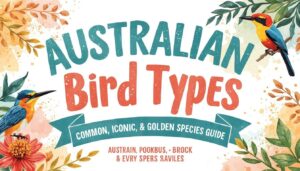
Australia hosts roughly 830 bird species—more than Europe and North America combined, despite covering far less landable terrain. That number alone tells you something about what evolution does when it operates in isolation for 45 million years.
A continent-sized laboratory, sealed off long enough for birds to develop tricks, colors, and behaviors found nowhere else on Earth.
The kookaburra laughs at dawn while a lyrebird down the ridge reproduces a chainsaw with unsettling accuracy.
Whether you’re chasing lifers in the field or trying to name the cockatoo demolishing your fruit tree, understanding Australian bird types reshapes how you see the landscape entirely.
Table Of Contents
- Key Takeaways
- Common Australian Bird Types
- Iconic Native Australian Birds
- Australian Birds by Habitat
- How to Identify Australian Birds
- Rare and Threatened Australian Birds
- Frequently Asked Questions (FAQs)
- What juice is safe for birds?
- How do Australian birds adapt to extreme droughts?
- What unique diseases affect native Australian birds?
- Can Australian birds survive in urban environments successfully?
- How long do different Australian bird species live?
- What role do Aboriginal cultures assign to birds?
- Which Australian birds are most dangerous to humans?
- How do invasive birds impact native Australian species?
- What role do Australian birds play in pollination?
- Can Australian parrots be kept as legal pets?
- Conclusion
Key Takeaways
- Australia’s 830+ bird species—shaped by 45 million years of isolation—display behaviors, adaptations, and ecological roles found nowhere else on Earth, making habitat context essential to understanding them.
- You can identify most Australian birds through four reliable field markers: plumage color and pattern, bill shape, body size, and vocalizations—each reflecting what the bird eats and where it lives.
- Urban environments support surprisingly rich bird communities, with species like the Australian Magpie, Laughing Kookaburra, and Rainbow Lorikeet adapting feeding and nesting behaviors to parks, backyards, and suburban corridors.
- Several iconic species—including the Orange‑bellied Parrot, Eastern Curlew, and Murray Grasswren—face critical population pressure from habitat loss, invasive species, and climate disruption, with recovery depending on active conservation programs.
Common Australian Bird Types
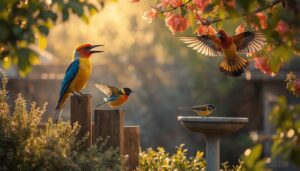
Australia’s most familiar birds aren’t hiding in remote wilderness — many share your backyard, local park, or the nearest power line. Getting to know them is the best starting point for anyone building their bird knowledge from the ground up.
If you’re curious how a similar approach works elsewhere, Florida’s most common backyard birds are a great example of how quickly familiar species become recognizable once you start looking.
Here are eight species you’re almost certain to encounter.
Australian Magpie
The Australian Magpie (Gymnorhina tibicen), measuring 37–43 cm, is one of the most recognizable birds for birdwatching across Australia. Its bold black-and-white plumage and flute-like social vocalizations make it hard to miss.
Urban adaptation has shaped this species well — territorial swooping during breeding season reflects strong territorial instincts, while cooperative breeding and impressive face recognition reveal just how cognitively complex it truly is.
Its glossy black upperparts contrast sharply with its white underparts.
Laughing Kookaburra
From the Australian Magpie’s bold territorial instincts, the Laughing Kookaburra (Dacelo novaeguineae) takes that attitude even further — its iconic call isn’t laughter at all. It’s pure Territory Marking, broadcasting ownership across open eucalypt woodland at dawn and dusk.
At 40–47 cm, it’s the world’s largest kingfisher, built for a Ground Foraging Technique — dropping fast from a perch to snatch lizards, snakes, and insects below.
Its Family Structure runs deep: older offspring stay with breeding pairs for multiple seasons, acting as helpers.
What makes this bird stand out in any Birdwatching guide to Australian species:
- Urban Presence — parks, backyards, and golf courses with mature trees all suit it well
- Dietary Flexibility — insects to venomous snakes, whatever the habitat offers
- Identification of Australian native birds — dark eye‑stripe, rufous‑barred tail, heavy pale‑and‑dark bill
- Bird vocalizations and mimicry in Australia — its cascading cackle reflects Habitat diversity of Australian birds, echoing from forests to suburban streets
Rainbow Lorikeet
If the Kookaburra owns the soundtrack, the Rainbow Lorikeet (Trichoglossus moluccanus) owns the color palette. This medium-sized parrot — 25–30 cm, roughly 75–157 g — is hard to miss.
| Trait | Detail |
|---|---|
| Head | Blue with orange-yellow chest |
| Feeding | Nectar feeding via papillate tongue |
| Habitat | Urban gardens to coastal forest |
Urban Adaptation has made it a backyard regular across eastern Australia.
Sulphur-crested Cockatoo
From vibrant lorikeets to loud white flocks — the Sulphur-crested Cockatoo (Cacatua galerita) is hard to ignore.
- Crest Communication signals mood instantly, raising 5–10 cm yellow feathers when alarmed
- Social Pair Bonds last decades within urban flock dynamics of hundreds
- Tool Use and Lifespan Longevity exceed 50 wild years — impressive among birds
Their urban impacts on bird populations raise real human-wildlife conflict with cockatoos, yet their cultural significance of Australian birds remains undeniable.
Australian White Ibis
Few birds capture the tension between wildlife and city life quite like the Australian White Ibis (Threskiornis moluccus). Its range expansion since the 1950s brought it squarely into urban and suburban bird habitats, where feeding ecology shifted toward garbage and scraps.
Breeding colonies form near wetlands and urban water bodies. Conservation status remains Least Concern, though human conflict over bold foraging continues to spark debate.
Masked Lapwing
The Masked Lapwing (Vanellus miles) is one of Australia’s most confrontational urban residents. You’ll find it claiming park nest sites on open lawns, ovals, and airfield margins — anywhere short grass meets bare ground. Four things make this 30–37 cm shorebird immediately recognizable:
- Bold yellow facial wattles and a black crown
- Pale olive-brown eggs with dark blotching — classic egg camouflage against bare soil
- Distinctive wing spur morphology — a sharp carpal spur used during territorial swooping
- Aerial courtship flights performed over defended breeding territories
Its territorial and social behavior peaks during breeding season, when it doesn’t hesitate to dive at intruders in urban and suburban bird habitats.
Noisy Miner
The Noisy Miner (Manorina melanocephala) is a honeyeater that plays by its own rules. territory defense is relentless — large coalitions of 50-plus birds practice aggressive exclusion, driving smaller woodland species from shared foraging zones.
Cooperative breeding binds the colony together, with adults raising each other’s young. You’ll spot them nectar foraging in eucalypts across eastern Australia’s open woodlands and urban parks.
Galah
The Galah (Eolophus roseicapilla) is one of the most recognizable parrots and common bird species of Australia — that bold pink-and-grey plumage is impossible to miss. Your Australian bird identification guide isn’t complete without it.
Unfortunately, habitat loss threatens even adaptable species like the Galah, making rare bird habitat protection efforts more critical than ever for Australia’s iconic wildlife.
- Iris Color: females show pink-red irises; males carry dark brown
- Bill Morphology: strong curved bill built for seed foraging and digging up roots
- Powerline Roosting: flocks gather on lines before fanning out to feed
seed foraging and digging up roots.
Iconic Native Australian Birds

Some Australian birds don’t just blend into the landscape — they define it. From towering flightless giants to master mimics hiding in dense forest, these species have shaped how the world sees Australia’s wildlife.
Here are the iconic native birds worth knowing by name, habit, and sight.
Superb Lyrebird
Few Australian songbirds stop you in your tracks quite like the Superb Lyrebird (Menura novaehollandiae). Its Syrinx Adaptations allow vocal mimicry of over 20 species — plus chainsaws and camera shutters. Males perform on Courtship Mound Construction sites, fanning lyre-shaped tails during displays. Their Leaf Litter Engineering reshapes forest floors, while Extended Lifespan and Seasonal Territory Shifts make them essential to any Australian bird identification guide.
| Feature | Detail | Significance |
|---|---|---|
| Vocal mimicry | 20+ species imitated | Core courtship strategy |
| Tail feathers | Up to 60 cm outer feathers | Lyre-shaped display structure |
| Habitat preferences | Moist eucalyptus and wet sclerophyll forests | Foraging and nesting base |
| Breeding and nesting behaviors | Single egg per season | Slow reproductive cycle |
| Lifespan | Several decades possible | Long territorial presence |
Southern Cassowary
Standing up to 1.8 meters tall, the southern cassowary (Casuarius casuarius) is a living pillar of Far North Queensland’s rainforest ecosystems. Its Casque Function likely helps it navigate dense vegetation.
Fruit Dispersal and seed dispersal by birds keep forests regenerating — large seeds few animals can move.
Yet Habitat Fragmentation, Road Mortality, and habitat loss threaten this species.
Male Incubation and Endangered conservation status make every chick count.
Emu
From the dense rainforest, Australia opens into sun‑scorched grasslands — and that’s where the emu (Dromaius novaehollandiae) rules.
Here’s what makes this giant worth knowing:
- Standing 1.9 m tall, emus dominate Flightless birds of Australia
- Gastrocnemius Muscles power sprints reaching 50 km/h
- Nomadic Foraging follows rainfall across vast inland regions
- Pair Bonding Behavior shifts roles — males incubate eggs alone
- Predator Avoidance relies on speed, not flight
Dust Bathing Behavior keeps plumage clean between journeys.
Black Swan
From open plains, follow the water — and you’ll find the black swan (Cygnus atratus).
| Feature | Detail | Significance |
|---|---|---|
| Bill | Deep red with pale band (Red Bill Morphology) | Species recognition |
| Diet | Aquatic Plant Diet; algae, submerged vegetation | Wetland ecosystem health |
| Movement | Long-distance Dispersal between wetlands | Habitat flexibility |
Mating displays strengthen pair bonds at nesting mounds.
Human interaction through parkland feeding is common, though it shapes behavior.
Waterbird ecology in Australian wetlands depends on species like this — habitat loss remains a real pressure for conservation of endangered species nearby.
Wedge-tailed Eagle
From water to sky — few birds command attention like the Wedge-tailed Eagle (Aquila audax), Australia’s peak raptor.
Its Wing Morphology allows smooth Thermal Soaring across open woodlands and alpine zones, covering vast distances daily. Prey Diversity keeps this bird adaptable:
- Rabbits, macropods, and lizards form its core diet
- Carrion supplements hunting during lean seasons
- Wingspan reaches roughly 2.3 meters
- Territorial Nesting pairs reuse large stick platforms for decades
- Cultural Symbolism ties this species to Indigenous Australian heritage
Habitat loss and collision risks threaten populations — Conservation of endangered species programs now monitor breeding pairs closely.
Little Penguin
From the soaring heights of the Wedge-tailed Eagle, meet something far smaller — the Little Penguin (Eudyptula novaehollandiae), roughly 25–30 cm tall and weighing about 1.2 kg.
Nighttime Foraging keeps this species largely hidden from casual observers, as adults always return to shore after dark. Burrow Nesting in sandy soil or under coastal structures reflects strong Urban Colony Adaptation — colonies thrive even in urban settings like St Kilda, Melbourne.
| Feature | Detail | Significance |
|---|---|---|
| Size | ~25–30 cm tall, ~1.2 kg | World’s smallest penguin |
| Plumage | Pale blue-indigo back, white belly | Camouflage while swimming |
| Diet | Small fish, krill, crustaceans | Provides chick provisioning |
| Nesting | Burrows in sand or under buildings | Reduces predator exposure |
| Lifespan | Teens in stable coastal habitats | Sensitive to habitat loss |
Population Monitoring at key sites tracks how Climate Impact — warming seas disrupting prey availability — affects breeding success. Bird conservation programs targeting habitat loss remain your best tool for keeping this species thriving along Australia’s southern coastlines.
Satin Bowerbird
Few birds blur the line between instinct and artistry quite like the Satin Bowerbird (Ptilonorhynchus violaceus). The male’s Bower Architecture — a stick-walled avenue decorated almost exclusively with blue Decoration Objects — drives its Mating rituals and displays entirely.
Here’s what defines this species:
- Males display glossy blue-black plumage with striking violet eyes
- Territorial Fidelity keeps males defending their bowers year-round
- Courtship Songs combine mimicry and original vocalizations to impress females
- Fruit Foraging aids both breeding and nonbreeding seasons
- Females build separate cup nests, independent of the bower site
Red-tailed Black Cockatoo
Few Australian bird species command attention quite like the Red-tailed Black Cockatoo (Calyptorhynchus banksii). Its Seed Cracking Adaptation — that heavy, curved bill — splits eucalypt pods most birds can’t touch.
Hollow Tree Dependency shapes where it breeds, while Seasonal Movement Patterns follow fruiting cycles across regions.
Strong Social Pair Bonding keeps mates together for decades, and Longevity in Captivity can reach 50 years.
Australian Birds by Habitat

Where a bird lives shapes everything about it—what it eats, how it behaves, and who it shares space with. Australia’s habitats range from scorched desert to dripping rainforest, and each one hosts a distinct community of birds worth knowing.
Here’s a look at the main habitat types and the species you’re most likely to encounter in each.
Forest and Woodland Birds
Eucalyptus woodlands are alive in ways you won’t fully appreciate until you’re standing beneath the canopy at dawn. Snag dependency shapes everything here — without dead hollow-bearing trees, parrots and cockatoos lose their nest sites entirely.
You’ll notice mixed-species flocks working the canopy edges, where forest edge effects shift species composition fast.
Cooperative breeding in honeyeaters, nectarivory timing tied to flowering cycles, and ground predator risks for low-nesting species all reflect the habitat diversity supporting Australian birds through these layered, regenerating forests.
Grassland and Farmland Birds
Open paddocks and mixed farmlands aren’t empty — they’re surprisingly complex bird habitats once you know what to look for.
- Field Margin Diversity and Insect Food Availability drive Breeding and nesting behaviors for ground-nesters like Masked Lapwings
- Mowing Schedule Strategies aligned with breeding cycles reduce nest destruction
- Fire Management Impacts shape grassland structure, affecting seed dispersal and insect control
- Predator Control Measures and habitat loss directly threaten bird identification opportunities here
Desert and Arid Zone Birds
Few habitats test birds as ruthlessly as Australia’s arid interior. Desert adaptation here hinges on water conservation, heat tolerance, and behavioral flexibility — qualities you’ll see in species like the Budgerigar and Emu.
Many rely on nocturnal foraging and burrow shelter to dodge peak temperatures. Thermal soaring helps raptors patrol vast territories efficiently.
Habitat diversity supporting Australian birds extends remarkably even into these harshest landscapes.
Wetland and Freshwater Birds
Freshwater wetlands are some of the most productive bird habitats on the continent. Species like the Australian Wood Duck (Chenonetta jubata), Black Swan (Cygnus atratus), and Chestnut Teal (Anas castanea) depend on these systems year‑round. Flood events act as key migration triggers, drawing nomadic birds like the Australian Pelican (Pelecanus conspicillatus) deep inland.
Here’s what drives wetland bird diversity:
- Reedbed Foraging and Floating Nesting — dense emergent vegetation provides habitat for the Little Pied Cormorant (Phalacrocorax melanoleucos) and nesting waterbirds anchoring platforms above the waterline.
- Mudflat Probing — waders extract invertebrates from exposed sediment using specialized bill shapes.
- Invasive Plant Impacts — introduced vegetation alters water depth, directly reducing foraging and nesting access for resident species.
Coastal and Seabirds
Where wetlands meet open water, coastal and seabird communities take over. Species like the Australasian gannet, Australian pelican, and Silver Gull anchor Australia’s marine food webs, foraging within 50 km of shore.
Nesting site protection on offshore islands and sea cliffs is critical, as human disturbance impacts breeding success considerably. Climate-driven migration increasingly shifts when and where these pelagic foraging strategies play out.
Rainforest Birds
Step from the coast into the canopy, and everything changes. Australia’s rainforests — particularly Far North Queensland’s wet tropics — pack rich habitat diversity supporting Australian birds in layered canopy feeding strategies, where epiphyte nesting sites shelter species that the open country never sees.
The Southern Cassowary forages the forest floor, practicing frugivory and seed dispersal, critical to forest regeneration.
Dawn chorus dynamics here feel almost orchestral, with the Regent Honeyeater and Yellow-tailed Black Cockatoo contributing distinct voices.
Edge effect impacts, however, are shrinking these corridors fast.
Urban and Suburban Birds
From rainforest canopy to city rooftop — Australian birds adapt remarkably well. Urban and suburban bird populations thrive where food and structure converge.
The Australian Magpie and Noisy Miner claim territorial patches in parks, while the Laughing Kookaburra hunts lawns confidently. Willie Wagtails exploit movement corridors along fences and powerlines.
Feeding adaptations, nesting innovations in building cavities, and human interaction shape practical conservation strategies for these resilient species.
How to Identify Australian Birds
Once you know where a bird lives, the next step is actually being able to name it. Australia has over 800 species, so having a few reliable tricks up your sleeve makes all the difference.
Here’s what to look for when bird catches your eye.
Plumage Colors and Markings
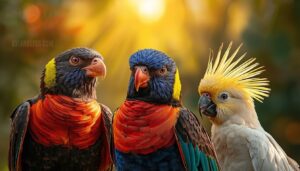
Plumage is your first real clue in bird identification and characteristics. Australian species run the full spectrum — from the Rainbow Lorikeet’s multicolored plumage to the Wedge-tailed Eagle’s black and white plumage contrasts. Here’s what to watch for:
- Structural coloration produces iridescent blues and greens without pigment
- Carotenoid pigments drive the bright yellows and reds in parrots
- Sexual dimorphism and seasonal molt shift colors noticeably between individuals
Camouflage patterns, vibrant white plumage, and colorful plumage all signal different ecological roles.
Beak Shape and Feeding Style
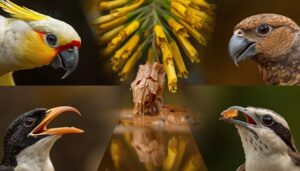
A bird’s beak tells you almost everything about what it eats.
Nectar feeding bills like the Rainbow Lorikeet’s narrow red bill laps pollen from eucalypts, while seed crushing bills on cockatoos shear through woody capsules.
Mud probing bills, predator gripping bills, and ground foraging bills each reflect distinct bird foraging and diet habits — key adaptations of birds to Australian environments and their ecological roles.
Bird Size and Body Shape
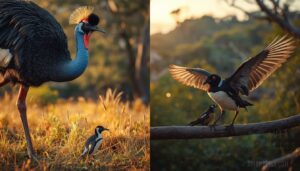
Size gives you a shortcut. The Little Penguin stands just 33 cm tall, while the Southern Cassowary towers past 150 cm — a striking contrast in Leg Length Adaptations and Keel Muscle Development.
Wing Morphology and Tail Length Variation shift dramatically too, from the budgerigar’s compact frame to the Australian Magpie’s balanced proportions. Body Proportions, alongside the flightless Emu’s broad torso, reveal habitat and lifestyle instantly.
Calls, Songs, and Mimicry
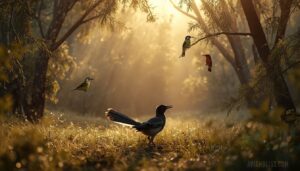
Sound is one of your most powerful identification tools.
Australia’s songbirds reveal themselves through Territorial Song Variation, shifting pitch and tempo to signal dominance or threat.
Dawn Chorus Dynamics layer species upon species into a rich acoustic map.
The Superb Lyrebird demonstrates Cultural Sound Transmission through Mimicry Learning, echoing kookaburras and even camera shutters.
Master Alarm Call Strategies, and you’ll read bird behavior and vocalizations like a fluent language.
Flight Patterns and Movement
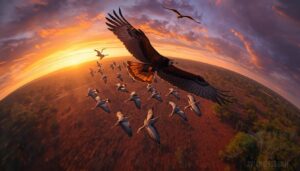
How a bird moves through the air tells you almost as much as its feathers do.
Raptors like the Wedge-tailed Eagle master Soaring Thermals, circling upward before long glides.
Smaller birds use distinct Wingbeat Mechanics—honeyeaters flap rapidly, while cockatoos undulate.
Altitude Variation, Local Flight Paths, and Stopover Strategies all reflect migration patterns and flight adaptation.
Even flightless birds like emus reveal identity through gait.
Nesting and Breeding Behavior
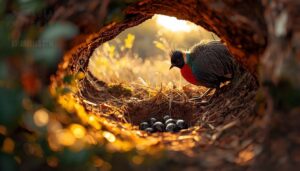
Nesting and breeding practices of Australian birds reveal identity as clearly as any field mark. Watch where a species builds, how many eggs it lays, and who raises the chicks.
- Nest Site Selection — Galahs and Rainbow Lorikeets favor tree hollow nesting; Masked Lapwings scrape bare ground.
- Clutch Size Variation — Cockatoos lay 1–3 eggs; Emus produce up to 15.
- Parental Care Strategies — Male Emus incubate alone; cooperative breeding in honeyeaters involves helper birds.
- Courtship Displays and Breeding Season Timing — Lyrebirds display in winter; Lapwings breed July–December.
Seasonal Range and Migration Clues
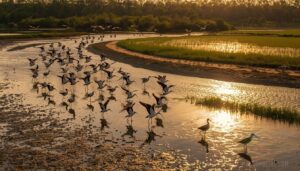
Where a bird shows up tells you almost as much as what it looks like. Shorebird Arrival Timing is a perfect example — Eastern Curlews reach Australian mudflats between August and October, so a large, long-billed wader on an estuary in December is almost certainly a summer migrant.
Rainfall Driven Movements pull ibis and lapwings into flooded paddocks, while Nectar Bloom Migrations draw lorikeets wherever eucalypts flower.
Rare and Threatened Australian Birds
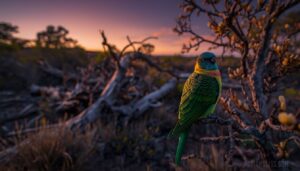
Australia is home to some birds that most people will never see in the wild—not because they’re hiding, but because there simply aren’t many left. Habitat loss, invasive species, and climate pressures have pushed several species to the edge.
Here’s a closer look at the rare and threatened birds that need our attention most.
Orange-bellied Parrot
Few birds carry as much urgency as the Orange-bellied Parrot (Neophema chrysogaster), one of Australia’s rarest and threatened Australian birds with fewer than 200 wild individuals.
Its Breeding Habitat spans temperate Tasmanian eucalyptus forests, while Migration Corridors stretch to mainland saltmarshes each autumn.
Captive Breeding, Fire Management, and Genetic Diversity programs are critical to threatened species recovery, making your sightings genuinely worth reporting.
Regent Parrot
Another parrot worth knowing well is the Regent Parrot (Polytelis anthopeplus), a threatened subspecies split across two populations with distinct Mallee distribution patterns.
Males show yellow and olive-green plumage; females are subtler.
Both depend on Nesting Hollows in river‑red gums—cavities that are disappearing fast.
Their dietary flexibility helps, but population monitoring confirms this Endangered Australian bird species still needs active habitat protection.
Barking Owl
The Barking Owl (Ninox connivens) takes a different approach to survival — it works the night shift. Relying on nocturnal foraging strategies and sharp hearing, this medium-sized bird of prey hunts mammals and insects across large territories.
Monogamous pairing facilitates year-round territory defense, with pairs returning faithfully to the same tree hollow roost.
Its dog-like bird calls make it unmistakable, yet population monitoring confirms its conservation status remains a serious concern.
Eastern Curlew
Where the Barking Owl holds its ground year‑round, the Eastern Curlew (Numenius madagascariensis) is constantly moving. Among migratory shorebirds of Australian coasts, none travels further.
That long down‑curved bill — up to 23 cm — probes intertidal mudflats for worms and crabs with impressive precision.
Staging site protection, population monitoring, and addressing climate impact are now critical to preventing this critically endangered species from disappearing entirely.
Great Knot
The Great Knot (Calidris tenuirostris) ranks among the most travelled migratory shorebirds of Australian coasts, completing exceptional journeys across the International Flyway from Siberian breeding grounds.
Measuring 25–30 cm, it depends on mudflat foraging along intertidal flats and builds critical fat reserves at Yellow Sea stopover habitat.
Degradation of these staging grounds drives population decline — a stark example of habitat loss reshaping wetland and coastal bird ecosystems in Australia.
Norfolk Island Morepork
Norfolk Island Morepork (Ninox novaeseelandiae undulata), a nocturnal bird of prey clinging to survival with fewer than 30 individuals remaining.
Its conservation status reflects compounding pressures — habitat loss, genetic diversity concerns, and predator competition all limit recovery.
Forest habitat restoration within Norfolk Island National Park, combined with predator control measures, nocturnal foraging pattern studies, and rigorous population monitoring techniques, now anchor its fragile future.
Mukarrthippi Grasswren
Few rare and threatened Australian birds occupy a range as heartbreakingly small as the Mukarrthippi Grasswren (Amytornis barbatus barbatus). This endemic species clings to a single 30-hectare sandhill in Yathong Nature Reserve, where spinifex habitat provides essential cover.
The Mukarrthippi Grasswren survives on a single 30-hectare sandhill — one of Earth’s most precarious bird ranges
Cooperative breeding strengthens its fragile social structure, while fire management and population monitoring address urgent genetic diversity concerns that define its precarious conservation status.
Conservation Threats and Recovery Efforts
The threats facing Australia’s rarest birds don’t work in isolation — hollow tree shortage, coastal habitat decline, ground predators, and migration bottlenecks all stack against species already running thin. Conservation status of native Australian birds has worsened where human pressure compounds natural limits.
Captive breeding programs, habitat corridors, and predator control now anchor threatened species recovery programs in Australia, offering real ground for hope.
Frequently Asked Questions (FAQs)
What juice is safe for birds?
No juice is truly "safe" — plain water wins every time. Citrus acidity, sugar overload, and additive hazards all stress a bird’s digestion.
Skip the juice; offer fresh water and watch hydration closely.
How do Australian birds adapt to extreme droughts?
Australian birds manage extreme droughts through Thermoregulatory Behaviors, Water-Use Efficiency, Dietary Shifts, and Refuge Relocation — shifting feeding times, following water, and delaying Breeding Timing until rains return and food recovers.
What unique diseases affect native Australian birds?
Native birds face silent threats from Beak Feather Disease, Avian Influenza, Chlamydia Psittaci, and Avian Pox.
Disease Surveillance Programs help track outbreaks, but habitat loss and human pressure keep pushing avian ecology toward a crisis.
Can Australian birds survive in urban environments successfully?
Yes, many can.
Urban food resources, nesting site availability, and reduced natural predators help adaptable species thrive. However, predator pressure from cats and noise pollution challenge sensitive urban and suburban bird populations.
How long do different Australian bird species live?
Like rings in a tree, a bird’s lifespan tells its whole story. Sulphur-crested Cockatoos reach 70 years captive; wild lifespans vary sharply with habitat security and Age Mortality Patterns.
What role do Aboriginal cultures assign to birds?
Birds hold profound indigenous cultural significance as Dreamtime Lawkeepers, Totemic Guardians, and Storytelling Messengers.
Their bird calls and vocalizations signal seasonal shifts, while Ritual Feather Art and songs weave ancestral knowledge across generations.
Which Australian birds are most dangerous to humans?
The Southern Cassowary and Australian Magpie top the list. Cassowaries deliver fatal kicks, while magpies dive‑bomb during nesting season.
Wedge‑tailed eagles and Sulphur‑crested Cockatoos also pose real beak strike risks near nests.
How do invasive birds impact native Australian species?
Invasive species like the Common Myna, House Sparrow, and European Starling drive nest site competition, food resource depletion, disease transmission, predation pressure, and habitat alteration — serious threats to Australia’s native avifauna.
What role do Australian birds play in pollination?
Nectar feeding by honeyeaters and lorikeets drives pollination across banksias, grevilleas, and eucalypts.
beak morphology allows floral trait matching, while they carry pollen over meaningful pollination distances, supporting seed dispersal and pollination by birds throughout diverse ecosystems.
Can Australian parrots be kept as legal pets?
Like a key that only fits certain locks, owning parrots in Australia depends on species-specific restrictions and state licensing rules.
Budgerigars and Sulphur-crested Cockatoos may be permitted, but CITES permit requirements, biosecurity import bans, and illegal possession penalties apply.
Conclusion
Like Darwin stepping ashore somewhere entirely new, you’re now equipped to read the landscape differently. Every Australian bird types guide can hand you names and field marks, but recognition only deepens when you connect behavior, habitat, and evolutionary history into one coherent picture.
The kookaburra laughing outside your window isn’t background noise—it’s 45 million years of isolation made audible. Pay attention to what’s flying past.
Australia’s birds reward every observer who actually looks.