This site is supported by our readers. We may earn a commission, at no cost to you, if you purchase through links.

The moment you raise a pair of binoculars and a distant hawk snaps into crisp, vivid focus, something shifts—you stop being a casual observer and start reading the landscape differently.
Most beginners assume they need expensive, complicated gear to reach that feeling, but the honest truth is that a solid pair of 8×42 binoculars under $300 outperforms what professional ornithologists used two decades ago.
The market has caught up with demand, and today’s entry-level optics deliver BaK-4 prisms, fully multi-coated lenses, and nitrogen-sealed weatherproofing at prices that won’t sting.
Knowing which specifications actually matter—and which numbers are marketing noise—separates a purchase you’ll treasure from one that collects dust.
Table Of Contents
- Key Takeaways
- Top 10 Binoculars for Beginners
- 1. Nikon Prostaff 8×42 Binoculars
- 2. Vortex Diamondback HD Binoculars
- 3. Celestron Nature DX Binoculars
- 4. Bushnell Waterproof 8×42 Binoculars
- 5. Celestron Outland Waterproof Binoculars
- 6. Nikon Aculon 8×42 Binoculars
- 7. Pentax Compact Outdoor Binoculars
- 8. Steiner Predator Auto Focus Binoculars
- 9. Vanguard 8×42 ED Binoculars
- 10. Carson Waterproof Birdwatching Binoculars
- Best Binocular Specs for Beginners
- Birdwatching Features That Matter
- Optics Quality and Prism Types
- Weatherproof and Portable Designs
- Beginner Buying and Use Tips
- Frequently Asked Questions (FAQs)
- Can I use binoculars with glasses or contacts?
- What does the center focus wheel actually do?
- How far can binoculars actually see clearly?
- Are expensive binoculars always better than cheap ones?
- Do binoculars need batteries or special power sources?
- Can children use adult binoculars comfortably?
- How long do beginner binoculars typically last?
- Are binoculars safe for solar observation?
- What accessories come included with binoculars?
- Can binoculars be used for stargazing effectively?
- Conclusion
Key Takeaways
- The 8×42 configuration hits the sweet spot for beginners — steady enough to hold in hand, bright enough for most conditions, and forgiving enough that you won’t need a tripod every time something moves.
- BaK-4 prisms and fully multi-coated lenses are the two specs that matter most; everything else on the box is largely marketing noise.
- You don’t need to spend a fortune — a solid mid-range pair around $200–$300 delivers roughly 80% of what premium glass offers, making thoughtful spec-matching smarter than simply spending more.
- Eye relief of at least 18mm with twist-up eyecups isn’t a luxury if you wear glasses — it’s the difference between seeing the full picture and fighting dark edges on every view.
Top 10 Binoculars for Beginners
Finding the right binoculars as a beginner doesn’t have to feel overwhelming — the market has genuinely excellent options across a range of budgets and use cases.
If you’re ready to level up from entry-level gear, exploring high-power binoculars built for serious use can help you understand what you’d eventually want to invest in.
Each pick below was chosen with first-timers in mind, balancing optical quality, ease of use, and real‑world durability.
Here are ten binoculars worth putting on your shortlist.
1. Nikon Prostaff 8×42 Binoculars
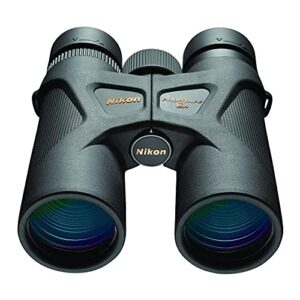
The Nikon Prostaff 8×42 is a strong first choice for anyone stepping into birding or wildlife watching. Its 8×42 configuration hits the beginner sweet spot — steady enough to hold by hand, bright enough for most daylight conditions.
Phase-corrected roof prisms and multilayer-coated eco-glass lenses deliver sharp, color-accurate images across the field.
The twist-up eyecups accommodate glasses wearers comfortably, and the nitrogen-filled, waterproof housing means unpredictable weather won’t cut your outing short.
| Best For | Beginner birders and wildlife watchers who want reliable, all-weather optics at an accessible level. |
|---|---|
| Magnification | 8× |
| Objective Lens | 42mm |
| Optical Coating | Multilayer eco-glass |
| Weight | 551g (1.2lb) |
| Eyecup Design | Turn-and-slide rubber |
| Weatherproofing | Waterproof & fog-proof |
| Additional Features |
|
- Multilayer-coated Eco-Glass lenses deliver sharp, bright images in typical daylight conditions
- Turn-and-slide rubber eyecups offer comfortable eye relief, making them a great fit for glasses wearers
- Waterproof and fog-proof construction holds up to unpredictable outdoor conditions
- Image brightness noticeably drops in low-light situations like dawn or dusk
- No built-in tripod mount makes steady long-distance viewing tricky
- The diopter ring can be stiff and frustrating to fine-tune
2. Vortex Diamondback HD Binoculars
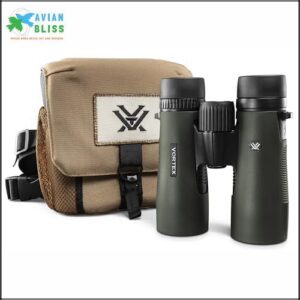
The Vortex Diamondback HD is where things start to get seriously capable. At 8×42 with 393 ft/1,000 yd field of view, it tracks birds through tree canopies without losing them.
The HD optical system, dielectric prism coatings, and fully multi-coated lenses produce bright, color‑faithful images — even pushing into dusk.
It weighs just 8 oz, so fatigue isn’t a factor on long outings.
The unlimited transferable lifetime warranty adds real long‑term confidence for any new buyer.
| Best For | Birders, hunters, and outdoor enthusiasts who want high-performing, durable binoculars with long-term warranty coverage at a mid-range price. |
|---|---|
| Magnification | 8× |
| Objective Lens | 42mm |
| Optical Coating | Fully multi-coated |
| Weight | 227g (8oz) |
| Eyecup Design | Twisted adjustable |
| Weatherproofing | Waterproof & fog-proof |
| Additional Features |
|
- Bright, color-accurate images thanks to fully multi-coated lenses and dielectric prism coatings — great in low light
- Lightweight at just 8 oz, making them comfortable for all-day use in the field
- Unlimited transferable lifetime warranty offers strong long-term value and peace of mind
- The focus wheel is overly sensitive, making precise adjustments tricky at varying distances
- The diopter has no lock, so it can drift during active use
- Optical quality, while solid for the price, falls short of premium ED-glass binoculars
3. Celestron Nature DX Binoculars
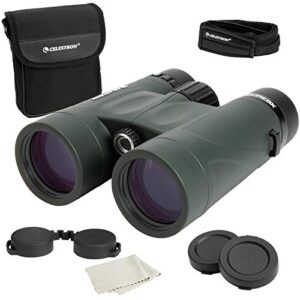
If the Vortex left you wanting more optical muscle, the Celestron Nature DX ED steps up with extra-low dispersion glass that noticeably cuts chromatic aberration — those distracting color fringes around high-contrast edges. Paired with phase-coated BAK-4 prisms and fully multi-coated lenses, you get sharp, color-faithful views even in forest shade.
The waterproof, nitrogen-purged body withstands unpredictable weather confidently. At 8×42, it’s a natural fit for birding and wildlife observation, and the generous eye relief works well for glasses wearers.
| Best For | Birders, wildlife watchers, and outdoor enthusiasts who want sharp, color-accurate optics in a durable, weather-ready package — especially eyeglass wearers who need comfortable eye relief. |
|---|---|
| Magnification | 8× |
| Objective Lens | 42mm |
| Optical Coating | Fully multi-coated |
| Weight | 794g (1.75lb) |
| Eyecup Design | Twist-up |
| Weatherproofing | Waterproof & fog-proof |
| Additional Features |
|
- Fully multi-coated optics with phase-coated BaK-4 prisms deliver bright, high-contrast views with accurate color rendition, even in low-light conditions
- Waterproof and nitrogen-purged body handles rain, fog, and unpredictable weather without missing a beat
- Generous eye relief and twist-up eyecups make extended viewing comfortable for glasses wearers
- The small internal eyecup screws have a reputation for loosening over time with heavy use
- The tripod adapter socket is built in, but the adapter itself isn’t included — that’s an extra purchase
- The strap and grip can get uncomfortable during very long viewing sessions
4. Bushnell Waterproof 8×42 Binoculars
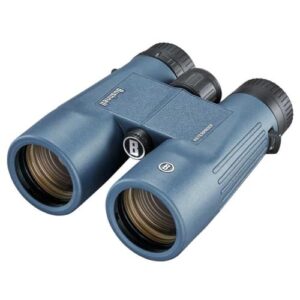
If the Celestron impressed you with its optics, the Bushnell H2O 8×42 brings a different strength to the table: rugged, real-world durability. Its IPX7 waterproof rating covers full submersion up to 30 minutes — not just splashes. Nitrogen purging keeps internal fogging out when temperatures shift fast.
BAK-4 prisms and fully multi-coated lenses deliver clear, bright views, while the non-slip rubber armor and large focus wheel make it genuinely comfortable for extended use, even with gloves on.
| Best For | Outdoor enthusiasts — birders, hunters, and boaters — who need a tough, weatherproof binocular that can take a beating in wet or unpredictable conditions. |
|---|---|
| Magnification | 8× |
| Objective Lens | 42mm |
| Optical Coating | Fully multi-coated |
| Weight | Not specified |
| Eyecup Design | Twist-up |
| Weatherproofing | IPX7 waterproof & fog-proof |
| Additional Features |
|
- IPX7-rated waterproofing means it can handle full submersion, not just rain or splashes
- Non-slip rubber armor and ergonomic grip make it comfortable for long sessions, even with gloves
- BAK-4 prisms and fully multi-coated lenses provide solid, bright image quality across a range of lighting conditions
- Bulkier than compact models, so it’s not the best pick for minimalist backpacking trips
- The diopter and focus lever can feel a bit imprecise, which may require some fiddling to dial in
- Optical brightness and contrast don’t quite match higher-end or larger-objective binoculars at the same price range
5. Celestron Outland Waterproof Binoculars
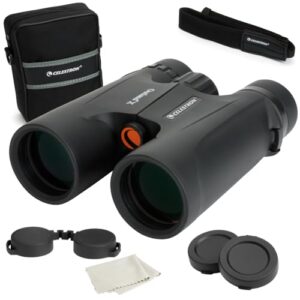
Another standout in Celestron’s lineup, the Outland Waterproof 8×42 is purpose‑built for beginners who spend real time outdoors.
Its roof prism construction keeps things compact and trail-ready, and understanding how prism design affects image clarity and brightness can help you appreciate why that choice matters for outdoor use.
It pairs fully multi-coated optics with BAK-4 prisms for sharp, high‑contrast images across the field.
The nitrogen‑purged, rubber‑armored body withstands rain and rapid temperature swings without fogging up inside.
With 18 mm eye relief and twist‑up eyecups, it suits glasses‑wearers comfortably.
A built‑in tripod adapter is a bonus most beginners won’t expect at this price point.
| Best For | Outdoor enthusiasts and beginner birders who want reliable, weatherproof optics with eyeglass-friendly design at an accessible price point. |
|---|---|
| Magnification | 8× |
| Objective Lens | 42mm |
| Optical Coating | Fully multi-coated |
| Weight | 624g (22oz) |
| Eyecup Design | Twist-up |
| Weatherproofing | Waterproof & fog-proof |
| Additional Features |
|
- Fully multi-coated optics and BaK-4 prisms deliver bright, sharp, high-contrast images even in low light
- Waterproof and nitrogen-purged construction handles rain, fog, and temperature changes without missing a beat
- Built-in tripod adapter and 18 mm eye relief with twist-up eyecups add real value for glasses-wearers and steady viewing
- Tripod adapter threads are built in, but you’ll need to buy the adapter itself separately
- The eyecup click mechanism can stiffen or lose tension after prolonged exposure to moisture
- 8× magnification is great for general use but may fall short for long-range identification where a 10× or 12× would shine
6. Nikon Aculon 8×42 Binoculars
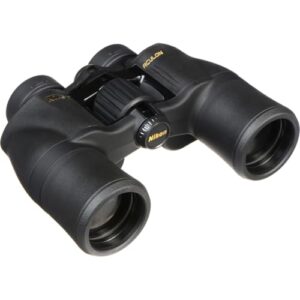
The Aculon 8×42 is Nikon’s practical answer for beginners who want trusted optics without overspending. Its BaK-4 porro prisms produce bright, high-contrast images, and the aspherical eyepiece lenses keep edge sharpness impressive across the field.
At 755 g, it’s heavier than ideal for long hikes, and the 12 mm eye relief falls short for eyeglass wearers. It also lacks waterproofing, so rainy-day outings call for extra care.
| Best For | Beginners and casual outdoor enthusiasts who want reliable Nikon optics for birdwatching or wildlife observation without breaking the bank. |
|---|---|
| Magnification | 8× |
| Objective Lens | 42mm |
| Optical Coating | Multilayer-coated |
| Weight | 755g (2.4lb) |
| Eyecup Design | Turn-and-slide rubber |
| Weatherproofing | Not rated |
| Additional Features |
|
- Aspherical eyepiece lenses deliver sharp, distortion-free images right to the edges of the field
- Multilayer-coated optics and a 5.3 mm exit pupil make for a bright, clear view even in lower light
- Rubber-armour coating and optional tripod adapter make it a solid, versatile companion for rugged outdoor use
- At 755 g, it’s on the heavier side and can cause fatigue during long handheld sessions
- No waterproof or fog-proof rating means you’ll need to be careful in rain or high humidity
- The 12 mm eye relief is tight for eyeglass wearers, and a 5 m minimum focus distance limits close-up viewing
7. Pentax Compact Outdoor Binoculars

When every gram in your pack matters, the Pentax Compact Outdoor earns its spot. Weighing around 300 g with an 8×25 configuration, it’s light enough to forget you’re carrying it.
BaK-4 prisms and fully multi-coated lenses deliver sharp, color‑accurate views, while 21 mm eye relief keeps eyeglass wearers comfortable.
Its nitrogen‑purged, waterproof build copes with trail weather without fuss.
The main trade‑off is a narrower field of view compared to 8×42 models.
| Best For | Hikers, bird-watchers, and travelers who want a lightweight, weatherproof binocular that works comfortably with glasses. |
|---|---|
| Magnification | 8× |
| Objective Lens | 25mm |
| Optical Coating | Full multi-layer (FMC) |
| Weight | ~300g (0.66lb) |
| Eyecup Design | Telescoping twist-up |
| Weatherproofing | Waterproof JIS Class 6 |
| Additional Features |
|
- Fully multi-coated lenses and BaK-4 prisms produce bright, sharp, color-accurate images even in low light
- At ~300 g with a waterproof, nitrogen-filled build, it’s easy to pack and ready for unpredictable weather
- 21 mm eye relief with adjustable eye cups means eyeglass wearers get the full field of view without hassle
- Narrower field of view than larger 8×42 models, which can make tracking moving subjects trickier
- The hard-shell case fits so snugly that getting the binoculars in and out becomes a minor chore
- Strap attachment loops sit on top rather than the sides, which feels awkward and doesn’t lie flat against your chest
8. Steiner Predator Auto Focus Binoculars
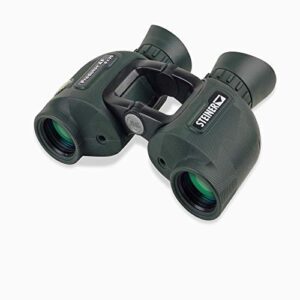
What if you never touched a focus wheel again? Steiner’s Predator AF auto-focus system keeps everything from 60 feet to infinity sharp after one quick diopter setup, letting you track skittish wildlife instantly.
Fully multicoated BAK-4 roof prisms boost contrast and color, while NBR rubber armor and nitrogen-filled sealing shrug off rain and rough trails.
Close focus reaches roughly 6 feet, and the compact, balanced body rides comfortably on long hikes, ideal for beginners wanting grab-and-go simplicity without fiddling with focus knobs.
| Best For | Hunters and wildlife watchers who want a lightweight, grab-and-go binocular that stays focused without constant adjustments during fast-moving action in daylight conditions. |
|---|---|
| Magnification | 8× |
| Objective Lens | 30mm |
| Optical Coating | Multi-coated |
| Weight | Not specified |
| Eyecup Design | Standard rubber |
| Weatherproofing | Waterproof & fog-proof |
| Additional Features |
|
- Set-it-and-forget-it single-focus system locks in sharp views from 60 feet to infinity, so you can track moving game without fumbling with a focus wheel
- CAT coating boosts color contrast and separation in dense foliage, making it easier to spot animals blending into vegetation
- Fully waterproof, fog-proof, and built on a lightweight open-bridge frame — ready for rain, rough trails, and all-day carries
- The 30 mm objective struggles in low light, making it a poor choice for dawn, dusk, or heavily shaded conditions
- Shared use is a minor hassle — each new user has to reset the diopter, since there are no markings to return to a saved position
- The basic neck strap gets uncomfortable on longer outings, and accessory instructions (like the neoprene sleeves) aren’t as clear as they should be
9. Vanguard 8×42 ED Binoculars
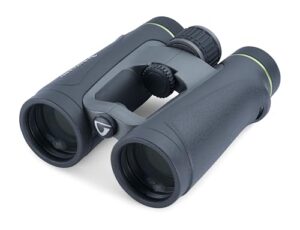
The Vanguard Endeavor ED 8×42 punches well above its mid-range price tag. Extra-low dispersion glass paired with phase-corrected BaK-4 prisms delivers sharp, color-accurate images with minimal chromatic fringing — a noticeable step up from basic beginner glass.
Its magnesium alloy chassis stays light despite rubber armor and full weatherproofing, while the 19 mm eye relief and three-stage twist-up eyecups make it genuinely comfortable for eyeglass wearers heading into the field.
| Best For | Wildlife observers, hunters, and birders who want high-resolution, low-light performance in a weather-ready binocular without jumping to a premium price point. |
|---|---|
| Magnification | 8× |
| Objective Lens | 42mm |
| Optical Coating | Fully multi-coated |
| Weight | 785g (27.7oz) |
| Eyecup Design | Three-stage twist-up |
| Weatherproofing | Waterproof & fog-proof |
| Additional Features |
|
- Extra-low dispersion glass and phase-corrected BaK-4 prisms produce sharp, color-accurate images with very little chromatic fringing
- Fully multi-coated optics and nitrogen-purged, waterproof housing make it a reliable all-weather companion from dawn through dusk
- 19 mm eye relief and three-stage twist-up eyecups offer genuine comfort for eyeglass wearers during long sessions
- At nearly 28 oz, it’s heavier than many competing 8×42 models, which can cause fatigue during extended handheld use
- Some users report a sticky or jumpy focus wheel and diopter knob that can make precise adjustments frustrating
- The diopter ring has shown failure in some units, and the carrying case fits snugly enough to require careful handling
10. Carson Waterproof Birdwatching Binoculars
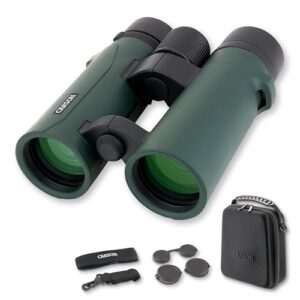
Carson’s Waterproof Birdwatching Binoculars round out this list as a solid, no-fuss option for beginners who want reliability without complexity. The 10×42 configuration with fully multi-coated lenses and BAK-4 prisms delivers bright, sharp views at dawn or dusk — prime birding hours.
Nitrogen-purged, O-ring-sealed barrels keep fog and moisture out, and the rubber armor cushions trail bumps without complaint. Twist-up eyecups with comfortable eye relief make extended sessions easier, whether you’re wearing glasses or not.
| Best For | Beginner birders and outdoor enthusiasts who want dependable, weather-ready optics at an approachable level of complexity. |
|---|---|
| Magnification | 8× |
| Objective Lens | 42mm |
| Optical Coating | Fully multi-coated |
| Weight | 640g (1.4lb) |
| Eyecup Design | Twist-down |
| Weatherproofing | Waterproof & fog-proof |
| Additional Features |
|
- BAK-4 prisms and fully multi-coated lenses produce bright, sharp, color-accurate images — great for low-light birding at dawn or dusk
- Nitrogen-filled, O-ring-sealed housing keeps fog and moisture out, making it genuinely field-ready in wet conditions
- 17 mm eye relief and twist-down eyecups make extended viewing comfortable, even for glasses wearers
- The carry case feels budget-grade — thin zippers and no belt loops make it less practical for serious field use
- The eyecup adjustment can feel loose, which may frustrate users who need a precise, consistent fit
- Field of view and close-focus distance are on the modest side, limiting wide-area scanning and very close-up subjects
Best Binocular Specs for Beginners

Knowing which specs actually matter can save you from a lot of second-guessing at the store — or worse, buyer’s remorse on the trail. A few key numbers tell you most of what you need to know before committing to a pair. Here are the specs worth understanding before you buy.
8×42 Beginner Sweet Spot
Few formats earn as much universal praise among beginners as the 8×42 configuration. With a 5.25 mm exit pupil, it delivers solid low-light performance, perfect for dawn and dusk viewing.
The magnification stays manageable for handheld stability, while the 42 mm lens gathers enough light for comfortable birdwatching without fatigue — a genuinely budget-friendly, compact sweet spot in optical performance.
Its wider field of view helps scan dense cover efficiently.
Magnification Versus Image Stability
Once you move past 8×, things get trickier. Handheld shake becomes visible at 10× and grows noticeably worse above 12×, where even a steady hand can blur the image.
That’s why 8× stays the go-to for beginners — it keeps your view steady without forcing you to reach for a tripod every time something moves.
Objective Lens Brightness
The objective lens diameter is one of the biggest drivers of image brightness. A 42 mm lens gathers much more light than a 25 mm compact, which matters most in shaded forests or overcast skies.
That light-gathering ability, combined with BAK-4 prism design and fully multi-coated optics, pushes light transmission above 95% — keeping images clear and vivid even when conditions aren’t.
Field of View Basics
Field of view is simply how wide a slice of the world you can see through your binoculars at once — usually measured in feet at 1,000 yards.
A typical 8×42 offers around 340–420 feet of coverage, letting you sweep across a treeline and reacquire moving birds quickly, without the narrow tunnel-vision that higher magnifications tend to create.
Close Focus for Birds
Watching a warbler hop through a hedge just three feet away is thrilling — but only if your binoculars can actually focus that close. For binoculars for bird watching beginners, look for a minimum focus distance of five feet or less. That sharpness unlocks real feather detail clarity for confident bird identification.
- Small bird observation improves dramatically at close range
- Close-range plumage inspection reveals eye color and beak texture
- 8x magnification helps reduce shake at near distances
- Strong close focus suits habitat viewing in dense hedges
Birdwatching Features That Matter

Not all binoculars are built with birdwatching in mind, and that difference shows up fast in the field. The right pair gives you quick target acquisition, comfortable long sessions, and the clarity to catch every color detail before a bird disappears into the canopy. Here’s what to look for.
Wide View for Tracking
A wide field of view is honestly one of the most underrated specs for first-time binocular buyers.
When a bird darts through the canopy, widefield viewing — usually 6 to 8 degrees in good 8×42 models — keeps you locked on without constant re-aiming. That scanning speed and subject re-acquisition advantage matters more in the field than any spec sheet suggests.
Color Clarity and Contrast
Color is where good optics quietly earn their place. Fully multi-coated lenses reduce spectral dispersion, so the greens, blues, and browns you see through the eyepiece stay true — not washed out or shifted.
Low-light contrast improves noticeably with quality coatings, and edge-to-edge sharpness keeps color fidelity consistent from center to corner, giving you a cleaner, more natural image throughout.
Eye Relief for Glasses
If you wear glasses, eye relief is non-negotiable. It’s the distance between the eyepiece and your eye — too short, and the edges of your view darken from vignetting.
Look for at least 18 mm of eye relief, which lets your lenses sit comfortably between your eye and the glass without losing the full picture. Twist-up eyecups help you fine-tune that position precisely.
Lightweight Field Comfort
A long day in the field will expose any weak link in your setup — and heavier binoculars are often the first thing you’ll regret.
Compact beginner models built from magnesium or polycarbonate alloys cut weight by up to 20 percent, letting you glass for hours without arm fatigue. Pair that with weight distribution straps, and the whole kit becomes genuinely portable.
Twist-up Eyecups
Twist-up eyecups seem like a small detail — until you’re wearing glasses and can’t see the full picture. Eye relief for glasses wearers depends entirely on this mechanism: rotating the cups down brings the eyepiece closer to your eye, eliminating the dark vignette that ruins an otherwise perfect view.
Most modern designs lock at five or six discrete settings, giving you precise, repeatable alignment every time.
Optics Quality and Prism Types
The glass inside your binoculars matters far more than most beginners expect — it’s what separates a crisp, vivid image from a muddy, frustrating one.
Understanding a few key optical features will help you cut through the spec sheet noise and pick something that actually delivers. Here’s what to look for regarding prisms, coatings, and glass quality.
BAK-4 Versus BK-7 Prisms
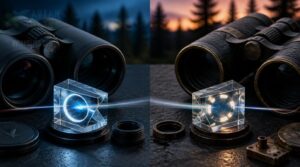
When you hold two pairs of binoculars side by side, the prism inside quietly determines everything.
BAK-4 prisms use a higher refractive index than BK-7, delivering rounder exit pupils, brighter edges, and more consistent low-light performance.
BK-7 prisms cost less but can scatter light slightly at the edges.
For beginners, BAK-4 is worth the modest price difference.
Roof Versus Porro Design
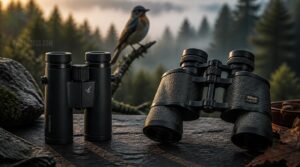
Prism design shapes how your binoculars feel in hand just as much as how they perform optically.
Roof prisms create a straight, compact light path — slimmer tubes, easier packing. Porro prisms offset the lenses, making binoculars wider but often delivering more natural image depth perception at lower prices. For beginners watching budgets, porro designs frequently outperform roof models dollar-for-dollar.
Porro prisms cost less than roof designs yet often outperform them dollar-for-dollar on image depth
Fully Multi-coated Lenses
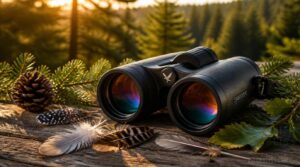
Lens coatings are where optical performance quietly separates the good from the great. Fully multi-coated lenses apply anti-reflective layers to every air-to-glass surface, pushing light transmission past 90–95% — meaning brighter, truer images with less eye strain. In low-light viewing, that difference becomes immediately obvious.
FMC coatings also cut glare and preserve color fidelity, so feather details and foliage textures stay crisp rather than washed out.
ED Glass Benefits
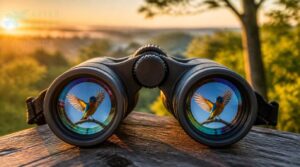
When fully multi-coated lenses enhance light transmission, low-dispersion ED lenses take image quality a step further by tackling chromatic aberration — the color fringing you’ll notice along high-contrast edges like a bird against a bright sky.
- Color fidelity accuracy keeps plumage tones true at dawn and dusk
- Edge sharpness improvement reveals subtle field markings clearly
- Low-light transmission stays consistent from center to edge
Reducing Glare and Distortion
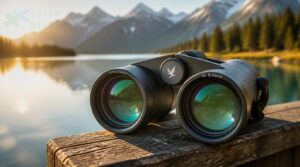
Glare and distortion can quietly ruin an otherwise perfect view. Anti-reflective coatings suppress surface reflections by up to 99%, while aspherical lens elements keep edges sharp and distortion-free. Chromatic glare reduction through ED glass and multicoating benefits ensures truer colors without fringing. Better exit pupil illumination means brightness stays even across the entire field.
| Feature | Benefit |
|---|---|
| Anti-reflective coating | Cuts surface glare up to 99% |
| Polarizing lens | Reduces water/glass reflections |
| Aspherical elements | Sharper edge-to-edge clarity |
| Chromatic aberration mitigation | Truer colors along contrast edges |
| Gloss reduction | Less scatter in bright daylight |
Weatherproof and Portable Designs

When you’re out in the field, weather rarely cooperates with your plans. The right binoculars need to handle rain, fog, and rough handling without missing a beat — and the good news is there are solid options across every budget. Here’s what to look for in a weatherproof, portable design.
Waterproof Versus Water-resistant
Can your gear survive a swim, or just a drizzle? Waterproof binoculars handle true submersion; water-resistant gear only blocks splashes. IPX7 Rating Explained: 1 meter, 30 minutes, sealed tight.
- Submersion vs Splashes: match rating to activity
- Seal Maintenance Tips: inspect gaskets yearly
- Protecting Optical Seals: avoid harsh cleaners
Rugged outdoor optics need weathersealed construction, giving you durable construction you trust.
Fog-proof Sealed Bodies
When temperatures drop suddenly, moisture inside your binoculars can cloud your view at the worst possible moment.
Fog-proof sealed bodies solve this through a nitrogen-purge process — inert gas replaces interior air, eliminating condensation risk entirely. Some premium models use argon gas for greater thermal stability.
Inspect gaskets periodically, since seal durability determines long-term fogproof housing performance across demanding, weathersealed construction conditions.
Rubber Armor Protection
Rubber armor is your binoculars’ first line of defense against real‑world punishment.
That rubberized grip does double duty — absorbing impact absorption from drops while giving your hands a secure hold in wet or cold conditions.
It also contributes to weather sealing by closing minor exterior gaps, and quality blends offer UV stability to resist fading during long field days.
Compact Travel Binoculars
When you’re packing light, every ounce matters.
Compact travel binoculars — commonly 8×25 to 8×42 with weights under 500 grams — slip easily into a jacket pocket or daypack without slowing you down. Models like the Olympus WP II, at just 260 g, prove that lightweight portable design doesn’t mean sacrificing fully multi‑coated lenses or solid handheld stability.
Tripod-ready Options
Ever wished your view stayed rock-steady at high magnification? Most beginner binoculars are tripod mountable, with a tripod adapter socket between the barrels.
- Universal Thread Compatibility via 1/4-20 sockets
- Arca-Swiss Quick-Release plates for instant tripod mount swaps
- Vehicle Window Mounts for wildlife watching
- Ball Head Selection balances weight and quick aiming
- Stability Counterweight Systems prevent tip-over during high-magnification tripod usage
Beginner Buying and Use Tips

Picking the right binoculars is only half the battle — knowing how to use and care for them is what turns a good purchase into a lasting one. Whether you’re working out a budget or figuring out which features actually matter for your needs, a few straightforward tips can save you time and frustration.
Here’s what every first-time buyer should know before heading outdoors.
Budget Ranges Explained
Budget-friendly options span $90 to $1,000 and beyond, with each tier revealing distinct entry-level trade-offs. Sub-$150 picks skimp on coatings and eye relief.
Mid-range value emerges near $200–$400, adding BAK-4 prisms and FMC glass. Premium glass upgrades arrive around $600, sharpening contrast and clarity. These budget feature limits shape your price-performance ratios, helping budget-conscious models become genuinely budget-friendly birding gear.
Best Value Features
Once you know your budget tier, the next step is squeezing the most performance from every dollar you spend.
For first-time binocular buyers, brightness per dollar matters most — the Nikon ProStaff P3 delivers solid relative brightness at roughly $140, while the Vortex Diamondback HD’s lifetime transferable warranty justifies its higher price through long‑term ownership value.
First-time Focusing Steps
Getting your first proper focus means working through a quick three-step setup before you ever find a bird.
Start by setting your eyecups — twist them up if you don’t wear glasses, down if you do. Then spread the barrels wide and slowly close them until two circles merge into one, matching your eye spacing exactly.
Diopter Adjustment Basics
Once your eyes are aligned and your eyecups are set, the next thing to calibrate is the diopter adjustment — a small wheel near the right eyepiece that corrects for differences between your two eyes.
Close your left eye, use only the center focus wheel until the right eye sees clearly, then open both eyes to experience that satisfying three-dimensional pop.
Cleaning and Storage Tips
Taking care of your binoculars is simpler than you’d think.
After each outing, brush loose dust away with a soft lens brush first, then apply lens solution to a clean microfiber cloth — never directly onto the glass.
Store them upright in a padded protective case with silica gel packs inside, targeting 40–45% humidity to protect coatings, seals, and glass long‑term.
Frequently Asked Questions (FAQs)
Can I use binoculars with glasses or contacts?
Yes, absolutely. With long eye relief (18–20 mm) and twist-up eyecups fully retracted, glasses wearers see the complete image without vignetting. Watch for dark edge rings when testing — that signals insufficient clearance.
What does the center focus wheel actually do?
The center focus wheel shifts internal lenses to align light precisely onto your eyepiece plane — sharpening both eyes simultaneously with one smooth turn, covering everything from close subjects to distant horizons.
How far can binoculars actually see clearly?
There’s no fixed answer — clear viewing distance depends on magnification, lens size, and atmospheric conditions. A standard 8×42 pair resolves high-contrast objects around 1–2 miles under good daylight, though haze or fog cuts that dramatically.
Are expensive binoculars always better than cheap ones?
Not always. A mid-range $300 pair often delivers 80% of a premium model’s performance at a fraction of the cost — making thoughtful spec-matching smarter than simply spending more.
Do binoculars need batteries or special power sources?
Most binoculars need no batteries at all — they’re purely optical. Only specialized types like image-stabilized, night vision, or digital models require power. For beginners, standard optics stay simple, reliable, and always ready.
Can children use adult binoculars comfortably?
Yes, children can use adult binoculars, but weight and eye relief matter most. Models under 700 g with 8x magnification and adjustable eyecups make the experience comfortable and fatigue-free for younger users.
How long do beginner binoculars typically last?
Entry-level binoculars usually last 3–5 years with regular use. Mid-range models stretch to 5–15 years when stored properly. Build quality, rubber armor, and sealed waterproof construction dramatically extend lifespan.
Are binoculars safe for solar observation?
Standard binoculars concentrate sunlight dangerously, risking permanent eye damage in seconds. Never point them at the sun without ISO 12312-2 certified solar filters covering both objective lenses securely.
What accessories come included with binoculars?
Most kits pack protective lens caps, a microfiber cloth, carrying strap, and a padded carrying case. Some bundles add a tripod adapter — small extras that make every outing cleaner and more comfortable.
Can binoculars be used for stargazing effectively?
Binoculars work surprisingly well for stargazing. A 10×50 setup delivers a 5mm exit pupil — perfect for dark-adapted eyes — while keeping magnification handheld-stable and gathering enough light to reveal star clusters clearly.
Conclusion
Like a trailhead sign pointing you toward unmarked terrain, the right binoculars for beginners don’t complete the journey—they begin it. Every specification you’ve learned here is a compass bearing: BaK-4 prisms sharpen your edges, wide field of view keeps you oriented, and weatherproofing means weather won’t turn you back.
You don’t need perfect gear—you need good-enough gear held by someone finally paying attention. The landscape has always been remarkable. Now you can actually see it.
- https://www.nytimes.com/wirecutter/reviews/the-best-binoculars
- https://shopping.rspb.org.uk/page/how-to-choose-binoculars-for-bird-watching
- https://gearjunkie.com/technology/best-binoculars
- https://imaging.nikon.com/sport-optics/guide/binoculars/basic/basic_02
- https://www.rei.com/learn/expert-advice/binoculars.html