This site is supported by our readers. We may earn a commission, at no cost to you, if you purchase through links.
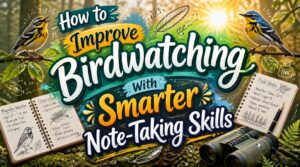
Most birders carry binoculars. Far fewer carry a pen. That small habit separates the casual observer from someone who actually knows the birds they’ve seen—not just vaguely remembers them.
Memory is a terrible field notebook. A warbler’s eye ring fades from your mind faster than it vanishes into the canopy. The specific rhythm of a call, the exact breast streak pattern, the way a bird held its wings on landing—gone within hours, replaced by a composite blur of similar sightings.
Smarter note-taking closes that gap. It sharpens your eye in the field, builds an honest record of what you’ve observed, and turns scattered outings into something that compounds over time. Whether you’re trying to crack a tough ID or contribute reliable data to platforms like eBird, the notes you take today become the expertise you carry tomorrow.
Table Of Contents
Key Takeaways
- Detailed field notes — capturing plumage, behavior, habitat, and weather — sharpen your identification skills in real time and build a reliable reference you’ll return to for years.
- Consistent, structured documentation using timestamps, GPS coordinates, species counts, and confidence levels transforms casual sightings into data that holds up under scientific scrutiny.
- The right tools — waterproof notebooks, quality binoculars, a birding app like Merlin, and an audio recorder — each serves a distinct purpose that together close the gap between what you observe and what you actually remember.
- Submitting standardized notes to platforms like eBird connects your personal logbook to global conservation research, turning individual observations into long‑term biodiversity data that genuinely matters.
Improve Birdwatching With Better Notes

Better notes don’t just help you remember what you saw — they sharpen how you see in the first place. A few consistent habits in the field can transform scattered sightings into a meaningful record you’ll return to for years. Here’s what smarter note-taking actually does for your birdwatching.
Digging into how to record bird sightings accurately reveals just how much detail — behavior, light, habitat — can turn a casual log into something genuinely insightful.
Consistent field habits don’t just record what you saw — they transform how you see
Sharpen Species Identification
Precise notes transform guesswork into certainty. When you document plumage pattern nuances — wing bars, rump color, breast streaks — you build a reliable reference for every future encounter.
Five field marks worth capturing every time:
- Wing bar width and contrast
- Bill thickness and base depth
- Eye ring and head stripe clarity
- Underparts shading and breast streaks
- Call rhythm and note cadence
Track Sightings Over Time
Once you’ve captured field marks with care, the next step is building a record that reveals patterns across time.
A cumulative sighting count shows how a species accumulates in your logbook week by week. Link each eBird checklist to consistent timestamps, and seasonal peak analysis surfaces migration windows you’d otherwise miss.
Gaps in your data recording signal low-effort periods worth addressing.
Remember Key Field Details
Patterns only mean something when the details behind them hold up to scrutiny.
- Note the exact date and time to the nearest minute
- Log GPS coordinates or a clear habitat description
- Record your observer initials for attribution
- Estimate bird size against a known species
- Document light direction and weather conditions
These anchors turn raw sightings into reliable, revisitable field notes.
Support Citizen Science Records
Those field details you’ve captured don’t just serve your personal logbook — they feed something much larger. Platforms like eBird run automated checks that flag inconsistent dates or locations, and expert reviewers assess unusual sightings before records go public.
Your standardized birding field notes, submitted with certainty levels and method metadata, contribute directly to long-term biodiversity trends that shape real conservation decisions. The aggregated, crowd‑sourced biodiversity data help scientists monitor species trends and inform conservation.
Choose Reliable Field Note Tools

The tools you carry into the field shape everything that comes after — how accurately you record, how quickly you confirm an ID, and how much useful data you actually bring home. Getting the right kit together doesn’t have to be complicated, but each piece earns its place for a reason.
Here’s what experienced birders rely on to keep their notes sharp and reliable.
Waterproof Birding Notebook
Rain doesn’t wait for a convenient moment. A waterproof birding notebook built from synthetic paper stays legible after a downpour, while stone paper withstands rough handling without tearing. For high-humidity environments, polypropylene pages prevent ink smudging entirely.
Pair your weather-ready notebook with a solid grasp of basic bird identification characteristics so quick field sketches capture the right details even when conditions turn ugly.
Look for these features in your birding field journal:
- Wire-O binding to keep pages flat
- A5 size for balance between detail and portability
- Polydur covers that resist scratches
Pencil and Highlighters
A graphite HB pencil writes reliably on synthetic paper without smearing, even in damp conditions where ink fails.
Softer B grades suit quick sketches; harder H grades keep lines crisp for small handwriting.
For color coding species groups, a chisel-tip fluorescent highlighter scans fast at a glance.
Just check your notebook’s paper weight — thin pages bleed through under heavy highlighter strokes.
Binoculars for Plumage Details
Good binoculars reveal what your notebook can’t capture alone — the subtle wing bar, the exact cap tone, the pale fringe on a tertial edge.
- 8x–10x magnification suits most passerine work without excessive hand shake
- ED or fluoride glass reduces color fringing on backlit plumage
- Fully multi-coated lenses sharpen contrast between feather bands
- 16–20 mm eye relief preserves detail visibility for glasses wearers
- Waterproof, fogproof construction protects optics during misty dawn surveys
Field Guide or Birding App
A birding app like Merlin narrows your options instantly using real-time location, date, and observed size, color, and habitat — cutting a sizeable species list down to a handful of realistic candidates.
For deeper offline use, the Sibley Guide to Birds stays reliable without cell service. Merlin’s audio call comparison and photo matching tools let you cross-check what you saw and heard before writing anything permanent in your notebook.
Audio Recorder for Calls
A call heard once is a call half-identified. Devices like the Sony PCM-M10 and Tascam DR-05 capture birdcalls at sample rates up to 192 kHz, preserving detail that your ears miss in the moment.
Stereo recording keeps directional cues intact, and lossless WAV files hold up under spectrogram analysis — letting you compare pitch and harmonic structure long after the bird has gone.
Record Every Birdwatching Sighting Clearly
Every sighting you record is only as useful as the details behind it. Vague notes like "small brown bird near the pond" won’t hold up when you’re trying to identify a species weeks later or contribute data to a larger study. Here’s what to capture each time you spot a bird in the field.
Date, Time, and Location

Every sighting starts with a timestamp and a pinpoint. Log date, time, and GPS coordinates first — before details fade.
- Record dawn and dusk sessions separately
- Note your timezone for cross-regional consistency
- Describe the microhabitat: canopy edge, streamside marsh
- Flag seasonal timing like spring migration windows
Geotagged observations transform casual birding field notes into a reliable recordkeeping system others can actually use.
Species Name and Count

Once your location is locked in, the next step is naming what you saw — precisely. Write the full binomial name (Setophaga coronata, not just "warbler") alongside the common name so your records stay compatible with platforms like eBird.
Log counts carefully, noting adult versus juvenile individuals when possible. If you counted 3–5 birds moving through, record that range. Assign a confidence level — probable or definite — based on how clearly you observed plumage or heard the call.
Weather and Light Conditions

Naming species precisely sets the foundation, but the conditions around you shape everything you actually see. Light angle and cloud cover change how plumage reads dramatically — sunrise produces warm, directional light that lifts feather edges into relief, while midday sun creates harsh shadows that flatten color and obscure fine markings.
Log these details consistently:
- Overcast vs. clear sky and estimated cloud coverage
- Wind direction and approximate speed
- Temperature range and precipitation type
- Visibility distance and atmospheric clarity
Dry, crisp air makes blues and greens pop; humid mornings wash out reds and yellows. That difference matters when you’re comparing two similar species by color alone.
Habitat and Micro-habitat

Where you stand tells only half the story. Note the vegetation layer — canopy, understory, or ground cover — and the substrate beneath: wet leaf litter, sandy soil, or rotting wood each attracts different species.
A sunlit clearing draws insectivores; a moss-covered seepage pulls moisture‑lovers closer.
These microhabitat details transform a vague sighting into genuinely useful birding field data.
Behavior, Calls, and Movement

Watch what a bird does as closely as what it looks like. Note flight style and movement cues — tail flicks, wing flicks, stretched necks — since these often confirm identity faster than plumage alone.
Capture vocalization context too: is that call an alarm, a contact note, or a flight signal? Your audio recorder catches what your pen can’t.
Use Notes to Improve Identification

Your field notes are only as useful as the details you capture in the moment. A sharp description of what you actually saw — not just "brown bird, medium size" — is what separates a confirmed ID from a frustrating maybe. Here’s what to focus on when you’re writing things down in the field.
Plumage Patterns and Colors
Plumage holds clues that reward careful notes. Melanin creates bars and spots, while carotenoid pigments — earned through diet — power vivid yellows and reds.
- Structural iridescence shifts color with viewing angle
- UV-reflective patches are clear to birds but invisible to us
- Sexual dimorphism shows in male plumage brightness
Record these differences carefully; they’ll help you separate similar-looking species on any review.
Size, Shape, and Posture
Beyond color, silhouette and posture often clinch an identification faster than any field mark.
A compact torso versus an elongated one changes how a bird sits on a branch entirely. Note wing length relative to body size and whether legs extend or crouch during foraging — these proportions separate look‑alikes at a glance, especially when light fails you.
Feeding and Nesting Behavior
Behavior is often the fastest path to a confident ID. Watch how a bird feeds — nestling feeding intervals can run every 12 to 60 minutes, so patient observation pays off.
Parents brooding while a partner forages, or adults cleaning fecal sacs, signals active nesting. These behavioral field notes narrow species possibilities before you even lift your guide.
Flight Style and Silhouettes
A bird’s flight style is a signature — readable before you ever spot a field mark. Wing aspect ratios tell the story instantly: long, slender wings mean a glider; short, rounded wings mean a forest specialist.
- Deep, slow wingbeats with glides → raptors
- Rapid, shallow strokes → small passerines
- Forked tail silhouette → swallows
- Squared tail → shorebirds
- Staggered V-formation → migratory flocks
Body posture cues and tail silhouette patterns clinch the ID.
Compare Notes With Guides
Your field notes are only half the picture. Holding them beside a trusted guide — the Sibley Guide or Merlin Bird ID — is where resolving identification ambiguity happens in real time.
Check plumage against illustrated field marks, match logged calls to guide descriptions, and use standardized IOC names to keep your birding field record consistent.
Flag anything uncertain with "possibly" and plan a follow‑up.
Organize Notes for Long-Term Birding

Good notes don’t just capture the moment — they build a picture of change over time. The way you organize your records now will determine how useful they are a year, five years, or a decade down the road. Here’s what to put in place to make your long-term birding notes actually work for you.
Standard Abbreviations and Templates
Think of abbreviations as your personal shorthand dialect — once you and your logbook speak the same language, accuracy soars.
- Spell out each term fully on first use, then place the abbreviation in parentheses
- Build a master glossary at the front of every notebook
- Use consistent naming conventions like "cnt" for count, "bld" for breeding
- Apply a standardized field notes template covering date, species, habitat, and behavior
- Audit entries regularly to catch ambiguous abbreviations before they corrupt your data
A clean birding field format means anyone reading your notes — including future you — won’t need to guess.
Digital Backups and Folders
Once your abbreviations are locked in, protecting those notes becomes the next priority.
Store copies in three separate locations — local device, external drive, and cloud. Services like Google Drive offer file versioning, recovering older states after accidental edits.
| Backup Type | Best Use |
|---|---|
| Cloud storage | Offsite, multi-device access |
| External drive | Fast local restoration |
Name files using YYYYMMDD format for instant retrieval.
EBird and Citizen Science
Once your files are safely backed up, your notes can do something far more powerful than sit on a hard drive.
Uploading sightings to eBird connects your observations to a global database launched by Cornell Lab of Ornithology, where data validation protocols flag unusual entries and researchers access pooled records for conservation impact studies. Your checklist becomes part of something genuinely bigger.
Migration Patterns and Trends
Your eBird uploads become even more meaningful when you analyze them over years rather than weeks.
- Flag climate mismatch risks when arrival dates outpace food availability
- Map stopover site importance by noting refueling locations repeatedly visited
- Record altitudinal movement shifts as species track temperature up slopes
- Note wind pattern influence on concentrated fallout days
- Track phenological timing changes across consecutive seasons
Long-term logbooks quietly reveal what single checklists never could.
Seasonal Habitat Changes
Seasons rewrite the landscape faster than most birders expect. Snowmelt water pulses expand wetland edges within days, opening nest sites that simply didn’t exist a week before. Longer spring daylight accelerates insect emergence, shifting foraging windows noticeably.
| Season | Habitat Change | Birding Focus |
|---|---|---|
| Spring | Wetlands expand, shrubs exposed | Waterfowl, early migrants |
| Summer | Dense vegetation cover peaks | Ground-nesters, insectivores |
| Autumn | Leaf fall opens forest floors | Seed-eaters, thrushes |
Log these microclimate temperature shifts alongside your species counts — the patterns will surprise you.
Frequently Asked Questions (FAQs)
How to improve birding skills?
The sharpest birders in the world built their skills one walk at a time. Focus on mental checklist training — size, shape, flight style — and practice silhouette recognition drills until reading birds in motion feels instinctive.
How do I attract rare birds to my yard?
Planting native layered habitat — trees, shrubs, and ground cover — draws rare visitors reliably. Add a circulating water feature, seasonal fruiting shrubs like elderberry, and predator-sheltering thickets to turn your yard into an irresistible stop.
What clothing should I wear for birdwatching trips?
Dress like a medieval scout heading into unknown terrain — quiet, practical, and ready for anything. Layer moisture-wicking base layers, add a waterproof shell, choose muted greens or browns, and wear waterproof boots.
Can birdwatching notes help with mental health benefits?
Yes. Writing down birding observations anchors you in the present, easing rumination and mental noise. Noting joy moments — a rare sighting, a striking call — builds a record of positive experiences that genuinely enhances emotional wellbeing.
How do I find the best birdwatching locations nearby?
Like a compass needle drawn north, your instincts point toward water. Start with regional nature centers and eBird hotspot maps — the Spreewald wetlands and observation towers nearby offer impressive seasonal migration peaks within easy reach.
Should I join a local birdwatching club or group?
Joining a local club connects you with experienced birders who offer mentorship and shared gear. You’ll gain access to guided outings, private habitats, and conservation projects — accelerating your field skills faster than solo practice ever could.
Conclusion
Gilbert White spent decades watching the same Hampshire fields, and his Selborne notebooks became the foundation of modern natural history. That kind of mastery doesn’t happen by accident.
Learning how to improve birdwatching with note‑taking works the same way—each entry sharpens your eye, builds your memory, and turns fleeting sightings into something permanent. Your notebook isn’t just a record. It’s the accumulation of every careful moment you chose to pay attention.
- https://www.aba.org/what-exactly-is-a-field-notebook
- https://bwdmagazine.com/tips-for-birders/getting-started/journal
- https://www.audubon.org/magazine/summer-2020/how-nature-journaling-can-make-you-better-birder
- https://thinkingmuseum.com/2022/06/29/9-thinking-routines-to-improve-your-powers-of-observation
- https://danasnaturereflections.substack.com/p/appreciating-birds-through-nature