This site is supported by our readers. We may earn a commission, at no cost to you, if you purchase through links.
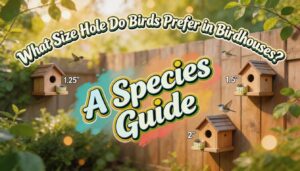
A ¼-inch difference decides whether a bluebird moves in or a European starling takes over. That’s not a rounding error—it’s the difference between a thriving nest and an invaded one. Most birdhouse builders focus on paint color or mounting height, but hole diameter is the single measurement that controls everything else.
Each species carries a hard biological limit: the width of its head. House wrens squeeze through 1⅛ inches. Eastern bluebirds need exactly 1½. Push that opening to 1¾, and starlings—aggressive, cavity-stealing invaders—slip right in behind them. The right diameter doesn’t just welcome the bird you want; it locks out the ones you don’t.
Species-specific sizing, predator guards, placement, and maintenance all hinge on getting that entrance right first.
Table Of Contents
- Key Takeaways
- Birdhouse Hole Sizes Birds Actually Prefer
- Factors That Determine The Right Hole Size
- Top 4 Predator Guards for Birdhouse Entrances
- Birdhouse Design, Placement, and Maintenance Tips
- Frequently Asked Questions (FAQs)
- What size hole does a birdhouse need?
- What is a birdhouse hole size chart?
- How do I choose the right Birdhouse size?
- What size bird nesting hole do I Need?
- What time of year should you put up a bird box?
- Can multiple species share the same birdhouse?
- How do I measure entrance hole size accurately?
- Should hole shape be round or oval?
- Does hole size vary by geographic region?
- How often should entrance holes be resized?
- Conclusion
Key Takeaways
- A ¼-inch difference in entrance hole size is the deciding factor between attracting your target species and losing the box to invasive birds like European starlings.
- Match hole diameter precisely to your target bird: 1⅛ inches for wrens and chickadees, 1½ inches for Eastern bluebirds, and up to 3–4 inches for larger woodpeckers.
- Keep any opening under 1½ inches to lock starlings out—once you exceed that threshold, you’ve handed them an open invitation.
- Hole size alone won’t do the job; predator guards, proper mounting height (5–10 feet), east-facing orientation, and annual cleaning are all essential for long-term nesting success.
Birdhouse Hole Sizes Birds Actually Prefer
Not every bird will squeeze through the same opening — size is everything regarding who actually moves in. The hole diameter you choose acts like a doorbell, signaling exactly which species you’re inviting.
A birdhouse hole size guide by species takes the guesswork out of matching the right diameter to your target tenant.
Here’s how different birds stack up by the numbers.
Small Birds: Wrens, Chickadees, and Finches
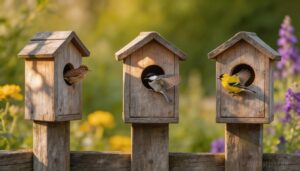
House wrens and chickadees don’t need much — just the right opening. A 1‑hole suits wrens; chickadees prefer 1⅛ inches.
These species-specific hole dimensions directly impact fledgling survival by blocking competitors. Their beak morphology, feeding strategies, and winter roosting habits all favor snug cavities.
Even finches benefit from tighter openings around 1.25 inches for effective territory defense.
Medium Birds: Bluebirds, Swallows, and Nuthatches
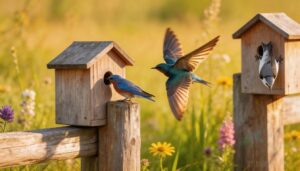
Step up from wrens and you’ll find bluebirds, tree swallows, and nuthatches — each with precise needs. Eastern bluebirds require a 1½-inch hole; Western bluebirds work with 1¼‑inch. A nuthatch fits through 1¼‑inch comfortably.
Get this right and you’ll support their egg clutch size, nesting material choice, and feeding habits without inviting unwanted guests.
To enhance bluebird success, you should maintain open habitats.
Large Birds: Woodpeckers, Flickers, and Purple Martins

Bigger birds need bigger doors.
Woodpecker excavation behavior shapes everything — pileated woodpeckers need 3–4‑inch openings, while flickers work with 1½–2½‑inch. Flicker cavity depth usually runs 4–7‑inch, matching their elongated nest chambers.
Purple martins need a clear purple martin flight path with a front-facing 1½–2‑inch hole.
Large bird seasonal timing matters — install boxes before spring migration.
How Hole Size Affects Nesting Success
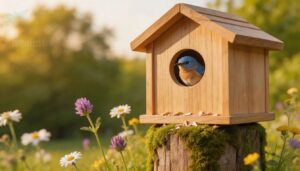
The right hole size drives real outcomes — fledgling survival, egg viability, and thermal regulation all hinge on this one measurement.
- Tight openings cut competition dynamics with starlings and sparrows
- Proper sizing facilitates moisture management inside the nest cavity
- Species-specific hole dimensions reduce predator access substantially
- Ideal entrance size boosts occupancy across seasons
Follow hole size recommendations closely — small margins matter.
Factors That Determine The Right Hole Size
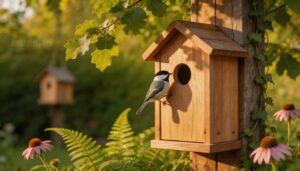
Getting the hole size right isn’t just about the bird you want — it’s about everything working together. Several factors shape that decision, from the species you’re targeting to your local climate and how high you mount the box.
For wrens and chickadees specifically, a 1-1/8" opening hits the sweet spot — more on that in this guide to bird houses suitable for wrens.
Here’s what you need to think about.
Matching Hole Diameter to Target Species
Every species has a body profile that dictates your hole diameter choice. Head width tolerance is the real limiting factor — a chickadee needs 1⅛ inches, while bluebirds require 1½ inches.
Regional species variation and seasonal hole sizing matter too. Match hole diameter directly to bird species requirements, and you’ll see occupancy rates climb with adjustable entrance design options.
Keeping Invasive Species Like Starlings Out
Starlings muscle into boxes with openings larger than 1½ inches — so hole size is your first line of defense. Species-specific birdhouse hole size recommendations exist precisely for invasive species control.
Hole size is your first line of defense — keep it under 1½ inches and starlings won’t stand a chance
Pair a tight entrance with exclusion nets, reflective mylar tape, and acoustic deterrents to reinforce the barrier. Fruit tree removal and bird spikes reduce nearby attractants, making your boxes genuinely inhospitable to starlings.
Nesting Material Access and Entry Comfort
The entry hole diameter does more than control who gets in — it shapes how birds build. A fiber-friendly opening lets adults carry nesting material without snagging. Bevelled entrance design and a smooth interior lip guide fibers cleanly through.
Trap door access simplifies nest removal between seasons.
Species-specific birdhouse hole size recommendations account for this; ideal birdhouse entrance hole sizes by species reflect debris deflection geometry, not guesswork.
Weather, Climate, and Ventilation Needs
Climate isn’t just background noise — it directly shapes what hole size works best.
In hot regions, a larger opening (1.5 in or more) facilitates weather-driven airflow and sunlight heat regulation, keeping interior temperatures safe. Humid climates demand humidity management techniques: tight ventilation and drainage holes prevent mold. Cold zones need smaller openings to trap warmth.
Climate-adjusted airflow and rain protection aren’t optional — they’re survival mechanics for nesting birds.
Installation Height and Surrounding Habitat
Where you mount a birdhouse matters as much as the hole size. Aim for 5 to 12 feet — high enough to block ground predators, low enough to monitor.
Factor in Wind Shelter, Sunlight Exposure, and Vegetation Density.
Keep Water Source Distance under 100 feet.
Edge Proximity to open ground aids fledgling exits.
These environmental factors and installation height guidelines directly shape occupancy.
Top 4 Predator Guards for Birdhouse Entrances
The right hole size only does so much — predators can still reach in and ruin a nest if the entrance isn’t protected. A good guard sits flush over the opening and makes that kind of access nearly impossible.
Here are four solid options worth considering for your birdhouse.
1. Hotop Copper Bird House Guard
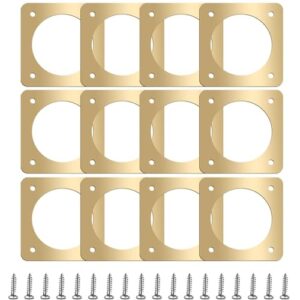
The Hotop Copper Bird House Guard comes in a pack of 12, each with a fixed 1½-inch opening — the right diameter for bluebirds, tree swallows, and chickadees. Each guard measures 5×5 cm and mounts with four stainless steel screws (48 total included).
Installation is straightforward: align the opening with your existing entrance hole and tighten.
At $12.99 for the pack, it’s a practical retrofit for multiple houses.
One heads-up — the included screws can rust in wet conditions, so swap them out if your site gets heavy rain.
| Best For | Backyard birders who want to protect small cavity-nesting birds like bluebirds, chickadees, and tree swallows from squirrels and larger birds without replacing their existing birdhouses. |
|---|---|
| Opening Diameter | 1.5 inches |
| Material | Copper |
| Pack Quantity | 12 guards |
| Screws Included | 48 screws |
| Price | $12.99 |
| Predator Protection | Squirrels, woodpeckers, sparrows |
| Additional Features |
|
- Pack of 12 guards for $12.99 is a solid deal, especially if you’re managing multiple houses across a larger property.
- Dead simple to install — just line it up with the existing hole and drive in four screws.
- Copper holds up well outdoors and blends naturally with wood, so it doesn’t look out of place.
- The included screws can rust fast in rainy or humid conditions, so you’ll likely need to swap them out.
- A few buyers reported getting fewer than the 48 screws advertised, which is annoying if you’re counting on the full kit.
- The 1½-inch opening is fixed, so if your birdhouse has a different hole size, these won’t work for you.
2. Metal Bluebird House Predator Guard
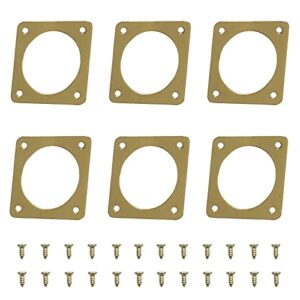
If you want something built to last, the Metal Bluebird House Predator Guard steps it up. Made from galvanized steel with a powder coat finish, it resists rust and weathering better than basic copper options.
Each guard fits a standard 1.5-inch entrance — right for bluebirds and similar cavity nesters.
At roughly $9.99 for six guards with 24 screws included, it covers multiple boxes without breaking the budget.
The rolled edges won’t snag adult birds or nestlings during entry or exit.
| Best For | Backyard birders who want an affordable, no-fuss way to protect multiple bluebird houses from squirrels and woodpeckers. |
|---|---|
| Opening Diameter | 1.5 inches |
| Material | Steel |
| Pack Quantity | 6 guards |
| Screws Included | 24 screws |
| Price | $9.99 |
| Predator Protection | Squirrels, magpies, woodpeckers |
| Additional Features |
|
- Six guards for $9.99 is a solid deal — great if you’re running several boxes across your yard.
- Screws are included, so you’re not hunting down hardware before you can get started.
- Steel construction holds up better than wood over time, especially against persistent chewers.
- Only works with a 1.5-inch entrance, so it won’t fit most other birdhouse sizes.
- Metal heats up in summer and gets cold in winter, which can affect comfort inside the nest.
- You’ll want to check the screws now and then — they can loosen up after a few seasons outdoors.
3. Copper Bird House Guard Eastern Bluebird
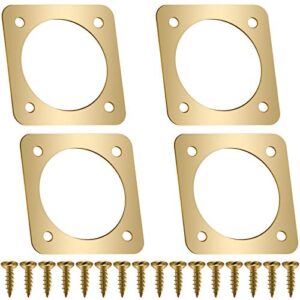
The Ripeng Copper Bird House Guard takes a different approach. Instead of steel, you get 1mm galvanized copper — naturally harder for squirrels to grip and chew through.
The 1⅛-inch opening fits chickadees, wrens, and finches precisely. Each pack includes four guards and 16 screws, all for $9.99.
One heads-up: the flat-head screws don’t always sit flush. Swap them for pan-head screws and you’re set.
Over time, the copper develops a patina that blends right into the garden.
| Best For | Bird enthusiasts who want durable, natural-looking protection for small cavity-nesting birds like bluebirds, wrens, and chickadees. |
|---|---|
| Opening Diameter | 1.5 inches |
| Material | Copper-coated metal |
| Pack Quantity | 18 guards |
| Screws Included | 72 screws |
| Price | Not listed |
| Predator Protection | Squirrels, woodpeckers |
| Additional Features |
|
- Copper is tougher for squirrels to chew through than standard steel guards
- Great value — four guards and 16 screws for just $9.99
- Develops a natural patina over time that blends beautifully into any garden
- Flat-head screws don’t always sit flush — you may need to swap them out
- Long-term rust resistance isn’t guaranteed depending on your climate
- Only fits a 1⅛-inch opening, so you’ll need to double-check your birdhouse before ordering
4. Bluebird Birdhouse Predator Guard
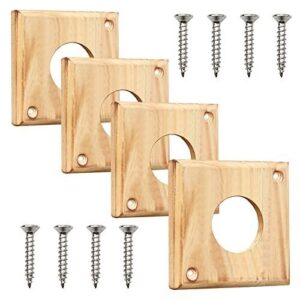
Cloud Fragrant takes a simpler route — solid wood instead of metal, with a 1.5-inch opening sized exactly for Eastern Bluebirds. Each pack includes four guards and eight pre-matched screws for $9.99, covering multiple boxes at once.
Installation is straightforward: align, screw, done. No extra hardware needed.
Keep in mind that wood can split if over‑tightened, so go firm but not aggressive. Annual checks for moisture damage will keep these guards doing their job season after season.
| Best For | Backyard birders who want a simple, affordable way to protect bluebird boxes from squirrels and predators without spending a lot of time on installation. |
|---|---|
| Opening Diameter | 1.125 inches |
| Material | Galvanized copper |
| Pack Quantity | 4 guards |
| Screws Included | 16 screws |
| Price | $9.99 |
| Predator Protection | Cats, squirrels, larger birds |
| Additional Features |
|
- Great value — four guards and eight screws for under $10 covers multiple birdhouses at once
- Easy screw-in setup with no extra hardware required
- Solid wood construction is reusable and easy to swap out during seasonal cleanings
- Only works with 1.5-inch openings, so it won’t fit every birdhouse style
- Wood can split if over-tightened or left untreated in wet conditions
- No color options beyond the blue finish shown
Birdhouse Design, Placement, and Maintenance Tips

Getting the hole size right is only half the equation — the rest comes down to how you build, place, and care for the box. A well-designed birdhouse can fail if it’s mounted too low, faces the wrong direction, or never gets cleaned between seasons.
Here’s what actually matters with respect to design, placement, and maintenance.
Best Wood Types and Construction Materials
Wood choice makes or breaks a birdhouse. Western Red Cedar is the best choice — it resists decay naturally, and no chemicals are needed. Douglas Fir strength holds up under stress. For budget builds, untreated cedar or pine works well.
- Western Red Cedar — naturally rot-resistant, zero treatment required
- Douglas Fir — structural strength, long-lasting frame
- Engineered Wood Stability — plywood durability reduces warping over seasons
Ventilation, Drainage, and Interior Depth
Even the right hole size fails if your interior is poorly built. Cross Ventilation Design starts with a 6–12 mm Airflow Gap Sizing slot near the roof — it prevents moisture buildup without chilling nestlings. Pair that with Drainage Plane Integration using floor drainage holes at each corner.
| Feature | Small Species | Medium Species |
|---|---|---|
| Interior Depth Optimization | 5–6 cm | 8 cm |
| Ventilation holes | 1/4 in near roof | 1/4 in bilateral |
| Drainage holes | 1/8 in corners | 1/8 in corners |
Moisture Control Strategies and cavity dimensions directly shape fledgling survival — get them right.
Optimal Mounting Height and Entrance Orientation
Mount most birdhouses 5–10 feet up — high enough to deter ground predators, low enough for easy monitoring. An east-facing entrance captures morning warmth while dodging harsh afternoon heat, a shade-sun balance that keeps nestlings comfortable. Wind-sheltered orientation reduces moisture intrusion.
Apply microclimate selection based on surrounding vegetation.
Seasonal height adjustment matters too: after growth, reassess whether dense branches now block the entrance approach.
Seasonal Cleaning and Annual Inspection Routine
After each breeding season, remove old nesting material and scrub interiors with mild soap and water. Seasonal cleaning and care of birdhouses — including annual structural checks — directly benefits returning birds and improves long-term nesting success.
Spring calls for a full exterior paint inspection and roof debris removal.
Check attic insulation and replace HVAC filters every one to three months.
Frequently Asked Questions (FAQs)
What size hole does a birdhouse need?
Think of the entrance hole as a front door — it has to fit the tenant. Birdhouse hole size generally ranges from 1 inch to 3 inches, depending entirely on your target species.
What is a birdhouse hole size chart?
A birdhouse hole size chart is a user guide that lists ideal birdhouse entrance hole sizes by species.
This chart format maps species-specific birdhouse hole size recommendations — from 1 inch for wrens to 2 inches for purple martins.
How do I choose the right Birdhouse size?
Match floor area and entrance diameter to your target species. A 4×4-inch floor suits wrens; bluebirds need 5× Use species-specific birdhouse hole size recommendations as your baseline — size drives occupancy.
What size bird nesting hole do I Need?
Hole size depends on your target species. Wrens need 1 inch, chickadees 1⅛ inches, and bluebirds 1½ inches. Get this wrong, and you’ll attract the wrong tenants entirely.
What time of year should you put up a bird box?
Put up your bird box before breeding season begins. In southern regions, aim for February. In the north, complete Early Spring Installation by mid-March. Frost-Free Installation ensures secure mounting.
Can multiple species share the same birdhouse?
Rarely. Most cavity-nesting birds are territorial and won’t share.
A compartmentalized design with species-specific holes can work, but seasonal occupancy shifts are common — one species nests early, another moves in later.
How do I measure entrance hole size accurately?
Use an inside caliper for direct hole diameter readings. Do a caliper zero check first. Take three measurements, then apply the measurement averaging method for accuracy.
Should hole shape be round or oval?
Round wins every time. It’s easier to drill cleanly, distributes stress evenly around the edge, and pairs with standard predator guards.
Oval shapes look appealing but risk rough edges that can injure birds.
Does hole size vary by geographic region?
Yes, hole size does vary by region.
Temperature zones, predator community variation, and vegetation density effects all influence the ideal diameter.
Local subspecies size differences and regional conservation policies also shape birdhouse hole size recommendations.
How often should entrance holes be resized?
Resize once a year. Check your Monitoring Data Logs and Predator Activity Logs each fall.
If Population Trend Checks show non-target species nesting, make Species Size Adjustments before the next breeding season.
Conclusion
Imagine installing a birdhouse with a 1½-inch hole, only to find European starlings have taken over. You can avoid this by choosing the right hole size.
For instance, a 1⅛-inch hole welcomes house wrens while keeping larger birds out.
When you select the correct hole size, you guarantee the birds you want to move in and the ones you don’t want to stay out.
What size hole birds prefer is vital. Make informed choices for a thriving bird community.