This site is supported by our readers. We may earn a commission, at no cost to you, if you purchase through links.
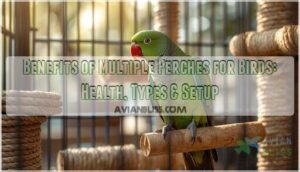
Running a mixed flock is rewarding—until you realize your cockatoo keeps muscling your finches off the only decent perch in the cage. Perch real estate matters more than most owners expect, and in a multi-bird household, the wrong setup quietly fuels stress, feather-picking, and even injury.
The diameter alone can misalign a bird’s foot grip, putting pressure on joints over months of daily use.
Getting it right means thinking about sizing, placement, and materials all at once—not just grabbing whatever fits the cage bars.
The five picks and practical guidelines ahead make that decision straightforward.
Table Of Contents
Key Takeaways
- Perch diameter directly affects foot health — small birds need 3/8–1/2 in, medium parrots 1/2–3/4 in, and large cockatoos 3/4–1 in for a proper grip.
- In a shared cage, aim for four to six perches spread across at least three vertical levels to cut down on stress and fighting.
- Stick with non-toxic woods like cedar, white oak, or apple wood, and always check for rust on bolts and wing nuts — especially in humid cages.
- Placement matters as much as materials: keep perches near food but never directly over bowls, and give smaller birds their own low, sheltered resting spots away from dominant cage-mates.
Top 5 Bird Perches for Shared Cages
Finding the right perch for a shared cage isn’t just about comfort — it’s about keeping every bird safe and stress-free. With so many options out there, it helps to know which ones actually hold up in a multi-bird setup.
Understanding why multiple perches matter for your birds’ health and behavior makes it much easier to choose the right setup for a shared cage.
Here are five natural wood perches worth a close look.
1. Libiline Natural Wooden Bird Perches
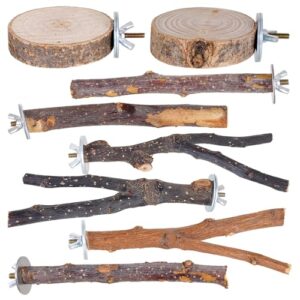
The Libiline set is a solid starting point for shared cages.
Each perch runs 5.8 inches long with a 2.9-inch platform, giving birds enough room to stand comfortably without crowding.
The untreated natural wood has no paint or chemicals — important when you’ve got chewers in the mix.
Built-in bolts and wing nuts make mounting quick and tool-free.
The rough surface helps birds grip securely, which reduces slipping and foot fatigue over time.
| Best For | Bird owners with mixed-size flocks (budgies, finches, quakers, or macaws) who want a natural, chemical-free perch setup that’s easy to install and rearrange. |
|---|---|
| Material | Natural untreated wood |
| Piece Count | 5 pieces |
| Mounting Hardware | Bolts and wing nuts |
| Bird Size Fit | Small to large |
| Chew Safe | Yes, non-toxic |
| Package Weight | 15.34 oz |
| Additional Features |
|
- Untreated natural wood means no chemicals or paint — safe for birds that love to chew
- Tool-free mounting with built-in bolts and wing nuts makes setup and repositioning really simple
- Rough surface gives birds a solid grip, which helps with foot health over time
- Branches can feel a bit bulky for very small birds like budgies
- At 5.8 inches, the perches are shorter than standard dowels, so larger birds may need extra support
- Wood can splinter with heavy use, so you’ll need to check them regularly and swap out worn pieces
2. Natural Wood Bird Perches Kit
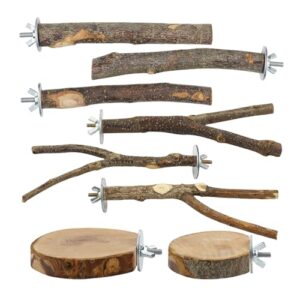
Another strong option is the Natural Wood Bird Perches Kit — an 8-piece set priced at just $12.99. It includes wooden perch stands, fork toys, a hanging multi-branch platform, and a hammock swing.
That’s real variety for one cage.
Perch diameters range from 2.4 to 3.5 inches, covering small to medium birds like parakeets and budgies. The untreated wood is safe for chewers, and wing nut hardware keeps everything snug without tools.
| Best For | Small bird owners with parakeets, budgies, or similarly sized birds who want a budget-friendly way to add variety and enrichment to their cage setup. |
|---|---|
| Material | Natural untreated wood |
| Piece Count | 8 pieces |
| Mounting Hardware | Washers and wing nuts |
| Bird Size Fit | Small to medium |
| Chew Safe | Yes, non-toxic |
| Package Weight | 11.99 oz |
| Additional Features |
|
- Eight pieces for $12.99 is genuinely hard to beat — you get perches, fork toys, a multi-branch platform, and a hammock all in one kit.
- Untreated natural wood is safe for birds that love to chew, and the varied perch shapes help keep feet healthy.
- Wing nut hardware makes installation and reconfiguration quick and tool-free.
- Too small for larger birds like cockatoos or big macaws, so it’s a pretty limited fit if your flock skews larger.
- Natural wood means dimensions vary piece to piece, and a few buyers have received a broken perch with little recourse for returns.
- The initial fit can be loose, so you’ll need to take a minute to tighten everything down before letting your bird near it.
3. Natural Wood Bird Perches for Cages
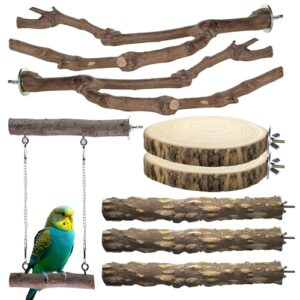
Want even more variety in a single kit? The Natural Wood Bird Perches for Cages set delivers exactly that — 8 perches for $18.99, including Y-shaped grapevine, pepperwood "claw" perches, round platforms, and an applewood swing. That’s six distinct styles in one box.
The uneven, non-slip surfaces work your bird’s feet naturally, reducing fatigue over time. Available in 5.9 in or 9.5 in lengths, it fits most compact cages. Hardware comes included — bolts, wing nuts, washers — so setup is straightforward.
| Best For | Bird owners with parakeets, budgies, cockatiels, conures, or lovebirds who want to add variety and natural enrichment to a compact cage without spending a lot. |
|---|---|
| Material | Grapevine, pepperwood, applewood |
| Piece Count | 8 pieces |
| Mounting Hardware | Bolts, wing nuts, washers |
| Bird Size Fit | Small to medium |
| Chew Safe | Yes, non-toxic |
| Package Weight | 1.26 lb |
| Additional Features |
|
- Eight perches across six styles means your bird gets real variety — swings, platforms, claw perches — all in one affordable kit
- Natural grapevine, pepperwood, and applewood are non-toxic, so chewing and preening on them is totally safe
- Mounting hardware is included and the setup is pretty simple for most standard or travel cages
- Some branch ends can be jagged right out of the box, so you may need to trim or wrap them before use
- The 5.9 in size is on the short side and won’t work well for larger birds or cages with wider bar spacing
- Wood wears down over time, especially with heavy chewers, so plan on replacing perches every so often
4. Natural Apple Wood Bird Perches
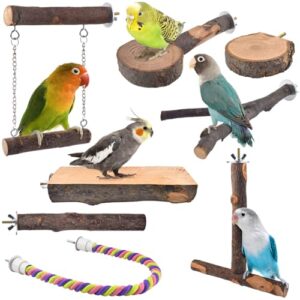
If your birds love to chew, apple wood is worth a close look. The DBNESS Natural Apple Wood set gives you 8 pieces for $20.99 — a swing, T-perch, Y-perch, rope perch, and more. Every piece is 100% unprocessed apple wood, so there’s no paint or sealant to worry about.
When you add a new piece to the mix, follow best practices for rotating and replacing bird perches so each one stays safe and enriching over time.
The natural grain and bark texture keep feet active without causing fatigue.
Just note: raw wood may carry insects, so a quick heat-treat before use is smart.
| Best For | Small to medium bird owners — think budgies, cockatiels, and parakeets — who want a natural, chewable perch set that keeps their birds mentally and physically engaged. |
|---|---|
| Material | Natural apple wood |
| Piece Count | 8 pieces |
| Mounting Hardware | Metal wing nuts and bolts |
| Bird Size Fit | Small to medium |
| Chew Safe | Yes, non-toxic |
| Package Weight | 1.81 lb |
| Additional Features |
|
- 8 different perch styles for $20.99 is genuinely good value — lots of variety without breaking the bank.
- 100% unprocessed apple wood means no paint, no sealant, nothing artificial for your bird to chew through.
- Built-in bolts and wing nuts make installation straightforward — no hunting for extra hardware.
- Raw wood can harbor insects, so you’ll need to heat-treat the pieces before putting them in the cage.
- No instructions included, so figuring out which hardware goes with which perch is a bit of a guessing game.
- Sizes can run smaller than expected, and it’s not a good fit for larger birds like macaws.
5. Deloky Natural Wood Bird Perch Stand
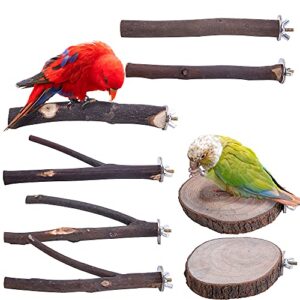
Running a multi-bird household means perch space fills up fast. The Deloky stand solves that with several diameters built into one unit — useful when your budgie and cockatiel refuse to share the same branch.
It’s freestanding or cage-mounted, easy to reposition, and light enough to move without hassle.
The non-toxic finish and rust-resistant hardware keep things safe for chewers.
Clean it with mild soap, dry it fully, and inspect the joints regularly.
| Best For | Small bird owners — budgies, lovebirds, cockatiels — who want to add variety and foot exercise to their cage setup without a big investment. |
|---|---|
| Material | Natural hardwood |
| Piece Count | 8 pieces |
| Mounting Hardware | Bolts and wing nuts |
| Bird Size Fit | Small to medium |
| Chew Safe | Yes, non-toxic |
| Package Weight | 9.59 oz |
| Additional Features |
|
- Eight pieces in one kit means you get a good mix of perch styles and diameters right out of the box.
- Natural hardwood is safe to chew, which helps keep beaks trimmed and gives birds something to actually do.
- Mounts directly to cage bars with built-in bolts and wing nuts — no extra tools needed.
- The washers can have oversized holes, so you might need to swap them out for a snug fit.
- Softer wood wears down faster than metal or plastic, especially if your bird is an aggressive chewer.
- Eight pieces is a lot for a small cage — you may end up leaving a few in a drawer.
Sizing Perches for Different Species
Getting the right perch size for a mixed-species cage isn’t guesswork — it’s one of the most practical things you can do for your birds’ health. A budgie and a cockatoo have very different needs, and one-size-fits-all just doesn’t cut it here.
Here’s what to look for when sizing perches across the board.
Adjustable Height Range for Mixed Bird Sizes
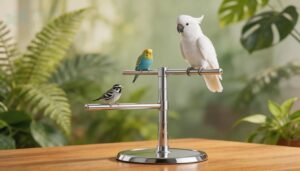
A 15 cm to 60 cm height range covers everyone — from your smallest finch to a full-grown cockatoo.
Look for adjustable perches for multiple bird sizes with a telescoping tube design, height step intervals every 5 cm, and a quick release mechanism for fast changes.
Magnetic height indicators and an anti-tilt base keep things steady and stress‑free for your whole flock.
Mount the perch on a pole at the minimum mounting height to reduce predator access.
Perch Diameter Flexibility for Small to Large Birds
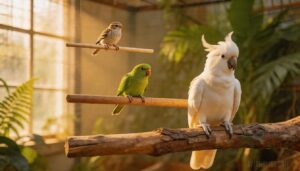
Think of diameter flexibility like shoe sizing — one size never fits all. Graduated Diameter Sets and a Species Diameter Chart take the guesswork out of matching perch diameter to bird sizes.
- Small birds need 3/8–1/2 in for full toe wrap
- Medium parrots grip best at 1/2–3/4 in
- Large cockatoos need 3/4–1 in for stable clamping
- Diameter Rotation Routine using Modular Diameter Inserts helps Foot Health Impact by preventing habituation
Weight Capacity for The Largest Bird
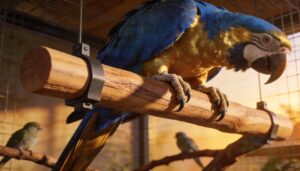
Your heaviest bird sets the bar for everything. A solid Load-Bearing Design with Reinforced Perch Structure isn’t optional — it’s essential for Heavy Bird Support.
Look for perches with a Maximum Weight Rating that exceeds your largest bird’s weight.
Structural Integrity Testing ensures durability and stability over time.
Safe, non-toxic natural wood perches protect bird health while multiple branches distribute load evenly.
Minimum Perch Count to Reduce Crowding
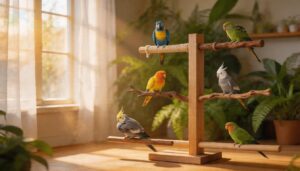
Too few perches means trouble — crowding leads to stress, feather damage, and fighting. For a multibird household, aim for at least four to six perches spread across three vertical levels.
In shared cages, fewer perches means more conflict — aim for four to six across three vertical levels
Crowd Distribution Metrics and Bird Density Guidelines suggest one perch per bird, plus one extra.
Flexible Perch Adjustment — adding or rotating perches seasonally — keeps Perch Count Ratios balanced and Vertical Level Allocation fair for all species.
Matching Perch Size to Cage Dimensions
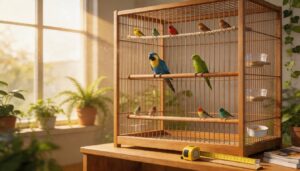
A perch that’s too long will block food bowls. One that’s too short leaves birds scrambling. Match every perch to your cage before you buy.
- Cage Width Alignment — perch length shouldn’t exceed cage width minus 1 inch
- Vertical Clearance Planning — keep 6 inches between levels
- Perch Spacing Guidelines — maintain a 2-inch gap minimum
- Bar Diameter Compatibility — confirm hardware fits your cage bars
Safe Materials and Long-Term Durability
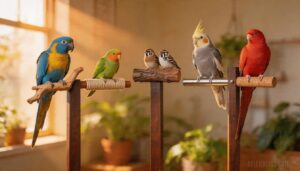
The perch material you choose matters just as much as the size. A bad pick can mean splinters, rust, or worse — a sick bird.
Here’s what to look for before you buy.
Non-toxic Natural Wood Options
When you’ve got a mixed flock, wood choice matters more than you’d think. Stick with Cedar for its natural pest resistance, White Oak for durability, or Black Locust for hardness that holds up long-term.
Birch smoothness protects sensitive feet, while Maple stability keeps adjustable height perches level across multiple branches.
All are non-toxic and safe for every perch diameter.
Splinter Resistance and Secure Grip Texture
Beyond wood type, texture is what keeps your birds from slipping. Look for a Diamond Grip Pattern or Bark-inspired Friction surface — both offer secure footing without sharp edges.
Rope Nubs Texture resists moisture well. Hybrid Ridge Surface blends smooth non-toxic hardwood branch texture with shallow 0.5 mm ridges.
The EdgeGuard Tacky Layer adds stability, making each perch texture genuinely slip‑resistant.
Rust-free Bolts, Wing Nuts, and Attachments
Hardware matters more than most bird owners realize. Rust sneaks in fast — especially in humid cages with misting routines.
Look for these features in safe attachments:
- Stainless Steel Grades 304 or 316 resist moisture without corroding
- Locking Nylon Inserts keep wing nuts tight through daily activity
- Corrosion-Resistant Coatings protect built-in bolts from droppings and cleaners
- Thread-Locking Compounds prevent loosening on permanent fixtures
- Vibration Dampening Washers maintain secure installation over time
Rust-free hardware means real perch safety standards — for every bird sharing that space.
Stability and Wobble-free Locking Mechanisms
Even rust-free hardware can’t help if the perch wobbles.
A Ball Bearing Collar spreads load evenly across the connection, cutting micro-movement quickly. Pair that with Anti-Rotate Tabs, Serrated Washers, and a Captured Nut, and your adjustable perch mechanisms hold firm through daily bird activity.
The Twist Lock Mechanism adds a second layer — built-in bolts and wing nuts stay tight for secure installation and real perch stability.
Cleaning and Routine Wear Inspection
Keeping perches clean isn’t optional — it’s part of keeping your birds safe.
- Weekly Disinfecting Routine — wipe with a bird-safe disinfectant, rinse well
- Splinter Detection Method — run your fingers along the wood every cleaning
- Hardware Tightness Check — verify bolts and wing nuts aren’t corroding or loose
- Moisture Content Monitoring — dry perches fully before returning them to the cage
- Surface Roughness Assessment — smooth grip means it’s time to replace
Easy to clean, safe, and non‑toxic, good perch cleaning maintenance directly helps the installation and durability of bird perches long‑term. Hardware rust resistance matters too — inspect every time.
Perch Placement for Comfort and Enrichment
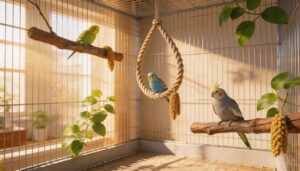
Where you place perches matters just as much as which ones you choose. thoughtful setup keeps your birds active, comfortable, and out of each other’s way.
Here’s what to focus on when arranging perches in a shared cage.
Using Multiple Heights in One Cage
Think of your cage as a vertical neighborhood — every bird wants its own floor.
Vertical zoning benefits every bird in the space. Use adjustable perches to create layered enrichment zones at different heights, giving each bird room to claim territory without conflict.
| Height Zone | Purpose |
|---|---|
| Top level | Dominant birds, viewing |
| Mid level | Height-based feeding stations |
| Lower level | Shy or younger birds |
| Ground-near | Easy retreat, safety clearance spacing |
Proper height change ramps and perch ergonomics keep movement smooth between levels.
Mixing Horizontal, Angled, and Tilted Perches
Not all perches should sit flat — variety is the backbone of bird foot health.
A Versatile Perch Layout works best when you mix angles intentionally:
- Horizontal perches support restful sleep and stability
- 10–30° angled perches deliver Foot Muscle Training without joint stress
- Tilted segments boost Balance Coordination and Flow Smoothness
- Adjustable perches let you customize Angle Variety Benefits by species
Placing Perches Near Food and Water
Where you put perches matters as much as what they’re made of.
Keep them close enough for Feeding Access, but never directly above bowls — Droppings Prevention is non‑negotiable.
Good Bowl Proximity means your bird can hop down easily without awkward stretching.
Use adjustable perches for multiple bird sizes to dial in the right height range, and always check Tail Clearance so feathers stay intact.
Creating Quiet Resting Spots for Smaller Birds
Small birds need their own safe corner — away from the chaos of dominant cage-mates.
- Use Low Profile Roosts with Soft Cushioning natural wood perches and a perch diameter variety of 0.25–0.75 in
- Install Shielded Nooks behind dividers using nontoxic materials
- Apply Noise Dampening fabric sleeves over mounts
- Keep Draft-Free Zones with Adjustable perch height away from vents
Adding Bird Trees and Flexible Rope Perches
Bird trees and rope perches turn a flat cage into a living environment that your flock actually wants to explore.
| Feature | Why It Matters |
|---|---|
| Vertical Foraging Zones | Encourages natural climbing and exploration |
| Tree Base Stability | Prevents tipping during active play |
| Rope Tension Adjustments | Creates Interactive Climbing Paths between perches |
| Modular Branch Replacement | Easy swaps keep the multiple-branching layout fresh |
Use a bird tree with adjustable perch height and diameter ranges alongside a safe and non-toxic rope perch for variety.
Frequently Asked Questions (FAQs)
How do I introduce perches to territorial birds?
Start slow. Add one new perch at a time, watch closely, and reward calm behavior right away. Gradual exposure and positive reinforcement work better than forcing it.
Can birds share perches without spreading disease?
Yes, but it takes some care. Shared perches carry fomite transmission risk. Keep up with perch hygiene protocols, maintain good ventilation to limit airborne spread, and isolate sick birds fast.
What perch materials help with overgrown claws?
Rough bark texture, cork bark abrasion, ceramic mineral surface, and sand-covered rope naturally wear claws down. Hardwood Manzanita and burlap sleeve roughness also help.
Safe, nontoxic natural wood promotes bird foot health daily.
How often should perches be fully replaced?
Check perches monthly. Replace them every one to three months if your bird chews hard.
A solid replacement schedule based on species wear rate and chewing aggression keeps feet safe and healthy.
Do different species prefer perches at specific times?
Absolutely — timing shapes everything.
Diurnal perch timing peaks in morning feeding perches near food zones, while nocturnal perch selection shifts to lower, sheltered spots.
Evening roosting heights drop as birds wind down.
Conclusion
Perfectly placed perches promote peaceful coexistence in your multi-bird household. By choosing the right bird perches for multiple bird households, you create a harmonious haven where each bird can thrive.
Consider sizing, placement, and materials to guarantee a stress-free environment. With these top picks and practical guidelines, you’re well on your way to crafting a bird-friendly space that balances comfort, safety, and fun for all your feathered friends to enjoy daily.