This site is supported by our readers. We may earn a commission, at no cost to you, if you purchase through links.
Most birders assume their binoculars can see as far as the magnification number promises. A 10x pair should handle 1,000 yards, right? Not quite.
Atmospheric haze, shaky hands, and low morning light routinely cut that theoretical range by 20–30%.
The gap between what your optics claim and what you actually identify in the field comes down to a handful of measurable factors—magnification, objective lens size, coatings, and conditions.
Understanding those factors tells you exactly how far your binoculars can see birds clearly, and which specs to prioritize before your next outing.
Table Of Contents
- Key Takeaways
- How Far Can Binoculars See Birds Clearly?
- How Magnification Affects Bird Viewing Distance
- Objective Lens Size and Its Role in Clarity
- Atmospheric Conditions That Limit Viewing Distance
- Best Binocular Specs for Birdwatching Distance
- Lens Coatings and Optical Quality Impact on Range
- Choosing Binoculars Based on Viewing Distance Needs
- Frequently Asked Questions (FAQs)
- How far can a 10x binocular see?
- Can people with astigmatism use binoculars?
- Can I see Saturn’s rings with binoculars?
- Can smartphone cameras replace binoculars for bird identification?
- How do binoculars compare to spotting scopes for distance?
- How does color accuracy affect distant bird identification?
- Are budget binoculars ever adequate for serious birding?
- Conclusion
Key Takeaways
- Your binoculars’ theoretical range shrinks by 20–30% the moment real conditions—haze, heat shimmer, or shaky hands—enter the picture.
- Magnification and objective lens size work as a team: pushing past 10x without matching your lens diameter means dimmer, harder-to-use images.
- Weather matters as much as glass quality—clear, low-humidity air below 21°C with a light breeze gives you the longest, sharpest views.
- Fully multi-coated lenses and phase-coated prisms aren’t marketing fluff; they’re what separates a confident bird ID at range from a frustrating blur.
How Far Can Binoculars See Birds Clearly?
Most birders ask this question before they buy anything: how far can I actually see?
The honest answer depends on your magnification, your glass, and the conditions around you.
If you’re still dialing in the right setup, this breakdown of binoculars for wetland birding covers how magnification and glass quality work together in real field conditions.
Here’s what the numbers really look like in practice.
Typical Identification Distances by Magnification
Magnification shapes how far you can actually identify a bird — not just see it. Here’s a quick look at identification range by power:
- 8x Distance Benchmarks: roughly 600–800 yards for medium-sized birds
- 10x Range Guidelines: pushes that to 800–1,000 yards in open terrain
- 12x Field Limits: extends Species-Specific Reach to around 1,000–1,200 yards
These Magnification Distance Ratios are your real-world baselines.
The wider field of view helps locate birds faster, especially with 8× binoculars.
Theoretical Range Vs. Practical Viewing Distance
Your binoculars may claim a Theoretical Optic Limit far beyond what you’ll actually use. Practical Field Constraints — heat shimmer, haze, handshake — cut that number quickly.
Think of it like a Signal-to-Noise Ratio: the more interference, the shorter your maximum effective distance.
| Condition | Effect on Practical Identification Range |
|---|---|
| Clear, dry air | Full theoretical range possible |
| Light haze | Range drops ~20% |
| High humidity | Range drops ~25% |
| Heat shimmer | Range drops up to 50% |
| Dense woodland | Range drops ~25% |
Why Practical Range is 20–30% of Theoretical Maximum
That 20–30% figure isn’t arbitrary. Several forces quietly chip away at your Maximum Effective Distance before you ever raise the glass.
- Light Transmission Loss dims the image before it reaches your eye.
- Eye Pupil Variability shifts perceived brightness at dawn and dusk.
- Atmospheric Turbulence bends and blurs distant details unpredictably.
- Background Clutter camouflages birds against complex terrain.
- Mechanical Alignment Errors soften edge sharpness at range.
How Magnification Affects Bird Viewing Distance
Magnification is the first number you see on any binocular, and it shapes everything about how far and how clearly you can spot a bird.
But more power isn’t always better — it comes with real trade-offs that matter in the field.
Here’s what those numbers actually mean for your birding range and performance.
What Binocular Magnification Numbers Actually Mean
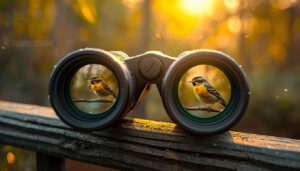
two numbers on your binoculars tell you everything.
The first is your Image Enlargement Factor — a 10× model makes birds appear ten times closer. The second is your objective lens diameter, which drives your Exit Pupil Size (diameter ÷ magnification).
A lightweight birdwatching chair for hiking trips lets you stay steady long enough to actually put those specs to work without wearing yourself out.
Push magnification too high without matching your Objective Diameter Ratio, and you hit a real Brightness Tradeoff — dimmer images, less feather detail.
8x Vs. 10x Vs. 12x for Bird Identification
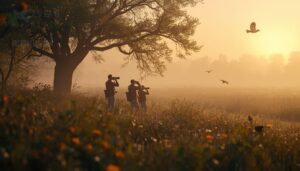
Each power level caters to a different birder.
8×42 binoculars cover most woodland and open-country species with comfortable Eye Relief and low Weight Impact — solid Cost Efficiency for beginners. 10×50 binoculars push your identification range to 800–1,000 meters, ideal for raptors. 12×50 binoculars reveal fine plumage at 600 meters, but demand calm air.
Match Species Suitability and User Preference before you buy.
Hand-Held Stability Limits Above 10x
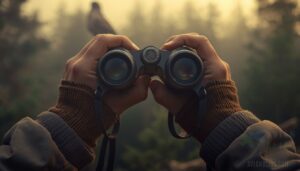
Above 10x, handshake becomes your biggest enemy. Most observers hit their magnification limit for handheld use right around that mark.
Lock in a Two Handed Grip with Elbow Tucking pressed against your torso. Practice Breath Control — exhale slowly before you focus.
A Chest Stabilized Stance or Monopod Support buys you clearer views. Image stabilization models help too, but they cost more.
Field of View Trade-Offs at Higher Magnification
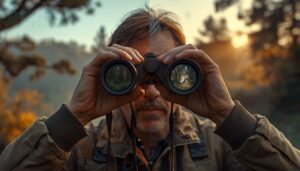
Every step up in magnification shrinks your field of view — and that trade-off hits hard in birdwatching.
At 8x, you’re working with roughly 350 feet at 1,000 yards. Push to 12x, and that window drops near 60 degrees of angular coverage.
Peripheral awareness suffers. Scanning speed slows. Target acquisition becomes a deliberate effort rather than a natural sweep. Eye relief and depth perception also feel the squeeze.
Objective Lens Size and Its Role in Clarity
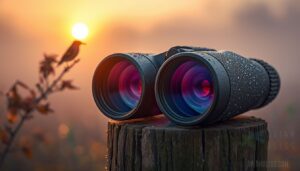
Magnification gets most of the attention, but the objective lens is quietly doing the heavy lifting. Its diameter controls how much light reaches your eye — and that shapes everything from color accuracy to how useful your binoculars are at 5 AM.
Here’s what you need to know about lens size and how it plays out in the field.
How Lens Diameter Determines Light Gathering
The objective lens diameter is your binoculars’ light engine. Larger aperture size impact is straightforward: light-gathering power scales with the square-law brightness principle — double the objective lens diameter; quadruple the photon collection area.
42mm lens gathers roughly 30% more light than a 32mm. That directly improves your exit pupil and low-light performance, making dawn birding noticeably sharper without fighting the magnification vs aperture tradeoff.
Best Objective Sizes for Birding (32mm Vs. 42mm Vs. 50mm)
Pick the wrong objective lens size and you’ll either strain your shoulders or miss birds in the shadows.
For casual woodland bird watching, 32mm keeps weight fatigue manageable at 400–700g with solid daylight field of view.
The 42mm hits the sweet spot — better light gathering, eyeglass compatibility, and shock resistance without bulk.
Reserve 50mm for open terrain where magnification and range matter most.
Low-Light Performance at Dawn and Dusk
Dawn and dusk drop light levels to as low as 0.1 lux — your pupil dilates, but the binoculars still need to do the heavy lifting. That’s where objective lens diameter and exit pupil size decide what you actually see.
- A 10×42 delivers a 4.2mm exit pupil — solid for most crepuscular contrast conditions
- A 10×50 pushes that to 5mm, noticeably improving lowlight performance during twilight factor hours
- Color desaturation sets in fast; bold plumage patterns stay identifiable longer than subtle hues
- eye relief optimization and fully multi-coated lenses preserve edge sharpness when light is scarce — red light adaptation between sessions helps too
Atmospheric Conditions That Limit Viewing Distance
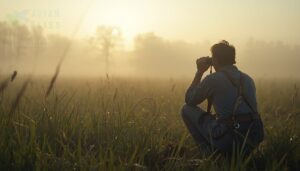
Your binoculars aren’t the only thing standing between you and a clear view — the air itself plays a big role. Conditions like fog, heat, and humidity can quietly shrink your effective range before you even realize it.
Here’s how each one affects what you can actually see.
How Fog, Haze, and Humidity Reduce Range
Fog scattering alone can slash your usable range by 70–90% in dense conditions. Haze contrast loss makes distant birds blend into the background, especially beyond 500 meters. Humidity light extinction kicks in above 80% relative humidity, cutting clarity by another 20–40%.
Dense fog alone can slash your birding range by up to 90%, and humidity above 80% cuts clarity by another 40%
Droplet halos wash out fine plumage detail.
Combined turbidity range reduction from these atmospheric conditions means coastal birders often work within 0.5–2 km instead of 5.
Heat Shimmer and Midday Visual Distortion
Heat shimmer hits hardest at midday. Temperature gradient effects near dark or rocky ground send hot air rising, causing ground heat refraction that makes distant birds wobble and blur. Air turbulence impact compounds quickly at higher magnifications — a 10× view becomes nearly useless past 500 meters. Surface albedo influence matters too: asphalt shimmers worse than grass.
Your best shimmer mitigation strategies: drop to 8×, use a tripod, and go out early.
How Elevation Extends Your Viewing Horizon
Elevation changes everything. Where heat shimmer cuts your range, climbing higher can win it back.
A ridge overlook benefit is simple: more height means more horizon. Every 100 meters up adds several kilometers of visible sky.
Coastal bluff advantage works the same way — sea-level observers gain 5–10 km standing on bluff edges.
Urban rooftop vantage extends raptor sightlines by a few kilometers.
Mountain peak visibility pushes that further.
Use elevated tripod setups to stabilize the view.
Best Weather Conditions for Long-Range Bird Observation
Getting the weather right matters as much as your gear. Here are the five conditions that give you the clearest long-range views:
- Mild Temperature Windows (10–21°C) reduce heat shimmer and keep atmospheric conditions stable.
- Light Breeze Conditions below 10 mph sharpen distant silhouettes without causing binocular shake.
- Partial Cloud Cover softens glare, boosting your objective lens’s light gathering power.
- Stable Barometric Pressure means predictable bird movement and consistent weather impact on visibility.
- Low Humidity Levels cut haze, extending your effective range — especially valuable in lowlight conditions at dawn.
Best Binocular Specs for Birdwatching Distance

Not all binoculars are built the same, and the specs you choose will make or break your time in the field. A few key decisions — magnification, lens size, and support — determine how much you can realistically see.
Here’s what actually works for birdwatchers who want distance and clarity.
Why 8×42 and 10×42 Are The Birding Standard
There’s a reason most serious birders land on 8×42 binoculars or 10×42 binoculars — they just work. The 42mm objective lens size hits a sweet spot between light-gathering and weight portability. The ergonomic design keeps your hands comfortable across long sessions.
User preference is likely to split on magnification: 8×42 for wider field of view in dense cover, 10×42 for distant detail.
Both offer solid build quality without punishing your budget.
Wide Field of View for Tracking Fast-Moving Birds
Fast birds don’t wait for you to catch up. A wide field of view — usually 350 ft at 1,000 yd with 8x binoculars — makes rapid panning techniques far less stressful.
You’ll track moving subjects without constant re-aiming. Prioritize edge sharpness consistency, and eye relief comfort to avoid peripheral distortion management issues.
The field of view vs magnification tradeoff is real: more power means a narrower window.
When to Use a Tripod for Maximum Range
Once your magnification climbs past 10x, hand‑holding stops working. A tripod addresses Stability vs. Magnification challenges by cutting 90% of shake, letting detail actually reach your eye.
Follow these four tripod rules for birdwatching:
- Tripod Load Capacity: Match it to your binocular weight — aim for 10+ lb rated
- Center Column Management: Keep it lowered for maximum rigidity
- Leg Spread Optimization: Widen the stance on loose or uneven ground
- Wind Resistance Strategies: Hang ballast weight from the center hook
Coastal and Marine Birding Binocular Configurations
Coastal birding throws salt spray, glare, and choppy horizons at you, all at once.
Marine binoculars in the 7×50 or 8×50 range handle this best — their larger lens diameter boosts low light performance at dawn and dusk, while a wide field of view helps you track fast-moving seabirds.
waterproof builds, UV protection coatings, polarized lens options, ergonomic grip design, and compact tripod mounts for steady scanning.
Lens Coatings and Optical Quality Impact on Range
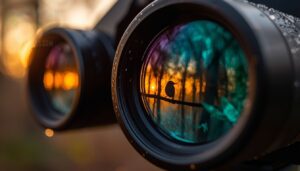
Magnification and lens size get most of the attention, but coatings and optical quality quietly do the heavy lifting regarding long-distance clarity. The difference between a great view and a frustrating one often comes down to what’s on — and inside — the glass.
Here’s what actually matters when you’re trying to identify a bird at the edge of your range.
Fully Multi-Coated Vs. Uncoated Lenses
Coating choice makes or breaks your low-light performance. Fully multi-coated lenses hit 98–99% light transmission, while uncoated glass loses considerably more to surface reflections.
That gap directly affects image brightness and lens coating effects at dawn or dusk.
FMC also delivers better color fidelity, ghosting reduction, and scratch resistance.
Cleaning ease and weather sealing come standard too.
Phase-Coated Prisms and Feather Detail Clarity
Phase-coated prisms do one thing really well: they fix the phase blur that roof prisms naturally introduce.
Without prism coating, fine plumage detail gets soft — feather edge definition suffers and contrast enhancement drops noticeably.
With it, you get sharper image resolution, truer color accuracy, and less color fringing on iridescent plumage.
For serious bird watching, that difference in lens coating effects is immediately visible.
Waterproof and Fog-Proof Builds for Field Use
Sharp optics mean nothing if moisture gets inside.
A solid Sealed Case Construction with a Nitrogen Purge System keeps internal fog out across temperature swings from -10 to 40°C.
The Pressure Equalization Valve prevents vacuum lock without breaking the water seal.
Add Corrosion Resistant Hardware and smart Desiccant Management, and your binoculars stay field-ready — protecting your magnification, field of view, and objective lens size investment every outing.
How Optical Quality Affects Long-Distance Identification
Sealed builds keep moisture out — but optical quality determines what you actually see at distance. In bird watching, these factors work together.
- Prism Alignment Tolerances keep distant feather edges crisp.
- Edge Definition Consistency prevents blur across the full field.
- Chromatic Aberration Management removes color fringing around plumage.
- MTF Retention preserves fine detail at your identification range.
- Color Fidelity and light gathering through objective lens size reveal true field markings.
Choosing Binoculars Based on Viewing Distance Needs
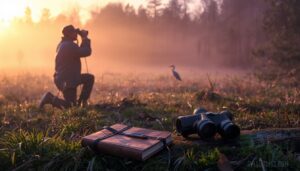
Not every birding situation calls for the same pair of binoculars. Your viewing distance needs should drive the decision more than any other factor.
Here’s how to match your optics to the terrain and birds you’re actually chasing.
Short-Range Woodland Birding Recommendations
In dense woodland, your best friend is a wide field of view. An 8×42 is the go-to choice — its magnification keeps images steady without a rest, and the 42mm lens size delivers a usable exit pupil at dawn.
Look for a rapid focus ring, ergonomic grip, compact body design, quiet operation, and camouflaged finish.
These features make woodland birdwatching noticeably smoother.
Open-Terrain and Raptor Watching at Extended Range
Open terrain flips the script. Here, distance is your playing field — and your gear needs to match it.
For raptor watching, prioritize these four factors:
- Horizon Elevation — Higher ground extends your detection range considerably.
- Sun Glare Management — Shoot in early morning to minimize backlit silhouettes.
- Thermal Air Distortion — Avoid midday; heat shimmer blurs Raptor Flight Patterns at 2–4 km.
- Landscape Silhouette Contrast — A 10×42 with a wide field of view sharpens distant shapes.
High-Magnification Models and Tripod Requirements
Once you push past 10×, hand-holding becomes a liability. High-powered binoculars at 12× or above need solid tripod support to deliver their full range potential.
| Feature | Minimum Requirement | Why It Matters |
|---|---|---|
| Tripod Load Capacity | 1 kg above binocular weight | Prevents vibration under load |
| Fluid Head Precision | Smooth pan-and-tilt | Tracks birds without jitter |
| Carbon Fiber Legs | Rigid, lightweight build | Reduces fatigue; improves Leg Spread Stability and Wind Resistance Design |
Balancing Portability, Clarity, and Maximum Range
Every birdwatching setup is a trade-off. Compact optics design keeps weight under 600 grams, boosting mobility without wrecking your field of view. Lightweight lens materials help resolve the weight vs stability tension at higher magnification.
A well-tuned adjustable exit pupil and ergonomic eye relief round out the package.
Match your lens diameter to your terrain, and you won’t sacrifice clarity for convenience.
Frequently Asked Questions (FAQs)
How far can a 10x binocular see?
A 10x binocular puts your identification range between 800 and 1,000 yards for medium-sized birds. Beyond that, hand-shake, exit pupil limits, and shrinking field of view work against you fast.
Can people with astigmatism use binoculars?
Yes, people with astigmatism can use binoculars. Wear your corrective glasses or contacts, prioritize 15mm+ eye relief, and use adjustable eyecups. Diopter adjustment helps fine-tune clarity between eyes.
Can I see Saturn’s rings with binoculars?
With 20× astronomical binoculars, tripod support, and a dark site during opposition phase, you can glimpse Saturn’s rings as faint horn-like extensions — especially when ring tilt favors Earth.
Can smartphone cameras replace binoculars for bird identification?
Smartphones can’t fully replace binoculars for bird identification. Digital Zoom Limits degrade sharpness, Battery Dependency interrupts fieldwork, and App Processing adds lag.
Binoculars deliver better Eye Relief Comfort, Weatherproof Durability, true magnification, wider field of view, greater identification range, and enhanced image stability.
How do binoculars compare to spotting scopes for distance?
Binoculars offer portability and depth perception for quick scanning, while spotting scopes extend identification range beyond 1,000 yards with enhanced image brightness — but require setup time, tripod support, and sacrifice field of view.
How does color accuracy affect distant bird identification?
Color does a lot of quiet work at distance. When plumage color fidelity breaks down, even familiar species become puzzles.
Good spectral rendering and low-light contrast separate confident ID from a frustrating maybe.
Are budget binoculars ever adequate for serious birding?
Yes, budget binoculars can handle serious birdwatching.
Look for 8×42 magnification, fully multi-coated lenses, solid build quality, and decent warranty coverage.
User feedback often reveals which price tier actually delivers reliable field performance.
Conclusion
Picture yourself at the marsh edge at dawn—light barely breaking, a shape moving through the reeds. Whether you name that bird or lose it to blur depends entirely on the specs in your hands.
Knowing how far binoculars can see birds clearly isn’t trivia—it’s the difference between a confirmed sighting and a guess. Match your magnification, lens size, and conditions to your terrain.
Then the birds stop being shapes and start having names.