This site is supported by our readers. We may earn a commission, at no cost to you, if you purchase through links.

Wetland birding punishes bad gear fast. One humid morning in a coastal marsh will fog up cheap optics, and a single stumble near the water’s edge can turn your investment into a paperweight. The birds don’t wait while you wipe lenses or fight a stiff focus wheel.
Choosing binoculars for wetland birding means thinking beyond magnification. You need waterproofing that manages real submersion, glass that performs when herons hunt at dusk, and a setup comfortable enough for three hours on a boardwalk. The right pair disappears in your hands—the wrong one reminds you it’s there every few minutes.
These six models cover every budget and every type of wetland, from open-water shorebird flats to dense reed beds.
Table Of Contents
Key Takeaways
- For most wetland birders, an 8×42 with ED glass and IPX-7 waterproofing hits the sweet spot — wide field of view, solid low-light performance, and enough weather protection to survive a muddy stumble.
- The Vortex Diamondback HD 10×42 (under $300) and Hawke Frontier ED X 8×42 (under $500) deliver premium optical features — phase-corrected prisms, dielectric coatings, nitrogen purging — without the four-figure price tag.
- Waterproofing isn’t just about rain: O-ring seals, argon or nitrogen purging, and rubber armor work together to protect your investment from the submersion, mud, and salt spray that wetland environments regularly dish out.
- Comfort features like eye relief (aim for 16mm+), focus wheel placement, and carry weight matter more than most buyers expect — wrong ergonomics will remind you that the binoculars exist every few minutes.
Top 6 Wetland Birding Binoculars
Wetlands demand a lot from your binoculars — low light, rain, mud, and birds that don’t wait around. After field-testing across marshes and open water, six models stood out for 2026.
Each pick earned its place through real field hours — see the full breakdown in this guide to the best binoculars for wetland birdwatching.
Here’s what made the cut.
1. Vortex Diamondback HD 10×42 Binoculars
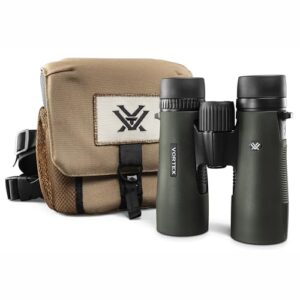
The Vortex Diamondback HD 10×42 is the kind of binocular that punches well above its $200 price tag.
You get 10× magnification, a 42 mm objective, and a 330 ft field of view at 1,000 yards — solid numbers for scanning open marsh.
Fully multi-coated lenses with dielectric and phase-corrected prisms deliver surprisingly bright, color-accurate images.
At 21.3 oz, it’s light enough for a full day on the boardwalk.
Add the transferable lifetime warranty, and the value case basically makes itself.
| Best For | Birders, hunters, and outdoor enthusiasts who want sharp, reliable glass at a mid-range price — especially those who spend long days in the field in all kinds of weather. |
|---|---|
| Magnification | Unknown |
| Objective Lens | Unknown |
| Waterproof | Unknown |
| Fogproof | Unknown |
| Lens Coating | Unknown |
| Tripod Compatible | Unknown |
| Additional Features |
|
- Bright, color-accurate images thanks to fully multi-coated lenses and dielectric prisms — genuinely impressive for the price
- Rugged and weather-ready with argon purging, O-ring seals, and rubber armor that can take a beating
- Transferable lifetime warranty with no fine print — Vortex just fixes or replaces it, no questions asked
- The focus wheel travel is very short, which makes dialing in fine focus trickier than it should be
- No diopter lock, so your setting can drift if you’re not careful
- The included soft case feels like an afterthought compared to the binoculars themselves
2. Nikon Monarch M7 Binocular

Step up in budget and the Nikon Monarch M7 10×42 rewards you with noticeably sharper optics. ED glass cuts chromatic fringing to a minimum, and the fully multilayer-coated lenses push brightness well past entry-level territory.
You get a 357 ft field of view at 1,000 yards — wider than most 10× competitors. Eye relief hits 16.5 mm, so glasses wearers won’t lose the edge of the frame.
Nitrogen-filled and O-ring sealed, it tolerates marsh weather without complaint.
At around $450, it’s a serious upgrade.
| Best For | Birders, wildlife watchers, and outdoors enthusiasts who want sharp, true-color optics in a durable package and are ready to spend a little more to get them. |
|---|---|
| Magnification | 10× |
| Objective Lens | 42 mm |
| Waterproof | Yes, O-ring sealed |
| Fogproof | Yes, argon-purged |
| Lens Coating | Fully multi-coated, dielectric |
| Tripod Compatible | Yes |
| Additional Features |
|
- ED glass delivers crisp, color-accurate images with minimal fringing — a real step up from budget glass
- Wide 357 ft field of view at 1,000 yards makes it easier to scan and track subjects
- Fully weatherproof build handles rain, fog, and humidity without missing a beat
- Some chromatic aberration can still show up on bright, off-axis subjects
- 10× magnification amplifies hand shake, so steady viewing may need a monopod
- The snap-shut lens cap design feels like a downgrade to users familiar with older Nikon styles
3. Swarovski NL Pure 8×32 Green Binoculars
 View On Amazon
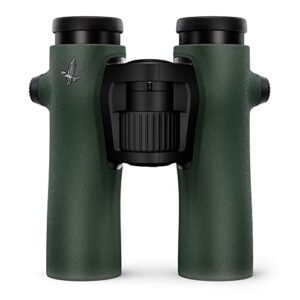
If the Nikon earns its place at $450, the Swarovski NL Pure 8×32 redefines what a compact binocular can do — at $2,799.
That wide field of view is the headline: 492 ft at 1,000 yards. For an 8×32, that’s impressive. You’re covering more marsh with less head-scanning.
SWAROVISION glass delivers color fidelity that makes plumage detail pop. waterproof to 13 feet, it manages wetland weather without hesitation. Compact at 640 g, it’s built for long days.
| Best For | Serious birders and naturalists who spend long hours in the field and want the absolute best optical performance money can buy. |
|---|---|
| Magnification | 10× |
| Objective Lens | 42 mm |
| Waterproof | Yes, nitrogen-filled |
| Fogproof | Yes, nitrogen-filled |
| Lens Coating | ED glass, dielectric multilayer |
| Tripod Compatible | Yes |
| Additional Features |
|
- SWAROVISION glass delivers stunning color accuracy and sharp contrast — plumage detail looks exactly as it should
- That 492 ft field of view at 1,000 yards is genuinely wide for an 8×32, making it easy to track fast-moving birds without losing them
- Ergonomic design and quality build mean you can glass for hours without your eyes or hands complaining
- At $2,799, this is a serious investment — hard to justify unless birding is a real passion or profession
- Lens cover straps have a habit of loosening, which gets annoying fast in the field
- The optional headrest costs extra and has been known to crack under stress or in humid conditions
4. GPO Passion ED Lightweight Binoculars
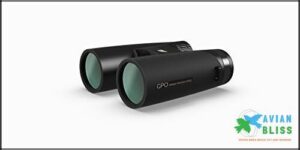
Not everyone wants to spend Swarovski money. The GPO Passion ED 8×42 lands at $501 — and it punches above that price point.
ED glass with GPObright coating keeps colors accurate and chromatic fringing out of the picture. The magnesium alloy body stays light without feeling fragile.
That 426 ft field of view at 1,000 yards? Wider than most competitors at this price. Waterproof, fog‑proof, and tripod‑compatible.
One note: the objective lens covers aren’t included, so order those separately.
| Best For | Birders, wildlife watchers, and hunters who want serious glass without the four-figure price tag. |
|---|---|
| Magnification | 8× |
| Objective Lens | 32 mm |
| Waterproof | Yes |
| Fogproof | Yes |
| Lens Coating | SWAROVISION premium |
| Tripod Compatible | Yes |
| Additional Features |
|
- ED glass with GPObright coating gives you sharp, color-accurate images with almost zero chromatic fringing
- Wide 426 ft field of view at 1,000 yards — genuinely hard to beat at this price
- Magnesium alloy build is light, tough, and handles rain, fog, and early-morning dew without a second thought
- The focus knob has a bit of slack, which can make fine-tuning a little fiddly
- Edge sharpness falls off near the outer rim — noticeable if you’re coming from higher-end glass
- Objective lens covers aren’t included in the box, so factor in that extra purchase
5. Hawke Frontier ED X Binocular
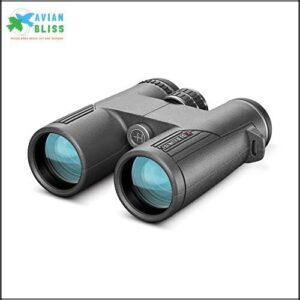
The Hawke Frontier ED X 8×42 is a serious contender under $500.
It uses ED glass with phase-corrected BAK-4 roof prisms and dielectric coatings — the same optical recipe you’ll find in binoculars costing twice as much.
That build quality also holds its value well over time, which matters if you ever upgrade — check out this guide to binoculars for seniors with strong resale and warranty protection.
That translates to a 426 ft field of view at 1,000 yards, which is genuinely wide for tracking herons or wading flocks.
Nitrogen-filled and IPX7-rated, it manages marsh conditions without complaint.
The 1.5-turn focus wheel is fast. At 692 g, it’s not ultralight, but a strap fixes that.
| Best For | Birders, wildlife watchers, and outdoor adventurers who want premium optics without paying premium prices. |
|---|---|
| Magnification | 8× |
| Objective Lens | 42 mm |
| Waterproof | Yes, sealed |
| Fogproof | Yes, sealed |
| Lens Coating | ED glass, GPObright |
| Tripod Compatible | Yes |
| Additional Features |
|
- ED glass with dielectric coatings delivers sharp, color-accurate images that punch well above the price point
- IPX7 waterproofing and nitrogen-filled tubes handle rain, fog, and rough field conditions without hesitation
- Fast 1.5-turn focus wheel makes tracking moving birds or wildlife quick and natural
- At 692 g it’s on the heavier side — you’ll want a harness for long sessions
- Some buyers reported missing or low-quality accessories out of the box, suggesting inconsistent quality control
- The short focus travel can feel touchy for users who need precise fine-tuning
6. Kite Optics APC Stabilized Binoculars

The Kite Optics APC 14×50 is built for birders who need serious reach without the shake. Its KITE Digital Gimbal Suspension uses dual accelerometers to cancel hand tremor at 14× — magnification that would otherwise make handheld use miserable.
The 50 mm ED objectives pull in solid light at dawn.
USB-C rechargeable with 30-plus hours of runtime. IPX7-rated and nitrogen-filled.
At 1.01 kg and $1,799, it’s a commitment — but on open marsh, nothing handheld compares.
| Best For | Serious birders and wildlife observers who need stable, long-range viewing in demanding outdoor conditions and don’t mind paying a premium for it. |
|---|---|
| Magnification | 8× |
| Objective Lens | 42 mm |
| Waterproof | Yes, IPX7 |
| Fogproof | Yes, nitrogen-filled |
| Lens Coating | ED glass, fully multi-coated |
| Tripod Compatible | Yes |
| Additional Features |
|
- Image stabilization at 14× actually works — wind and hand shake stop being a problem
- 50 mm ED lenses keep things bright and color-accurate well into low light
- USB-C rechargeable with 30 hours of runtime means one less thing to worry about in the field
- At $1,799, it’s a hard sell for anyone who isn’t out in the field regularly
- Just over a kilo adds up fast during a long day without a harness or tripod
- The eyepiece adjustment runs stiff, which is annoying if you wear glasses or share the binos
Best Magnification for Wetlands

Magnification is one of those decisions that can make or break a day in the marsh. Pick the wrong power and you’re either missing fast-moving birds or fighting shaky hands trying to hold a distant flock in frame.
Here’s how each option stacks up for real wetland conditions.
Why 8×42 Suits Most Wetland Birders
The 8×42 hits a sweet spot for wetland birding that other configurations just can’t match. You get genuine low light performance at dawn and dusk activity peaks, a wide field of view built for reed edge scanning, and handheld stability that keeps details sharp without a tripod.
At roughly 24 oz, long walk portability stays reasonable.
Bird identification ease, waterproof, and fog‑proof protection complete the package.
The design also includes a woven tapestry neck strap for comfortable wear.
When 8×32 is Better for Long Walks
Covering miles of boardwalk changes the math. An 8×32’s compact body size and lower carry fatigue make it the smarter pick for long wetland walks.
Most models weigh under 700 g, enabling one-hand operation and quick target reacquisition when birds flush unexpectedly.
The wide field of view helps you track movement fast.
Low light performance dips slightly, but in bright wetland habitats, that trade-off is worth it.
Where 10×42 Helps on Open Water
Open water is where 10×42 binoculars earn their place. Remote shoreline scanning and fine plumage detail become far easier when birds sit 200 meters out.
The Vortex Diamondback HD 10×42 and Vortex Viper HD 10×42 both deliver solid lowlight performance for dawn bird detection in wetland habitats.
Add steady viewing techniques — elbows tucked, body braced — and glare management improves naturally.
Field of View Vs Distant Reach
Wide angle views and long range reach don’t play well together.
An 8×42 objective lens gives you roughly 400 feet of field of view at 1,000 yards — scanning efficiency that’s hard to beat in dense reeds.
Push to 10x magnification, and that drops to 340 feet.
You gain distant detail, but lose edge sharpness and depth perception fast.
When Image Stabilization is Worth It
Image stabilization earns its place at 12x and above. At those magnifications, hand tremor turns distant herons into blurs — especially during extended viewing sessions at dawn.
The Canon 12×36 IS III and Kite APC handle tripod‑free scanning and rapid panning without sacrificing lowlight performance. For nighttime observation or windy marsh conditions, image jitter reduction makes the difference between a confident ID and a guess.
Optical Features That Matter
Magnification gets you close, but glass quality determines what you actually see when you get there. The difference between a good pair and a great pair often comes down to a few key optical features inside the barrel.
Magnification gets you close, but it’s the glass inside the barrel that reveals what’s truly there
Here’s what to look for.
ED Glass for Sharper Color and Detail
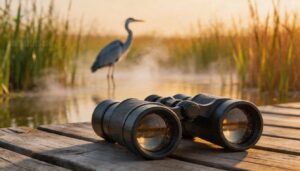
ED glass makes a real difference when choosing binoculars for wetland birding. Extra-Low Dispersion glass cuts chromatic aberration at the source, keeping color fidelity boost consistent across high-contrast scenes like herons against bright marsh water.
The result is accurate color rendering, clean plumage color separation, and fine feather detail that standard glass simply smears.
Optical contrast stays sharp. Colors stay honest.
Fully Multi-coated Lenses for Brighter Views
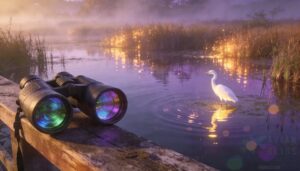
Coating matters more than most birders expect.
Fully multicoated optics apply anti-reflection layers to every glass surface, pushing light transmission to 90–95%.
That means brighter views at dawn and dusk without bumping up magnification.
Broadband coverage keeps colors balanced across mixed wetland light.
Full surface coating also cuts veiling glare for a real contrast boost — making pale birds pop against reflective water.
Phase-corrected Prisms and Better Contrast
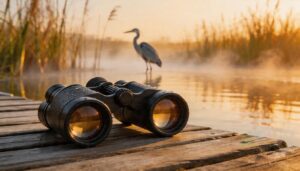
Phase correction picks up where multi-coating leaves off.
roof-prism designs, light splits across the prism’s roof edge and recombines slightly out of phase — dulling contrast and softening fine detail.
Phase-corrected prisms fix that mismatch directly.
marsh birding, the phase coating impact is real: reed edges stay crisp, color fidelity holds across flat light, and resolution retention keeps distant birds readable.
Field-flattener Systems for Edge Sharpness
Most binoculars keep the center sharp but let the edges go soft — and in marsh birding, that’s where the bird often is. Field flattener lenses correct that flat field correction problem by adding carefully balanced lens elements to the optical design.
The trade-off is complexity, but edge field uniformity and peripheral sharpness across the full frame make roof prism design genuinely useful when scanning reed beds.
Low-light Performance at Dawn and Dusk
Dawn and dusk are when wetlands come alive — and that’s exactly when your optics get tested hardest.
Key low-light performance factors:
- Exit Pupil: 8×42s produce a 5.25 mm exit pupil, matching your eye’s dusk dilation
- Twilight Factor: 10×42 scores 20.5; higher means sharper detail in fading light
- Objective Diameter: 42 mm gathers enough light for reliable dawn marsh scans
- Prism Reflectivity: Dielectric coatings reflect 99 % of light, maximizing low‑light contrast
- Lens Coatings: Fully multi‑coated glass hits 92 % transmission — critical for low‑light performance in marsh habitats
Waterproof Protection for Marsh Conditions

Wetlands don’t forgive gear that can’t handle the conditions. Rain, mud, spray, and morning mist are just part of the deal — your binoculars need to be built for all of it.
Here’s what to look for for waterproof protection.
O-ring Sealing for Rain and Spray
Every wetland binocular worth carrying uses an O-ring seal — but not all seals hold equally. Material choice matters here: EPDM and silicone stay flexible through cold dawns and humid afternoons, keeping that compression ratio consistent where cheaper rubbers harden and leak.
Proper groove geometry and surface finish close the remaining gaps. Good installation care keeps it airtight for years.
Nitrogen Vs Argon Fog-proofing
Both gases do the job — but they’re not identical. Nitrogen purged binoculars cost less because nitrogen is abundant. Argon purge adds value through better Cold Temperature Tolerance and slower Seal Diffusion Rate, meaning Long-term Gas Retention stays stronger after minor seal wear.
- Nitrogen: lower Gas Fill Cost, widely used in fog proof binoculars
- Argon: higher Moisture Control Efficiency in cold, damp marshes
- Both: effective waterproof optics with solid seal technology
Why IPX-7 or Better Matters
Slip once on a muddy bank, and your binoculars are underwater. That’s where your Waterproof Rating decides everything. IPX-7 means submersion safety at one meter deep for 30 minutes—real Emergency Retrieval protection, not just Rainstorm Resilience. Pair that with solid Seal Technology, and you get Longevity Assurance across seasons of hard use in marsh habitats.
| Scenario | IPX-6 | IPX-7 |
|---|---|---|
| Heavy downpour | ✓ Manages it | ✓ Manages it |
| Dropped in ditch | ✗ Fails | ✓ Survives |
| Marsh fog & mist | ✓ OK | ✓ Waterproof and fogproof |
| Low-light performance in marsh habitats | Reduced | Maintained |
| Depth Rating protection | Surface only | 1 meter / 30 min |
Rubber Armor for Grip and Durability
Rubber armor does more than protect your investment — it keeps the binoculars in your hands when conditions turn slippery.
A Pebbled Grip Texture gives real traction on wet or cold fingers, while Full Edge Coverage and Impact Absorbing Edge protection guard the corners that take the hardest knocks.
Abrasion Resistant Rubber manages strap friction and trail abuse without peeling. That rugged construction pays off across seasons of serious wetland use.
Water-repellent Coatings in Muddy Habitats
Beyond grip, what keeps optics field-ready is how they shed mud. Superhydrophobic Texture and Hierarchical Surface Design work together so water beads and rolls off, carrying silt with it — that’s Self-Cleaning Performance in action.
- PDMS Chemistry lowers surface adhesion
- Abrasion-Resistant Coatings survive grit and repeated wiping
- Lens coating stays clear through repeated splash exposure
Comfort for Long Wetland Walks

A long day in the marsh will test your gear — and your body. wrong binoculars leave you with a sore neck, foggy lenses, and a loose focus wheel at the worst possible moment.
what to look for before you head out.
Ideal Weight for All-day Birding
Weight distribution matters more than raw grams. Full-size 8×42 binoculars sit around 700g — workable, but front-heavy designs add noticeable load over miles of marsh walking. Lightweight ergonomic design shifts the balance point closer to your hands, cutting fatigue fast.
| Category | Weight Range | Best For |
|---|---|---|
| Compact 8×32 | ~500g | Long walks |
| Full-size 8×42 | ~680–750g | All-day birding |
| Stabilized 14×50 | 900g+ | Fixed platforms |
Cross your weight threshold, and portability and weight considerations become real.
Eye Relief for Glasses Wearers
Glasses compatibility starts with one number: eye relief. Aim for at least 16 mm. That distance keeps the full field visible without clipping edges — a real problem when scanning reed margins for bitterns.
Eyecup adjustment covers the rest. Collapse the eyecups fully, and most 8×42 models cooperate well.
Face shape fit matters too, so field testing any binocular before buying always pays off.
Focus Wheel Placement and One-hand Use
Once eye relief checks out, focus wheel placement becomes your next test. A center-mounted wheel with good thumb reach lets you refocus without shifting your grip — critical when a snipe breaks from cover.
Central wheel ergonomics directly affect one-hand focus speed. Strong grip stability and a well-placed balance point mean less hand shake, keeping your field of view locked on fast-moving birds.
Neck Straps Vs Binocular Harnesses
Neck straps offer fast access — no setup, no fuss. But after hours in a marsh, neck fatigue hits hard.
A binocular support strap fixes this through load balancing, spreading weight across both shoulders. It also manages swing control, keeping birding equipment close to your chest on uneven ground.
Many harnesses add a protection enclosure and quick release buckles, smart choices for serious wetland field testing.
Cases, Lens Caps, and Cleaning Kits
Wetlands are rough on gear. That’s why hard protective case with foam inserts beats a soft travel pouch for transport. In the field, keep it simple:
- Spare lens caps and covers prevent mud buildup fast
- A microfiber cleaning kit deals with smudges without scratching coatings
- Waterproof design and rain-resistant gear keep optics field-ready
Pack smart. Your binoculars will last.
Choosing The Right Price Tier
Wetland birding doesn’t require a $2,000 binocular to be a good experience — but the tier you choose does change what you see at dawn. Budget, mid-range, and premium optics each hit different sweet spots depending on how often you’re out and what conditions you’re birding in.
Here’s how to figure out where your money actually makes sense.
Best Budget Binoculars for Wetlands
You don’t need to spend $500 to get reliable glass in a marsh.
The Vortex Diamondback HD 10×42 sits comfortably budget under $300 and delivers solid lowlight performance in marsh habitats, with O-ring sealing and argon purging keeping it waterproof and fogproof through seasonal shifts.
Field testing and user feedback consistently back it up.
Add basic budget accessories and a simple maintenance routine, and it’ll last.
Best Mid-range Value for Serious Birders
Spend $300–$600 and you hit the sweet spot where Price-Performance Ratio actually makes sense for serious field work. Mid-range optics deliver real Durability Benchmarks, solid Lowlight performance in marsh habitats, and genuine Lens Clarity Index improvements over budget glass.
- Hawke Frontier ED X 10×42 — under $500, ED glass, strong Ergonomic Grip
- Nikon Monarch M7 8×42 — 145m field of view, excellent Accessory Compatibility
- Maven C.1 8×42 — $400, 19.5mm eye relief, sharp across the view
- Vortex Viper HD 10×42 — ~$450, phase‑corrected prisms, MidRange 300‑800 value pick
When Premium Optics Justify The Cost
Premium binoculars earn their keep when conditions push budget glass to its limits. The Investment Value becomes clear quickly — better LowLight Performance at dawn, rock-solid Waterproof and fogproof features for birding gear, and Brand Prestige that holds Resale value strong.
| Feature | Budget vs Premium Binocular Comparison |
|---|---|
| Low-light clarity | Poor → Excellent |
| Resale Market value | Low → High |
Premium 800-range optics offer Lifetime Service with near-zero Maintenance Costs.
Warranty Coverage and Long-term Ownership
A lifetime warranty sounds great — until you read the fine print. Check whether coverage is transferable, because that directly affects resale value if you ever upgrade.
Keep your proof of purchase; missing it can stall any claim.
Most service turnaround times run four to six weeks.
Coverage exclusions usually skip eyecups and straps, so factor those ownership costs in before buying.
Matching Your Binoculars to Wetland Habitats
Warranty sorted — now match your glass to where you actually bird.
Reed bed scanning calls for 8×42s with a wide field. Open water reach favors 10×42.
Coastal marsh edge and mudflat dusk work best with ED glass and 42mm objectives.
For saltmarsh birding in rain or wader flats at low tide, waterproof seals aren’t optional.
Marsh harrier and bittern watching reward patience and brightness equally.
Frequently Asked Questions (FAQs)
Can binoculars handle saltwater wetland environments safely?
Yes, but only if they’re built for it.
Look for O-ring seals, IPX-7 waterproofing, and nitrogen-argon purging. After saltwater exposure, a quick freshwater rinse keeps corrosion-resistant coatings and seal integrity intact long-term.
How do I clean mud off binocular lenses?
Start with a blower to remove loose debris. Soften dried mud with a few drops of water, then use gentle wiping technique with microfiber.
Apply lens fluid, dry fully, and store capped.
Are roof prisms better than porro prisms for wetlands?
Roof prisms seal tighter, weigh less, and handle marsh mist better. For wetland birding, that prism type wins on weight savings and durability.
Porro prisms still offer a stronger depth effect for the budget.
How often should wetland binoculars be serviced professionally?
No fixed service frequency exists. Send your binoculars in when fogging indicators appear, seals fail, or drop damage occurs.
Wetland use accelerates wear, so let performance changes drive your lubrication schedule.
Conclusion
Ironically, the best binoculars for wetland birding are the ones you forget are there. You focus on herons, not foggy lenses.
Investing in quality binoculars for wetland birding pays off. Look for waterproofing, sharp glass, and comfort.
With the right pair, you’ll spot birds, not limitations. Choose wisely, and your wetland adventures will be unforgettable, with the perfect binoculars for wetland birding by your side always.