This site is supported by our readers. We may earn a commission, at no cost to you, if you purchase through links.

A chickadee will abandon a nesting box that gets too hot—not because she’s picky, but because overheating kills eggs and weakens chicks. One small detail separates boxes that fledge healthy broods from boxes that sit empty all season: which way the entrance faces.
North-facing boxes block the harshest afternoon sun, keeping interior temperatures measurably steadier when summer heat peaks.
That single adjustment influences breeding success, predator pressure, and how often birds return year after year.
Getting the orientation right takes more than pointing a compass—site selection, mounting height, and local weather patterns all shape the outcome.
Table Of Contents
Key Takeaways
- A north-facing entrance shields the nest from afternoon sun, keeping interior temperatures steady enough to protect eggs and reduce heat stress on developing chicks.
- Site selection — clear flight paths, morning shade, distance from predator perches, and wind shelter — matters just as much as which direction the box faces.
- Mounting height between 5 and 15 feet, paired with a predator baffle, cuts ground and aerial predator risk without making seasonal inspections a chore.
- If birds keep passing the box by, a small 30–45-degree rotation and a post-season clean-out are often all it takes to turn an ignored box into an active nest.
Why Face Nest Boxes North
Facing a nest box north is one of those small decisions that quietly makes a big difference for the birds inside. It’s not complicated, but there are a few solid reasons why north is often the right call.
North-facing placement helps regulate temperature and reduce direct sun exposure, and you can dig into the full reasoning over at owl nest box placement and design tips.
Here’s what that direction actually does for your birds.
Avoid Harsh Afternoon Sun

When afternoon sun beats down hardest, a north-facing entrance keeps that heat out of the picture. Direct sun exposure through the entrance is one of the fastest routes to overheating.
tree canopy buffer adds an extra layer of shade and cooling, while reflective exterior paint and an adjustable overhang angle help regulate temperature before it becomes a problem for nesting birds.
Keep Interior Temperatures Steadier

North placement does more than block sunlight — it maintains steady thermal regulation inside the box. Thick walls with solid insulation thickness, a sealed hatch design, and thermal mass materials absorb daytime heat and release it slowly at night.
ventilation balance and smart microclimate buffering through nearby shade and airflow, and you get a nest cavity that holds a remarkably consistent temperature all day.
Reduce Heat Stress in Summer

Summer heat stress is real, and your box’s north-facing orientation is the first line of defense.
Pair that with reflective roof coating to bounce radiant energy away, an insulating interior lining to buffer temperature swings, and mesh vent panels for steady airflow.
Cool paint colors and thermal mass materials help moderate sun exposure, keeping temperature regulation working in birds’ favor all season.
Know When North Works Best

Hot climates are where north-facing boxes truly shine. Species preference matters here — cavity nesters like chickadees actively seek cooler entrances during seasonal temperature shifts.
In hot climates, north-facing nest boxes give cavity nesters like chickadees the cooler refuge they instinctively seek
If your geographic latitude brings intense summers, a north orientation provides steady temperature regulation without extra intervention.
It also reduces predator activity patterns near overheated, stressed nests.
Microclimate matching and smart climate and weather considerations for nest box placement make north the reliable default.
Considering grid north versus magnetic north ensures precise alignment with map-based orientation guidelines.
Pick The Best Site

Facing a box north is a great start, but the spot you choose matters just as much. The right location keeps birds safe, comfortable, and more likely to return each season.
Picking a sheltered spot with the right sun exposure makes all the difference—this bird house installation and placement guide breaks down exactly what to look for.
Here are the key site factors to check before you mount anything.
Choose a Clear Flight Path
Think of the flight path as a runway.
Birds need clear unobstructed access from their perch straight to the entrance — keep a branch‑free buffer of at least three feet around the box. Provide landing zone clearance of roughly two feet in front.
Use visual guidance markers like nearby shrubs to guide approach, and maintain a pet‑free buffer zone within 50 feet.
Check Morning Shade and Light
Morning shadow patterns shift throughout the season, so check your chosen spot at dawn before committing. Shade duration variability matters too — deciduous trees alter coverage as leaves drop.
Dappled light through foliage creates light intensity gradients that conceal nest activity from predators while supporting early foraging support for occupants. Dew retention effects keep humidity stable, balancing shade and morning warmth for nest boxes without blocking beneficial sunlight for temperature regulation in nest boxes.
Avoid Strong Prevailing Winds
Prevailing winds can turn a well-placed box into an uncomfortable, drafty space birds won’t use. Wind Direction Mapping helps you identify your strongest seasonal gusts before you commit to a spot.
Pair a north-facing placement with Windbreak Vegetation nearby, and you’ve got solid wind shelter.
A Shallow Wind Shield, Aerodynamic Box Design, and Flexible Mounting Brackets all reinforce that ideal orientation for bird houses without blocking ventilation.
Keep Away From Predator Perches
A hawk doesn’t need to be close to cause problems — it just needs a good vantage point. Predator perches within 100 meters raise ambush risk substantially, so Perch Distance matters as much as box orientation.
For reliable predator avoidance strategies in nest box placement, focus on:
- Perch Removal of low branches facing the entrance
- Visual Deterrents like reflective tape on nearby poles
- Perch Guard Installation on surrounding tree trunks
- Ground Clearance to eliminate hidden approach routes
A northfacing box loses its predator protection through house placement advantage, fast if a raptor has a clear sightline straight to the entrance. Keep that space open.
Set Height and Mounting

Getting the direction right is only half the job. How high you mount the box — and what you mount it on — shapes whether birds actually move in.
Here’s what to get right before you hang anything.
Mount Boxes 5 to 15 Feet High
Height matters more than most people expect. Mount your north-facing box between 5 and 15 feet — this range blocks most ground predators while keeping inspection manageable with proper ladder safety.
Use corrosion-resistant fasteners and confirm your mount has a solid wind load rating and weight capacity.
Anchor stability keeps the box from wobbling during storms, which disturbs nesting birds.
| Height | Predator Risk | Inspection Ease |
|---|---|---|
| Under 5 ft | High | Easy |
| 5–10 ft | Low | Moderate |
| 10–15 ft | Very Low | Needs ladder |
Use Poles or Sturdy Trunks
Your support structure is the foundation, everything else depends on. For pole diameter selection, aim for 4 to 6 inches — sturdy enough to handle wind load without wobbling.
A concrete base pad keeps moisture out and the pole upright long-term. Apply fire retardant coating to extend its outdoor life.
Use adjustable angle brackets with a protective sleeve wrap to mount the box at ideal orientation for Tree Swallow nest boxes without damaging bark.
Metal pole or PVC pipe both work well.
Add Predator Baffles or Collars
Once your pole is secure, add a baffle beneath the box. Baffle Material Choice matters — metal baffles outlast plastic in harsh weather. Follow Baffle Size Standards: at least 8 to 12 inches wide.
For Collar Installation Height, position it 4 to 6 feet above ground. Dual Protection Setup — collar plus lower skirt — covers multiple climbing angles. Stick to a Baffle Maintenance Routine each spring.
Space Boxes Far Enough Apart
Spacing matters just as much as height. Keep at least 25 meters between boxes — that’s your Minimum Separation for Competition Mitigation and Scent Interference control. Follow birdhouse placement guidelines to protect Predator Buffer Zones and support Habitat Connectivity across your site.
- Maintain clear flight paths between boxes
- Follow ideal orientation for bird houses at each spot
- Apply mounting height and site selection guidelines consistently for predator avoidance
Fine-Tune for Weather

Getting the direction right is only half the job — weather will test every decision you make. few small tweaks can mean the difference between a box that works and one that birds quietly ignore.
Here’s what to look at next.
Compare North and Northeast Placement
Both directions work, but each has a trade-off.
A true north face gives stronger shade and cooler thermal regulation in nest boxes during summer heat.
Northeast shifts that balance slightly, offering gentle morning sun exposure while still limiting afternoon warmth. It also helps with wind exposure by ducking prevailing winds and improves moisture management near the entrance. For predator visibility and species preference, northeast edges ahead.
Add Roof Overhangs for Rain
Once you’ve settled on north or northeast, rain protection becomes your next concern. A natural overhang does quiet, reliable work.
Here’s what makes overhang utilization effective:
- Overhang Width — Aim for 12–24 inches to redirect rain runoff away from the entrance.
- Slope Angle — Tilt the roof 5–10° toward the back for faster water shedding.
- Drip Edge Design — A sealed drip edge channels water cleanly off the fascia.
- Material Durability — Coated metal or treated wood resists rot through repeated wetting cycles.
Gutter integration isn’t always practical on a small box, but even a modest overhang cuts moisture intrusion considerably, keeping rain protection for nesting birds simple and solid.
Include Ventilation and Drainage Holes
Even with a north-facing box, heat and moisture still build up inside. That’s where ventilation holes near the top and drainage holes at the base earn their place.
Hole size optimization matters — too small and airflow stalls; too large and drafts chill nestlings.
Add mesh screens to block debris without restricting airflow balance.
Drainage placement at the rear bottom lets water exit cleanly, keeping your ideal orientation for bird houses working through wet seasons.
Adjust for Local Climate Conditions
Where you live shapes everything.
In hot, dry regions, a strict north orientation manages temperature control and cuts solar exposure index risk through the summer.
In wet or coastal areas, moisture control means prioritizing drainage and wind deflector design over light access.
Cold climates benefit from snow load mitigation through elevated mounting.
Always read your local climate considerations first — microclimate management decisions matter more than any single rule.
Check, Clean, and Adjust
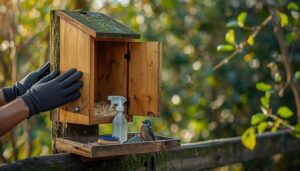
Once nesting season wraps up, your job isn’t quite finished. A little seasonal attention keeps the box safe, functional, and ready for next year’s arrivals.
Here’s what to check each time you visit.
Inspect The Box Each Season
Before each breeding season, give your box a full once-over. A quick Structural Integrity Check catches cracks, warped joints, and loose hardware before birds arrive.
Run through your Hardware Function Test — latches, hinges, and screws should all move cleanly.
Check the Entrance Hole Assessment for any enlargement, then complete a Moisture & Mold Review and finish with a Predator Guard Inspection to confirm baffles remain secure.
Clean It After Breeding Ends
Once chicks fledge, cleaning becomes your most important act of nest box maintenance.
Remove all old nesting material immediately — parasite management starts here. Scrub the interior with a 1 percent soap solution, then allow complete drying for 24–48 hours before closing it up.
- Disinfect hinges and latches thoroughly
- Replace with fresh nesting material suited to your target species
- Mold prevention protects next season’s brood
Repair Damage Before Reuse
Before reusing your nest box, give it a close inspection. Seal cracked joints with marine-grade epoxy — epoxy joint sealing stops water intrusion.
Replace worn screws with stainless fasteners, and fill any gouges using wood filler application.
Clear blocked ventilation slots, then finish with weatherproof sealant application on all exterior seams.
This north-oriented nest box maintenance routine keeps your ideal orientation for bird houses performing season after season.
Reposition if Birds Avoid It
If birds keep passing your box by, don’t assume the location is permanently wrong. Try rotating it 30 to 45 degrees — a simple compass shift toward north or east can break a familiar overlook path.
Glare management matters too; diffuse light reduces hesitation near the entrance. Monitor for several weeks after repositioning, and check habitat proximity to water and cover before making further changes.
Frequently Asked Questions (FAQs)
What wood types work best for nesting boxes?
Cedar durability and Redwood longevity make both top choices — naturally rot-resistant and safe for nesting wildlife. Pine works well when sealed properly.
Cypress manages humidity reliably, while marine-grade plywood offer solid eco-friendly building materials alternatives.
How far apart should multiple boxes be spaced?
Space matters more than you’d think. Species Spacing varies — bluebirds need 25–40 feet apart, wrens 15–20 feet.
Predator Buffer, provide an Airflow Gap, and leave room for Maintenance Access between boxes.
Can nesting boxes be used for winter roosting?
Yes, nesting boxes double as winter roosts.
Add insulation lining for thermal buffering, face them north to limit cold wind exposure, and use occupancy monitoring to track species preference and adjust placement as needed.
How do you monitor a box without disturbing birds?
You don’t need to open the box at all.
A wireless nest camera with infrared night vision and remote data transmission lets you watch activity from your phone without ever getting close.
Conclusion
Think of your nesting box as a tiny house facing the right street—when you orient it correctly, everything else falls into place. A chickadee scouting your yard reads the details you’ve set: the shaded entrance, the steady interior, the clear flight path.
Facing your nesting box north isn’t just a compass decision; it’s the foundation every other choice builds on. Get that one thing right, and the birds will find you.