
This site is supported by our readers. We may earn a commission, at no cost to you, if you purchase through links.

Bluebirds are particular about real estate. Set up a house in the wrong spot—too shady, too close to shrubs, or on a wobbly wooden post—and they’ll ignore it completely, season after season.
Most people blame the box itself, but the location does almost all the work. A well-made house in a poor spot sits empty, while a modest one in the right field draws a pair within weeks.
clear set of rules these birds have followed for centuries, and once you understand their logic, every decision clicks into place.
Table Of Contents
- Key Takeaways
- Pick Open, Sunny Habitat
- Avoid Trees, Shrubs, and Dense Cover
- Mount Boxes at Proper Height
- Face The Entrance Correctly
- Use The Best Mounting Method
- Space Boxes for Bluebird Territories
- Add Predator and Competitor Protection
- Match Placement to Bluebird Species
- Check Placement Through The Season
- Frequently Asked Questions (FAQs)
- Conclusion
Key Takeaways
- Location does almost all the work — open, sunny spots with short grass and a water source nearby will attract bluebirds far more reliably than any fancy box design.
- Mount your box on a smooth metal pole 4–6 feet high, facing east or northeast, so birds get gentle morning sun and stay shielded from afternoon heat and prevailing winds.
- Keep boxes 100–300 feet apart, well away from trees, shrubs, and brushy edges, to respect bluebird territories and block wrens, sparrows, and predators from moving in.
- Check your boxes weekly during nesting season, clean them out each spring, and move any underperforming ones after the season ends — bluebirds reward consistency.
Pick Open, Sunny Habitat

Bluebirds are picky about where they set up home — and that’s actually good news for you. Once you know what they’re looking for, picking the right spot becomes straightforward.
Once you nail the location, the next step is building a box they’ll actually use — these bluebird house design and placement tips cover exactly what features to include.
Start by thinking about the type of open space you have to work with.
Choose Fields, Pastures, Orchards, or Large Yards
Bluebirds thrive where the land opens up — think fields, pastures, orchards, or large yards with large expanses of short grass. These spots offer the right mix of soil moisture, insect abundance, and microclimate variation that bluebirds need.
Look for places with:
- Low human activity levels nearby
- Natural landscape connectivity between feeding areas
- Open areas free of dense cover
- Good predator protection for bluebird nest boxes
Prioritize at Least Six Hours of Morning Sun
Once you’ve found that open patch of land, check how much sun it actually gets. Bluebirds need at least six hours of morning light duration daily — east-facing spots catch early-morning sunlight exposure that helps circadian alignment and thermal regulation without cooking the nest by noon.
Sun exposure balance matters here.
Seasonal sun shifts can change coverage, so observe your site across different months before committing.
Look for Short Grass and Easy Foraging Areas
Short grass is where bluebirds do their best hunting. Aim for grass height management in the 1–3 inch range — that’s the sweet spot for insect abundance and ground cover clearance.
Native grasses in open areas let bluebirds spot insect prey fast. Water proximity within 100 feet boosts activity too, and seasonal forage shifts mean natural ground cover needs regular mowing to stay productive.
Include Nearby Perches Like Fence Posts or Wires
Once your grass is trimmed and ready, give bluebirds a place to land and look around. Fence Post Perches spaced 10–20 feet apart along your fence line work perfectly. Wire Perch Installation between posts adds more options.
Keep Perch Height Optimization in mind — align them near the entrance height. Follow basic Perch Safety Features: no sharp edges, secure anchoring, and a clear flight path.
Keep a Water Source Reasonably Close
A water source within 100 feet makes a real difference.
Place a shallow dish design in a sunlit water spot — not right under the box, but 10–15 feet away. Proper placement distance keeps splash away from the nest.
Follow a simple maintenance routine: refresh daily, scrub weekly. Water source proximity is one of the easiest water source considerations for bluebirds you can get right.
Avoid Trees, Shrubs, and Dense Cover

Bluebirds are open-country birds — they don’t trust cluttered spaces, and neither should your box placement.
Dense cover nearby gives predators a place to hide and wrens a reason to move in.
Here’s what to watch out for when choosing your spot.
Keep Boxes 100–200 Feet From Wooded Edges
Trees look beautiful, but they’re a bluebird’s worst neighbor. Keep your boxes 100–200 feet from wooded edges, where edge predator density spikes and ambushes happen quickly.
That gap delivers real microclimate benefits — more sunlight, better insect abundance, and a human disturbance buffer that lets birds settle in. Smart birdhouse placement guidelines always prioritize open habitat, because crowding the tree line invites trouble.
Avoid Brushy Areas That Attract Wrens
Wrens love dense bushes — and that’s bad news for your bluebirds. edge clearance of at least 15–20 meters keeps wrens from patrolling nearby.
low perch removal, ground litter reduction, and seasonal brush trimming to shrink their foothold. birdhouse placement guidelines and careful nest site selection mean avoiding competition from house wrens and sparrows, giving bluebirds a fair shot.
This is driven by House Wren territorial aggression that peaks in early spring.
Maintain a Clear Flight Zone Around The Entrance
Think of the entrance as a tiny runway — bluebirds need clean, unobstructed space to land and exit safely. Keep a 6-meter approach corridor width clear in every direction, and practice regular ground debris clearance around the base.
- Trim vegetation within 6 meters for clear sightlines
- Remove loose wire management hazards within 2 meters
- flat landing pad just beyond the entrance
- soft dawn lighting to gently brighten the opening
- safe distance and open area from nearby structures
Reduce Predator Hiding Spots Near The Box
Predators are patient — they’ll use every shadow within reach. Clear underbrush and eliminate woodpiles within 15 feet of your box. Install a gravel ring around the base to remove concealment.
Maintain an open perimeter with low ground cover so bluebirds have clear sightlines in every direction.
Dense bushes and nearby perches attract predators, so keep a safe distance and add predator guards to the pole.
Skip Deep Shade and Overgrown Corners
Deep shade isn’t just dim — it’s a signal to bluebirds that this spot isn’t safe. Overgrown corners hide predators, trap moisture, and block airflow. Here’s what to avoid:
- Eliminate Overgrown Edges within 6–8 feet of your box
- Avoid Hidden Perches created by dense bushes nearby
- Reduce Moisture Retention by skipping low, shaded spots
- Promote Air Circulation and Keep Entrance Visible with vegetation clearance
Stick to sunny open areas — balancing sunlight and shade in birdhouse placement makes all the difference.
Mount Boxes at Proper Height
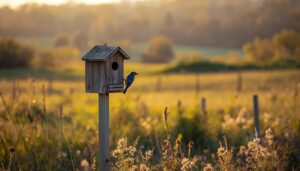
Height matters more than most people realize when mounting a bluebird box. Get it wrong and you’ll either make life easier for predators or harder for yourself during monitoring season.
Mount your bluebird box at the wrong height and you hand predators an advantage
Here’s what to keep in mind when deciding how high to go.
Install Boxes 4–6 Feet Above Ground
Mount your bluebird box so the entrance sits 4–6 feet off the ground — a pole set 54 inches works well as a starting point for height measurement. This birdhouse mounting height keeps nests clear of flooding and most ground predators.
Use safety brackets and check your installation angle so the box stays level.
Steel rebar pole anchoring adds post depth and solid predator protection for bluebird nest boxes year‑round.
Leave Open Vertical Space Above The Entrance
Once your birdhouse height is set, check what’s directly above the entrance. Leave at least 12 inches of vertical airspace buffer — this entrance gap size gives bluebirds a clean Bird Comfort Zone for swooping in without bumping anything.
Good airflow matters here too.
Camera access space stays open, and above entrance clearance helps predator guards do their job without blocking flight paths.
Keep The Box Level After Mounting
Once the entrance clearance looks good, check that your box sits perfectly flat. A tilted box shifts nesting material and throws off your monitoring angle. Use a Spirit Level to check on the top edge right after tightening.
- Shim Adjustments behind the bracket fix ground irregularities fast
- Laser Level Alignment keeps a row of boxes consistent
- Drainage Pad Placement under the post prevents settling
Secure The Post to Prevent Swaying
A level box is only half the job — a wobbly post undoes everything.
Diagonal Braces and Anti‑Sway Hardware keep your post rigid through wind and rain.
Concrete Footings dug below the frost line prevent seasonal shifting, while Ground Anchors work great in softer soils.
Choose sturdy posts in weather‑resistant Post Material, and swaying birdhouses become a thing of the past, making mounting a bluebird house much easier.
Place The Entrance at a Practical Monitoring Height
Think of the entrance as your daily checkpoint. Keeping it at eye level — right in line with birdhouse height recommendations of 4–6 feet — turns every weekly check into a quick, comfortable glance.
This Eye-Level Entrance approach gives you a clear Viewing Angle without crouching.
Follow a simple Adjustment Protocol: use Height Markers on your pole, maintain Standardized Clearance, and you’ll be mounting bluebird house successfully every time.
Face The Entrance Correctly

The direction your birdhouse faces matters more than most people think. A small tweak in angle can mean the difference between a box bluebirds love and one they ignore.
Here’s what to get right.
Aim East or Northeast When Possible
Facing east or northeast is one of the simplest wins you can make for your bluebird box.
This protective orientation, east or northeast, delivers Dawn Light Warmth early, which sparks Early Insect Activity right when nestlings need feeding most. It also improves Predator Visibility during morning checks and maintains Temperature Consistency throughout the day, keeping your box comfortable without overheating.
Capture Gentle Morning Sun
Morning sun does more than warm your box — it sets the whole day up right. The Dawn Light Angle hitting an east-facing entrance creates a Warm Morning Glow that bluebirds respond to almost instantly. Orientation matters more than most people realize.
Here’s what Soft Sun Exposure delivers:
- Early Light Reflection off dew-covered grass guides birds toward foraging zones
- Dew Enhanced Visibility helps bluebirds spot insects earlier
- Early morning sunlight exposure warms the entrance gradually, reducing stress
- Light exposure optimization keeps nest temperatures stable without overheating
Avoid Harsh Afternoon Heat
Afternoon heat can turn a cozy nest into an oven. That’s why east or northeast placement gives you the best of both worlds — morning sun for warmth, afternoon shade for relief.
Light Shading Structures or Heat-Reflective Paint on exterior surfaces help manage temperature regulation in birdhouses.
Pair that with Breeze Channeling and Evaporative Cooling nearby, and balancing sunlight and shade in birdhouse placement becomes second nature.
Turn The Entrance Away From Prevailing Winds
Wind hits the entrance like an open door in a storm — cold, wet, and uninviting. Point the opening away from prevailing winds to keep the nest dry and warm. Use Wind Rose Mapping to identify your site’s dominant wind direction, then orient accordingly.
Good wind protection for bird boxes includes:
- Entrance Overhang Design to block direct gusts
- Gust Deflection Screens made from Wind-Resilient Materials
- Wind exposure mitigation through smart positioning
- Seasonal Wind Adjustment after major storms shift patterns
Adjust Direction for Local Weather Patterns
No two backyards share the same microclimate, so the direction your bluebird house faces may need fine-tuning each season. A Seasonal Orientation Review helps you catch subtle shifts in wind exposure mitigation and Microclimate Temperature Balancing needs.
Near water or open fields, try an Eastward Tilt Adjustment toward east or southeast to increase morning sunlight. Add North Shield Implementation and a Windbreak Placement Strategy for consistent temperature control.
Use The Best Mounting Method
How you mount your bluebird box matters more than most people think. The right setup keeps the box stable, safe, and easy to check on throughout the season.
Here’s what to focus on regarding mounting method and materials.
Prefer Smooth Metal Poles or Round Pipes
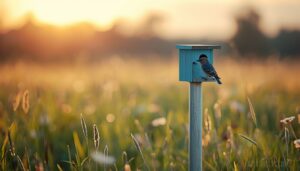
Regarding birdhouse anchoring, a smooth round pipe is your best friend. Round pipes offer structural uniformity, distributing wind loads evenly for solid Wind Resistance. Their corrosion protection coatings cover smooth surfaces without weak spots.
Installation Speed is a bonus too — standard hardware fits right away, no fuss. Mounted 5 to 10 feet off the ground, these poles also deliver clean Aesthetic Integration in any open field.
Avoid Mounting on Trees or Fences
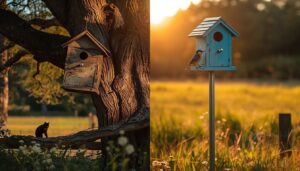
Smooth poles beat trees and fences every time. Tree mounting causes Tree Sap Damage as bark heals around hardware, and branch sway misaligns your box over time.
Fences bring Fence Shade Issues that cut into that morning sun, bluebirds need.
Both surfaces also invite predators.
For solid birdhouse anchoring and Bluebird house placement guidelines, a freestanding pole wins hands down.
Choose Stable Hardware for Long-term Support
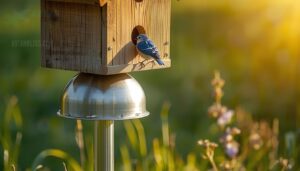
Good hardware is what separates a box that lasts one season from one that lasts twenty.
Use wind-load rated brackets and corrosion-resistant fasteners — 304 or 316 stainless steel poles hold up without rust.
Concrete footings below the frost line stop heaving.
UV-coated hardware resists sun breakdown, and pole baffles pair naturally with stable steel rebar poles for secure, long-term mounting.
Use Untreated, Weather-resistant Box Materials

Once hardware is locked in, the box itself needs to hold up just as well. Cedar durability makes it the top pick — its tight grain sheds moisture naturally without any treatment.
A light coat of tung or linseed oil adds extra protection. Choose sustainable lumber, and your box stays strong season after season.
Keep The Setup Simple for Easy Access

Keeping things simple pays off when it’s time for regular checks. Use standardized kits so you’re not hunting for the right bolt each visit.
A labeling system on each post saves guesswork.
Clear pathways to each box and a portable ladder nearby make birdhouse cleaning and maintenance quick and stress‑free.
Choose a removable roof so the box is easily opened for cleaning with minimal tools.
Space Boxes for Bluebird Territories

Bluebirds are territorial birds, and crowding their boxes is a quick way to end up with an empty yard. Getting the spacing right makes a real difference in whether they settle in and stay.
Here’s what to keep in mind when laying out multiple boxes.
Place Single Boxes 100–300 Feet Apart
Bluebirds are territorial by nature — crowd them and they’ll simply move on. Territorial Mapping starts with understanding that each pair needs breathing room. Inter-box Competition drops dramatically when you apply proper nest box spacing.
Follow these spacing between birdhouses guidelines:
- Place boxes 100–300 feet apart minimum
- Reduce Population Density conflicts by honoring territory size
- Avoid Edge Effects by spacing along open corridors
- Prevent Habitat Fragmentation with consistent placement
- Follow Bluebird house height and spacing guidelines regionally
Use Wider Spacing in Smaller Yards
If your yard is small, less really is more. One well-placed box beats two that trigger territorial fights. Think of Yard Zoning as dividing your space honestly — if 300 feet isn’t available, skip the second box entirely. Do a quick Visual Survey first.
| Yard Size | Boxes Recommended | Distance Optimization |
|---|---|---|
| Under 0.5 acre | 1 box | Focus on best spot |
| 0.5–1 acre | 1–2 boxes | Maximum separation |
| 1–2 acres | 2 boxes | 150+ feet apart |
Seasonal Adjustments and Neighbor Awareness also matter — neighboring birdhouse placement guidelines affect your spacing between birdhouses too.
Align Boxes Along Open Edges and Corridors
Think of your boxes as a quiet road bluebirds travel daily. Align them along field margins and open grasslands, using gentle curves that follow the land’s natural shape — that’s Gentle Curve Design working for you.
Space multiple houses 100–300 feet apart for Corridor Continuity and strong Open Edge Visibility. Facing a field keeps Travel Path Alignment natural and foraging easy.
Avoid Clustering Several Boxes Too Closely
crowding multiple houses together is a trap many well-meaning yard hosts fall into. When spacing between nest boxes shrinks below 100–300 feet, Territory Integrity breaks down fast — pairs compete for food, stress rises, and Nest Success drops.
Competition Reduction, Microclimate Balance, and Monitoring Efficiency, treat each box as its own zone.
Best bluebird house placement means spreading multiple houses across open ground using solid competition avoidance strategies.
Plan Box Placement Before Installing Multiple Houses
Before you drive a single post, walk the land.
Survey Land Topography, Map Insect Hotspots, and Assess Soil Drainage so you know exactly where bluebirds will thrive.
Plan Access Paths for easy weekly checks, and Coordinate with Neighbors if open habitat crosses property lines.
Sketch your layout first, keeping spacing multiple houses 100–300 feet apart, then install with confidence.
Add Predator and Competitor Protection
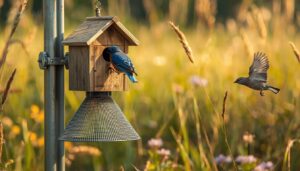
Getting bluebirds to move in is one thing — keeping them safe is another. Predators and competing birds can quietly undo all your careful placement work.
Here’s what you can do to protect your box and give bluebirds a real fighting chance.
Install Pole Baffles Below Each Box
Below every box, a predator baffle is your first line of defense. Proper baffle positioning means mounting it 4 to 5 feet below the box on a smooth metal pole, leaving the bottom edge at least 4 feet above ground.
Choose a weatherproof coating with strong material durability, and use stainless attachment hardware with a rotation mechanism for easy seasonal inspections.
Predator exclusion this simple genuinely works.
Use Metal Entrance Guards to Prevent Damage
Once your baffle is in place, the entrance hole needs its own layer of predator protection.
A metal entrance guard fits right over the opening, adding impact absorption that raw wood simply can’t offer. Stainless steel options offer solid corrosion resistance through wet seasons.
Check your installation fit twice a year — loose guards invite damage. Good predator guards keep bluebird house placement working long-term.
Limit Nearby Perches for Sparrows and Starlings
Once your predator guards are secure, take a look at what’s nearby.
Sparrows and starlings love any perch within reach of the entrance. Strip those away.
Use reflective deterrent strips on rails, overhead wire barriers above the box, and unstable perch design on nearby posts. Check perch density monitoring weekly, and do seasonal perch adjustment each spring — perches attract predators and competitors alike.
Keep Distance From House Wren Habitat
House wrens are cavity nesters, and they’ll claim your bluebird box fast if you’re not careful.
Wren Habitat Mapping starts with spotting brushy edges and dense thickets — then placing your box well away from them.
A solid Wren Territory Buffer means keeping 30 feet minimum between boxes and wren-friendly cover.
Smart Buffer Zone Design and Perch Limitation Strategy protect bluebirds from house wrens without much extra effort.
Protect The Box Without Blocking Bluebird Access
Protecting your box doesn’t mean making it a fortress that bluebirds can’t enter. A Low Profile Baffle below the pole blocks climbers, while Entrance Lip Smoothing prevents snags on entry. Reflective Deterrent Strips near the opening startle raccoons without slowing birds down. Your Easy Access Panel keeps monitoring simple.
- Use Ventilation Guard Design to keep airflow open without gaps that predators exploit
- Size the Entrance hole to exactly 1.5 inches — bluebirds fit; starlings don’t
- Orient the box east or northeast for Protective Orientation that also deters wind-driven intruders
- Swap worn guards each spring when you clean the box for Predator protection for bluebird nest boxes
Match Placement to Bluebird Species
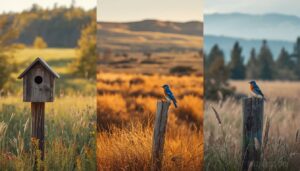
Not all bluebirds are the same, and where you put your box should reflect that. Eastern, Western, and Mountain Bluebirds each have slightly different habitat needs, spacing preferences, and climate tolerances.
Here’s how to match your placement to the species you’re hoping to attract.
Consider Eastern Bluebird Habitat Preferences
Eastern Bluebirds thrive in open grasslands with native vegetation nearby — think rolling pastures, old orchards, or large backyard edges.
They need landscapes with good connectivity between foraging zones and minimal human disturbance.
Soil moisture affects seasonal insect peaks, so wetter spots often mean better food.
Keep your ideal birdhouse height at 4–6 feet, east facing, with sunlight and shade considerations for nesting in mind.
Run a quick predator survey before you commit to a spot.
Adjust Spacing for Western Bluebirds
Western Bluebirds need room to breathe. Territory Density Mapping shows they do best when you’re spacing multiple houses 100–300 feet apart, with Landscape Patch Distribution and Corridor Connectivity Planning guiding your layout along open edges.
- Use Edge Buffer Zones near wren habitat
- Apply Seasonal Spacing Adjustments as vegetation shifts
- Follow Bluebird house height and spacing guidelines consistently
- Prioritize best bluebird house placement in sunny corridors
- Keep ideal birdhouse height at 4–6 feet
Allow Broader Territories for Mountain Bluebirds
Mountain Bluebirds roam wider than their cousins. Their Territory Size Mapping follows Elevation Gradient Use and Seasonal Migration Patterns across high-elevation grasslands and open sagebrush flats.
Place boxes in the most open area you can find, spacing multiple houses 100–300 feet apart. Landscape Connectivity matters here — link Insect Abundance Zones along corridors, and keep ideal birdhouse height at 4–6 feet throughout.
Factor in Regional Climate and Heat Exposure
Climate shapes everything about where your box succeeds. Do some Microclimate Mapping before you install — note Seasonal Wind Patterns, afternoon shade pockets, and Water Proximity Effects that cool or trap heat nearby.
Use Heat‑Resistant Materials like cedar to handle seasonal temperature fluctuations, and orient entrances for ideal sun exposure for birds while practicing smart Humidity Management and temperature management in bird nesting boxes across regional variations in bluebird house placement.
Choose Placement That Fits Local Nesting Behavior
Every bluebird species reads the landscape differently. Microclimate Matching means studying your yard’s Habitat Edge Preference — where open meets shelter — then placing your box where Insect Food Availability peaks seasonally. Do your Local Predator Mapping before you commit to a spot.
- Align with Seasonal Migration Timing so boxes are ready early
- Follow Bluebird house height and spacing guidelines for your species
- Face entrances toward morning sun, ensuring predator protection for nesting birds
Check Placement Through The Season
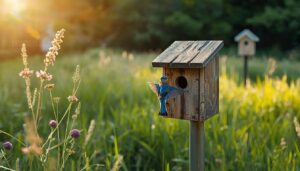
Getting your box in the right spot is just the beginning. Bluebirds, weather, and local predators all shift through the season, so what worked in March might need a tweak by July.
Here’s what to watch and do to keep your setup working all year long.
Inspect Boxes Weekly During Nesting Season
Once a week, open each box and take quick notes — Egg Count, Nestling Growth, and any Predator Signs you spot. Jot a brief Weather Log entry too, since conditions affect nest success.
Good Sanitation Protocol means removing waste and checking the latch every visit.
These regular checks make nest box maintenance simple, and your seasonal monitoring records will show exactly what’s working.
Reassess Sun, Wind, and Predator Exposure
Your weekly notes pay off here. Use them for Microclimate Monitoring — tracking how sun exposure, shade, and wind shift across the season.
If morning sun fades or afternoon heat builds, Adaptive Orientation Adjustment may help.
Seasonal Wind Mapping reveals new gusts that need wind protection for bird boxes.
Check for gaps in Predator Visual Barriers too, and apply Heat Stress Mitigation before temperatures peak.
Clean Boxes Before Each Breeding Season
Once you’ve reassessed sun and wind exposure, it’s time to clean. A solid Cleaning Schedule starts with removing old nesting material — don’t skip the Mite Inspection.
Scrub surfaces, do a thorough Disinfectant Rinse, then follow a careful Drying Procedure before adding fresh Bedding Replacement.
Birdhouse cleaning and maintenance done right each spring give bluebirds a healthy head start.
Record Which Locations Have The Best Success
Once the box is clean and ready, start keeping simple notes. Jot down your Occupancy Tracking dates, clutch sizes, and fledgling counts at each spot. Basic Breeding Data, like this, builds your own Site Mapping system over time.
Habitat Scoring helps you spot patterns — which bluebird house placement and ideal birdhouse height combinations actually drive nesting success. Your best locations will make themselves obvious.
Reposition Poorly Performing Boxes After The Season
Once the season wraps up, let your notes do the talking. Compare Bird Activity, fledgling counts, and Environmental Data across locations — your Site Evaluation will reveal the underperformers quickly.
Relocation Success comes from smart Adjustment Planning: move struggling boxes toward open foraging edges, improve your Choosing the best location for bluebird houses decisions, and revisit Seasonal considerations for bluebird nest placement before next spring begins.
Frequently Asked Questions (FAQs)
What are common bluebird house problems?
Common problems include sparrow intrusion, mold buildup, ventilation blockage, water leakage, and box deterioration.
Skipping predator baffles, using the wrong entrance hole size, poor spacing, inconsistent cleaning and maintenance, and human disturbance also hurt nesting success.
Can bluebirds share a box with other species?
Technically, no. Bluebirds rarely share a box with another species during active brooding. Each pair claims their cavity. True species coexistence happens between boxes, not inside one.
What box interior dimensions do bluebirds prefer?
For eastern bluebirds, aim for a 4×5 inch floor size, a 5-inch entrance hole diameter, and about 6 inches of interior depth. Add ventilation holes near the top and drainage below.
Do bluebirds return to the same box yearly?
Yes, bluebirds often return to the same box yearly. Site fidelity is strong when boxes stay clean and predator‑free.
Good parasite management and long‑term monitoring substantially boost return rates each nesting season.
How does urban noise impact bluebird nesting activity?
Urban noise stresses bluebirds in ways you might not expect. Noise-induced stress leads to altered feeding, reduced brood size, and delayed hatching — quiet placement matters more than most people realize.
Conclusion
Bluebirds have turned location-scouting into an art form so refined it would put most real estate agents out of business. Every choice you make when positioning birdhouses for bluebirds—the height, the direction, the distance from trees—speaks directly to instincts these birds have sharpened over centuries.
Get it right, and you won’t just attract a pair. You’ll build a habitat that keeps generations of bluebirds returning to your yard, season after season.