This site is supported by our readers. We may earn a commission, at no cost to you, if you purchase through links.

A bird you’ve never seen before lands in the reeds thirty feet away. You fumble for your phone—wet hands, bright sun, dead battery. By the time you sort it out, bird is gone.
A field notebook never has those problems. The best birders treat their notebook as field gear, not an afterthought—same priority as binoculars or good boots.
Waterproof pages, a tough cover, smart layout, and the right binding turn a simple notebook into a reliable tool that works in any weather, any terrain, on any day you head out.
Table Of Contents
Key Takeaways
- Weatherproof pages and a tough cover aren’t extras — they’re what keep your sighting records safe when rain, mud, and sweat are part of every outing.
- The best binding (spiral or Wire-O) lets pages lie flat so you can write one-handed in the field without wrestling your notebook.
- Layout matters as much as durability — look for built-in fields for date, time, location, and species so you’re capturing the right details fast, not scrambling mid-sighting.
- No single notebook fits every birder, so match your pick to how you actually bird — pocket-sized and rugged if you’re deep in the marsh, more pages if you sketch or list seriously.
Key Features of a Good Notebook

Not every notebook survives a morning in the marsh. The right one holds up to rain, rough handling, and miles of trail — and makes your job easier in the field.
For a deeper look at what actually holds up out there, bird watching journals built for citizen scientists covers what to look for before you buy.
what to look for.
Weatherproof Pages That Resist Rain and Sweat
When rain hits mid‑observation, weatherproof pages make all the difference. Notebooks like the Rite in the Rain Weatherproof Spiral Notebook use a hydrophobic coating that forms a moisture barrier, beading water away so your notes stay legible. The anti‑fog surface and quick‑dry ink compatibility mean no smearing, even in humid forest conditions.
Better yet, the rainproof paper is recyclable — practical and planet‑friendly.
Recent advances in sustainable coatings, such as a bio‑based fluorine‑free coating, further improve water resistance while remaining eco‑friendly.
Durable Covers That Handle Outdoor Use
Your pages stay dry — but without a solid cover, they’re still at risk. That’s where durability and cover quality come in. A good cover protects against mud, scratches, and UV exposure without fading or cracking.
- Polymer Coatings and UV Blocking prevent fading after months outdoors
- Impact-Resistant Polydura cover material resists daily rough handling
- Reinforced Stitching keeps corners intact through constant folding
- Adjustable Drawcords secure the notebook against strong gusts
- Waterproof covers with weather resistance features shield rainproof paper inside
Spiral or Wire-O Binding for Easy Writing
A tough cover keeps moisture out — but how your notebook opens matters just as much.
Spiral and Wire-O binding both offer Flat Lay Stability, so pages stay completely open without a fight.
You get 360° Rotation for one-handed writing, smooth Page Registration across spreads, and real binding durability in rough weather.
Some models, like the Rite in the Rain Weatherproof Spiral Notebook, even offer Replaceable Coils.
| Feature | Spiral Binding | Wire-O Binding |
|---|---|---|
| Lay Flat | Yes | Yes |
| Coil Material Choice | Plastic or metal | Metal only |
| Page Registration | Good | Excellent |
Ink Compatibility With Waterproof Pens
Binding keeps your pages open — but the wrong ink turns a wet page into a blur. Pigment ink wins here: it dries fast, resists smearing, and holds on waterproof paper even after a downpour.
Platinum Carbon Black checks every box for fountain pen safety. Always run a quick feathering test first, since bleed resistance and ink drying speed vary with paper weight and writing surface.
Weatherproof Design and Durability
A good field notebook needs to hold up out there—rain, mud, and all. Durability isn’t just a nice bonus; it’s what separates a notebook you can trust from one that falls apart on a wet morning.
That’s exactly why gear like weatherproof birdwatching notebooks matters—pages that stay legible when everything else is soaked through.
Durability isn’t a bonus in the field — it’s what separates a notebook you trust from one that fails you on a wet morning
Here’s what to look for regarding weatherproof design.
Waterproof or Water-resistant Paper

Your notebook paper is doing real work out there. The best weatherproof pages use synthetic polymer fibers or fluorine-free coating technologies that keep water beading right off.
A low Cobb test rating means less absorption — so your notes stay readable after a downpour. UV stabilization prevents fading on sunny days.
The Rite in the Rain Weatherproof Birders Journal nails this, and some options even include recycled paper content.
Stain-resistant and Scratch-resistant Covers

Your cover takes the first hit every time — and a good one bounces back.
Modern birding notebooks use a Hydrophobic Film Coating and Fluorinated Stain Guard to repel coffee, mud, and sweat on contact. A Ceramic Scratch Layer protects keys and rough gear. The Polydura cover adds real Durability and Cover Quality, while a UV Stabilized Finish prevents fading.
- Wipes clean in seconds, even after messy flushes through the brush
- Resists deep scratches after repeated contact with field gear
- Stays flexible without cracking in cold or heat
Reliable Binding for Rough Field Handling

When your notebook takes a tumble down a muddy bank, the binding decides whether your sightings survive.
Spiral binding with strong Coil Seal Integrity stays functional from freezing mornings to humid afternoons. Wire binding relies on Wire Gauge Strength to keep pages flat under rough handling.
Ring Clamping Security, Stitch Reinforcement Techniques, and Adhesive Moisture Resistance round out the best impact-resistant bindings for serious field use.
Protection Against Moisture and Mud

Mud and rain are part of the job — your notebook should handle both without complaint.
- Moisture-wicking fibers pull water away from the writing surface fast.
- Hydrophobic coating technology keeps weatherproof pages readable through downpours.
- gasketed spine seal slows water from creeping inside.
- Fold-over flap closures block splashes when you’re moving between spots.
- Silica desiccant inserts manage humidity buildup inside.
Weatherproof Birders Journal pairs weatherproof paper with stain-resistant covers — practical weather-resistant paper built for real field days.
Layout, Size, and Organization

A good notebook isn’t just about surviving the rain — it also needs to work with you in the field. The right layout and size can make the difference between a smooth outing and a frustrating scramble for information.
Here’s what to look for.
Date, Time, and Location Entry Fields
Every field diary lives or dies by three simple fields: date, time, and location. Use ISO format (2026-05-01) so your Bird Watching Log Book stays consistent across seasons.
Log time in 24-hour format with time zone handling to avoid migration confusion.
GPS coordinates beat vague descriptions every time.
Auto-fill hotspots and validation rules make Field Notes Recording faster and practically foolproof.
Species Checklists and Life-list Pages
A solid life list page does more than track ticks — it’s your personal record of species over time. Look for notebooks with bird species checklist pages that include taxon identifiers, so each entry stays stable even when common names shift.
Synonym management and versioning updates keep your birding checklist accurate across seasons.
Bonus points for distribution mapping and metadata extensions that add context to every sighting.
Space for Behavior Notes and Sketches
Beyond tracking species, you’ll want room to capture what birds actually do.
dual-page layout gives you a dedicated sketch area alongside a behavior margin for quick notes on foraging, wing flicks, or alarm calls.
Dot-grid pages and 90–120 gsm paper quality and a writing surface for sketching keep gesture sketches clean.
margin note space turns raw observations into meaningful bird behavior notes.
Pocket-friendly Size and Lightweight Design
All those sketches and notes mean nothing if your notebook stays back at camp. That’s why size and portability matter as much as paper quality.
At roughly 4.5 by 7 inches with a slim profile, this compact pocket notebook slips right into your vest. Thin pages, a lightweight polymer cover, rounded corners, and a handy pocket sleeve keep your lightweight field notebook trail-ready.
Top 5 Bird Watching Journals
Knowing what to look for is one thing — finding a notebook that actually delivers is another.
These five journals stand out for birders who spend real time in the field. Each one brings something different to the table, so you can pick what fits your style.
1. Bird Watching Spiral Journal
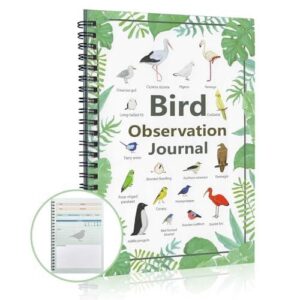
Bird Watching Spiral Journal is a solid everyday companion for birders who want structure without complexity.
Its 126 full-color pages each include dedicated fields for date, time, species, location, behavior, and sketches — so you’re never scrambling to organize notes mid-sighting.
The lay-flat spiral binding means one-handed writing is actually easy.
At 6.7 oz and A5 size, it fits most vest pockets comfortably.
For $11.99, it’s an accessible entry point for hobbyists and citizen-science participants alike.
| Best For | Birders of all levels — from weekend hobbyists to citizen-science contributors — who want a structured, portable field journal that keeps sightings organized without getting in the way. |
|---|---|
| Price | $11.99 |
| Page Count | 126 pages |
| Dimensions | 5.83 x 8.27 in |
| Weight | 6.7 oz |
| Sketch Space | Yes, per page |
| Index Included | 16-page alphabetical |
| Additional Features |
|
- Lay-flat spiral binding makes one-handed writing and sketching easy, even with binoculars around your neck
- 126 structured pages with dedicated fields for species, behavior, sounds, weather, and more — no setup needed
- Lightweight and compact enough to toss in a vest pocket or day bag at just 6.7 oz
- Softcover construction can bend or get damaged under heavy pressure or rough handling
- Small interior lines may feel cramped for anyone with larger handwriting
- A typo on the front cover ("Eagle" misspelled) could be a turnoff if you’re buying it as a gift
2. Sibley Bird Life List Diary
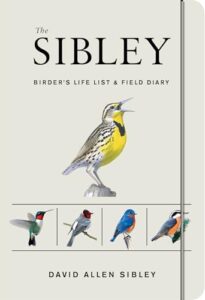
If you’re after something more structured for the long haul, the Sibley Bird Life List and Field Diary is worth a look. It comes pre-loaded with 923 North American species — ordered to match Sibley’s field guides — so you’re already working with a familiar system.
A six-column checklist lets you track sightings across different years or trips.
At 304 pages and around $18, it’s a smart investment for birders building a serious life list over time.
| Best For | Birders who want a dedicated, long-term logbook that matches the Sibley field guide system and keeps their life list organized in one place. |
|---|---|
| Price | $18.11 |
| Page Count | 304 pages |
| Dimensions | 5.31 x 7.64 in |
| Weight | 16 oz |
| Sketch Space | No dedicated area |
| Index Included | Alphabetical, dual-section |
| Additional Features |
|
- Comes pre-loaded with 923 North American species, so there’s no setup — just start logging
- Six-column checklist makes it easy to separate sightings by year or trip
- Compact and affordable at around $18 for 304 pages
- The cover scuffs easily and isn’t built to survive years of rough field use
- The index has some errors and prints in light gray, which can be hard to read
- Species list is from 2017, so newer splits and Hawaiian birds aren’t included
3. Bird Watching Log Book
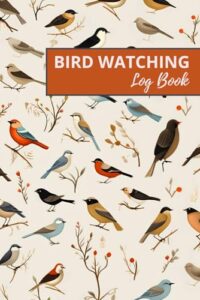
If you want a no-fuss journal that’s ready to go right out of the box, the Bird Watching Log Book delivers. At $9.99, it gives you 90 structured sighting entries with prompts for date, time, location, weather, species, behavior, and habitat — everything you’d want in the field.
There’s also a sketch area on each page.
It’s compact at 6 × 9 inches, fits easily in a field bag, and works well for beginners and seasoned birders alike.
| Best For | Beginner birders and casual enthusiasts who want a simple, structured way to track sightings in the field. |
|---|---|
| Price | $9.99 |
| Page Count | 109 pages |
| Dimensions | 6 x 9 in |
| Weight | 8.2 oz |
| Sketch Space | Yes, per entry |
| Index Included | Indexed pages |
| Additional Features |
|
- 90 pre-formatted entry pages take the guesswork out of what to record — just fill in the blanks
- Dedicated sketch space on every page is a nice touch for visual notetakers
- Compact 6 × 9 size slides right into a backpack or field bag without any fuss
- 90 entries will fill up fast if you bird regularly — serious listers may outgrow it quickly
- No digital backup means a lost or soaked journal takes your records with it
- Note fields run a bit tight, so detailed observations can feel cramped
4. Birdwatching Field Journal Sketchbook Life List
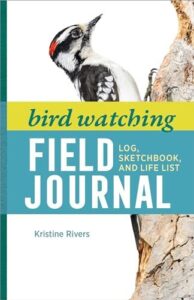
At just $7.53, the Birdwatching Field Journal Sketchbook Life List punches well above its price.
It comes with a "Birdwatching 101" intro section — handy if you’re just starting out — plus structured log pages with pre-printed fields for date, time, location, beak shape, and wing shape.
Each entry includes a dedicated sketch area, and a built-in Life List lets you track every species you’ve spotted.
It’s 154 pages at 5.5 × 8.5 inches, simple, beginner-friendly, and ready to use.
| Best For | Beginners and casual birders who want a simple, structured way to log sightings and build their life list without relying on apps. |
|---|---|
| Price | $7.53 |
| Page Count | 154 pages |
| Dimensions | 5.5 x 8.5 in |
| Weight | 9.6 oz |
| Sketch Space | Yes, per page |
| Index Included | No index |
| Additional Features |
|
- Comes with a "Birdwatching 101" intro — great if you’re just getting started
- Pre-printed log fields and a sketch area make it easy to capture details on the spot
- Built-in Life List section keeps all your sightings in one place
- No photos or species illustrations, so you’ll need a separate field guide for ID help
- 154 pages can fill up fast if you’re out birding often
- Experienced birders may find the fields too basic for serious record-keeping
5. Rite in the Rain Birding Journal
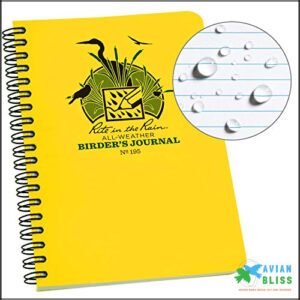
If you spend serious time in the field, the Rite in the Rain Birding Journal was made for you.
At 4.625 × 7 inches and just 3.2 oz, it slips into your shirt pocket without a second thought.
Its waterproof Polydura cover and weatherproof pages hold up through rain, mud, and sweat — your notes stay legible no matter what.
The Wire-O binding keeps pages flat and easy to write on.
At $10.95, it’s a dependable, no-fuss companion for any serious birder.
| Best For | Birders, hikers, and field researchers who need a rugged, pocket-sized notebook that can handle rain, mud, and all the mess that comes with serious time outdoors. |
|---|---|
| Price | $10.95 |
| Page Count | 64 pages |
| Dimensions | 4.625 x 7 in |
| Weight | 3.2 oz |
| Sketch Space | Yes, fill-in layout |
| Index Included | No index |
| Additional Features |
|
- Waterproof pages and Polydura cover hold up through rain, sweat, and mud without smearing or falling apart
- Tiny and light — at 3.2 oz and shirt-pocket size, it goes wherever you go without any bulk
- Wire-O binding keeps pages flat and aligned, so writing in the field stays easy
- Only 64 pages, so heavy note-takers will burn through it fast and need to carry extras
- Water-based inks won’t work — you’re limited to pencil or all-weather pens
- The compact size is great for most pockets, but not ideal if you need more writing room
Frequently Asked Questions (FAQs)
What do people put in a bird watching journal?
Most birders record species names, exact location, date, time, weather conditions, and behavioral notes. You might also add quick sketches, vocalization descriptions, and equipment used during the outing.
What makes a good field notebook?
Imagine: you’re deep in a marsh at dawn, rain drizzling down. A good field notebook stays dry, lies flat, and captures every detail without fighting you.
How do I organize notes after returning home?
Once you’re home, create a folder called BirdsNotes and sort entries by date or location. Transfer your notes digitally within 48 hours while details are still fresh.
Which pens work best in cold weather?
In cold weather, go for pressurized cartridge pens or oil-based ballpoints — they won’t skip or freeze up. All-weather pigment ink pens are your most reliable choice when temperatures drop.
Can beginners use the same notebook as experts?
Yes, beginners can use the same notebook as experts. One flexible journal accommodates both casual entries and detailed taxonomic notes.
Just label your sections clearly, and you’ll naturally grow into expert habits over time.
How many pages should a good journal have?
Most birders do well with 192 pages — enough for a full season without the bulk. If you sketch often, go for 240 or more.
Are digital apps better than physical notebooks?
Neither wins outright. Digital apps offer speed and search, but paper never runs out of battery. The best birders often carry both — one for backup, one for soul.
Conclusion
When push comes to shove, your notebook is only as good as its weakest feature. A soggy page, a cracked cover, or a binding that won’t lie flat can cost you the record of a lifetime sighting.
Knowing what makes a good bird watching field notebook means choosing one that keeps up with you—rain, mud, and all.
The right notebook won’t just hold your notes. It’ll hold your best mornings in the field.