This site is supported by our readers. We may earn a commission, at no cost to you, if you purchase through links.
Cats kill between 1.3 and 4 billion birds in the U.S. every year—and a significant portion of these deaths occur near backyard feeders. A cat requires no luck to catch a bird at your feeder; it relies on patience, which cats possess in abundance. They lie motionless in nearby shrubs for extended periods, then strike in under two seconds. Birds focused on feeding rarely stand a chance.
The solution lies in implementing smart changes to your setup, which can significantly increase the difficulty for cats to hunt in your yard—all without causing harm to either species.
Table Of Contents
Key Takeaways
- Placing feeders 10–12 feet from shrubs and on smooth metal poles 5.5–6.5 feet tall takes away a cat’s best weapon: the ambush.
- Catching spilled seed with a tray cuts ground-level bird activity by up to 60%, which means fewer easy targets for lurking cats.
- Layering deterrents — baffles, motion-activated sprinklers, and scent repellents — works far better than relying on any single fix.
- Keeping cats indoors at dawn and dusk, or outfitting them with bright collar covers, can cut bird kills by up to 87% without harming your pet.
Why Cats Threaten Backyard Birds
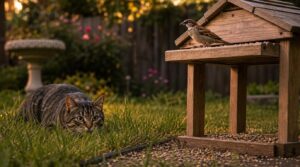
Cats are natural hunters, and your backyard feeders and baths put birds right in their crosshairs. Understanding exactly how cats target birds — and which birds are most at risk — helps you make smarter choices about protection.
Knowing your cat’s favorite ambush spots makes it much easier to follow smart bird bath placement strategies that keep predators at bay.
Here’s what’s actually happening out there.
How Outdoor Cats Hunt Near Feeders and Baths
Cats are patient, calculated hunters — and your feeder is their favorite ambush spot. They rely on a stealth approach, creeping slowly through nearby shrubs before striking. Their burst hunting style means the whole attack lasts just seconds.
Dawn activity peaks when birds are hungriest and least alert. Even your bird bath becomes a bath reflection lure, drawing birds into the open.
Pet cats usually log about three hunting hours daily, illustrating their average hunting hours.
Birds Most Vulnerable to Cat Predation
Not every bird faces the same level of risk. Ground-nesters like meadowlarks have almost no defense — their nests sit right in a cat’s natural hunting zone. Shorebird ground nests along coastal areas are also easy targets.
For finches, predation risk spikes near open feeders. These locations concentrate birds, making them vulnerable to predators.
Cavity-nesting species fare better overall, but fledglings and small songbirds remain dangerously exposed during their first awkward weeks of flight.
Why Spilled Seed Attracts Ground-feeding Birds
Spilled seed turns your yard into a bird buffet — and that’s where the trouble starts. Ground foraging birds like sparrows, juncos, and towhees flock to fallen seed because seed is easily accessible at ground level.
Mixed-species flocks gather quickly, especially around open feeder placement. That concentration of birds, combined with their low vigilance against predators, creates an ideal scenario for danger.
This vulnerable gathering draws cats in close, exploiting the birds’ reduced awareness. The easy access to prey makes your yard a hunting ground for feline predators.
Risks for Fledglings, Songbirds, and Ground-nesting Birds
Young birds face the steepest risks. Fledglings spend up to three days grounded before they can fly well — making them easy targets. Predator diversity, weather exposure, and habitat fragmentation all stack the odds against them.
- Fledglings freeze instead of fleeing
- Ground nests lack concealment from roaming cats
- Human activity pushes birds toward dangerous edges
Bird mortality from cats hits hardest here.
Cat-Proof Bird Feeder Placement
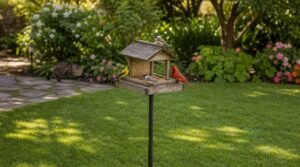
Where you put your feeder matters more than most people think. A few smart placement decisions can make it a lot harder for cats to ambush visiting birds. Here’s what to focus on first.
Place Feeders 10–12 Feet From Cover
Think of a 10–12 foot buffer zone as your birds’ personal runway — it gives them open sightlines and a clear flight corridor to escape if a cat appears. This spacing is one of the most effective cat-proof bird feeder design and placement guidelines for feeders and baths you can follow.
Birds spot danger sooner, and cats lose their ambush advantage completely.
Use Smooth Metal Poles 5.5–6.5 Feet High
A smooth metal pole — standing 5.5 to 6.5 feet tall — is one of the simplest cat deterrent methods for yards. Cats cannot grip its surface, making it an effective barrier.
For a more complete solution, pairing the pole with cat-proof fencing and bird-safe enclosure designs creates layered protection that covers what a single barrier can’t.
Look for poles made of galvanized steel or aluminum with a Corrosion-Resistant Finish, a solid Wind-Load Rating, and Deep Foundation Placement to ensure stability in outdoor conditions.
Features like an Adjustable Bracket System and Easy-Clean Surface simplify maintenance. These elements support pole-mounted baffles and cat-proof bird feeder design, enabling genuinely low-maintenance setups.
Choose Hanging, Tubular, or Caged Feeders
Not all feeders are equal regarding cat-proof bird feeder design and placement. Hanging feeders offer weather durability and flexible placement, keeping them out of reach.
Tubular models excel at seed compatibility for finches, while caged feeders provide enhanced safety guidelines by blocking paws entirely.
Match your target species and prioritize maintenance simplicity—cost efficiency will follow naturally.
Add Seed-catching Trays to Reduce Ground Activity
Spilled seed on the ground is essentially a dinner invitation for cats — and ground-feeding birds pay the price. A seed-catching tray quietly fixes this problem.
Good trays cut spillage by up to 60 percent through solid spill reduction efficiency. Most feature quick-snap installation with adjustable clamps, fitting poles up to 1.5 inches wide.
Material durability matters: UV-stabilized plastic or powder-coated metal ensures longevity across seasons.
Just stick to a weekly cleaning routine to maintain freshness and functionality.
Keep Bird Baths Elevated and Away From Shrubs
A birdbath placed too close to shrubs is basically a cat’s hunting blind with free water service. Position yours 10 to 15 feet from dense vegetation — shrub buffer zones give birds a clear sightline to escape routes. Mount it 2 to 3 feet high; bath height benefits are real.
- Stable base design prevents tipping when birds land and splash
- Non-slip edges on the basin rim help small birds step on and off safely
- Water flow features like drippers discourage mosquitoes and attract more birds
- Smooth metal poles double as cat exclusion strategies, blocking climbing attempts
Physical Barriers That Stop Cats
Sometimes the best solution is simply making your yard harder for cats to navigate. A few well-placed physical barriers can block their favorite climbing and stalking routes without harming anyone.
Here are five that actually work.
Install Cone or Cylinder Baffles on Poles
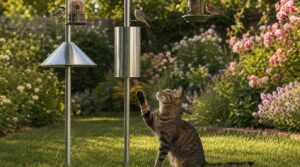
A baffle is basically a ‘no entry’ sign for cats’. Mount cone or cylinder baffles on your smooth metal poles around 4–5 feet up — that’s the sweet spot for installation height guidelines. For baffle material selection, galvanized steel or heavy-duty plastic withstands weather well and lasts for seasons.
Maintain a seasonal cleaning routine to keep pole-mounted baffles working like new.
Use Slippery Guards on Trees and Posts
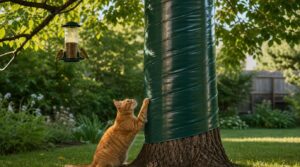
Baffles handle the pole — but what about nearby trees or wooden posts? Slippery guards wrap around trunks and posts, creating smooth surfaces cats simply can’t grip.
Material durability matters here: choose vinyl or composite with weather-resistant coatings that hold up through freeze-thaw cycles.
Follow these installation best practices:
- Match diameter fitting guidelines to your trunk or post size — no gaps
- Wrap from ground level to 5–6 feet high
- Overlap edges so there’s nothing to wedge a claw into
- Check alignment after heavy snow or wind
- Inspect monthly as part of seasonal maintenance
These physical barriers turn slippery poles into reliable cat deterrent devices for any catproof bird feeder design and placement.
Add Pinecones, Gravel, or Thorny Mulch Barriers

Once the poles are guarded, think about the ground around them. Cats stalk low and slow — so making that approach uncomfortable works surprisingly well. Layer pinecones 3–4 inches deep, add a gravel drainage layer underneath, or spread prickly mulch 2–3 inches thick. These physical barriers disrupt stalking paths without harming birds.
Refresh these seasonally and after heavy rain to maintain consistent protection.
Place Humane Scat Mats Around Feeder Bases
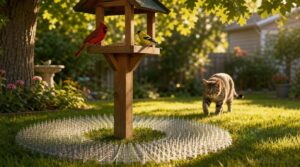
Scat mats take ground-level defense one step further. The Hmyomina Cat Spike Deterrent Mat uses 1-inch plastic prongs—uncomfortable underfoot but completely harmless—making it one of the more reliable humane cat deterrent methods available.
To install, cut mats to fit your feeder base using the sizing guide, then secure them with landscape staples following the installation tips. Adhere to the recommended monthly maintenance schedule to ensure longevity.
The mats feature a weatherproof design that withstands rain, and most cats learn avoidance within just a few visits.
Use Coyote Rollers on Fences Near Bird Areas
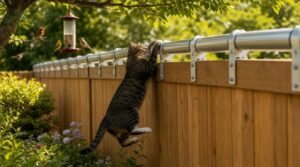
Fence lines are your last line of defense — and coyote rollers make them count. These spinning aluminum cylinders collapse under a cat’s grip, so even the most determined climber can’t hold on.
For reliable cat exclusion fencing:
- Installation Height — mount on fences 6–8 ft tall
- Material Compatibility — works on wood, vinyl, or chain link
- Spacing Guidelines — no gaps at corners or joints
- Maintenance Schedule — inspect twice yearly; clean debris blocking rotation
Wildlife-friendly fencing like this integrates smoothly with your other outdoor cat deterrents.
Humane Outdoor Cat Deterrents

Good news — you don’t have to choose between loving cats and protecting birds. There are several humane deterrents that work well without harming any animal in the process.
Here are the best options to keep cats away from your backyard feeders and bird baths.
Motion-activated Sprinklers for Feeder Protection
Motion-activated sprinklers are one of the most reliable humane cat deterrents for use near bird feeders. These devices detect approaching cats via heat signatures, then activate a brief water burst—typically lasting 5 to 15 seconds.
To ensure effectiveness, adjust pressure settings and optimize coverage overlap between units. This protects the entire feeding zone while minimizing false triggers caused by wind or small wildlife.
Ultrasonic Cat Deterrents Near Bird Zones
Ultrasonic cat repellers work quietly in the background, emitting sounds between 22 and 40 kHz — audible to cats but not to humans. Frequency selection allows targeted deterrence of felines while prioritizing non-target bird safety.
Most motion-activated models provide coverage across an effective radius of 5 to 12 meters, balancing reach with precision.
For durability, prioritize devices with weatherproof housing rated IP65 or higher, ensuring year-round reliability in outdoor environments.
Solar-powered Animal Repellers for Gardens
Solar-powered animal repellers are a low-maintenance way to protect your feeding area around the clock. A good 2026 Solar Ultrasonic Animal Repeller Set combines solar panel technology with PIR sensors to detect cats before they get close. Look for these features:
- Panel placement facing south for maximum charge
- Battery longevity supporting 21+ days of operation
- Sensor tuning to filter false triggers from wind
- Weather resistance rated IP66 or higher
Multi-species coverage means one device manages cats, foxes, and more.
Safe Scent Repellents Cats Tend to Avoid
Cats have a surprisingly sensitive nose — and you can use that against them. Citrus peels, vinegar mist, and herb sachets work as natural cat repellents without harming a single bird.
| Repellent | Application Schedule |
|---|---|
| Citrus peels / lavender | Refresh weekly |
| Peppermint and lemongrass oils (oil dilution required) | Every 60 days |
| Herb sachets / cat-repelling plants | Replace monthly |
Keep everything away from feeders and water.
Texture Barriers That Discourage Stalking Paths
Think of your yard as an obstacle course cats just don’t want to bother with.
Rubbery mat paths create unstable footing near feeders, while spiky rubber edging and coarse metal sleeves on poles stop silent approaches in their tracks.
Add gravel noise barriers and pinecone gravel mulch — cats hate the crunch.
Corrugated plastic shields and cat-friendly landscaping tweaks round out your natural and mechanical deterrents for backyard feeders.
Where to Place Deterrents for Best Results
Placement is half the battle. Even the best deterrent fails if it can’t see what’s coming.
- Keep a clear line of sight — at least 30 feet of open space between cover and your feeders
- Follow proximity rules: mount devices 20 feet from dense brush, at the right elevation height of 3–5 feet
- Use weatherproof mounting on level ground — terrain leveling keeps sensors accurate
Good cat-proof bird feeder design and placement, combined with motion-activated devices and a layered bird protection approach, gives cats nowhere to hide.
Safer Cat Management for Birds
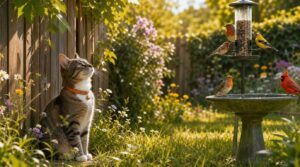
Sometimes the best way to protect backyard birds is to work with your cat, not just around them. A few simple changes to how you manage your pet can make a real difference for the birds visiting your yard.
Here’s what actually works.
Keep Pet Cats Indoors During Peak Bird Activity
The simplest protection you can offer backyard birds costs nothing—just a bit of routine. Morning Lock-down and Dusk Indoor Routine keep pets indoors during peak bird activity hours when feeding frenzies occur.
Behavioral conditioning helps cats accept Quiet Home Zones through structured Cat Activity Schedules. This approach encourages pets to adapt to designated indoor areas during sensitive times.
Establish clear guidelines for indoor versus outdoor cat management. Incorporate indoor cat enrichment toys to maintain calm environments and reduce disruptive behaviors.
Use Catios for Safe Outdoor Enrichment
A catio might be the best middle ground for cat owners. These cat-friendly outdoor enclosures use predator-proof screening and weather-resistant materials, allowing cats to enjoy fresh air and sunshine without the freedom to hunt. Many feature modular design with multi-level enrichment — ramps, perches, and scratching posts — to keep cats genuinely engaged.
Just schedule seasonal maintenance to inspect screens and anchors, and you’re set. This ensures a safe, stimulating environment year-round.
Try High-visibility Collar Covers or Bibs
If a catio isn’t practical, a BirdsBeSafe collar cover or similar anti-bird cat collar is worth trying. Studies show cats wearing these bright covers kill up to 87% fewer birds. Reflective safety panels offer visibility beyond daytime, staying visible in low light too.
BirdsBeSafe collar covers reduce cat predation by up to 87%, making them a simple, effective bird-saving solution
Look for options that offer:
- Comfortable fit with adjustable, breakaway closures
- Weather durability through water-resistant, machine-washable fabric
- Reflective safety panels for 360-degree visibility
- Easy visibility testing indoors before outdoor cat acclimation
Provide Toys, Climbing Trees, and Puzzle Feeders
Keeping your cat mentally busy is one of the quietest ways to protect birds. A bored cat hunts. An engaged one doesn’t.
| Enrichment Type | What It Does |
|---|---|
| Interactive Puzzle Toys | Extends mealtime, reducing outdoor roaming |
| Vertical Climbing Modules | Satisfies climbing urge safely |
| Rotating Treat Dispensers | Channels hunting instincts indoors |
| Stimulating Scent Stations | Redirects tracking behavior away from birds |
| Weather-proof Play Structures | Keeps cats active outside without targeting wildlife |
Work With Neighbors to Protect Backyard Birds
Coordinating with neighbors through neighborhood agreements and shared feeder mapping creates a connected buffer that cats can’t easily navigate. Joint hazard walks help everyone spot weak points together, while community education events and wildlife education rapidly build awareness.
When cat containment strategies and coordinated cat monitoring become a neighborhood habit, birds across multiple yards stay safer.
Frequently Asked Questions (FAQs)
How to keep outdoor cats away from birds?
You could say it’s a cat-astrophic problem for backyard birds.
To keep outdoor cats away, use motion-activated sprinklers, ultrasonic deterrents, cat-proof bird feeder design and placement, and smart bird-friendly landscaping around your yard.
What cat decoy scares birds away?
A lifelike cat decoy with realistic fur texture and reflective eyes works well.
Seasonal rotation and varied movement patterns prevent birds from habituating, making it a reliable visual deterrent near feeders.
Can bird feeders be made completely cat-proof?
Honestly, no feeder is fully cat-proof. Determined cats jump, climb, and adapt. Smart cat-proof bird feeder design and placement — smooth poles, feeder baffles, and proper spacing — gets you close, but regular maintenance challenges remain.
Conclusion
The right feeder placement, the right barriers, and the right deterrents—each small change stacks in your birds’ favor. None of it requires being perfect, just consistency.
Your backyard can’t protect every bird in the country, but it can become a corner of the world where they feed without fear. Choosing an effective outdoor cat deterrent for birds isn’t just about your yard—it’s about deciding what kind of place you want to tend.
- https://www.greengardener.co.uk/help-and-advice/cat-repellent-we-tested-what-works/
- https://catgoods.com/?srsltid=AfmBOorWi21JxJ0GGv8xDvjFHNROYSrZkMMJEKPGvrhSgMuhM5_jNShr
- https://mimofpet.net/do-sonic-barriers-work-for-cats/?srsltid=AfmBOorCnDCq-eqhRDAu5SucO3BR3rtMxmXtHG_nqiBMk-k1z_8RZ8Dq
- https://www.audubon.org/news/how-stop-cats-killing-birds
- https://sonic-barrier.us/blogs/cats/ultrasonic-cat-deterrent-reviews?srsltid=AfmBOooAlMQgsts_CyMuDJ_SjdBMa-AdmPdmpmeKi_saJ6WY-1cVEMXK