This site is supported by our readers. We may earn a commission, at no cost to you, if you purchase through links.
Each year, cats kill an estimated 1.3 to 4 billion birds in the United States alone—a number that dwarfs losses from window strikes, pesticides, and habitat loss combined.
Most of those deaths trace back to outdoor and feral cats, but even a well-fed house cat with a full belly will hunt. instinct, not hunger.
If you’re filling feeders and watching birds visit your yard, a roaming cat can quietly dismantle everything you’ve built for them.
The good news is that a few targeted changes—to where you place feeders, how you manage cat access, and what barriers you install—can protect backyard birds from cats far more effectively than most people realize.
Table Of Contents
- Key Takeaways
- Keep Cats Indoors Safely
- Place Feeders Away From Ambush Spots
- Make Bird Baths Cat-Safe
- Protect Nest Boxes From Cats
- Add Barriers Cats Cannot Climb
- Use Humane Cat Deterrents
- Scatter Citrus Peels Near Vulnerable Areas
- Apply Cat-safe Scent Repellents Carefully
- Use Motion-activated Sprinklers Near Feeders
- Try Ultrasonic Deterrents in Problem Zones
- Install Motion-activated Lights for Nighttime Visits
- Reapply Homemade Repellents After Rain
- Avoid Poisons or Harmful Deterrent Methods
- Top 6 Bird Protection Products
- Work With Neighbors and Cat Owners
- Frequently Asked Questions (FAQs)
- How do I keep cats out of my backyard and away from my pet birds?
- What is the 5 7 9 rule for bird feeders?
- What is the number one meat you should never feed your cat?
- Do bell collars actually reduce bird predation?
- Which bird species are most vulnerable to cats?
- How many birds do cats kill annually worldwide?
- Can indoor cats still stress backyard birds?
- What laws protect wild birds from cat predation?
- Conclusion
Key Takeaways
- Keeping your cat indoors is the single most effective way to protect backyard birds, since cats hunt by instinct—not hunger—and even a well-fed pet will kill given the chance.
- Where you place feeders and birdbaths matters as much as what’s in them; positioning them at least 10 feet from shrubs, fences, and walls removes the cover cats rely on to ambush birds.
- Physical barriers like pole-mounted baffles, smooth metal poles, and predator guards on nest boxes stop cats from reaching birds even when they do enter your yard.
- Protecting birds from cats works best as a layered effort—combining placement, barriers, humane deterrents, and neighbor cooperation delivers far better results than any single fix alone.
Keep Cats Indoors Safely

Keeping your cat indoors is the single most effective thing you can do to protect the birds visiting your yard.
Beyond keeping cats inside, you can further support your backyard birds by learning about wing injury prevention methods that help injured wildlife recover safely.
But "indoors" doesn’t have to mean boring or restrictive for your cat. Here are some practical ways to make it work for everyone.
Why Indoor Cats Are Safest for Backyard Birds
Keeping your cat indoors is the single most effective step you can take against cat predation on backyard birds. An indoor cat provides all-day protection and zero outdoor access to birds year-round, which is exactly what continuous supervision can never fully guarantee.
Cats kill up to 4 billion birds annually in the U.S. — responsible pet ownership and cat containment break that cycle entirely, lowering seasonal risk with no exceptions.
Cats kill up to 4 billion birds annually in the U.S., but responsible pet ownership and containment can break that cycle entirely
Use Catios for Protected Outdoor Access
A catio, or cat patio, gives your cat fresh air without putting birds at risk.
These outdoor cat enclosures and bird safety structures work through smart cat containment design:
- Mesh Screening Standards block small birds from entering
- Multi-level Platforms satisfy climbing instincts
- Weatherproof Flooring and Secure Entry Latches prevent escapes
- Observation Windows let you monitor safely
Ensuring an escape-proof enclosure design helps keep cats safely contained while protecting birds.
Catproof fencing completes the setup.
Try Supervised Leash or Harness Outings
Not every cat takes to a catio right away. Leash training offers another path to safe outdoor spaces for cats.
Start with gradual exposure indoors, letting your cat get used to gear fit before stepping outside. Use a short 3–4 foot leash and build a reliable recall cue with treats.
stress monitoring signs like panting or freezing.
Avoid Outdoor Cat Time at Dawn and Dusk
Timing matters as much as location. Birds are most active at dawn and dusk — and so are outdoor cats.
That overlap is where most predation happens.
Keep your cat inside during these crepuscular risk alert windows, especially near your bird feeder placement strategies.
Sunset window perches let curious cats watch safely indoors, satisfying that twilight feeding schedule urge without putting backyard birds at risk.
Add Indoor Enrichment to Reduce Hunting Behavior
A cat that’s mentally busy indoors is far less driven to hunt outside. Indoor enrichment for cats — think Puzzle Feeding, Wand Play with feather wands, and Toy Rotation using toy mice — directly helps cat behavior modification by satisfying natural instincts safely.
Try these three enrichment essentials:
- Vertical Territory — A 5–6-foot cat tree replaces fence‑stalking urges
- Clicker Training — Short 3–5‑minute sessions redirect focus toward earning rewards
- Puzzle Feeding — Splitting meals across 3–5 stations keeps cats mentally engaged indoors
Support Neighborhood Indoor-cat Education
When neighbors work together, birds win. Community Workshops with local wildlife experts help residents understand why responsible pet ownership starts with keeping your cats indoors.
Owner Resource Guides and running School Outreach Programs get the message across early.
Neighborhood Ambassador Networks keep awareness alive block by block, while Pet Licensing Awareness campaigns reinforce accountability.
Pair that with indoor enrichment for cats, and real cat behavior modification follows.
Place Feeders Away From Ambush Spots
Where you put your feeder matters just as much as what’s in it.
Cats are patient hunters, and a feeder placed near a fence or shrub basically hands them the advantage. These simple placement tips can take that advantage away.
Keep Feeders at Least 10 Feet From Shrubs
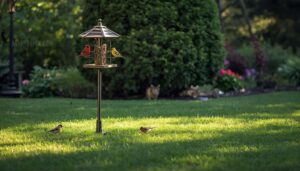
Shrubs are a cat’s best friend — and a bird’s worst nightmare. That’s why shrub buffer zones matter so much in bird feeder placement strategies.
Keep every feeder at least 10 feet from any shrub edge. This open flight path gives birds time to spot danger and escape.
Follow basic shrub trim guidelines and shrub proximity mapping to maintain clear visibility line clearance year-round.
Avoid Placing Feeders Near Fences or Walls
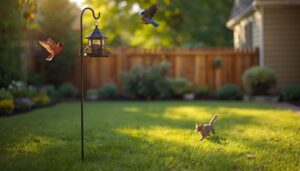
Fences and walls are silent helpers for hunting cats.
Fence Proximity Risks are real — a cat can leap roughly 5 to 6 feet straight up, turning any nearby rail into a launch point. Wall Ambush Hazards work the same way, hiding a stalking cat until it’s too late.
For safer bird feeder placement, move feeders at least 10 feet from any boundary to create Open Flight Zones, birds actually need.
Use Tall, Smooth Feeder Poles
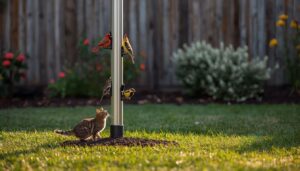
The pole itself is your first line of defense. Getting the Height Requirements right matters more than most people realize — aim for a pole that keeps your feeder ports at least 5.5 to 6.5 feet off the ground.
- Choose a Smooth Metal Finish; aluminum or galvanized steel gives cats nothing to grip
- Pick a Round Pole Design to eliminate corner footholds
- Anchor it securely with Secure Ground Anchoring, burying 18–24 inches deep
- Practice Seasonal Surface Cleaning to remove algae and debris that add unwanted traction
- Keep all hardware flush — exposed bolt heads act like tiny climbing steps
Hang Feeders Over Open Areas When Possible
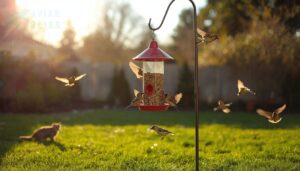
Open space is your birds’ best shield. When you hang feeders over open lawn — with at least 10 feet of Unobstructed Airspace and no Overhead Canopy nearby — cats lose their cover. That Clear Flight Path lets birds spot trouble and escape fast.
| Placement Factor | Recommendation |
|---|---|
| Elevated Feeder Height | 5–6 feet above ground |
| Distance from shrubs | 10+ feet |
| Overhead branches | None within 10 feet |
| Bright Contrasting Feeders | South or east-facing |
These Bird feeder placement strategies make your yard genuinely safer.
Choose Tube or Hanging Feeders
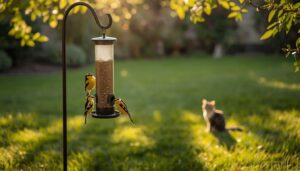
Tube and hanging feeders do more than hold seed — they work as part of your bird feeder placement to prevent cat access.
Tube feeders offer solid seed capacity, weather resilience, and cleaning simplicity, with narrow ports that match species suitability for finches and chickadees. Hanging models keep everything elevated and visible.
Both are cost-effective choices that quietly improve bird feeder safety.
Clean Spilled Seed Beneath Feeders Regularly

Spilled bird seed on the ground is an open invitation for cats to crouch and wait. Good bird feeder placement strategies include keeping the area beneath feeders clean and clear.
Here’s a simple routine:
- Use Seed Catch Basins to catch fallen bird seed before it spreads
- Follow Seasonal Cleanup Routines — sweep twice weekly in summer, weekly in fall
- Apply Ground Cover Management by laying gravel under feeders for easy cleaning
- Stick to a Disinfection Schedule with a 10% bleach rinse monthly to reduce attractants
Clean ground means fewer reasons for cats to linger.
Make Bird Baths Cat-Safe

Bird baths are just as vulnerable to cat ambushes as feeders are.
smart placement and design choices can make yours a safe spot for birds to drink and bathe without worry.
what works.
Place Bird Baths in Open, Visible Areas
birdbath as a stage — birds need to see trouble coming. Wide Visibility Zones matter here: position your bath on open ground at least 10 feet from shrubs or fences.
Reflective Water Surface movement helps birds spot approaching cats instantly.
| Placement Factor | Recommended Setup |
|---|---|
| Open Ground Buffer | 10+ feet clearance |
| Low Profile Stands | 24–36 inches high |
| Nearby Perch Access | 5–10 feet away |
Keep Baths Away From Dense Ground Cover
Dense ground cover is a cat’s best friend — and a bird’s worst nightmare. Low Shrub Avoidance around your birdbath is non‑negotiable for Clear Flight Paths.
Keep these three rules in mind:
- Maintain a Gravel Surround Buffer of at least 10 feet
- Choose Sunlit Open Placement away from tall grasses
- Trim any creeping cover that narrows escape routes
Use Elevated Baths on Smooth Stands
Elevating your birdbath is one of the simplest catproof moves you can make. Stand Height Guidelines suggest placing the basin 24–30 inches off the ground — a 28-inch pedestal works well for most small birds.
Choose stainless steel or coated aluminum for Surface Material Choice, since smooth stands resist rust and stay easy to clean.
Stability Features matter too, so pick a wide base that won’t tip.
Keep water at 1–2 inches for Water Depth Optimization, and rinse the bowl daily as part of your Cleaning Routine.
Provide Nearby Escape Branches for Birds
Birds need a quick getaway — and that’s where escape branches come in. Follow Branch Height Guidelines by positioning native thornless shrubs 5–15 meters from your bath, with perches staggered at multiple levels as part of smart bird feeder and bath placement strategies.
Perch Spacing of 2–6 cm thick limbs helps birds grip quickly. Apply Seasonal Pruning to keep Predator Approach Angles clear.
Refresh Water Without Creating Hiding Spots
Keeping water fresh doesn’t have to invite trouble. A few simple habits make a real difference:
- Use Smooth Edge Basins and Elevated Water Bowls on pedestals, 2–3 feet high to eliminate hiding ledges.
- Commit to Frequent Water Refresh every one to two days.
- Choose Spill-Resistant Design with stable bases and Open Ground Placement.
- Keep surrounding grass trimmed short within five feet.
Monitor Cat Activity Around Water Sources
A simple camera aimed at your birdbath reveals patterns you’d never notice otherwise. Set it to capture a 10–15 foot radius and review clips weekly. You’ll quickly spot time-of-day patterns — cats tend to prowl most at dawn and dusk. Track weather influence too, since rain shifts their routes.
Log approaches in a simple data dashboard, then adjust your motion-activated sprinklers and cat deterrent devices accordingly.
Protect Nest Boxes From Cats
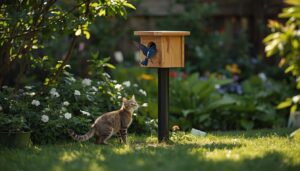
Nest boxes are some of the most vulnerable spots in your yard when cats are around. A few smart design choices can make a real difference in keeping nesting birds safe.
Here’s what to focus on.
Mount Nest Boxes on Poles, Not Trees
Trees feel like a natural choice for nest boxes, but they’re basically a ladder for cats.
A freestanding metal pole—with corrosion coatings to handle the weather—changes everything.
Birdhouses on poles, fitted with baffles on poles below the box, become genuinely catproof bird nesting boxes.
Material choice and quick-release mounts also make seasonal cleaning simple, saving you real time.
Install Boxes at Least 8 Feet High
Eight feet off the ground isn’t arbitrary—it’s where cats simply can’t reach. When you place bird boxes at least eight feet high using adjustable height brackets and concrete foundations, you’re following solid birdhouse placement guidelines that work.
Use UV-stable materials to handle years of weather, and keep clear flight paths around the box. A seasonal height review helps you stay ahead of any new predator pressure.
Keep Nest Boxes Away From Shrubs
Height gets you halfway there—placement does the rest. Shrub distance guidelines recommend keeping nest boxes 6 to 10 feet from any dense vegetation.
Dense ground cover removal and vegetation pruning create an open perimeter zone that cats simply can’t hide in. Consider where you’re placing nesting boxes carefully: clear access pathways give birds a clean line of sight and a fighting chance.
Use Predator Guards Beneath Nest Boxes
Even with good placement, a cat can still climb a smooth pole. That’s where predator guards come in.
Mount a cone or cylinder baffle 4–6 inches below the box, angled slightly outward to block any grip. For Guard Material Selection, aluminum or galvanized steel holds up best.
Check your Maintenance Schedule each spring—gaps from weather shift can quietly undo everything.
Avoid Perches on Birdhouse Entrances
Once your baffle is in place, look at the birdhouse entrance itself. Most store-bought boxes include a small perch below the hole — skip it.
A perchless design removes the foothold cats and raccoons rely on to probe inside.
Check the interior edge sharpness regularly; wear signals predator pressure.
Metal reinforcement around the hole prevents claw damage and keeps steep roofs doing their job.
Choose Small, Species-appropriate Entrance Holes
The entrance hole does a lot of heavy lifting in a catproof birdhouse. Match it to your target species — chickadees and wrens fit snugly through 1¼ inches, while finches may need up to 1½ inches. Hole Size Guidelines and Species Matching work together to keep larger threats out.
- Smooth Edge Finishing prevents feather snags
- Apply Placement Strategy: position holes away from nearby shrubs
- Use Occupancy Monitoring to confirm the right species moved in
Use Natural Colors to Reduce Attention
Color is a quiet but effective cat deterrent in birdhouse design. Camouflage Nest Boxes painted with an Earth Tone Palette — muted browns, olive greens, or natural wood finishes — blend into tree bark and shrubs, making them harder for cats to spot.
Matte Surface Treatments prevent glare.
Seasonal Color Matching keeps your catproof birdhouse concealed year‑round, quietly working alongside your Bird feeder and bath placement strategies.
Add Barriers Cats Cannot Climb
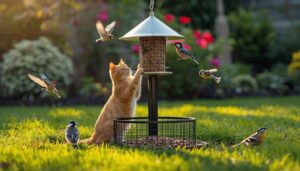
Even the most determined cat struggles when there’s nothing to grip. Physical barriers are one of the most reliable ways to keep cats away from feeders, nest boxes, and trees where birds are most at risk.
Here are six simple options worth adding to your yard.
Install Pole-mounted Baffles Below Feeders
A pole-mounted baffle is one of the most reliable physical barriers you can install. Thread a conical or cylindrical baffle onto your feeder pole, positioning the bottom edge 4–5 feet above ground — ideal baffle height that stops cats mid-climb.
For weatherproofing baffles, choose powder-coated steel or aluminum. Always run installation safety checks for feeder compatibility, ensuring no gaps cats can squeeze through.
Use Cone or Cylinder Baffles on Nest Boxes
The same logic that protects feeders applies to nest boxes — a cone or cylinder-shaped baffle beneath the box stops cats from climbing up to the entrance. For catproofing bird nesting boxes, material choice matters: go with galvanized metal or UV-stable plastic for wind-resistant design.
Mount baffles 12–18 inches below the box, conduct seasonal inspection after storms, and track effectiveness monitoring by watching for claw marks.
Wrap Vulnerable Tree Trunks With Guards
Tree trunks are a cat’s natural highway straight to nesting birds. Wrapping them with metal mesh sleeves or plastic spiral cat guards creates physical barriers that break that route.
For Installation Timing, early spring works best—before cats grow bold. Check Guard Material Choices like recycled plastic for eco‑friendly options. Apply Size Adjustment annually so tree baffles don’t constrict growth, and keep seasonal maintenance consistent.
Add Scat Mats Around Posts or Trunks
Scat mats are one of the quietest cat deterrents you can add today. Wrap a continuous strip around each post or trunk using weatherproof mats, with teeth facing outward.
For best Mat Placement Strategies:
- Overlap edges by one inch to close any gaps
- Anchor with stakes every 12–18 inches
- Rinse quarterly and replace every one to three years
Consider Coyote Rollers on Fences
Coyote rollers are one of the smartest catproof fences upgrades you can make. These spinning tubes sit along the fence top and collapse under a cat’s grip, making it impossible to pull over.
Roller Installation Steps are simple: mount corrosion-resistant rollers every 4–6 feet using secure brackets.
For Roller Cost Effectiveness, they outlast most cat exclusion methods.
Check Roller Effectiveness Monitoring quarterly.
Block Access to Common Stalking Routes
Once you’ve secured your fence tops, think about the paths cats take to reach birds in the first place. Route Mapping and Stalk Path Identification at dawn and dusk reveal exactly where cats move.
Clear away dense ground cover to maintain Clear Sightlines, and use baffles, scat mats, or netting to block those corridors. Seasonal Barrier Review keeps your catproof fences and tree baffles effective year-round.
Use Humane Cat Deterrents
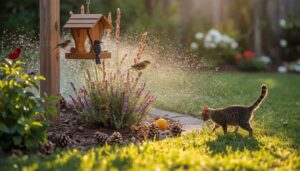
Sometimes the best way to protect your backyard birds isn’t a physical barrier — it’s making your yard feel unwelcoming to cats in the first place. Humane deterrents work by triggering a cat’s instinct to avoid discomfort, without causing any real harm.
Here are seven simple methods worth trying.
Scatter Citrus Peels Near Vulnerable Areas
One of the easiest natural cat repellents you can try is scattered citrus peels. The citrus smell—driven by limonene—keeps cats away without harming birds.
For scent ring placement, spread peels 6–12 inches wide around feeders or nest boxes. Refresh every 3–5 days for consistent protection, and increase peel use during breeding season for smart seasonal peel adjustments.
Compatibility with sprinklers makes this a strong layered defense. Keep peels clean and mold‑free.
Apply Cat-safe Scent Repellents Carefully
Beyond citrus peels, cat deterrent sprays using essential oils—like peppermint give you another layer of protection.
Stick to non-toxic ingredients with safe dilution ratios, and apply a light mist along perimeter zones every one to two weeks.
Keep an observation log to track weather adjustments and bird activity. Reapply natural cat repellents after rain, since scent deterrents fade fast when wet.
Use Motion-activated Sprinklers Near Feeders
Motion-activated sprinklers take deterrence a step further than scent repellents. Infrared sprinkler sensor types detect movement instantly, triggering a short burst—just one to two seconds—at standard water pressure settings of 20–60 psi.
For smart sprinkler placement angles, position units 6–10 feet from feeders.
Activation timing strategies focused on dawn and dusk hours enhance bird feeder safety while preventing cat predation on wild birds efficiently.
Try Ultrasonic Deterrents in Problem Zones
Ultrasonic devices work surprisingly well in problem zones — garden trials showed they cut cat visits by roughly 46% and reduced visit duration by 78%. Here’s how to use them effectively:
- Device Placement: Position each ultrasonic cat deterrent 3–5 meters from bird feeder safety zones, targeting fence gaps and entry points.
- Frequency Rotation: Switch between frequencies weekly to prevent habituation.
- Multi-Device Coverage: Overlap two units around high-traffic zones for completely safe outdoor spaces for birds.
- Weatherproofing Tips: Choose outdoor-rated, weatherproof models only.
- Power Settings: Use motion-activation mode to extend battery life.
Install Motion-activated Lights for Nighttime Visits
When cats prowl after dark, motion-activated devices give your yard a reliable second line of defense.
Mount fixtures 6–8 feet high — that’s your sweet spot for Installation Height — and set Sensor Sensitivity to filter out small wildlife.
Choose warm-white LEDs in the Bird-friendly Spectrum, and pick a Power Source suited to your setup. A simple quarterly Maintenance Routine keeps sensors accurate all season.
Reapply Homemade Repellents After Rain
Rain Timing matters more than most people realize — homemade citrus and vinegar sprays wash away within 15 to 60 minutes after a heavy shower. Wait for Surface Drying before reapplying, since Spray Adhesion drops sharply on wet surfaces.
Keep a Weather Calendar reminder to refresh treated zones after each rain event.
For Safety Concentration, use light passes rather than heavy soaking near feeders.
Avoid Poisons or Harmful Deterrent Methods
Poison is never the answer — not for cats, not for birds, not for your yard’s ecosystem. Stick to these humane deterrent ethics instead:
- Use nonchemical barriers like baffles and scat mats around poles and trunks.
- Try citrus scent deterrents or safe scent repellents near feeders.
- Fit cats with cat collar deterrents with bells to warn birds.
- Choose nonlethal cat deterrents like catios for outdoor containment.
- Practice environmental stewardship by storing all household chemicals locked away.
Top 6 Bird Protection Products
The right product can make a real difference when other deterrents aren’t quite enough. Each item below targets a specific weak spot in your yard’s defenses, from climbing poles to free-roaming cats in the neighborhood.
Here are six worth considering.
1. Hmyomina Cat Spike Deterrent Mat Indoor Outdoor
One simple line of defense can make a real difference. The Hmyomina Cat Spike Deterrent Mat gives you 10 snap-together panels, each 16 × 8 inches, that form a continuous barrier around feeders, garden beds, or any spot cats like to lurk.
The blunt polypropylene spikes won’t cut paws, but they’re uncomfortable enough to turn cats away.
Secure the panels with garden staples so wind doesn’t shift them, and check after rain to keep everything snug and effective.
| Best For | Gardeners and pet owners who want a simple, humane way to keep cats (or dogs) out of flower beds, planters, or off furniture without harming them. |
|---|---|
| Material | Polypropylene (PP) |
| Weather Resistant | Yes |
| Target Threat | Cats, dogs |
| Installation Type | Snap-together panels |
| Price Range | Not listed |
| Product Finish | Black |
| Additional Features |
|
- 10 snap-together panels give you plenty of coverage right out of the box
- Blunt spikes deter without injuring — safe for paws and surfaces
- Weather-resistant PP holds up outdoors and cleans up easily with water
- Lightweight panels can shift in wind or get pushed aside unless anchored with stakes
- Short spikes lose effectiveness if grass or weeds grow up through them
- The snap connectors can be tough to work with if you have limited hand strength
2. Woodlink Bronze Squirrel Baffle
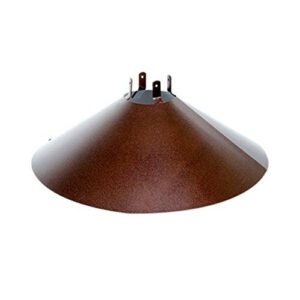
A squirrel climbing your feeder pole is a problem cats don’t cause — but the Woodlink Bronze Squirrel Baffle solves it anyway.
This 22-inch wide alloy steel shield wraps around any standard 4×4 post and locks in place with a snap seam.
Mount it 4 to 5 feet up, and climbing animals simply can’t get past it. The weather-resistant bronze finish holds up through seasons without much fuss.
At $59, it’s a durable, low-maintenance layer of protection for your feeding station.
| Best For | Bird lovers who want a simple, set-it-and-forget-it way to keep squirrels and raccoons off a 4×4 post-mounted feeder. |
|---|---|
| Material | Alloy steel |
| Weather Resistant | Yes |
| Target Threat | Squirrels, raccoons |
| Installation Type | Wraps around post |
| Price Range | $59.04 |
| Product Finish | Antiqued bronze |
| Additional Features |
|
- Solid alloy steel build that holds up year-round without rusting or fading fast
- Easy snap-around install — no tools required, just lock it into place
- The bronze finish actually looks good in a garden, not like an eyesore you’re hiding
- Only works on 4×4 square posts — round poles or other sizes are out of luck
- Snapping the seam into place can be tricky and might need a second pair of hands
- Won’t help if squirrels are jumping from a nearby tree or deck rather than climbing up
3. Birdsbesafe Geodelic Cat Collar Cover

Baffles stop climbers, but what about the cat that’s already in your yard?
That’s where the Birdsbesafe Geodelic Cat Collar Cover earns its place.
It slips over any standard breakaway collar and uses a bold, multicolored pattern that triggers birds’ sharp color vision — giving them a split-second warning to escape.
An independent study found an 87% reduction in bird kills.
At $15.95, it’s a simple, washable ask for any cat owner willing to help.
| Best For | Cat owners who let their pets roam outdoors and want a simple, low-effort way to protect local birds without keeping their cat inside. |
|---|---|
| Material | Nylon/polyester fabric |
| Weather Resistant | Partial |
| Target Threat | Cats |
| Installation Type | Slides over collar |
| Price Range | $15.95 |
| Product Finish | Multicolored geodelic |
| Additional Features |
|
- That 87% reduction in bird kills is backed by an independent study — not just marketing fluff.
- At $15.95, it’s cheap, washable, and slides right onto a collar your cat already wears.
- Works even better when paired with a bell — easy to layer with other deterrents.
- It needs a separate breakaway collar to work, so it’s not a grab-and-go solution on its own.
- Hot or wet weather can reduce how well it stays put, and some cats will just work it off.
- Won’t stop cats from hunting lizards or small mammals — birds are really the main target here.
4. Erva SB3 Tan Post Mounted Squirrel Baffle
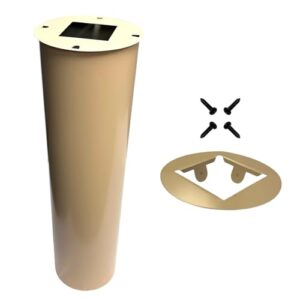
The collar cover helps with cats already roaming your yard — but what about stopping climbers before they reach your feeder post?
The Erva SB3 Tan Post Mounted Squirrel Baffle manages that job well. It’s a galvanized steel cylinder, 28 inches tall and 8 inches wide, built to wrap a standard 4×4 post. Cats and squirrels simply can’t get past it. The tan finish blends in naturally, and installation takes just a screwdriver. At $69.99, it’s built to last seasons.
| Best For | Bird-feeding enthusiasts with a 4×4 post setup who want a no-nonsense, long-lasting barrier against squirrels and raccoons. |
|---|---|
| Material | Galvanized alloy steel |
| Weather Resistant | Yes |
| Target Threat | Squirrels, raccoons |
| Installation Type | Mounts to post with screws |
| Price Range | $69.99 |
| Product Finish | Tan baked-enamel |
| Additional Features |
|
- Tough galvanized steel that shrugs off chewing, rust, and bad weather season after season
- Tan finish blends right in with wooden posts — it won’t stick out like a sore thumb
- Straightforward install with just a screwdriver and the included screws
- Only works with 4×4 posts, so any other size is a no-go without some extra work
- A 28-inch steel cylinder isn’t exactly lightweight, which can make mounting a bit awkward
- Determined climbers that make it over the top will still reach your feeder — not a complete fix for every critter
5. Audubon Torpedo Steel Squirrel Baffle
If the Erva feels like more than you need, the Audubon Torpedo Steel Squirrel Baffle performs the same job at a lower price point. At $38.97, this powder-coated steel baffle measures 15.75 inches long with a 6‑inch torpedo‑shaped body that slides right onto your feeder pole.
It fits poles from half an inch to 1⅜ inches wide — no tools needed. Cats and squirrels can’t grip past it, and the solid steel construction holds up season after season.
| Best For | Bird lovers who want a no-fuss, budget-friendly squirrel blocker for a standard pole-mounted feeder. |
|---|---|
| Material | Powder-coated steel |
| Weather Resistant | Yes |
| Target Threat | Squirrels, small mammals |
| Installation Type | Slides over pole |
| Price Range | $38.97 |
| Product Finish | Black powder-coat |
| Additional Features |
|
- Solid powder-coated steel that holds up through rain, snow, and sun without rusting out
- Slides right onto your pole — no drilling, no tools, no headaches
- At $38.97, it gets the job done without breaking the bank
- Some shipments arrive without the mounting coupler, which means a hardware store trip before you can use it
- Struggles with poles wider than about 1.25 inches, despite the listed max of 1⅜ inches
- Raccoons can muscle past it — if you’ve got bigger wildlife problems, this won’t cut it alone
6. Atvkov Bluebird House Predator Guard
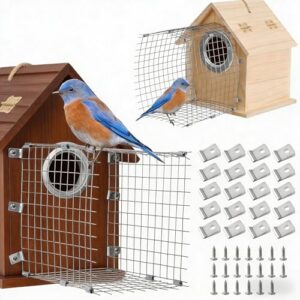
For bluebirds specifically, the Atvkov Bluebird House Predator Guard takes protection right to the nest box entrance.
This stainless-steel wire mesh guard fits standard 1½-inch entry holes and extends 2–3 inches outward, blocking cats, raccoons, and snakes from reaching inside.
You get two guards per package with mounting screws included — no special tools required.
Install it after bluebirds start nesting to avoid confusing them early in the season.
It’s small, durable, and built to last through multiple seasons outdoors.
| Best For | Bluebird enthusiasts who want a simple, no-fuss way to protect their nest boxes from snakes, raccoons, and competing birds. |
|---|---|
| Material | Stainless-steel wire mesh |
| Weather Resistant | Yes |
| Target Threat | Snakes, raccoons, birds |
| Installation Type | Screws to birdhouse |
| Price Range | Not listed |
| Product Finish | Silver |
| Additional Features |
|
- Comes as a two-pack with screws included — easy to install without any special tools
- Stainless steel holds up outdoors season after season without rusting
- Fits standard bluebird houses right out of the box, with some flexibility for other sizes
- Wire edges can be sharp, so you’ll want to handle them carefully during install
- Determined house sparrows may still find their way through the mesh
- Installing too early in the season can throw off bluebirds before they’ve settled in
Work With Neighbors and Cat Owners

Protecting your backyard birds isn’t just a solo effort — your neighbors play a bigger role than you might think. A single roaming cat from next door can undo everything you’ve worked to build.
Here are some practical ways to get the whole block working toward the same goal.
Encourage Neighbors to Keep Cats Indoors
A simple conversation with your neighbor can go a long way. Door-to-Door Outreach lets you personally educate cat owners about how indoor living protects birds.
Community Pledge Programs and a Volunteer Ambassador Program help spread the message block by block.
Shared Bird Sanctuaries thrive when everyone agrees to keep your cats indoors.
Cat-friendly Incentives, like free enrichment kits, make the ask much easier.
Promote Cat Collars With Bird-warning Covers
Bird-warning collar covers give birds a fighting chance. Share options that feature Bright Color Choices and Reflective Elements so birds spot approaching cats from meters away.
Cat collar deterrents with bells add an audible warning on top of the visual signal. Look for Easy-Release Safety closures and encourage neighbors to join Collar Adoption Programs, updated with Seasonal Color Updates each spring.
Discuss Nighttime Cat Restrictions Politely
Bringing up a community cat curfew doesn’t have to feel awkward. Start with friendly timing — a casual chat, not a formal complaint.
Polite scripts work well here: "I love your cat, and I’m worried about nesting birds after dusk. Could we keep your cat indoors by 9 pm?"
Agreement templates and quiet signage posted near shared spaces reinforce the message without pressure.
Share Bird-friendly Yard Protection Tips
Sharing what works is one of the best tools you have.
When neighbors see your birdfriendly garden design in action — the physical barriers, scent repellents, and motion-activated sprinklers — they get curious.
Walk them through your seasonal yard adjustments, vegetation management habits, and strategic lighting placement.
Predator activity monitoring and wildlife-friendly landscaping aren’t complicated once someone shows you the basics firsthand.
Report Recurring Feral Cat Problems Humanely
Feral cats showing up repeatedly near your feeders aren’t just a nuisance — they’re a documented wildlife concern. Contact local animal control or community hotline, using clear documentation templates to log colony size, hotspot locations, and activity times.
Good follow-up tracking and data sharing with neighbors strengthen your case.
Responsible pet ownership and community involvement in wildlife protection, paired with nonlethal cat deterrents, drive real results.
Support Local TNR and Licensing Programs
Supporting local TNR programs is one of the most effective ways to reduce outdoor cat populations humanely. Many municipalities offer Community TNR Grants and Licensing Incentive Programs that cover spay/neuter costs, especially for low-income households. Volunteer Training Workshops and Multilingual Outreach Materials help diverse neighborhoods participate.
Data Transparency Dashboards track real progress. When communities invest in cat licensing and responsible pet ownership together, wildlife protection becomes a shared neighborhood success.
Create Shared Cat-free Bird Zones
Once TNR efforts reduce roaming cats, take the next step: work with nearby households to create cat‑free bird habitats together.
- Community Mapping & Boundary Signage — Involve at least three households, draw clear zone boundaries, and post visible signs.
- Legal Agreements & Zone Enforcement — Draft a simple written agreement and register it with your neighborhood association.
- Shared Monitoring — Use motion‑activated sprinklers and physical barriers, then log cat activity monthly to improve your bird‑friendly garden design.
Frequently Asked Questions (FAQs)
How do I keep cats out of my backyard and away from my pet birds?
Want to truly safeguard your yard?
Start by keeping cats indoors, using motion-activated sprinklers, smart birdbath placement, and scent deterrents. These cat deterrents, combined with thoughtful garden layout design, stop predation before it starts.
What is the 5 7 9 rule for bird feeders?
The 5 7 9 rule is a simple bird feeder placement guide: mount your bird feeder 5 feet high, 7 feet from structures, and 9 feet below branches — creating a safety bubble against predators.
What is the number one meat you should never feed your cat?
Raw fish is the number one meat to never feed your cat.
It carries harmful bacteria, raises parasite risk, and can trigger vomiting and diarrhea — stick to cooked, boneless options instead.
Do bell collars actually reduce bird predation?
bell collars cut bird kills by roughly one-third to nearly half.
Better collar fit comfort keeps bells audible longer, improving auditory detection range—they work best alongside other protective measures.
Which bird species are most vulnerable to cats?
Ground-nesting songbirds, fledglings, and small passerines face the greatest risk.
Island endemic birds and forest specialists suffer too, especially near feral cat hotspots during bird breeding season, when wild bird mortality peaks.
How many birds do cats kill annually worldwide?
Cats are nature’s tiny, purring assassins with an impressive résumé.
Global mortality estimates suggest they kill between 3 and 4 billion birds annually in the U.S. alone — conservation impact at a staggering scale.
Can indoor cats still stress backyard birds?
Even indoor cats create stress for backyard birds.
Through window perching and cat activity timing, they send visual stress cues and acoustic disturbance that trigger bird behavioral adaptations—reducing feeder visits and raising baseline anxiety levels nearby.
What laws protect wild birds from cat predation?
Several laws work together here. The Migratory Bird Treaty and Endangered Species Act set federal protections, while State Cat Laws and local wildlife laws address predation at the community level.
Conclusion
You don’t need a perfect yard or a cat-free neighborhood to make a real difference. Even applying three or four of these strategies consistently can dramatically cut the risk to birds visiting your space.
To protect backyard birds from cats, think in layers—placement, barriers, and deterrents working together rather than any single fix.
The birds coming to your feeders and baths are counting on the choices you make. Small actions, done right, add up.