This site is supported by our readers. We may earn a commission, at no cost to you, if you purchase through links.

The rarest bird you ever see means nothing if you can’t prove you saw it. Serious birders know this—a mental snapshot fades, details blur, and without a written record, a potential life bird becomes a story no one can verify.
Field notes are the difference between an observation and evidence, and the best ornithologists have always treated their notebooks like a second brain in the field.
The problem isn’t motivation; it’s structure. Without a reliable system for how to organize your birding field notes, even dedicated observers end up with scattered entries, missing data, and records too incomplete to contribute to citizen science platforms like eBird.
Table Of Contents
Key Takeaways
- A consistent entry template — covering date, GPS coordinates, weather, habitat, and effort — is what turns a casual observation into evidence that actually holds up scientifically.
- Your gear setup matters more than most birders realize: a weatherproof notebook, reliable pencil, and laminated field guide can save a record that a dead phone battery would have lost forever.
- Structuring each species entry around field marks, vocalizations, behavior, and count estimates means you’re capturing the full picture, not just a name on a list.
- Digitizing your notes, uploading to eBird, and automating cloud backups is what transforms a personal notebook into a contribution to real, trackable citizen science.
Choose Your Field Note Setup

Before you ever lift your binoculars, what’s in your hands matters just as much as what’s in the trees. The right setup keeps you ready to capture every detail without fumbling or losing information to a rainy morning or a dead phone battery. Here’s what you’ll want to have with you before heading out.
A solid bird watching equipment guide can help you build your kit with confidence, from optics to weatherproof notebooks.
Weatherproof Notebook
Your notebook is the foundation of everything — choose it carefully. Stone paper notebooks repel water entirely, staying legible even after rain showers or brief submersion. Synthetic polymer pages resist tearing when pulled from damp pockets. Their sustainability is notable, thanks to stone paper’s waterless production. Look for these three features before buying:
- Weatherproof certification (immersion-rated)
- Pocket-sized format (3×5 in or 5×7 in)
- Rigid, UV-resistant cover
Pencil and Pen Kit
Once your weatherproof notebook is sorted, the next question is what you’re writing with.
A bolt action pencil kit manages field conditions well — the smooth advance mechanism deploys 7mm lead cleanly without fumbling with a cap, and the integrated eraser in the end cap lets you correct sketches immediately.
Pair it with a permanent ink pen for final species confirmations.
Pocket Field Guide
With your writing tools sorted, you’ll want an equally reliable reference beside them. A compact folding field guide — laminated card stock, under an ounce, pocket-sized — holds up through rain and rough handling without adding bulk to your kit.
It lists both English and Latin names, so your birding field notes stay scientifically accurate whenever your phone dies mid-observation.
Sketching Space
A clear, stable surface makes all the difference when you’re sketching birds quickly in the field.
A portable lap desk or clipboard gives you a firm base wherever you sit, while a foldable field easel expands your workspace on steadier ground.
Pair either with adjustable-height seating to reduce fatigue and position yourself where natural light catches the bird’s shape cleanly.
Digital Backup Tools
Even seasoned birders lose years of records to a single hardware failure — so treat digital backup as non‑negotiable from day one.
Pair cloud storage like Google Drive or Dropbox with a local copy for a hybrid storage strategy that survives both device loss and site disasters.
Enable automated backup schedules and versioning so your data stays protected without lifting a finger.
Use a Consistent Entry Template

Every solid set of field notes starts with the same foundation: a reliable template you fill in before you even raise your binoculars. Without that structure, even the sharpest observations can lose their scientific value over time. Here’s what every entry should include from the moment you arrive at a site.
Date and Time
Start every entry with date in ISO 8601 format — YYYY-MM-DD — followed by your start and stop times using a 24-hour clock (e.g., 06:15–08:40). Always note your local time zone, and if Daylight Saving Time is in effect that day, flag it.
Pairing your time-stamped field notes with resources like unusual bird migration reporting tips and best practices can sharpen your observations and help scientists spot meaningful patterns faster.
This keeps your chronological records clean and comparable across seasons.
Exact Birding Location
After the date and time, log your exact birding location — not just "city park," but the specific trail junction, bench, or stream bend where you were standing.
Record GPS coordinates to four decimal places (e.g., 51.3456°N, 12.3789°E, WGS 84 datum), and pair them with a named reference point so others can verify or revisit the same spot reliably.
Weather Conditions
Weather tells a story before you even raise your binoculars. Log temperature, wind speed and direction, cloud cover, and precipitation for every outing — because these variables directly shape what you’ll encounter:
- Temperature drops overnight by 5–15°C, suppressing or triggering early-morning activity
- Strong gusty winds reduce bird detectability greatly at dawn
- High humidity and fog cut visibility and affect vocal behavior
Habitat Details
Habitat is the lens through which every sighting gains meaning.
Beyond the broad label — riparian forest, alpine meadow — you need to capture vertical vegetation structure: are birds foraging in the canopy, subcanopy, or understory? Note substrate too, since leaf litter depth and woody debris directly shape which ground-dwellers appear.
Flag water features, human disturbance nearby, and any seasonal phenology cues like spring green-up or post-drought pond contraction.
Birding Effort
Effort is what transforms raw observation into reliable science.
Log your start and stop times for each session and separate active birding from travel. Note whether conditions — wind, heat, poor light — cut your attention short.
Without this context, a low species count looks like absence when it was simply a difficult morning.
A low count without effort context mistakes a hard morning for an empty sky
Record Birds in Standard Sections

Once you’ve got your entry template locked in, the real work begins — actually recording what you see in a way that’s consistent and easy to revisit later. Breaking your bird observations into dedicated sections keeps everything where you expect it to be, whether you’re in the field or reviewing notes months down the line.
Here’s how to structure each species entry so nothing important slips through the cracks.
Species Name
Every species entry begins with the common name, followed immediately by the italicized scientific name in parentheses — for example, Turdus migratorius for the American Robin.
That scientific name isn’t arbitrary; its Latin or Greek roots often describe a defining trait, habitat, or the collector who first documented it, giving you a built-in memory anchor every time you write it down.
Physical Field Marks
Once you’ve captured the species name, your next task is documenting exactly what you saw. Physical field marks are the visual details that separate one bird from another — and recording them systematically makes later identification far more reliable.
Focus on three core areas:
- Bill shape and depth — note whether it’s short and stout like a finch’s, long and curved, or fine and pointed
- Plumage patterns and texture — record wing bar configuration, breast spotting, eye ring color and intensity, and whether feathers appear velvety or glossy under light
- Tail and body proportions — tail feather length relative to wingspan, plus leg coloration and any feathering on the tarsi
When sketching, a quick oval body outline with annotated arrows pointing to key marks is often more useful than a detailed drawing. Jot superciliary stripe thickness, malar patch shape, and underwing covert coloration if the bird was in flight. These small specifics are exactly what confirm a tentative ID later.
Calls and Songs
Sound is the quickest ID tool you have in the field. Where plumage gives you visual clues, song versus call tells a different story — songs are long, complex vocalizations used during breeding, while calls are brief, instinctive signals for alarms or flock contact. Noting which you heard immediately sharpens your record.
When you transcribe, capture acoustic syllable patterns phonetically — "cheer-cheer-cheerily" for an American Robin, or a sharp "chip" for a contact call. Note pitch direction, tempo, and any trill elements. In urban settings, some species shift to higher-amplitude calls to cut through ambient noise, so flag that context too.
Seasonal changes matter here. Peak singing activity commonly concentrates in breeding season, so a rich, elaborate song in May carries different significance than a quiet chip note in October. Always note time of onset — dawn choruses follow predictable patterns that anchor your entries to reliable observation windows.
| Feature | Song | Call |
|---|---|---|
| Length | Long, complex phrases | Short, simple notes |
| Purpose | Mate attraction, territory | Alarm, contact, coordination |
| Learning | Learned; varies by population | Instinctive; consistent within species |
| Seasonal peak | Breeding season | Year-round |
| Transcription example | "cheer-cheer-cheerily" | Sharp "chip" or "tik" |
If you’re carrying a recorder, link audio files directly to the corresponding notebook entry — a timestamp and species label is all you need to make retrieval seamless later.
Behavior Notes
Once you’ve logged a bird’s vocalizations, shift your attention to what it’s actually doing.
Behavioral sketches anchor a record in reality — note the foraging substrate patterns first: is the bird working bark, leaf litter, or open ground? Document feeding bout duration in seconds, because tempo reveals energy strategy far better than a general description ever could.
Count Estimates
Few birders realize how much a tally shapes the story. Timed interval counts — say, five-minute blocks — give your numbers analytical weight rather than vague impressions. Detection probability drops in dense habitat, so note that too.
- Use tally marks for large flocks
- Log observer effort hours per session
- Flag uncertain counts with a question mark
Index Notes for Easy Searching

Even the most detailed field notes lose their value if you can’t find what you’re looking for when it matters. A solid indexing system turns your notebook from a pile of dated pages into a living reference you’ll actually use. Here are five practical ways to organize your notes so any entry is just seconds away.
Date-Based Organization
Think of your date-based index as a time machine.
Using ISO 8601 format (YYYY-MM-DD) for every entry lets you reconstruct a chronological sequence instantly, so you can trace exactly how your sightings evolved from January through migration peaks in May.
Each daily entry should carry time-stamped event logs, weather conditions, location, and effort notes — making every page a self-contained, searchable field record.
Location-Based Tabs
When each site gets its own tab, your field notebook transforms from a pile of pages into a structured location-based notetaking system.
- Color-code by habitat type — blue for wetlands, green for deciduous forest
- Note GPS coordinates as the tab header for precise indexing
- Record microhabitat details like understory density per site
- Document seasonal habitat changes within each tab
- Use page dividers to enable quick cross-site comparison
Species Index
A well-built species index is the backbone of any serious field notebook.
Dedicate a rear page to listing every species by common and scientific name — Turdus migratorius, not just "robin" — so you can cross-reference entries instantly. This directly facilitates species distribution mapping and helps flag taxonomic data gaps in your regional coverage over time.
Color-Coded Categories
Color-coding transforms your field notebook from a wall of text into a system you can parse at a glance.
Assign red for rare or urgent sightings, blue for routine observations, green for high‑confidence IDs, and yellow for anything uncertain.
Keep a legend on a visible page to prevent color‑code drift across trips, and always verify contrast under dawn and dusk light conditions.
Sketch and Media Labels
Every sketch and photo you capture deserves a label that works as hard as you do. Write each label with a title, date, and brief description, then add your initials for traceability.
Reference the file type — sketch, JPEG, WAV — so retrieval takes seconds, not minutes. Consistent font size and placement keep these labels visually aligned with your other field entries.
Digitize and Share Your Records
Your paper notes hold real scientific value, but they’re only as useful as your ability to find, share, and build on them over time. Moving your records into a digital workflow protects that work and opens the door to contributing alongside a global community of birders and researchers. Here’s how to do it step by step.
Scan Notebook Pages

Scanning your handwritten field notes is the first real bridge between paper and permanent record. Aim for 300 to 600 dpi resolution — anything lower risks losing fine pencil strokes and species abbreviations.
Use batch scanning to process multiple pages at once, then apply consistent brightness and contrast presets across the run. Name each file sequentially, embed date and location in the PDF metadata, and store copies in at least two locations.
Add Photos and Audio

Once your scanned pages are filed, the next layer is multimedia. Attach photos as JPEG or PNG files, named with date, time, and species — for instance, 2026-06-23_0714_AmericanRobin.jpg.
For audio, save vocalizations as WAV or MP3, noting start and end times so each clip aligns precisely with your written observation entry.
Enter Data in EBird
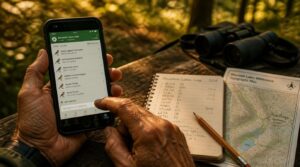
With your media files named and filed, it’s time to transcribe them to eBird. Open the eBird Mobile app or website and create a new checklist, setting the precise date, start time, and location. Your effort metrics — duration and distance traveled — belong here too, since they give your citizen science data entry real analytical weight.
For each species, enter the exact eBird taxonomy common name and your count. If a number isn’t possible, mark it X rather than guessing.
- Attach your labeled photos or audio clips directly to the checklist for media integration and identification support
- Apply breeding codes only when you’re confident — accuracy matters more than completeness
- Use eBird data export later to compare your records against seasonal patterns
Once submitted, review each checklist for checklist accuracy before closing the session.
Cloud Backup Routine

Once your eBird checklist is submitted, protecting those records becomes your next priority. A solid data backup strategy means automating daily incremental backups to capture new notes without wasting time, while scheduling a full weekly backup as a reliable restore point.
Use multi-cloud redundancy — storing copies across at least two providers and two geographic regions — so no single failure wipes your records.
| Backup Type | Frequency |
|---|---|
| Incremental backup | Daily |
| Full backup | Weekly |
| Recovery drill | Quarterly |
Data encryption methods protect your files both in transit and at rest, with multi-factor authentication controlling access. Enable versioning so you can restore a specific field session date if something goes wrong. Run integrity check protocols regularly to confirm your local and cloud copies match exactly.
Review Seasonal Patterns

Once your records are safely backed up, the real reward begins — using them. Your field notes become a living calendar of avian phenology, revealing how migration timing shifts year to year, when breeding activity peaks, and how weather impact patterns alter detection rates.
Cross-referencing dates exposes food resource cycles and habitat seasonal changes that explain which species appear and when.
Frequently Asked Questions (FAQs)
How do I handle duplicate sightings across multiple outings?
Assign a master sighting entry for each species per date, then flag any overlap within a 200-meter spatial tolerance as a potential duplicate — linked, not deleted, and annotated with a brief explanation.
Can beginners use shorthand or abbreviations effectively?
Yes — beginners can use shorthand effectively by creating a personal legend at the notebook’s front. Keep abbreviations clear, apply them consistently, and review them post-session to guarantee your quick notetaking never sacrifices clarity.
How should rare or unusual species sightings be flagged?
When a species seems out of place — wrong season, wrong region — flag it immediately. Note why it’s unusual, document precise location and field marks, and attach any photos or audio you captured.
How do I record observations made by birding companions?
Two birders, one bird — log each observer separately, using the same date, time, and location. Note certainty levels, any disagreements, and tag entries with a shared trip name for easy cross-validation later.
Conclusion
What separates a serious birder from someone who simply watches birds? Documentation.
Learning how to organize your birding field notes transforms fleeting observations into a permanent, searchable record that actually means something—to you, to science, and to the broader birding community.
Your notebook becomes a field instrument as essential as your binoculars.
Build the habit now, stay consistent with your system, and every entry you make today becomes verifiable evidence tomorrow.
- https://bwdmagazine.com/tips-for-birders/getting-started/journal
- https://buffaloaudubon.org/birding-dos-donts-9-tips-for-respectful-birdwatching
- https://www.aba.org/what-exactly-is-a-field-notebook
- https://www.allaboutbirds.org/news/take-note-tips-for-keeping-a-field-notebook
- https://support.ebird.org/en/support/solutions/articles/48000803130-how-to-document-your-sightings