This site is supported by our readers. We may earn a commission, at no cost to you, if you purchase through links.

A bored bird doesn’t stay quiet about it. Feather-plucking, repetitive screaming, and cage-bar biting are all signs your bird’s mind has nothing to work with—and those behaviors are harder to reverse than they are to prevent.
Birds in the wild spend most of their waking hours foraging, climbing, and investigating their environment, so a bare cage with a single perch is a bit like giving someone a blank room and calling it home.
The right accessories change everything. Swings that mimic natural branch sway, foraging toys that reward curiosity, and shreddable materials that satisfy the urge to chew all work together to build a richer, healthier daily life for your bird.
Table Of Contents
Key Takeaways
- Boredom in birds shows up fast — feather-plucking, repetitive screaming, and beak-biting are warning signs that your bird’s environment needs more stimulation, not correction after the fact.
- Foraging toys that hide treats and shreddable materials that satisfy chewing instincts tackle boredom at its root, keeping your bird’s mind and beak genuinely busy.
- Matching toy size and materials to your bird’s species isn’t optional — the wrong fit can cause real harm, so untreated hardwoods, natural fibers, and rust‑free hardware are your baseline.
- Rotating three to five toys weekly, rather than leaving the same setup in place, is the single most effective habit for keeping your bird curious, active, and mentally sharp.
Best Accessories That Entertain Birds
Finding the right accessories can genuinely transform your bird’s day from dull to exciting. The options below cover everything from colorful cage toys to cozy hammocks, so there’s something for every bird’s personality. Here are five accessories worth adding to your bird’s space.
Whether you have a parakeet or another feathered companion, browsing bird cage accessories designed for parakeets can spark some great ideas for keeping your bird mentally sharp and physically active.
1. Colorful Bird Cage Toy Set
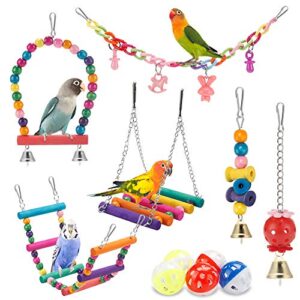
A colorful bird cage toy set is one of the easiest ways to brighten your bird’s day.
This 11-piece set includes swings, ladders, a hammock, chewing toys, and bells — everything your small parrot, budgie, or finch needs.
The wood is dyed with edible, non-toxic colors, so chewing is completely safe.
Hook attachments make installation quick, and the compact size fits most cages without crowding your bird’s space.
| Best For | Small bird owners — especially those with parrots, budgies, or finches — who want an affordable, all-in-one enrichment set that keeps their birds active and entertained. |
|---|---|
| Primary Material | Natural wood with edible dyes |
| Mounting Style | Hook attachments at cage top |
| Bird Compatibility | Small parrots, budgerigars, finches |
| Chew Support | Bite-resistant natural wood pieces |
| Mental Enrichment | Visual and auditory stimulation via bells and color |
| Physical Activity | Climbing, swinging, and muscle strengthening |
| Additional Features |
|
- 11 varied pieces (swings, ladders, hammock, bells, and chewing toys) give your bird plenty to explore and interact with
- Made from natural wood with edible, non-toxic dyes, so it’s safe even for heavy chewers
- Hook attachments make setup fast and easy without taking up extra cage space
- Metal hooks can rust over time, so regular inspection and cleaning is a must
- Colors may fade with frequent washing or long-term sun exposure
- The soft wood isn’t ideal for larger birds — better suited to smaller species who won’t chew through it too quickly
2. Shredding Forage Toy Set
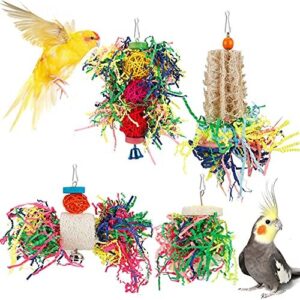
A shredding forage toy set takes enrichment one step further, putting your bird’s natural instincts to work.
These sets combine loofah, rattan, wood, and crinkly paper — layers your bird tears apart to find hidden treats inside. That slow, exploratory process keeps curious minds busy and helps reduce feather-picking.
The built-in hook makes hanging straightforward, and the bright paper strips draw attention immediately. Just monitor the hook and remove any metal bells that aren’t stainless steel.
| Best For | Bird owners with small to medium parakeets, budgies, cockatiels, lovebirds, or conures who want to keep their pets mentally stimulated and curb boredom or feather-plucking. |
|---|---|
| Primary Material | Loofah, rattan, wood, cotton rope |
| Mounting Style | Built-in hook, standard cage eyelet |
| Bird Compatibility | Parakeets, budgies, cockatiels, lovebirds, conures |
| Chew Support | Natural shredding and foraging materials |
| Mental Enrichment | Foraging and treat-dispensing problem-solving |
| Physical Activity | Light exercise reducing cage-bound boredom |
| Additional Features |
|
- Combines multiple natural materials (loofah, rattan, wood, crinkly paper) to satisfy shredding and foraging instincts
- Treat-hiding capability turns playtime into an engaging problem-solving activity
- Easy to hang with a built-in hook and immediately eye-catching thanks to bright, colorful paper strips
- Crinkly paper fragments shed during play, meaning more frequent cage cleanup
- The included hook can open unexpectedly, so regular safety checks are a must
- Metal bells may not be stainless steel and should be removed to prevent potential toxicity
3. Wooden Parakeet Swing Set
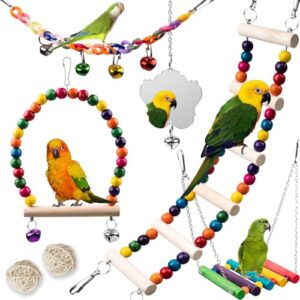
Once your bird has had its fill of foraging, a swing set brings a whole new kind of joy.
The Wooden Parakeet Swing Set uses natural untreated wood colored with edible dyes, so your bird can peck and chew safely. A flat wide perch bar suits small species like budgies and cockatiels perfectly.
The bells and food-grade dyes make this swing a sensory delight—explore more stimulating bird toys for curious, active birds to keep your feathered friend happily entertained.
The pendulum-style swing rocks gently, giving your bird vestibular stimulation that enhances balance. You can also swap perches quickly to keep things fresh.
| Best For | Small bird owners with parakeets, budgies, cockatiels, or small conures looking to keep their pets active, entertained, and mentally stimulated. |
|---|---|
| Primary Material | Natural wood with edible dyes, stainless steel |
| Mounting Style | Easy-mount hook design |
| Bird Compatibility | Parakeets, budgies, cockatiels, small conures |
| Chew Support | Safe-pecking wood with edible dyes |
| Mental Enrichment | Color variation and ringing bell stimulation |
| Physical Activity | Climbing, swinging, and physical health support |
| Additional Features |
|
- Made from natural wood colored with edible dyes, so it’s completely safe for birds that love to peck and chew
- The variety of 7 accessories — swings, ladders, and perches — keeps your bird engaged and encourages natural climbing and swinging behaviors
- Bells and bright colors add sensory stimulation that helps reduce boredom and feather-picking
- Not suitable for larger parrots, as they can put too much force on the hardware and damage it
- Chains and small parts can wear down over time, so you’ll need to inspect the set regularly
- Assembly and adjustments should be done under adult supervision, especially for first-time setup
4. Natural Wood Bird Toy Set
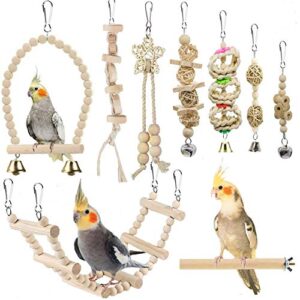
If swings bring movement, a good toy set brings variety — and that’s where the Natural Wood Bird Toy Set earns its place.
This 9-piece set includes six chew toys, a ladder, a bell swing, and a perch stand. Everything mounts with active hooks, so you don’t need tools. The untreated hardwood is safe for biting, and rounded, sanded edges protect small beaks and feet from splinters during active play.
| Best For | Small-to-medium bird owners looking for an all-in-one enrichment set that keeps budgies, parakeets, cockatiels, lovebirds, and finches mentally and physically active. |
|---|---|
| Primary Material | Natural non-toxic wood |
| Mounting Style | Active hooks, tool-free installation |
| Bird Compatibility | Budgerigars, parakeets, cockatiels, lovebirds, finches |
| Chew Support | Bite-resistant handcrafted natural wood |
| Mental Enrichment | Climbing, swinging, and perching variety |
| Physical Activity | Climbing, swinging, and beak conditioning |
| Additional Features |
|
- Nine pieces in one set means plenty of variety — chewing, climbing, swinging, and perching all covered without buying extras
- Tool-free installation with active hooks makes setup quick and keeps cage space tidy
- Natural, non-toxic hardwood is safe for biting and gentle on small beaks and feet
- Too small for larger parrots or macaws, so it’s not a one-size-fits-all solution
- The plain natural wood finish won’t appeal to those wanting colorful, visually stimulating toys
- Heavy chewers can wear through wooden pieces faster than they would synthetic alternatives
5. Organic Seagrass Bird Hammock
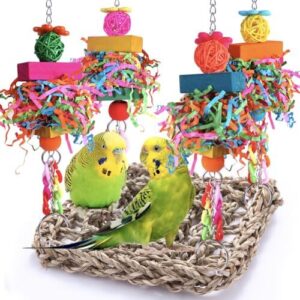
Most birds need more than play — they need a place to simply be. The Organic Seagrass Bird Hammock gives your small parrot exactly that.
Woven from untreated, dye-free seagrass, it’s safe for chewing and gentle on feathers. At 6.7 × 6.7 inches, it fits neatly without crowding your cage. Four stainless-steel chains make hanging simple.
Your bird can perch, sway, and rest here — all naturally.
| Best For | Small-to-medium birds like parakeets, cockatiels, lovebirds, conures, and budgies who need a cozy spot to play, perch, and unwind. |
|---|---|
| Primary Material | Organic seagrass, wood, rattan, acrylic |
| Mounting Style | Four stainless-steel chains plus hook |
| Bird Compatibility | Parakeets, cockatiels, lovebirds, conures, budgies |
| Chew Support | Pecking and shredding seagrass and wood |
| Mental Enrichment | Pecking, shredding, and preening encouragement |
| Physical Activity | Swinging, perching, and simultaneous active play |
| Additional Features |
|
- Made from organic, untreated seagrass with natural add-ons like rattan, wood, and beads — safe for curious beaks and gentle on feathers
- Doubles as a perch, swing, and resting spot, keeping birds mentally stimulated and physically active all in one place
- Four removable stainless-steel chains make it easy to hang just about anywhere — cage bars, windows, or ceiling hooks
- Not built for larger parrots or heavy chewers, who may tear through the mat faster than expected
- Can feel bulky in a smaller cage, especially if other toys are already taking up space
- Some birds take time to warm up to it and may need a slow, patient introduction before they’ll use it comfortably
Foraging and Chewing Accessories
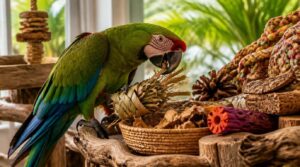
Foraging and chewing are two of the most natural instincts your bird brings to every waking hour. Giving them the right outlets keeps beaks busy, minds sharp, and that restless energy pointed somewhere productive. Here are some of the best options to explore.
Treat-hiding Foraging Toys
Foraging toys tap into one of the most natural instincts your bird has — the drive to search and discover. These puzzle feeders hide treats inside sliding panels or small compartments, encouraging your bird to manipulate openings to retrieve rewards. Progressive difficulty levels keep things engaging as your bird grows more skilled.
- Sensory search cues like bright colors and textured surfaces guide your bird toward hidden treats
- Refillable compartments let you swap in seeds, pellets, or chopped fruit between sessions
- Bird-safe materials — smooth plastics and untreated wood — keep exploration safe and worry‑free
Mental stimulation from structured foraging behavior reduces boredom, discourages feather picking, and promotes healthy problem‑solving habits every day. Consistent foraging opportunities reduces stress markers and decreases screaming behavior in parrots.
Shreddable Paper Toys
Shreddable paper toys tap straight into your bird’s natural urge to tear, explore, and rearrange. Choose unprinted, non-glossy paper without coatings or scents to keep chewing safe.
Mixing corrugated strips with crinkly paper adds auditory feedback, your bird reacts instantly.
Refresh the toy weekly — that simple swap maintains novelty and keeps your bird’s mind genuinely engaged.
Natural Wood Chew Toys
Natural wood chew toys give your bird something genuinely satisfying to work through. Untreated hardwoods like birch, maple, and beech are your safest choices — no paints, no finishes, no hidden toxins.
- Smooth sanding removes sharp edges that could injure delicate beaks
- Varied textures stimulate tactile exploration across chewing sessions
- Hollowed sections double as foraging spots, hiding treats naturally
- Regular chewing prevents beak overgrowth and maintains healthy jaw muscles
- Swap pieces every one to two weeks to prevent boredom
Palm and Rattan Toys
Palm and rattan toys are where natural fiber textures truly shine for curious beaks. Woven rattan pieces resist quick tearing, giving your bird longer, more satisfying chewing sessions. The irregular braided surfaces encourage beak maintenance naturally.
Safe cleaning is simple — wipe with a damp cloth only.
Always choose sustainably sourced rattan to support both your bird’s health and responsible environmental practices.
Puzzle Feeders
Think of a puzzle feeder as a tiny brain gym built right into mealtime. Your bird must push, turn, or slide a mechanism to release a treat, naturally slowing eating and sharpening problem-solving skills.
Most designs offer adjustable difficulty levels, so you can increase the challenge as your bird gets smarter. Clean them thoroughly after each use with warm water and bird‑safe soap.
Climbing and Exercise Accessories
Birds need more than a perch to stay healthy — they need to move, climb, and stretch every day. The right accessories can turn your bird’s cage into a real playground that keeps their muscles strong and their mind sharp. Here are the best climbing and exercise accessories to get them moving.
Bird Swings
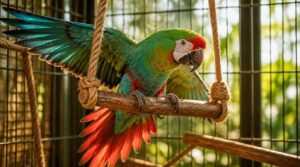
Bird swings are one of the best investments you can make for bird enrichment. They double as a climbing toy and a balance trainer, gently building core muscle strength with every sway.
For swing balance training, position yours at varying cage heights, keeping it away from water bowls.
Always prioritize material durability standards — untreated wood and corrosion-resistant hardware only.
Wooden Ladders
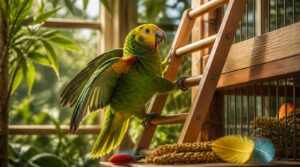
Swings build balance, and wooden ladders take that a step further by encouraging active vertical climbing. Spaced rungs — usually 10 to 12 inches apart — let your bird step confidently without risking toe entrapment.
Here are five things to look for:
- Hardwood construction for durability
- Moisture-resistant sealant to prevent warping
- Smooth, sanded edges for safe grip
- Stable base or clip mounts for security
- Appropriate rung spacing for your bird’s size
Rope Bridges
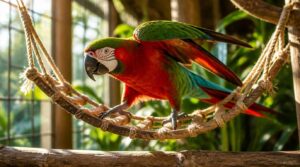
Ladders build vertical confidence, and rope bridges take that movement sideways across open space. Your bird grips, balances, and shifts weight with every crossing, developing core muscle strength naturally.
Ladder-style rope bridges mix rungs with rope, making each crossing a genuine physical challenge. Spaced rungs encourage active foot dexterity without risking toe entrapment — a real win for your bird’s daily enrichment.
Multi-level Play Gyms

Once your bird has mastered rope bridges, a multi-level play gym brings everything together in one structure. Each vertical level offers climbing, foraging, and resting zones, keeping your bird physically active and mentally engaged throughout the day.
Modular gym assembly means you can expand or reconfigure as your bird grows, making it a long-term investment.
Rope-based Perches
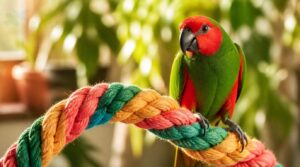
Rope perches might just be your bird’s favorite place to land. A colorful bird rope perch made from nontoxic rope gives your bird a soft, textured grip that exercises foot muscles naturally.
Choose diameters between 0.5 and 1.5 inches to match your bird’s size, and bend the flexible core into spirals or bridges for varied climbing activity that keeps enrichment fresh.
Choosing Safe Bird Entertainment
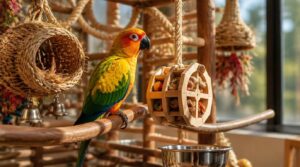
Keeping your bird safe is just as important as keeping them busy. Not every toy on the market is made with your feathered friend’s well-being in mind, so knowing what to look for makes all the difference. Here’s what you should check before adding anything new to your bird’s space.
Match Size to Species
Getting toy size wrong isn’t just inconvenient — it can genuinely harm your bird.
Small species need 4–6 mm gaps in toys and perches around 8–12 mm in diameter, while larger parrots require 20–30 mm perch diameters and deeper foraging hollows.
Match beak width, grip size, and foraging depth to your bird’s species, and enrichment actually works.
Use Bird-safe Materials
Choosing bird-safe materials isn’t optional — it’s the foundation of every enrichment decision you make.
- Use untreated birch, maple, or beech for chew toys and perches
- Choose natural cotton or hemp fabrics for hammocks and rope perches
- Select non-toxic water-based finishes on painted wood surfaces
- Verify metal parts are cadmium- and nickel-free
- Source organic, pesticide-free seeds and dried fruits for foraging toys
Avoid Swallowable Parts
A tiny detached bead can become a life-threatening hazard faster than you’d think.
Avoid toys with loose parts — beads, small fasteners, or brittle painted pieces that crumble during chewing.
Always check that joints are sealed and no fragments can loosen.
Monitor your bird’s chewing behavior closely, since frantic gnawing often signals a dangerous toy needs immediate removal.
Inspect Toys Regularly
Even a well-loved toy can quietly become dangerous over time.
Check your bird’s toys weekly for cracks, splinters, or rust, since small damage escalates fast. Wipe surfaces with a 1:1 vinegar-water solution, rinse completely, and dry before returning to the cage.
- Look for fraying rope or loose bells
- Spot mold on wood before it spreads
- Remove any toy with persistent odor
Rotate Toys Often
Think of your bird’s toy bin as a playlist — keep it fresh, or the music stops. Rotate toys weekly, swapping chews, foraging toys, and puzzles to prevent habituation.
Treat your bird’s toy bin like a playlist — keep rotating, or the music stops
Label your bin and track a simple rotation log so nothing gets forgotten.
Watch your bird closely after each swap — renewed curiosity means your system is working.
Frequently Asked Questions (FAQs)
What household items do birds like?
Birds love simple stuff: safe cardboard tubes, untreated wood scraps, and recycled container feeders double as foraging toys. Natural fiber textures and bamboo grip surfaces offer chewing and mental stimulation birds genuinely crave daily.
How do I introduce new toys to shy birds?
Start slow — place the new toy outside the cage first. Let your bird observe it from a safe distance, pair each exposure with a treat, and move it closer only when your bird stays calm.
Can birds become addicted to certain toys?
Yes, birds can develop toy fixation. Puzzle feeders and shredding toys, especially, drive reward-driven behaviors that dominate playtime. Rotate toys every few weeks to keep enrichment balanced and prevent obsession.
What signs show a bird is bored or understimulated?
Your bird may show repetitive pacing, excessive screaming, or feather plucking when understimulated. Reduced foraging enthusiasm and low arousal postures — drooping wings, fixed staring — are clear warning signs of boredom.
How many toys should a bird cage have?
Most cages do best with 3 to 5 toys at once. Smaller birds need fewer; larger parrots thrive with more. Always include one foraging toy and at least one chew toy.
Do birds prefer playing alone or with owners?
Most birds enjoy both types of play, but social species like parrots thrive with owner interaction. Your presence reduces stress, strengthens trust, and makes foraging or training sessions far more engaging than solo play alone.
Conclusion
The smallest cage can hold the biggest spirit—until the right accessories set it free. Knowing what accessories help birds stay entertained isn’t just about keeping your bird busy; it’s about honoring the wild, curious creature living in your home.
Rotate toys, hide treats, add a swing, and watch a bored bird transform into an engaged one. Your bird can’t tell you what it needs, but its behavior always will.
- https://www.phoenixlanding.org/perches.html
- https://todaysveterinarynurse.com/nutrition/feeding-puzzles-for-nutrition-and-enrichment
- https://squawkboxes.com/blogs/news/foraging-bird-toys-stimulate-your-pets-natural-instincts
- https://www.petmate.com/blogs/petmate-academy/best-bird-cage-accessories
- https://caitec.com/collections/bird-toys-foraging