This site is supported by our readers. We may earn a commission, at no cost to you, if you purchase through links.
 Birds typically don’t sleep in the same place every night, though they often return to familiar territories.
You’ll find that most species are creatures of habit but with flexibility—think of them as having favorite neighborhoods rather than specific addresses.
Many factors influence where birds choose to roost, including weather conditions, predator activity, and food availability.
Some species, like chickadees, may return to the same general area, while others, particularly migratory birds, change locations regularly.
Birds have fascinating sleep adaptations too, including the ability to lock their feet onto branches so they don’t fall off while snoozing—nature’s own seatbelt system at work.
Table Of Contents
- Key Takeaways
- Bird Sleep Patterns
- Do Birds Sleep Same Place
- Roosting Location Factors
- Bird Roosting Variations
- Species Specific Roosting
- Unihemispheric Sleep Benefits
- Nocturnal Bird Sleep
- Safe Roosting Adaptations
- Frequently Asked Questions (FAQs)
- Do birds sleep in the same place every night?
- Where do birds sleep?
- Where do birds go at night?
- Do birds sleep in water areas at night?
- Why do birds sleep at night?
- When do nocturnal birds go to bed?
- Do birds sleep if the sun goes down?
- Why do birds roost together at night?
- Do birds sleep in nests?
- Do garden birds like sleeping?
- Conclusion
Key Takeaways
- Birds don’t usually sleep in the same spot every night but stick to familiar areas for safety and convenience.
- Roosting spots depend on weather, predator activity, and food availability, with birds adjusting locations as needed.
- Most birds avoid nests for sleeping, choosing sheltered areas like tree canopies, cavities, or dense shrubs.
- Some species, like woodpeckers, show stronger roosting site fidelity, while migratory birds often change locations regularly.
Bird Sleep Patterns
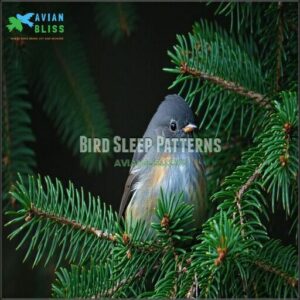
You’ll be surprised to learn that most birds don’t actually sleep in their nests at night, instead choosing protected roosting spots in trees, shrubs, or cavities where they can stay safe from predators.
I’ll craft a short, engaging blockquote about bird sleeping habits that matches the tone of the article:
Birds don’t tuck into nests at night—they find secret roosting hideaways where predators can’t reach them.
While you’re tucked in bed each night, birds are taking hundreds of micro-naps throughout the day and night, with some species even able to sleep with one eye open and half their brain alert to danger.
General Sleeping Habits
Most birds don’t actually sleep like you might imagine.
Instead of taking one long rest like humans, they typically grab hundreds of brief daily naps throughout a 24-hour cycle.
Their diurnal sleep patterns differ drastically from ours, with birds often sleeping when there’s nothing more useful to do.
Bird sleeping positions vary widely—some perch on branches, others float on water, each adapting their sleep habits to maximize survival in their environment, using brief daily naps and resting in various positions to ensure their well-being, with a focus on diurnal sleep patterns.
Roosting Spots and Locations
When you spot birds at dusk, you’re witnessing their search for the perfect roosting spots.
Most birds select locations based on predator avoidance and roost microclimate.
Tree cavities, dense foliage, and even urban structures serve as popular bird roosting sites.
Notably, roost fidelity varies widely—some species return to identical branches nightly, while others prioritize food proximity over roost site selection.
Bird roosting behavior often reflects a delicate balance between safety and convenience.
Nesting Vs Roosting
While we’ve explored where birds catch their Z’s, it’s important to understand the difference between nesting and roosting.
Nests serve primarily as nurseries for eggs and chicks, not bedrooms.
After raising young, most birds avoid nesting sites due to poor nest hygiene—they’re often full of parasites and droppings.
Instead, they choose separate roosting sites that offer better roosting safety through protection from predators and weather, following seasonal roosting patterns.
Do Birds Sleep Same Place

Curiosity about bird sleep habits often leads to fascinating discoveries about our feathered friends.
In terms of roost site fidelity, most birds don’t sleep in identical spots every night, though they typically stay within familiar territories.
Here’s what influences their roosting consistency:
- Safety concerns – birds relocate if they sense predator threats
- Weather changes – they’ll seek better shelter during storms
- Food availability – roosting often occurs near reliable food sources
- Seasonal variations – many birds adjust sleep locations with changing seasons
- Species differences – woodpeckers and some wrens show stronger sleep location memory
Individual bird habits vary widely, with some showing remarkable roosting preferences while others respond quickly to roost relocation triggers.
You might notice your backyard visitors maintaining general areas rather than specific perches for their nightly rest.
Birds often use dense foliage for roosting, providing camouflage and comfort.
Roosting Location Factors
You’ll find that birds choose their sleeping spots based on three main factors: weather conditions, food availability, and territorial advantages.
Just as you wouldn’t camp in an open field during a thunderstorm, birds adjust their roosting locations to stay safe from predators and harsh elements while remaining close to their food sources, considering territorial advantages.
Weather Conditions

Now that we’ve established birds don’t always return to the same sleeping spot, let’s look at how weather shapes their choices.
You’ll notice birds quickly adjust their roosting sites when storms approach.
They’ll seek dense foliage for wind protection and move to lower perches during heavy precipitation.
Temperature regulation drives seasonal roosting patterns too—birds often choose south-facing locations in winter for warmth and shadier spots during summer heat.
Food Availability

While weather plays a role in bird roosting decisions, food availability often drives where birds choose to sleep.
Birds typically select roosting sites near their primary foraging areas to conserve energy.
You’ll notice in winter that bird roosting habits change as they congregate near reliable food sources. This strategic positioning minimizes travel distance between sleeping and feeding locations—why fly far for breakfast when you can have it right outside your bedroom?
Seasonal abundance of certain foods can also trigger dietary changes and roosting shifts accordingly, which is a key factor in understanding bird behavior and their primary foraging areas.
Territorial Advantages

Just as birds choose feeding spots based on food supply, they also select roosting sites with territorial advantages.
Sleeping in the same area helps birds establish ownership of valuable resources.
When birds maintain consistent roosting sites, they gain:
- Better defense efficiency against intruders who might challenge their territory
- Improved mate acquisition opportunities during breeding season
- Enhanced familiarity with escape routes for predator avoidance
This resource control strategy makes bird sleeping locations more than just comfortable spots—they’re strategic territorial investments.
Birds use various visual displays to mark these territories.
Bird Roosting Variations

You’ll notice that birds don’t all sleep the same way, with some preferring dense tree canopies while others seek out cavities or even urban structures for their nightly rest.
From wrens tucking into bird houses to pigeons lining city ledges, each species has adapted unique roosting preferences that balance safety, comfort, and their natural habitat.
Trees and Shrubs
Most birds prefer dense tree canopy cover or leafy shrubs when selecting their nightly roosting spots.
You’ll find them tucked away in thickets where shrub density impacts their security.
Coniferous trees offer year-round protection, while deciduous roosting locations work best in summer.
Bird sleeping locations in trees provide essential safety from ground predators, with higher branches in the tree canopy serving as premier bird roosting sites, offering year-round protection.
Cavities and Nests
Many cavity-dwelling birds seek out tree hollows, abandoned woodpecker holes, and natural crevices for their nightly rest.
Unlike popular belief, birds don’t typically sleep in their nests unless they’re incubating eggs or raising chicks. After breeding season, nest sanitation becomes an issue, so they’ll find fresh cavity roosting sites instead.
Competition for premium cavities can be fierce, especially during harsh weather when these sheltered bird roosts offer superior protection.
Consider providing a safe roosting environment for local birds.
Urban Areas and Structures
While natural cavities offer shelter, cities transform bird sleeping environments completely.
You’ll notice urban birds adapt ingeniously to building roosting opportunities, using bridges, streetlights, and even skyscrapers as makeshift bedrooms.
City lights disrupt normal bird sleep patterns, yet urban birds persist, finding safety from urban predators in unexpected places.
Human impact and habitat loss continue reshaping their choices, with many species creatively turning our architectural features into their nightly bird roosts, utilizing urban spaces.
Species Specific Roosting
You’ll find that different bird species have developed unique sleeping arrangements based on their physical adaptations and survival needs.
Woodpeckers carve out cozy tree cavities for nightly shelter, while waterfowl might doze on water surfaces or shorelines.
Social species like starlings gather by the thousands in spectacular roosting displays at dusk.
Woodpeckers and Tree Trunks
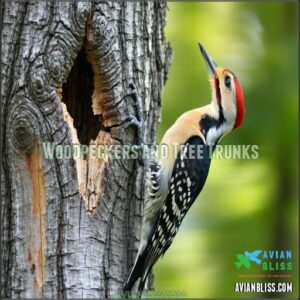
Unlike their feathered neighbors, woodpeckers are creatures of habit in terms of their sleeping quarters. You’ll find these remarkable birds creating and using specialized cavities in tree trunks for both nesting and nighttime rest.
Woodpecker sleep patterns involve:
- Excavating custom cavities that provide trunk insulation against weather and predators
- Returning to the same roosts night after night, unlike most bird species
- Creating separate cavities for nesting versus regular roosting during non-breeding seasons
This unique behavior showcases the woodpeckers’ ability to adapt and utilize their environment efficiently, making them one of the most fascinating bird species to study, with their specialized cavities playing a crucial role in their survival.
Waterfowl on Land and Water

Ducks and geese have mastered the art of floating sleep, drifting peacefully on water while remaining alert for aquatic predators.
You’ll notice waterfowl often tuck one leg close to their body while sleeping, conserving heat in wetland habitats.
They don’t always sleep in the same spot, alternating between shoreline roosting and open water depending on safety needs and weather conditions.
Many species exhibit specialized bills adapted for their feeding habits. Near-shore vegetation offers additional protection during vulnerable moments.
Communal Roosting

During cold winter nights, you’ll find some bird species gathering in communal roosts for survival advantages.
These feathered neighbors practice communal sleeping to cope with harsh conditions.
- Flocking together creates shared warmth that can mean the difference between life and death
- Predator protection increases as more eyes watch for danger
- Despite benefits, crowding risks like crushing smaller birds can occur
Cardinals, crows, and starlings are classic examples of winter roosting birds that gather in communal groups.
Unihemispheric Sleep Benefits

You’ll be amazed to learn that birds can sleep with half their brain awake, keeping one eye open to watch for danger while the other half rests.
This remarkable ability, called unihemispheric sleep, lets birds stay alert to threats and even continue flying during migration, all while getting the rest they need.
Sleeping With One Eye
Many birds have mastered the remarkable skill of sleeping with one eye open, a phenomenon known as unihemispheric slow-wave sleep.
You’ll notice this adaptation allows them to rest while maintaining vigilance against potential threats.
| Sleep Feature | Benefit | Example Species |
|---|---|---|
| One eye open | Predator detection | Mallard ducks |
| Brain hemisphere division | Sleep regulation | Peregrine falcons |
| Alternating eyes | Extended alertness advantage | Eurasian blackbirds |
This evolutionary benefit helps birds balance their need for rest with survival, and is a key example of how birds have adapted to their environments through remarkable skill and extended alertness.
Half Brain Alertness
Birds possess a remarkable evolutionary advantage called unihemispheric slow-wave sleep, allowing half their brain to remain alert while the other half rests.
You’ll find this adaptation essential for predator detection without sacrificing sleep quality. Research shows this split brain function enables birds to maintain essential cognitive functions while simultaneously scanning for threats.
Some species conserve energy with avian sleep habits. This clever adaptation helps explain why some birds can appear watchful even when they’re technically catching some much-needed rest, highlighting their unique ability to balance sleep quality and vigilance.
Migration and Flight Adaptation
When migrating across vast distances, birds have perfected the art of in-flight rest through unihemispheric sleep.
You’ll be amazed to learn that during migration, species like swifts can sleep while flying, keeping one brain hemisphere alert for navigation sleep while the other rests.
This remarkable adaptation allows them to maintain altitude roosting without landing for days.
Their flight sleep patterns optimize bird migration routes, ensuring they can travel thousands of miles without exhaustion.
Birds achieve this partly due to their light, hollow bones, which aid in reducing weight for efficient flight.
Nocturnal Bird Sleep

You’ll find that nocturnal birds like owls and nightjars flip the script on traditional sleep patterns, resting during daylight hours in sheltered spots while most other birds are active.
When you’re fast asleep at night, these remarkable creatures are wide awake, using their specialized vision and hearing to hunt prey that other birds simply can’t detect in the darkness.
Owls and Whip-Poor-Wills
While most birds rest when the sun sets, owls and whip-poor-wills flip the script completely.
These nocturnal hunters sleep during daylight hours in carefully selected spots that offer protection from daytime predators.
When it comes to nocturnal birds’ roosting habits:
- Owls typically select dense foliage or tree cavities for diurnal roosting, using camouflage sleep techniques to blend with bark or branches
- Whip-poor-wills rest on forest floors, their mottled plumage providing perfect camouflage
- Both utilize sensory adaptations that allow them to detect threats even while resting
You’ll rarely spot these bird predator avoidance experts during their sleep – that’s precisely the point! They are nocturnal hunters that have adapted to their environment in unique ways.
Baby Owls Sleep Posture
While adult owls perch upright during sleep, you’ll notice owlets sleep in a surprisingly different position.
Here’s a short, engaging blockquote in the same tone as the provided paragraph:
Owlets sleep face-down like exhausted college students, their heavy heads too much for their tiny necks to handle!
Baby owls sleep face-down on their stomachs because their heads are too heavy for their weak neck muscles.
Their special back toe (hallux) keeps them from falling during this developmental sleep difference.
As they grow stronger, these nocturnal adaptations change, allowing them to eventually sleep perched upright like adults, though they might occasionally revert to their adorable "face-plant" position, which is a result of their developmental needs.
Hunting Habit Adaptation
During the night, nocturnal birds have developed fascinating hunting habit adaptations that directly influence their sleep patterns.
You’ll notice they’ve evolved sensory adaptations that allow them to balance rest with prey availability. Their remarkable foraging efficiency depends on this sleep-hunt balance.
Many species use unihemispheric sleep to maintain predator avoidance while resting. This hunting-sleep link explains why they don’t always return to the same roost—they follow their food sources instead.
Safe Roosting Adaptations
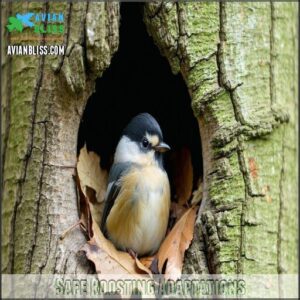
You’ll be amazed at how birds have evolved remarkable adaptations to stay safe while sleeping, from special leg-locking mechanisms that prevent falls to clever insulation techniques.
These survival strategies allow our feathered friends to rest securely in their chosen spots, whether perched on branches or tucked into sheltered nooks, using remarkable adaptations.
Leg Locking Mechanisms
While nocturnal owls rest during daylight, most perching birds rely on remarkable leg locking mechanisms to sleep safely.
This evolutionary advantage keeps birds from falling while they sleep.
Some enthusiasts even explore products for birds to enhance their understanding.
How tendon structure creates this perch security:
- Flexor tendons automatically tighten when a bird’s legs bend
- No active muscle engagement required – it’s purely mechanical
- Birds literally can’t fall off branches when sleeping
- This grip strength works even in high winds or rain, providing a mechanical advantage.
Feather Insulation
Beyond that amazing leg-locking ability, feathers play a vital role in keeping birds warm while they sleep.
You’ve likely noticed how birds appear fluffier at night—they’re creating air pockets between feathers for maximum insulation.
This feather structure traps body heat effectively, especially during cold nights.
Many bird enthusiasts also consider specialized winter products to help birds survive the elements.
Regular preening maintains these natural "down blankets," as oils waterproof and arrange feathers for maximum warmth during roosting.
Torpor and Physiological Adjustments
In the face of harsh conditions, many birds enter torpor, a remarkable state of suspended animation.
During torpor, their metabolic rate and body temperature drop substantially, conserving precious energy.
This physiological adjustment can last hours or even days, depending on the species and conditions.
When it’s time to wake up, arousal mechanisms trigger, gradually returning their body heat to normal levels, it’s like nature’s emergency power-saving mode for bird physiology.
Frequently Asked Questions (FAQs)
Do birds sleep in the same place every night?
Like nomads of the sky, most birds don’t return to the same sleeping spot nightly.
You’ll find that while woodpeckers and some wrens are creatures of habit, most birds choose different safe roosting locations each evening.
Where do birds sleep?
Birds sleep in sheltered spots like tree canopies, thickets, and bird houses—not typically in nests.
They’ll perch with locked leg muscles, fluff their feathers for warmth, and often tuck their beaks into their back feathers.
Where do birds go at night?
Most birds retreat to sheltered spots at night – dense foliage, tree cavities, or birdhouses.
You’ll find them roosting in their daytime territories, often fluffed up with heads tucked backward for warmth and safety.
Do birds sleep in water areas at night?
You’d think they’d avoid it, but some birds actually do sleep on water! Ducks and waterfowl often float while sleeping, using unihemispheric sleep to keep one eye open for predators.
Why do birds sleep at night?
Nighttime offers birds a chance to rest and recharge, conserving energy for daytime activities.
By sleeping during darkness, they avoid predators and align with natural light cycles, ensuring safety and peak functioning in their environment, which allows them to engage in daytime activities effectively.
When do nocturnal birds go to bed?
Nocturnal birds, like owls, "go to bed" as the sun rises.
They find hidden, sheltered spots—tree hollows or dense foliage—to rest during daylight hours, staying tucked away from predators and harsh weather.
Do birds sleep if the sun goes down?
When the sun sets, most birds settle down to sleep, finding safe spots like tree branches or bushes.
Their internal clocks sync with daylight, though nocturnal birds flip the script, becoming active under moonlit skies.
Why do birds roost together at night?
Over 25% of bird species roost together at night, huddling for warmth and predator protection.
It’s like a feathery sleepover—safety in numbers, shared body heat, and a few keeping watch while others snooze.
Do birds sleep in nests?
Birds don’t usually sleep in nests unless they’re raising chicks.
Nests get messy with bugs and droppings, so most birds prefer safer, cleaner spots like tree branches, cavities, or bushes for their nightly rest.
Do garden birds like sleeping?
Garden birds do enjoy their rest, often fluffing up feathers and tucking heads for warmth.
They’re light sleepers though, always ready to dart off if danger lurks—think of them as nature’s ultimate power nappers!
Conclusion
Around 80% of bird species don’t sleep in the same place every night, showcasing their adaptability.
While some birds stick to familiar spots, others, especially migratory species, constantly change roosting locations based on weather, predators, and food.
Whether locking their feet onto branches or finding cozy cavities, birds have evolved clever ways to rest safely, and their sleep habits are as diverse as their feathers, so next time you wonder, "Do birds sleep in the same place every night?" remember!
- https://www.audubon.org/news/how-do-birds-spend-cold-winter-nights
- https://www.birds.cornell.edu/k12/do-birds-sleep/
- https://www.birdsandblooms.com/birding/birding-basics/birds-sleep-night/
- https://www.kennedywildbirdfood.co.uk/news/what-do-birds-do-at-night/
- https://www.birdspot.co.uk/bird-brain/where-do-birds-sleep-at-night