This site is supported by our readers. We may earn a commission, at no cost to you, if you purchase through links.
Most people never think about where birds go when the sun sets. One moment a robin’s hopping across your lawn, and the next it’s simply gone—as if the night swallowed it whole.
Birds don’t just "go to sleep" the way you might. They seek out carefully chosen roost sites, each selected for warmth, concealment, and protection from predators. A chickadee wedges itself into a tree cavity. A mallard floats on open water, one eye open—literally. A starling vanishes into a murmuration of thousands before the flock descends, all at once, into a reed bed.
Understanding where birds sleep at night reveals something impressive: survival is woven into every detail of how they rest.
Table Of Contents
- Key Takeaways
- Birds Sleep in Safe Roosts
- Why Birds Choose Certain Spots
- Do Birds Sleep in Nests?
- Where Songbirds Sleep at Night
- Where Larger Birds Sleep
- Where Water Birds Sleep
- How Birds Sleep Safely
- How Birds Stay Warm Overnight
- Why Some Birds Stay Awake
- How to Support Night Roosting
- Frequently Asked Questions (FAQs)
- Do birds sleep at night?
- Where do birds sleep?
- Do birds fly at night?
- How do birds stay warm at night?
- Do birds sleep in the same spot each night?
- What is the best sleep position for breathing and brain?
- Where do birds sleep in a storm?
- Where do birds roost at night?
- How do nocturnal and diurnal birds sleep?
- Where do birds settle at night?
- Conclusion
Key Takeaways
- Birds choose roost sites based on three survival priorities: protection from predators, shelter from weather, and proximity to food — every species picks its spot deliberately, not by chance.
- Biological tricks like locking foot tendons, sleeping with only half the brain at a time, and fluffing feathers to trap warm air allow birds to rest safely without ever fully switching off.
- Nests aren’t bedrooms — they’re nurseries used only during breeding, while most adult birds roost in trees, cavities, ledges, reed beds, or open water throughout the year.
- You can support local birds overnight by planting native evergreens, preserving dead trees with cavities, installing nest boxes, dimming outdoor lights, and keeping cats indoors.
Birds Sleep in Safe Roosts

Birds don’t just doze off anywhere — they’re surprisingly choosy about where they spend the night. Each species gravitates toward a spot that keeps it hidden, sheltered, and ready to bolt if trouble shows up. Here are the main places birds curl up after dark.
From dense thickets to hollow trees, the variety of bird roosting spots reflects a fascinating survival strategy you can explore in detail at where birds go at night and why it matters.
Trees and Dense Shrubs
When night falls, trees and dense foliage become a bird’s first line of defense. Songbirds tuck themselves into thickets and dense evergreen shrubs, where layered branches block wind and hide them from predators.
Vertical canopy complexity matters too — taller trees offer multiple roosting layers, while native shrubs attract insects that support nearby nocturnal species. Evergreens earn their keep year-round, holding foliage when other trees go bare. Utilizing layered planting techniques can further improve these essential habitats for local wildlife.
Cavities and Nest Boxes
Not every bird settles for an open branch. Cavity nesters — woodpeckers, chickadees, and bluebirds — prefer enclosed spaces like tree holes or nest boxes, where walls block wind and hide them from owls.
A good box needs drainage holes, walls at least ¾ inch thick, and the right entrance — around 1⅛ to 1⅜ inches for small species. Clean it each season, and birds return.
Ledges, Eaves, Rooftops
Tree holes aren’t the only option. Urban birds — pigeons, sparrows, and swifts — have adapted brilliantly to human architecture, treating building ledges and eaves much like natural cliff shelves.
Eaves offer something valuable: a shaded microhabitat beneath the roofline that moderates temperature and blocks driving rain, creating a sheltered place surprisingly close to ideal roosting conditions.
Common urban roosting spots include:
- Roof ledges that overhang exterior walls
- Protected eave undersides near soffit panels
- Recessed window ledges on tall buildings
- Decorative bargeboards on gabled rooftops
- Parapet walls along flat commercial roofs
Birds aren’t being opportunistic — they’re being smart.
Reeds and Tall Grasses
Move from city rooftops to wetland edges, and the roosting logic shifts entirely. Reed beds — dense stands of Phragmites australis reaching up to three meters — give marsh birds like rails vertical, layered shelter that hides them from predators almost completely.
| Feature | Benefit for Birds |
|---|---|
| Dense reed stems | Concealment from predators |
| Tall grass seedheads | Winter food source |
Rhizome soil stability keeps these nighttime bird habitats intact even during storms.
Open Water Roosts
Open water might seem like a strange bird resting place, but for ducks, geese, and swans, it’s actually one of the safest choices around. Floating roost patterns work simply: water creates a natural barrier, keeping ground predators at a distance.
Any ripple or splash doubles as an alarm system, giving these communal roosts a built-in aquatic predator detection advantage no thicket can match.
Why Birds Choose Certain Spots

Birds don’t pick their nighttime spots by accident — every roost is a calculated choice shaped by survival instincts honed over millions of years. A sheltered thicket, a familiar tree hollow, or a spot close to reliable food can mean the difference between waking up and not. Here’s what actually drives those decisions.
Protection From Predators
Why risk an exposed branch when predators prowl below? Predator avoidance shapes roosting sites, blending camouflage effectiveness, sentry bird roles, and escape route availability.
- Sentries watch and call out danger
- Foliage camouflage hides silhouettes from above
- Communal roosting boosts collective vigilance and predator detection
- Wide escape routes confuse pursuing predators
Visual deterrent strategies, like cryptic plumage, shield birds even further.
Shelter From Bad Weather
| Factor | Strategy | Benefit |
|---|---|---|
| Roof drainage design | Sheds rain | Dry cavities |
| Windbreak effectiveness | Evergreen shrubs | Cuts wind 40% |
| Moisture prevention | Ground membranes | No flooding |
| Structural anchoring | Buried stakes | Storm stability |
| Microclimate stability | Insulation | Steady warmth |
When storms roll in, birds need shelter to rest safely.
This thermoregulation toolkit, plus insulating feathers tucked close, keeps roosts dry, stable, and truly storm-ready year-round.
Warmth and Insulation
A bird’s feathers work like a built-in down jacket. Fluffing them traps warm air against the skin, keeping body temperature near 105°F on cold nights. Four key thermal regulation strategies matter:
- Fluffed feathers trap insulating air pockets
- Tucked bills and feet reduce heat loss
- Cavity roosting blocks cold wind
- Winter fat accumulation fuels metabolic heat overnight
Nearby Food Sources
Roosting spots rarely exist in isolation — birds pick rest sites close to where they’ll feed at dawn. Native berry shrubs, insect-rich microhabitats like deadwood piles, and wetland edges all pull birds toward specific neighborhoods.
Orchard fruit drops in autumn concentrate thrushes nearby overnight. Even a well-stocked backyard bird feeder can anchor a songbird’s nightly roost just a few branches away.
Familiar Safe Locations
Ever notice how you keep going back to the same coffee shop, even when better ones open nearby?
That same creature-of-habit loyalty explains why cats thrive on routine too — and channeling it into safe indoor enrichment and bird-friendly habits keeps everyone happy, feathered friends included.
Birds do this too. Once a roosting area proves safe, they’ll return to that exact perch, cavity, or shrub night after night, trusting tree cavity safety and known natural microclimates over unfamiliar shelter to rest, even as seasonal habitat shifts nudge them toward new bird resting places eventually.
Do Birds Sleep in Nests?
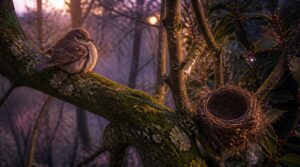
You’d think every bird sleeps in a nest each night, but that’s rarely true. Nests work differently than bedrooms, and only certain birds, or certain ages, actually use them for sleep. Here’s a look at when a nest becomes a sleeping spot, and when it’s strictly for raising young.
Nesting Versus Roosting
Picture a nest as a nursery and a roost as a bedroom—two very different jobs. Nests exist purely for breeding, built to cradle eggs and shelter chicks, while roosts handle nightly rest.
Roosting spots often get reused season after season, sometimes by entirely different birds. That’s resource allocation in action: building a nest costs energy nests don’t need to spend twice.
Breeding Season Exceptions
Breeding season bends the rules. When heavy rains trigger sudden insect swarms, some species nest immediately to capitalize on that brief food spike — calendar be damned.
Cold springs can delay nesting despite long daylight hours, because temperature often outweighs light as a trigger. Urban lighting nudges certain birds to start days or weeks early, quietly reshaping instincts that took millennia to develop.
Baby Birds in Nests
Baby birds don’t just sleep in nests — they depend on them to survive. Hatchlings arrive featherless and can’t regulate their own temperature until around day five to seven, so parental brooding through cold nights isn’t optional.
Five things happening inside a nest:
- Parents brooding chicks to maintain warmth overnight
- Pin feathers emerging visibly around day eight
- Fecal sacs removed by adults to reduce parasites
- Feeding visits occurring dozens of times daily
- Full thermoregulation developing gradually by week two
Cavity Nesters Year-round
While baby birds rely on parental warmth to survive the night, cavity nesters get that protection from the cavity itself. Woodpeckers, chickadees, and bluebirds return to the same tree hole or nesting box nightly, year-round — a pattern called nesting site fidelity.
| Species | Year-round Roosting Habit |
|---|---|
| Black-capped Chickadee | Roosts alone inside tree hollows |
| Downy Woodpecker | Returns nightly to self-excavated cavities |
| Eastern Bluebird | Uses nest boxes across all seasons |
| White-breasted Nuthatch | Shelters in bark crevices or cavities |
| Carolina Wren | Occupies birdhouses even outside breeding season |
Narrow entrances block larger predators, and the surrounding wood holds heat — creating a natural thermal microclimate that cuts overnight energy costs dramatically.
Reused Raptor Nests
Raptors like eagles and hawks often skip building altogether — they simply return to the same nest platform year after year.
- Nests persist for 18–20 years in studied forest raptor communities
- Multiple raptor species can reuse one nest across breeding seasons
- Reuse cuts energy costs, but older nests may harbor parasites
Protecting these old platforms is a real conservation priority.
Where Songbirds Sleep at Night
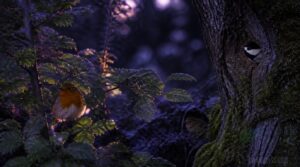
Songbirds don’t all pick the same kind of spot when the sun goes down — their choices depend a lot on their size, habits, and what’s available nearby.
Some tuck into dense shrubs, others squeeze into tree cavities, and a few settle deep in tangled thickets. Here’s a closer look at where some of the most familiar backyard songbirds spend their nights.
Robins in Thick Shrubs
Robins don’t sleep out in the open — they tuck into thick shrub interiors, usually 1 to 2 meters above ground, where tangled branches break wind and create warmer microclimates.
That layered cover also hides them from aerial predators, since robin plumage blends naturally with bark and leaf litter. Thorny shrubs add extra protection, while nearby berry-producing plants like holly keep winter food within easy reach.
Cardinals in Evergreens
Cardinals nearly always pick dense evergreen canopies — pine, spruce, or holly — when night falls. Needle clusters cut wind chill and conceal their bright plumage from hunting predators.
Four reasons evergreens suit cardinals for winter survival:
- Year-round cover when deciduous trees go bare
- Dense needles block cold drafts
- Pine seed foraging right near the roost
- Stable mid-canopy perches through winter storms
Sparrows in Thickets
Ever wonder where sparrows vanish after dusk? They tuck into thorny thickets, gripping stems for a tight, secure perch.
The tangled understory hides their tiny shape from predators, while humid microclimates and nearby leaf litter support easy nighttime foraging. Urban garden thickets work too, shifting with the seasons—proof of sharp, instinctive survival smarts.
Finches in Dense Foliage
Finches don’t perch in the open—they sink into thick shrub interiors, where dense twigs aid silhouette reduction and trap warmth for thermal stability on cool nights. These foliage microhabitats sit near seed patches, supporting easy understory foraging.
As seasonal vegetation shifts, finches favor evergreen mixes, reusing the same leafy roost—a quiet sign of bird survival instincts shaping where birds sleep.
Chickadees in Cavities
Chickadees don’t just stumble into any hollow they find. They inspect multiple cavities before committing, favoring snags — standing dead trees — where the entrance hole, roughly 1 to 2 inches wide, keeps larger animals out.
They line the interior with moss, fur, and feathers for warmth. Once they’ve claimed a good spot, they return season after season.
Where Larger Birds Sleep

Larger birds have very different roosting needs compared to their smaller cousins, and their choices often reflect their size, strength, and hunting habits.
Eagles, hawks, herons, owls, and crows each have their own preferred spots, shaped by where they feed and how they stay safe. Here’s a closer look at where these bigger birds actually bed down for the night.
Eagles in Tall Trees
Eagles don’t just pick any tree — they seek tall pines or oaks exceeding 20 meters, often near rivers or lakes where fish are easy to spot at dawn.
Their massive nests, called eyries, can weigh hundreds of kilograms and grow larger each season. That height isn’t just habit; it keeps ground predators at a safe distance while giving eagles a commanding view of the landscape below.
Hawks on High Perches
Hawks trade eagle-like height for practicality. Red-tailed hawks often perch 6 to 12 meters up on utility poles, using binocular vision to scan open farmland below.
Their approach is simple:
- Find an elevated pole with clear sightlines
- Wait, conserving energy until prey moves
- Strike fast before being spotted
That perch-and-wait method turns a telephone pole into an efficient hunting post.
Owls Near Hunting Areas
Unlike hawks, owls don’t just perch high — they roost within 1 to 2 kilometers of reliable hunting grounds. That keeps travel short and energy costs low.
They favor tall trees or dense shrubs near field margins, where voles, mice, and shrews concentrate. On windy or light-polluted nights, hunting efficiency drops, so a familiar roost close by matters even more.
Herons in Wetland Trees
Herons are big birds that need strong wetland trees — ideally 20 to 60 feet high, with thick branches near open water.
They look for:
- Tall trees overhanging channels or ponds
- Clear flight paths to feeding zones
- Dense canopy for nighttime cover
- Island locations to block mammal predators
- Proximity to shallow foraging grounds
That keeps their aquatic roost both efficient and safe overnight.
Crows in Communal Roosts
Few birds make bedtime look as dramatic as crows. Every evening, hundreds — sometimes thousands — funnel into communal roost sites, usually tall trees or dense urban canopies, in a gradual, noisy buildup.
| Roost Feature | Why It Matters |
|---|---|
| Tall trees or buildings | Vantage points against predators |
| Dense canopy cover | Concealment overnight |
| Seasonal location shifts | Tracks food availability |
| Large group size | Collective vigilance benefits |
| Repeated site use | Familiarity reduces risk |
These roosts double as social information hubs, where crows exchange foraging cues — birds that found good food basically lead others back the next morning.
Where Water Birds Sleep

Water birds have their own approach to nighttime rest, shaped by the open landscapes and wet environments they call home. Ducks, geese, swans, and shorebirds don’t tuck themselves into hedgerows or tree hollows — they work with what’s around them. Here’s where these birds actually settle down when the light fades.
Ducks on Open Water
Ducks treat open water like a floating fortress. Mallards and scaup roost on open water, where buoyancy keeps them safe from foxes and land predators through the night.
- Floating vegetation rafts offer a transient rest spot
- Shallow depth allows a rapid takeoff if threatened
- Group roosting spreads vigilance across the whole flock
Water depth and calm conditions make the difference.
Geese in Large Flocks
Geese rarely sleep alone. They gather in large communal roosts on open water or shorelines, where high visibility gives the whole flock an early warning of threats.
Dominant birds guide these gatherings, while younger geese learn safe roost sites by following experienced adults. One alarm call triggers an instant, synchronized response — safety truly does come in numbers.
Swans Floating Safely
Float like a cork, sleep like a log — that’s a swan’s nightly trick. Their secret? air-filled bones and trapped air under waterproof, oil-coated feathers, keeping them buoyant with zero effort.
This stability lets them rest without sinking or drifting into danger.
Why floating beats land:
- 360-degree predator detection
- Hard to flip or ambush
- Feather insulation traps warmth
- Minimal movement saves energy
- Quick access to vegetation cover
Shorebirds on Open Ground
Sandpipers and plovers skip the tree-and-shrub routine entirely, bedding down right on bare sand or mud. Open terrain offers a clear view for shoreline predator detection, while tidal foraging cycles keep them near rich invertebrate prey.
Many even nest in sand substrate scrapes nearby. It’s a trade-off: less cover, more visibility — a fair swap when your whole world is wide-open beach.
Predator Warning Vibrations
Feel a ripple before you spot the threat? Water birds rely on substrate signal transmission, where leg mechanoreceptors detect predator movement through tiny vibration patterns, reading vibrational alarm frequency and amplitude to gauge predator type:
- Wingbeats
- Footsteps
- Snapping jaws
- Current shifts
This multimodal alert system shifts whole flocks to safer roosting pockets instantly, protecting nocturnal sleep patterns every night, too.
How Birds Sleep Safely
Staying safe while asleep isn’t easy when you’re small and the world is full of predators — but birds have quietly mastered it. They rely on a handful of clever biological tricks that work together like a built-in alarm system. Here’s a closer look at how each one keeps them alive through the night.
One-brain-half Sleep

While you sleep, your whole brain rests. Birds don’t have that luxury.
Unihemispheric slow-wave sleep lets one brain half doze — achieving restorative slow-wave recovery — while the other maintains hemispheric vigilance, scanning for threats. Impressive frigatebirds use this during long migrations, a clear migratory sleep advantage.
| Feature | Awake Hemisphere | Sleeping Hemisphere |
|---|---|---|
| Role | Predator detection | Restorative slow-wave |
| Activity | Sensory monitoring | REM sleep in birds |
| Found in | Avian sleep cycles | Both hemispheres, alternating |
Humans show mild human sleep asymmetry on unfamiliar nights, but it’s far weaker.
Locked Gripping Tendons
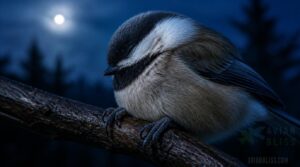
That brain-half trick works hand-in-hand with another clever feature — one built right into a bird’s feet.
When a bird lands on a branch, tendon locking mechanism engages automatically. Bending the leg tightens flexor tendons through pulley inflammation-prone channels, clamping toes shut without muscle effort. The bird literally can’t fall off, even fully asleep.
- No active gripping required overnight
- A1 pulley thickening keeps the lock secure
- Releasing only happens when the leg straightens at takeoff
Hidden Sleeping Postures
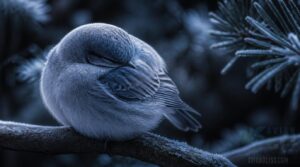
With feet locked tight, birds tuck into surprisingly compact shapes. Many pull their bill beneath scapular shoulder feathers — the area near the upper wing — cutting heat loss from the face dramatically.
Tucking one leg up reduces exposed surface area and redirects blood flow toward the center. Posture shifts mid-night adjust to wind or temperature without full waking — quiet, efficient, invisible.
Quick Nighttime Alertness
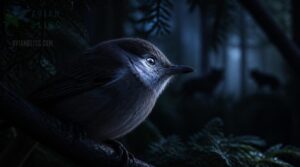
Stillness isn’t the same as switched off. Even mid-sleep, a bird’s retina — packed with rod-dense photoreceptors — keeps scanning for shadows and motion. During unihemispheric slow-wave sleep, the alert hemisphere integrates visual cues with threat memory, flagging anything unfamiliar in milliseconds.
Twilight predator peaks sharpen this further. A roosting bird can shift from deep rest to full flight readiness almost instantly, wings slightly cocked, feet already unlatching.
Group Vigilance Benefits
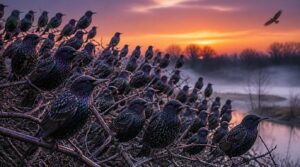
Roosting in a group is like having a neighborhood watch that never clocks out. The many eyes effect means each bird added to the roost raises predator detection odds for everyone.
- Alarm calls spread danger warnings instantly
- Sentinel role rotation keeps a fresh lookout active
- The dilution effect lowers each bird’s individual risk
- Collective vigilance frees more time for rest
- Synchronized escape responses confuse attacking predators
No single bird carries the whole burden.
How Birds Stay Warm Overnight
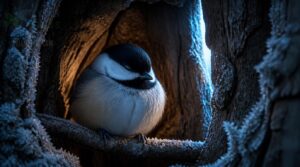
Staying warm through a cold night is serious business for a bird that weighs less than a handful of coins. Fortunately, birds have several clever built-in tricks — and a few learned habits — that help them hold onto precious body heat until morning. Here’s how they do it.
Fluffed Insulating Feathers
When temperatures drop, birds don’t just endure the cold — they engineer against it. By fluffing their feathers, they create pockets of trapped air around their bodies, turning their plumage into a personal sleeping bag.
Beneath the outer contour feathers sit soft plumules, fluffy underlayers that improve this air-trapping effect. That’s why a puffed-up bird on a winter night isn’t sick — it’s simply conserving heat brilliantly.
Tucked Bills and Feet
Fluffing feathers covers the body, but birds take warmth a step further with precise posture. By tucking the bill beneath wing coverts, they shield the face from cold air streams, and the upper and lower mandibles stay aligned to reduce heat loss from any gap.
Drawing feet close to the body limits exposure from unfeathered legs — avian biology working every angle overnight.
Shared Body Warmth
Pressed together in dense foliage, small birds like sparrows and chickadees create a thermal microclimate — a pocket of shared warmth that individual feathers alone can’t match.
Wing and flank contact cuts convection, the heat-stealing effect of moving air, and reduces individual metabolic rate by up to 20 percent. Clustering isn’t just comfort; it’s calculated survival.
Fat Reserves for Energy
Each winter day, birds gorge deliberately to build triglyceride-rich fat stored in adipose tissue. At night, lipolysis quietly breaks those reserves into fatty acids, fueling warmth without a single meal. Fat yields roughly nine calories per gram — more than double carbohydrates or protein.
Five ways fat keeps birds alive overnight:
- Slow-burn overnight energy source
- Subcutaneous layer for insulation
- Metabolic rate stabilization
- Hormone-regulated mobilization on demand
- Seasonal reserve accumulation before winter
Hummingbird Torpor
Hummingbirds take a dramatic shortcut overnight: torpor. Think of it as hitting a biological pause button — the body doesn’t just slow down, it nearly halts. Metabolic rate drops steeply, and body temperature follows. A lipid threshold triggers this shift — when fat reserves fall low enough, torpor kicks in. At dawn, rewarming begins before sunrise, restoring flight readiness just in time.
| Torpor Factor | Shallow Torpor | Deep Torpor |
|---|---|---|
| Body temperature drop | Modest | Significant |
| Metabolic suppression | Moderate | Severe |
| Wake-up speed | Fast | Slow |
| Fat reserves needed | Higher | Lower |
| Common in | Lowland species | Andean hummingbirds |
Why Some Birds Stay Awake
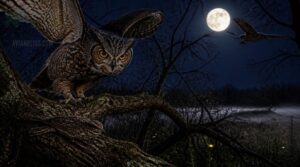
Not every bird punches out at sundown. While most species are tucking their bills into their feathers, a surprising number are just getting started with their night. Here’s a look at the birds that keep the darkness busy — and why.
Owls Hunting at Night
While most birds settle in for the night, owls are just getting started. Their nocturnal hunting cycle peaks around midnight, powered by:
- Rod-dense eyes that capture light in near-darkness
- Asymmetric ears triangulating prey sounds with millisecond precision
- Serrated feather edges enabling silent flight
- Binocular vision for precise striking depth
- Facial disc funneling faint rustling toward their ears
Nightjars Feeding After Dark
Owls aren’t the only nocturnal fliers out there. Nightjars take to the air just after sunset, catching moths and beetles mid-flight using wide, bristle-fringed mouths that funnel insects straight in. Their large, light-sensitive eyes help them spot prey in near-darkness.
On moonlit nights, insects swarm around lights — and nightjars follow, snatching quick meals before returning to their camouflaged daytime roosts.
Migration Under Starlight
Some birds don’t sleep at all during migration — they fly through the night for hours, using the stars as a map. Many species orient themselves by the Milky Way and star patterns, cross-checking that celestial compass against Earth’s magnetic field to hold a steady course.
Even with a tiny brain, a warbler can read the night sky well enough to cross continents.
A warbler’s tiny brain holds a map of the entire night sky
Artificial Light Disruptions
Stars work as a compass only when the sky stays dark. But light pollution from cities washes out that celestial map, leaving migrating birds disoriented mid-flight.
Streetlights also trigger circadian rhythm disruption, shifting melatonin production and fooling birds into treating night like day. Blue-rich LED lights are especially potent — they suppress the sleep signals birds rely on most.
Nighttime Bird Singing
Not every bird treats darkness as bird bedtime. Mockingbirds and robins sometimes sing well past dusk, staying vocally active for three key reasons:
- Nocturnal mate attraction — calm nights carry avian vocalization farther with less atmospheric interference
- Territory signaling — quieter nocturnal hours reduce competition from rival songs
- Moonlight singing triggers — brighter lunar phases visibly extend nocturnal activity windows
Urban noise interference and light pollution shift circadian cues, pushing city-dwelling birds to sing long after natural dark.
How to Support Night Roosting

Your backyard can become a genuine safe haven for birds once you understand what they actually need at night. A few simple changes go a long way toward making your outdoor space roost-friendly. Here are five practical steps you can take to help local birds sleep safely after dark.
Plant Native Evergreens
Planting native evergreens gives birds a reliable answer to where they go at night. Eastern red cedar, American holly, and inkberry holly offer dense, year-round cover, plus winter berry benefits that fuel overnight survival.
Mountain laurel and yew shrubs work as native shrub selection for smaller yards. Even low evergreen groundcover adds layered habitat birds genuinely use.
Preserve Dead Tree Cavities
Dead trees pull their weight. Wood decay creates hollows, woodpeckers widen them, and cavity nesters like chickadees and bluebirds claim the result.
Three reasons to leave a dead tree standing:
- Hollow trunks trap warmth, creating microclimates on cold nights.
- Decaying wood feeds insects, giving nearby birds a food source.
- Veteran trees host more cavities, supporting more species at once.
Add Safe Nest Boxes
A well-built nest box replaces what dead trees can’t always provide. Walls at least 15 mm thick insulate against cold nights, while proper ventilation slots prevent summer overheating.
Match the entrance hole diameter to your target species — bluebirds need different sizing than chickadees. Add a cone baffle or pole guard to stop climbing predators, and clean the box each fall.
Reduce Outdoor Lighting
Outdoor lights left blazing all night act like a false dawn, throwing off birds’ internal clocks and disrupting their sleep cycles.
Switching to warm LEDs at 2700K–3000K cuts atmospheric scattering and attracts fewer insects. Pair that with motion-sensor or dimming controls, and you’re only lighting what needs it. Even small changes — shielded fixtures aimed downward, lights off by midnight — help nocturnal species find their way.
Keep Cats Indoors
Cats are natural hunters, and even a well-fed indoor cat can kill a sleeping bird. Keeping cats inside overnight protects roosting songbirds when they’re most vulnerable.
An indoor cat with window perches, vertical climbing towers, and rotating toys stays mentally stimulated and physically active — a fair trade for the birds quietly tucked into the shrubs outside.
Frequently Asked Questions (FAQs)
Do birds sleep at night?
Yes, birds sleep every night. They follow natural circadian rhythms, cycling between rest and activity with daylight changes. Without enough sleep, birds face serious health risks, just like any other animal.
Where do birds sleep?
Birds don’t exactly rent hotel rooms for the night. They roost in trees, cavities, ledges, reeds, or open water — wherever predators can’t easily reach and weather can’t easily bite.
Do birds fly at night?
Some do. Most migratory songbirds travel after dark, using stars and magnetic fields to navigate. Owls and nightjars hunt routinely at night. Even a few diurnal species take short nocturnal flights when conditions demand it.
How do birds stay warm at night?
Staying warm overnight is a matter of biology and behavior. Birds fluff their feathers to trap thermal air pockets, tuck their bills into back plumage, and burn stored fat through metabolic heat production to survive the cold.
Do birds sleep in the same spot each night?
Some do, some don’t. Woodpeckers often return to the same cavity each night, while songbirds shift roosts based on wind or predator pressure. Migratory species change locations entirely with the seasons.
What is the best sleep position for breathing and brain?
Side sleeping is best. It keeps your airway open, reduces snoring, and helps brain drainage overnight. Left side works especially well for breathing comfort and minimizing reflux.
Where do birds sleep in a storm?
During a storm, birds squeeze into weatherproof refuges — tree cavities, dense thickets, or the leeward side of buildings. These spots block wind and trap warmth, giving sleeping birds a fighting chance until conditions ease.
Where do birds roost at night?
By day, birds are everywhere. Come dusk, they vanish into cover — tucked into dense shrubs, tree cavities, building ledges, reedbeds, or floating on open water, wherever safety and shelter meet.
How do nocturnal and diurnal birds sleep?
Nocturnal birds rely on unihemispheric sleep — resting one brain hemisphere while the other stays alert. Diurnal birds usually use bilateral sleep, resting both hemispheres at once, since daytime predator pressure drops considerably overnight.
Where do birds settle at night?
Birds settle in dense shrubs, tree cavities, building ledges, reed beds, and open water — wherever cover, warmth, and safety combine. The exact spot depends on species, season, and what’s nearby.
Conclusion
Think of a bird settling onto its roost as a sailor dropping anchor—not giving up, but holding steady against whatever the dark hours bring. Every chickadee tucked into bark, every mallard drifting with one eye open, is running the same quiet calculation: stay safe, stay warm, survive.
When you understand where do birds sleep at night, you stop seeing an empty yard at dusk. You see a neighborhood full of small, deliberate lives—each one choosing exactly where to weather the night.
- https://www.capecodtimes.com/story/news/environment/2017/01/06/x2018-sleep-number-tree/22770872007
- https://bioengineering.hyperbook.mcgill.ca/sleeping-in-flight-adaptations-of-a-birds-brain-wing-3
- https://www.arkwildlife.co.uk/blogs/wildlife-guides/where-do-birds-go-at-night
- https://centerofthewest.org/2016/04/25/how-do-birds-sleep
- https://www.lyricbirdfood.com/birding-hub/behavior/where-do-birds-go-at-night