This site is supported by our readers. We may earn a commission, at no cost to you, if you purchase through links.
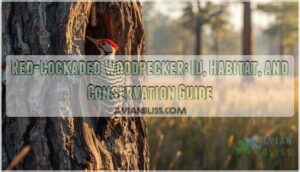
The red-cockaded woodpecker won’t settle for just any pine tree. This bird demands pines that have stood for 90 years or more, old enough to produce the sticky resin that protects its nest cavities from predators. That pickiness nearly wiped out the species.
When loggers cut mature southern pine forests and fire suppression turned open woodlands into dense thickets, red-cockaded woodpecker populations crashed across the Southeast. The species now clings to scattered fragments of its former range, listed as Near Threatened and protected under federal law.
You’ll recognize this woodpecker by its bold black-and-white ladder back and the tiny red streak—the cockade—that males sport behind each eye. Understanding what this bird needs to survive reveals why restoring fire to pine forests matters as much as protecting the trees themselves.
Table Of Contents
- Key Takeaways
- What is The Red-Cockaded Woodpecker?
- Physical Characteristics and Identification
- Habitat and Behavior
- Conservation Status and Threats
- Conservation Efforts and How to Help
- Frequently Asked Questions (FAQs)
- Why is the red-cockaded woodpecker endangered of becoming extinct?
- How rare is the red cockaded woodpecker?
- Where do red cockaded woodpecker live in Florida?
- How long do red-cockaded woodpeckers live?
- What do red-cockaded woodpeckers eat?
- How do red-cockaded woodpeckers find food?
- Do red-cockaded woodpeckers migrate seasonally?
- How do red-cockaded woodpeckers avoid predators?
- How long do red cockaded woodpeckers live?
- What predators threaten red cockaded woodpeckers?
- Conclusion
Key Takeaways
- The red-cockaded woodpecker requires pine trees at least 90 years old to excavate nest cavities protected by sticky resin, making habitat loss from logging and fire suppression the primary cause of its Near Threatened status across fragmented southeastern forests.
- This species functions as a keystone ecosystem engineer by creating cavity networks that shelter bluebirds, wrens, and owls while regulating bark beetle outbreaks through foraging, demonstrating how one bird’s survival directly supports broader biodiversity.
- You’ll identify males by a tiny red streak behind each eye and both sexes by bold black-and-white ladder backs, though the species’ cooperative breeding behavior—where helper birds assist nesting pairs—matters more for survival than visual traits alone.
- Conservation success depends on restoring prescribed fire regimes that maintain open pine understories, with fewer than 10,000 individuals remaining in scattered populations that require your sighting reports and support for active habitat management to prevent local extinctions.
What is The Red-Cockaded Woodpecker?
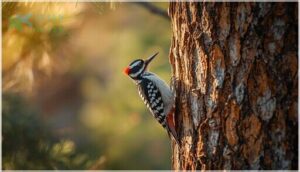
The Red-cockaded Woodpecker is a small black-and-white bird found in pine forests across the southeastern United States. You’ll recognize this species by its ladder-striped back and the male’s tiny red streak above the cheek.
Like other woodpeckers of North Carolina, this species plays a vital role in maintaining healthy pine ecosystems through its foraging and nesting habits.
Understanding this woodpecker’s classification, range, and ecological role helps you appreciate why conservation efforts matter so much for its survival.
Species Overview and Taxonomy
The Red-cockaded Woodpecker (Picoides borealis) belongs to the family Picidae, sharing evolutionary relationships with other North American woodpeckers. Taxonomic classification relies on genetic analysis and phylogenetic history to confirm species boundaries within the Picoides group.
This southeastern pine forest specialist shows distinctive traits:
- Small size compared to related woodpecker species
- Unique red crown markings in males
- Genetic isolation from neighboring populations
A better understanding of the Red-cockaded Woodpecker’s placement within formal classification systems in taxonomy helps to clarify its relationships with other species.
Historical and Current Range
Historically, the Red-cockaded Woodpecker occupied mature southern pine forests from eastern Texas to the Mid Atlantic, with dense populations in Florida’s longleaf belt.
Today, range fragmentation has isolated the species in scattered habitat patches across the southeastern United States. Geographic isolation, elevation variance, and climatic shifts continue to reshape occupied territories, leaving stable breeding populations localized within protected pine stands.
Understanding a species’ distribution over time requires a careful assessment of historic range concepts and data.
Unique Role in Pine Forest Ecosystems
Beyond range considerations, this species functions as a keystone ecosystem engineer in pine forest ecosystems. You’ll find redcockaded woodpecker colonies creating cavity networks that support bluebirds, wrens, and small owls—biodiversity conservation in action.
The red-cockaded woodpecker engineers entire ecosystems, excavating cavities that shelter bluebirds, wrens, and owls throughout southern pine forests
Their foraging patrols regulate bark beetle outbreaks, stabilizing woodpecker habitat health. Woodpecker ecology intersects directly with forest fire management: frequent, low-intensity burns maintain the open understories these birds need, linking wildlife conservation to pine forest dynamics and ecological conservation practices.
Physical Characteristics and Identification
You can identify a Red-cockaded Woodpecker by looking at three key features.
If you’re uncertain about visual identification alone, a woodpecker sound identifier can help confirm the species by its distinctive call patterns.
Size and overall appearance matter first.
Then check for the distinctive markings that separate this species from other woodpeckers.
Size, Shape, and Plumage
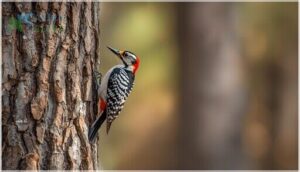
You’ll recognize a red-cockaded woodpecker by its compact robin-sized frame measuring 7.9 to 9.1 inches long and weighing just 1.5 to 1.8 ounces.
The black-and-white ladder striped back catches your eye immediately. Its body proportions include a short, chisel-like beak around 0.4 inches long and stiff tail feathers that provide balance while climbing pine trunks.
Distinctive Markings (Red Cockade, Cheek Patch)
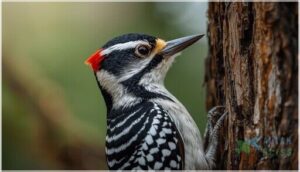
Look for a striking white cheek patch that dominates the bird’s face, bordered by jet black crown feathers and a bold black moustache stripe. Males show a tiny red streak—the cockade—tucked just above that white patch, though you’ll rarely spot it in the field. This facial pattern pairs with the ladder striped back to create unmistakable marking contrast.
The facial markings are further characterized by the following details:
- The white cheek extends from beak to ear region in a bright, prominent patch
- Males develop the red cockade after fledging, hidden beneath crown feathers
- Black-and-white plumage creates sharp boundaries around facial markings
- The cheek patch remains visible year-round for reliable identification
Differences Between Males and Females
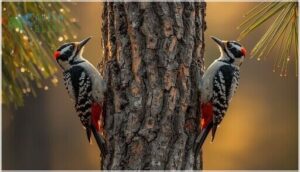
Sexual dimorphism in this avian species is subtle beyond the red cockade itself. You’ll notice males generally carry slightly greater body mass and muscle development, while females maintain higher body fat percentages year-round. Hormonal variations drive these physical differences, with testosterone influencing male traits during breeding season.
Behavioral traits remain largely identical between sexes in foraging and territorial defense patterns.
| Characteristic | Males | Females |
|---|---|---|
| Red cockade marking | Present (tiny streak) | Absent |
| Average body mass | Slightly higher | Slightly lower |
| Body fat percentage | Lower baseline | Higher baseline |
| Reproductive roles | Territory defense, helper recruitment | Egg production, nest site selection |
Habitat and Behavior
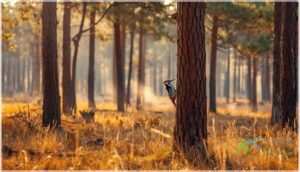
Red-cockaded Woodpeckers depend entirely on mature pine forests with specific conditions. Their survival hinges on open woodlands maintained by fire and trees old enough to produce resin.
Understanding where these birds live and how they behave reveals why conservation efforts focus on preserving ancient pine ecosystems.
Preferred Pine Forest Habitats
The Red-cockaded Woodpecker requires mature pine forests with open understories maintained by forest fire management. You’ll find them in longleaf pine ecosystems where trees reach 90-100 years old and produce resin-rich bark for tree cavity creation.
Pine forest ecology depends on controlled burns to prevent habitat fragmentation. These woodpeckers need well-drained sandy soils supporting widely spaced pines with grassy ground layers for foraging.
Nesting Habits and Cooperative Breeding
You’ll observe cooperative breeders forming family groups at nesting cavities excavated in live pines infected with red heart fungus. Helper roles include incubation shifts, territorial defense, and provisioning nestlings alongside the breeding pair.
Nest cavity selection targets trees 30-40 feet above ground surrounded by resin wells. Helpers increase nesting success by providing additional care and protection throughout the breeding season.
Foraging Techniques and Diet
You’ll find these insectivorous diet specialists using distinctive feeding behaviors to extract protein-rich prey from pine bark. Their foraging strategies reveal notable dietary adaptations for nutrient acquisition in mature forests.
Key woodpecker characteristics in feeding include:
- Bark excavation – Chisel-like beaks pry loose bark to expose wood-boring beetle larvae and galleries
- Mid-trunk hunting – Foraging concentrates where beetle activity peaks at upper trunk heights
- Insect prey focus – Diet consists primarily of bark beetles, longhorn beetle larvae, and ants
- Seasonal shifts – Warmer periods increase foraging when beetle emergence aids bird species identification
- Cooperative feeding – Family groups exploit different tree zones, demonstrating complex woodpecker behavior and ornithology patterns
Conservation Status and Threats
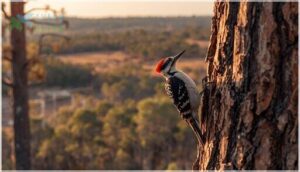
The red-cockaded woodpecker faces serious threats across its range. You’ll find this species listed as Near Threatened globally and protected under federal law in the United States.
Here’s what you need to know about its conservation status, the forces pushing it toward extinction, and where populations stand today.
Endangered and Protected Status
The Red-cockaded Woodpecker holds Near Threatened status on the IUCN Red List and remains federally listed as Threatened under the Endangered Species Act.
Federal protections designate critical habitat and restrict activities that harm the species or degrade pine forest ecosystems.
Conservation laws trigger recovery planning and monitoring protocols.
Protected areas safeguard nesting colonies while Species Recovery efforts focus on habitat restoration and population expansion across its southeastern range.
Causes of Population Decline
Habitat loss and fragmentation drive the decline of the Red-cockaded Woodpecker. Fire suppression eliminates the open understory these birds require, allowing dense vegetation to replace their pine forest home. Over-cutting removes mature trees before they reach the 90-year age needed for cavity excavation.
Human activities fragment remaining habitat, isolating colonies and reducing genetic diversity. Climate change compounds these threats by altering forest composition and increasing storm frequency.
Current Population and Distribution Trends
These habitat losses have left the species with fewer than 1,000 breeding individuals across fragmented southeastern landscapes. Population trends show stability in protected areas with active fire management, but range dynamics remain constrained. Habitat shifts through restoration projects offer hope, though spatial distribution stays clustered in core strongholds rather than expanding naturally.
Where You’ll Find Them Today:
- Military installations with controlled burns in Florida and Georgia
- Longleaf pine restoration sites in South Carolina
- Protected tracts in eastern Texas with active management
- Fragmented stands along margins of historic range
- Isolated populations in pond pine and loblolly communities
Conservation efforts focus on connecting these scattered groups through habitat corridors and prescribed fire programs. Endangered species recovery depends on expanding suitable woodpecker habitat management across private and public lands, supporting both redcockaded woodpecker conservation and broader ecosystem health. Understanding woodpecker biology helps target interventions where they’ll make the biggest difference.
Conservation Efforts and How to Help
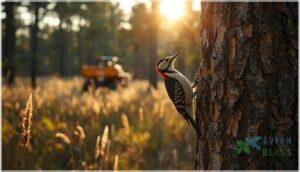
Red-cockaded Woodpeckers face serious threats, but targeted conservation work offers real hope for recovery.
Multiple strategies now protect remaining populations and restore degraded pine habitats across the Southeast. You can support these efforts through habitat management, conservation programs, and community action.
Habitat Restoration and Management
Across degraded longleaf pine stands, ecological restoration requires prescribed burning every one to three years to maintain open understory structure.
Forest management targets competing species removal within five to ten years while creating fire buffers around restoration blocks. Ecosystem engineering includes cavity network installation supporting cooperative breeding groups.
Forest regeneration depends on quarterly monitoring of soil moisture and litter depth to track habitat preservation milestones and reduce habitat fragmentation.
Legal Protections and Conservation Programs
You’ll find the Red-Cockaded Woodpecker protected under the Federal Endangered Species Act after being downlisted from endangered to threatened in October 2024. The US Fish and Wildlife Service enforces a special 4d rule preventing harm to active cavity trees.
The US Fish and Wildlife Service also supports Habitat Restoration through Safe Harbors, which offer private landowners flexibility through voluntary Conservation Plans. Habitat Conservation Plans permit limited development when offset by species protection laws requiring long-term Wildlife Protection measures.
Community Involvement and Reporting Sightings
You can join wildlife conservation efforts by reporting Red-Cockaded Woodpecker sightings through local hotlines or online portals. Your observations help biologists track this endangered species and guide habitat management decisions while protecting data privacy.
- Submit location, date, and bird behavior details through mobile apps with auto-fill GPS coordinates
- Attend community training workshops to distinguish RCW from similar species during bird watching
- Receive conservation feedback showing how your citizen science contributions support protection efforts
Frequently Asked Questions (FAQs)
Why is the red-cockaded woodpecker endangered of becoming extinct?
When the world you built for crumbles, survival gets tough.
Fire suppression, habitat loss, and fragmentation, and climate change have driven population decline for this endangered species, making woodpecker conservation critical to prevent ecosystem disruption and species extinction.
How rare is the red cockaded woodpecker?
The RCW population includes fewer than 10,000 individuals scattered across isolated southeastern communities.
This threatened species faces ongoing habitat loss, making localized extinction a genuine conservation challenge despite federal endangered species protections.
Where do red cockaded woodpecker live in Florida?
You’ll find these woodpeckers in mature pine forests across northern and central Florida.
They prefer longleaf pine stands with open understories, but also inhabit slash and loblolly pine ecosystems maintained by prescribed fire.
How long do red-cockaded woodpeckers live?
In wild pine forests, these birds usually reach 10 to 12 years. Some documented individuals survive beyond 16 years when habitat quality remains high and predation pressure stays low throughout their lifetime.
What do red-cockaded woodpeckers eat?
Your feathered friend survives on an insectivorous diet of ants, beetles, termites, and wood roaches flaked from pine bark.
Arthropod diet dominates year-round, with occasional pine seeds and fruit when insect prey becomes scarce.
How do red-cockaded woodpeckers find food?
Like tiny prospectors, these birds hitch up pine trunks, flaking bark plates to expose hidden beetles, ants, and termites.
Males work upper branches while females forage lower—cooperative foraging strategies divide the habitat efficiently.
Do red-cockaded woodpeckers migrate seasonally?
Red-cockaded woodpeckers don’t migrate. They remain year-round residents in mature pine forests.
Local dispersal occurs within home ranges as birds seek food and cavities, demonstrating habitat stability and residency behavior.
How do red-cockaded woodpeckers avoid predators?
You’ll notice sticky resin wells surrounding nest cavities form a barrier against rat snakes.
Cooperative vigilance among group members strengthens nest defense, while camouflage tactics blend plumage with bark during foraging, improving predator evasion.
How long do red cockaded woodpeckers live?
You can expect wild populations of RCW to survive 10 to 12 years when habitat quality favors them. First-year Survival Rates hover near 40 percent, while older adults face gradually rising Mortality Risks.
What predators threaten red cockaded woodpeckers?
Rat snakes, corn snakes, raccoons, and Cooper’s hawks pose significant threats through Snake Predation and Mammal Attacks. Avian Threats include screech owls and red-tailed hawks.
Habitat Fragmentation intensifies predator encounters, requiring Predator Control measures.
Conclusion
A single red-cockaded woodpecker clan claims 200 acres of pine forest as territory. That’s how much old-growth habitat one family needs to survive.
Your recognition of these birds in the field aids their persistence across fragmented landscapes. Report sightings to local wildlife agencies. Support prescribed burning programs that maintain open pine savannas.
Each action reinforces the ecosystem this species requires. The red-cockaded woodpecker’s survival depends on landscapes managed with fire and age in mind.