This site is supported by our readers. We may earn a commission, at no cost to you, if you purchase through links.
You won’t mistake a pigeon guillemot once you’ve seen one. Against the dark coastal waters of the Pacific, these compact seabirds flash vivid white wing patches and vermilion feet—a striking color combination that sets them apart from nearly every other bird on the rocky shoreline.
The species thrives in one of the ocean’s most challenging environments, splitting its life between vertical cliff faces and frigid water where it hunts fish up to 150 feet below the surface. Unlike many seabirds that gather in massive colonies, pigeon guillemots nest in smaller groups tucked into rocky crevices, making them accessible to observers willing to explore the tide line.
Understanding this distinctive auk means recognizing how its physical adaptations, foraging behavior, and habitat preferences work together to define a bird perfectly suited to the Pacific’s rugged edge.
Table Of Contents
- Key Takeaways
- What is The Pigeon Guillemot?
- Physical Characteristics and Identification
- Habitat and Geographic Range
- Diet, Foraging, and Behavior
- Breeding, Nesting, and Conservation
- Frequently Asked Questions (FAQs)
- How deep can pigeon guillemots dive?
- What is a pigeon guillemot?
- What is the difference between pigeon and black Guillemot?
- What are some interesting facts about pigeon guillemot?
- What is the difference between a Black Guillemot and a pigeon guillemot?
- Do pigeon guillemots migrate?
- What is the difference between a Black Guillemot and a Pigeon Guillemot?
- How deep can a Pigeon Guillemot dive?
- Are Pigeon Guillemots endangered?
- What is the behavior of a Pigeon Guillemot?
- Conclusion
Key Takeaways
- You can identify pigeon guillemots by their split white wing patches with a dark wedge, vivid red feet that stay bright year-round, and dramatic seasonal plumage shifts from deep black in breeding season to mottled gray in winter.
- These diving specialists hunt fish and invertebrates at depths up to 150 feet using wing-propelled swimming at 2.1 beats per second, typically foraging 15-20 meters down for 87-second dives along rocky Pacific coastlines.
- Pigeon guillemots form lifelong pair bonds starting at age three to five, nest in hidden rocky crevices with strong site fidelity, and both parents share incubation and chick-feeding duties in small coastal colonies.
- While listed as Least Concern globally with 235,000-470,000 individuals, regional populations face serious threats from oil spills (Prince William Sound dropped 47% after Exxon Valdez), climate-driven prey loss, gillnet bycatch, and coastal development pressures.
What is The Pigeon Guillemot?
The pigeon guillemot is one of the Pacific coast’s most distinctive seabirds, built for a life split between rugged cliffs and cold ocean water. If you’ve ever spotted a stocky black bird with bold white wing patches zipping low over the waves, you’ve likely crossed paths with one.
It’s just one member of the broader seabird community along the Pacific Coast, which includes everything from puffins to pelicans.
Here’s what defines this species — from its place in the bird family tree to the features that set it apart.
Taxonomy and Classification
The pigeon guillemot (Cepphus columba) isn’t just a seabird — it’s a masterclass in evolutionary precision. Its scientific naming places it firmly within:
- Kingdom: Animalia
- Order: Charadriiformes
- Family: Alcidae (the auk family)
- Genus: Cepphus
- Species: Cepphus columba
Phylogenetic analysis confirms its tight kinship with puffins and murres — cold-water divers built for the deep. Like other members of the auk family, their allows them to thrive in marine environments.
Distinguishing Features
Once you know its taxonomy, the pigeon guillemot’s physical identity snaps into focus fast. Cepphus columba carries field marks that cut through coastal clutter — bold Wing Patches split by a dark wedge, unmistakable Red Feet flashing against rock, and Vocal Displays that ring out across nesting cliffs.
Breeding Plumage runs deep velvety black; Nonbreeding Plumage shifts to mottled gray.
Many of the species’ most distinct attributes, including identification and media details, are essential for distinguishing it throughout the year.
| Feature | Breeding Plumage | Nonbreeding Plumage |
|---|---|---|
| Body Color | Deep black, iridescent | Mottled gray and white |
| Wing Patches | Bold white, dark wedge split | Visible but subdued |
| Red Feet | Vivid, year-round | Vivid, year-round |
| Bill | Straight, black | Straight, black |
| Underparts | Solid dark | White belly |
Plumage Changes between seasons are dramatic, but those Red Feet and split Wing Patches on Guillemots stay constant — reliable anchors for identification no matter the time of year.
For cardinals and other seed-loving visitors, offering a premium birdseed mix designed for cardinals ensures you’re meeting their nutritional needs while encouraging repeat visits to your yard.
Body Shape stays compact and upright throughout.
Comparison With Similar Species
Those vivid red feet and split wing patches set Pigeon Guillemots apart even within their own family.
In Seabird Comparison and Species Differentiation, three Bird Morphology clues help nail the ID:
- Guillemot Variations: darker underwings than Black Guillemots
- Auk Family Traits: longer bill than Marbled Murrelets
- Unlike Puffins or Common Murres, Auks like Seabirds in this group show red feet year-round
Physical Characteristics and Identification
The pigeon guillemot is one of those birds that doesn’t blend into the background — it’s built to stand out. From its dramatic seasonal wardrobe to its bold courtship features, every physical detail tells a story about how it survives and thrives on the Pacific coast.
Here’s what makes this seabird so easy to spot and impossible to forget.
Breeding and Non-Breeding Plumage
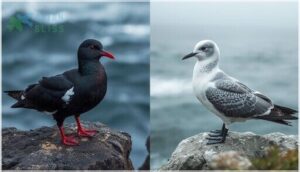
Few avian species flip their look as dramatically as the pigeon guillemot. During bird breeding season, guillemots wear almost solid black breeding plumage — bold, unapologetic.
Come winter, feather molting shifts everything: pale, mottled tones take over, delivering visual camouflage against open seas.
This seasonal change in plumage variation isn’t random — color significance runs deep, balancing courtship display against predator survival.
Size, Shape, and Coloration
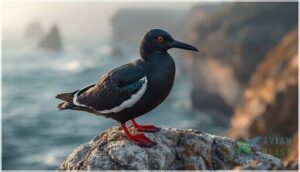
This stocky avian species carries its identity in bold brushstrokes. Body proportions are compact but purposeful — 30 to 37 cm long, barrel-shaped, built for diving. Feather patterns shift with the seasons, but beak shape stays constant: long, straight, black. Leg coloration? Unmistakably red year-round.
Whether studying plumage variations or broader bird species characteristics, the guillemot’s breeding plumage and overall Pigeon Guillemot form speak for themselves.
Unique Courtship Features
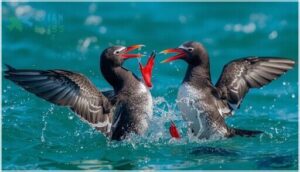
Courtship in the Pigeon Guillemot is anything but subtle. Red Foot Displays kick off breeding season as males flash brilliantly colored legs against dark water — a visual signal you can’t miss.
Guillemots escalate through Water Chases, zigzagging across the surface, then launch into Aerial Duets, circling together while trading high whistling calls.
Mouth gaping reveals a vivid red-orange lining, layering visual signals into remarkably complex Courtship Rituals.
Habitat and Geographic Range

The pigeon guillemot doesn’t just live anywhere—it’s built for a very specific kind of place. From rocky Pacific coastlines to remote offshore islands, where this bird calls home shapes everything about how it behaves and survives.
Here’s a closer look at the environments and regions where you’re most likely to find it.
Preferred Coastal Environments
The pigeon guillemot doesn’t just live near the coast — it chooses its coast carefully. You’ll find it where rocky shorelines offer the full package: exposed headlands, sheltered coves, and complex coastal topography all within reach.
Three coastal features define its marine habitat:
- Rocky shores with crevices for resting
- Shallow nearshore waters under 90 feet
- Productive benthic marine ecosystems below
Habitat fragmentation along developed coastlines is a real threat to this coastal wildlife specialist.
Breeding Colony Locations
Where a species chooses to raise its young tells you everything about what it values. The Pigeon Guillemot breeds on rocky shores, cliff faces, and offshore islets — but it doesn’t stop there. Artificial nesting sites like wharves and pilings have become legitimate habitat, expanding regional strongholds considerably. Foraging proximity matters too; nesting always stays close to shallow feeding grounds.
| Colony Type | Example Locations | Typical Breeding Size |
|---|---|---|
| Rocky Cliff/Islet | Farallon Islands, CA | ~3,000 birds |
| Salish Sea Islands | Mitlenatch, Mandarte | ~100 birds each |
| Artificial Structures | Harbor pilings, wharves | Dozens of pairs |
Distribution Across The Pacific
Think of the Pigeon Guillemot as the North Pacific seabird that never strays far from shore. Its Overall Pacific Range sweeps from Russia’s Kamchatka Peninsula through the Aleutian Islands to California’s Channel Islands.
Eastern Pacific Extent covers Alaska down through British Columbia, Washington, Oregon, and California. Western Pacific Extent hugs Hokkaido and the Kurils.
Seasonal Shifts push northern birds south when ice advances, making Seabird Migration Patterns and Marine Ecosystem Conservation deeply linked along the Pacific coast.
Diet, Foraging, and Behavior

The pigeon guillemot is a surprisingly capable hunter, shaped by the cold Pacific waters it calls home. What it eats, how it hunts, and the way it interacts with others of its kind all tell a bigger story about how this bird survives.
Here’s a closer look at three key aspects of its daily life.
Primary Food Sources
The pigeon guillemot’s diet is anything but predictable. Its seabird diet shifts with the seasons, leaning heavily on benthic prey like sculpins, gunnels, and rockfish — sometimes up to 90 percent of chick meals in California colonies.
Schooling fish like sand lance and herring step in when conditions favor them. Marine invertebrates — crabs, shrimp, worms — round out these flexible foraging strategies year-round.
Diving and Foraging Techniques
You’ll spot pigeon guillemot wing propulsion at work the moment they hit the water — those rounded wings beat about 2.1 times per second, powering tight underwater maneuvering around rocks and kelp.
Dive patterns usually run 87 seconds at 15–20 meters, where benthic exploration pays off. Their webbed feet assist when foraging strategies demand precision over speed, letting these diving birds probe crevices and “walk” the seafloor for prey hidden in coastal complexity.
Social Structure and Communication
While foraging happens solo or in small groups, colony dynamics get loud fast when birds return to shore. Pair bonding drives the social structure — vocal signals like the hunch-whistle claim territory, and agonistic behavior flares when neighbors crowd too close.
You’ll hear trills, screams, and whistles peak at dawn and dusk, especially during courtship. These avian species rely on social learning and constant chatter to keep colony life running.
Breeding, Nesting, and Conservation
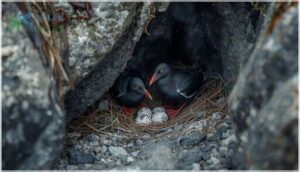
Pigeon guillemots don’t rush into parenthood—they wait until they’re three to five years old before they start breeding, and once they find a partner, many stick together for life. Their nesting strategy is all about staying hidden, choosing rocky crevices and burrows that keep predators at bay while they raise their young.
Understanding how these birds reproduce and what threatens their survival gives you a clearer picture of what it takes to protect them along the Pacific coast.
Breeding Cycle and Pair Bonds
You’ll spot real commitment when pigeon guillemots lock into pair bonding—many couples reunite at the same breeding sites year after year, strengthening their connection through courtship displays like mutual circling and bill-touching.
Breeding rituals kick off with chases and high-pitched trills, leading to mate selection around age three to five. Once paired, both partners share incubation duties and feed their chicks for weeks, directly boosting fledging success.
Nesting Habits and Site Selection
Once pair bonds form, you’ll see these seabirds tackle nest site selection with precision. They choose rocky crevices, cliff cavities, or burrows along rugged coasts—sites that shield eggs from gulls and foxes through steep slopes and narrow entrances.
Pigeon guillemot habitat and behavior includes:
- Nesting in natural rock gaps or artificial structures like pipes and wharves
- Laying one to two eggs on bare rock with minimal shell or stone lining
- Defending small territories of 1–4 square meters around nest entrances
- Reusing the same cavity for years, showing strong site fidelity
- Clustering in small colonies where cavity availability and predator avoidance align
Coastal erosion threatens burrow usage, but offshore islands offer safer colony layout options.
Population Status and Conservation Challenges
You’ll find pigeon guillemots listed as Least Concern globally, with roughly 235,000 to 470,000 individuals spread across the Pacific. Yet oil spill impact—like the Exxon Valdez disaster—hammered Prince William Sound populations by 47 percent, and climate change now disrupts prey availability during breeding.
Though globally listed as Least Concern, pigeon guillemots face severe threats from oil spills and climate-driven prey loss
Predator control on islands, habitat preservation of rocky coasts, and seabird conservation and management programs remain essential to counter gillnet bycatch and coastal development pressures.
Frequently Asked Questions (FAQs)
How deep can pigeon guillemots dive?
You’ll see diving birds hit maximum depths around 148 to 150 feet—that’s where pigeon guillemots push their limits—but their everyday foraging happens much shallower, usually between 33 and 66 feet.
What is a pigeon guillemot?
The pigeon guillemot is a stocky diving seabird from the auk family found along Pacific coasts. You’ll recognize this benthic feeder by its red feet and striking breeding plumage.
What is the difference between pigeon and black Guillemot?
Though both guillemot species share similar breeding plumage, you’ll spot key differences: black guillemots show cleaner white wing patches and inhabit Arctic waters, while pigeon guillemots display dusky underwings across Pacific coastlines.
What are some interesting facts about pigeon guillemot?
Like feathered acrobats of the kelp forest, these diving birds flip upside down to pluck prey from rocky crevices.
Pigeon guillemots form monogamous bonds, begin breeding at three to five years, and master underwater agility through benthic foraging along rocky shores.
What is the difference between a Black Guillemot and a pigeon guillemot?
You’ll notice the wing patch tells the story: Black Guillemots show clean white, while Pigeon Guillemots reveal a dark wedge splitting theirs.
Range also separates these avian species—Atlantic versus Pacific waters.
Do pigeon guillemots migrate?
Yes, these coastal birds display varied migration patterns depending on region. Northern Alaska breeders head south to ice-free waters, while California populations undertake impressive northbound coastal routes to British Columbia and Southeast Alaska wintering grounds.
What is the difference between a Black Guillemot and a Pigeon Guillemot?
Though ocean basins separate them, the key lies in wing patch patterns: Black Guillemots show clean white patches in breeding plumage, while Pigeon Guillemots display dark wedges cutting through theirs.
How deep can a Pigeon Guillemot dive?
Diving birds can reach depths around 45 meters, or 150 feet, though most feeding happens between 15 and 20 meters where prey hides. Breath hold duration averages 87 seconds during foraging dives.
Are Pigeon Guillemots endangered?
No, Pigeon Guillemots aren’t endangered—they’re listed as Least Concern globally with stable population trends. However, oil pollution effects and climate change impacts threaten specific colonies, making ongoing wildlife conservation and threat assessment essential for seabirds.
What is the behavior of a Pigeon Guillemot?
You’ll find these seabirds are truly hooked on bottom feeding. Their foraging strategies include swift underwater flights, paired courtship displays, fierce territorial defense, coordinated parental care, and complex vocal communication throughout breeding seasons.
Conclusion
What other seabird wears its identity so boldly on its wings? The pigeon guillemot stands apart not through sheer numbers but through specialization—you’ll find it where cliff meets current, hunting deep and nesting hidden.
Its survival depends on cold, fish-rich waters and undisturbed rocky shores. If you’re drawn to coastlines where resilience trumps spectacle, this compact auk rewards your attention.
Watch for those wing patches—they mark a bird that has mastered the edge.
- https://www.birdweb.org/birdweb/bird/pigeon_guillemot
- https://www.nps.gov/places/pigeon-guillemot.htm
- https://www.allaboutbirds.org/guide/Pigeon_Guillemot/overview
- https://app.mybirdbuddy.com/birds/pigeon-guillemot/bc9d7b31-560b-42b6-8511-7d0223f1ebd0
- https://www.alaskasealife.org/aslc_resident_species/20