This site is supported by our readers. We may earn a commission, at no cost to you, if you purchase through links.
You won’t spot the white-winged scoter on a suburban pond. This heavyweight sea duck spends most of its life riding Pacific swells and Atlantic chop, disappearing beneath the waves to wrench mollusks from rocks six meters down.
Males flash velvety black plumage split by a bold white comma behind each eye, while females wear muted chocolate brown that blends into winter’s gray horizons. That stark white wing patch—visible only when the bird banks into flight—cuts through fog and distance like a semaphore flag, separating this species from its darker scoter cousins in seconds.
Understanding how to identify these diving specialists, track their 3,000-kilometer migrations between boreal breeding lakes and coastal wintering grounds, and recognize the threats reshaping their populations requires looking beyond field marks into the ecological currents that define their existence.
Table Of Contents
- Key Takeaways
- White-winged Scoter Identification Guide
- Habitat and Range of The White-winged Scoter
- Behavior and Diet of White-winged Scoters
- Breeding and Life Cycle
- Conservation Status and Threats
- Frequently Asked Questions (FAQs)
- Are White-winged Scoters rare?
- Are White-winged Scoters good to eat?
- How can I identify a White-winged Scoter?
- What is a white-winged scoter?
- Where do white winged scoters live?
- What kind of bird is a white-winged scoter?
- What is the difference between Stejneger’s scoter and white wing scoter?
- How big do white winged scoters get?
- Are white winged scoters benthic?
- What does a white winged scoter look like?
- Conclusion
Key Takeaways
- You’ll identify white-winged scoters by their bold white wing patches visible in flight, velvety black plumage in males with a white comma behind the eye, and heavy wedge-shaped bills, separating them from surf and black scoters that lack the distinctive white speculum.
- These heavyweight sea ducks execute 3,000-kilometer migrations between remote boreal breeding lakes across Alaska and central Canada and coastal wintering grounds along both the Pacific and Atlantic coasts, with 70% of the Atlantic population concentrated in Chesapeake Bay and southern New England.
- White-winged scoters dive 6 to 20 meters deep to wrench mollusks from rocks using specialized benthic foraging techniques, staying submerged 20 to 30 seconds while their diet shifts seasonally from marine shellfish in winter to freshwater insects in summer, demonstrating critical ecological adaptability.
- Despite a global population estimated at 400,000 to 800,000 birds and a “Least Concern” IUCN status, the species faces compounding threats from oil spills, coastal pollution, habitat loss fragmenting nesting sites, and climate-driven disruption of breeding wetlands and food webs, with numbers potentially dropping 50% since the 1950s.
White-winged Scoter Identification Guide
Spotting a White-winged Scoter in the field comes down to knowing exactly what to look for—and there’s more to it than just size.
Start by focusing on the white wing patches and curved bill profile, then compare them to similar species like the White-crowned Sparrow to sharpen your identification skills.
Once you learn its key features, you won’t mix it up with anything else on the water. Here’s what to pay attention to.
Key Physical Characteristics
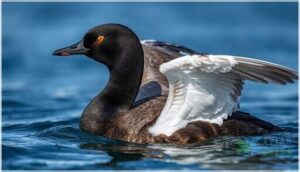
The White-winged Scoter is built like a bruiser among diving ducks — heavy-bodied, thick-necked, and unmistakable once you know what to look for.
Key duck identification markers include:
- Body size: Males reach ~55 cm, weighing up to 1,780 g
- Speculum: Bold white secondary feathers flash clearly in flight
- Beak shape: Heavy, wedge-shaped with a distinctive black knob
That white wing patch is your freedom flag in the field.
You can distinguish ages and sexes by observing head shape and bill pattern.
Male Vs. Female Appearance
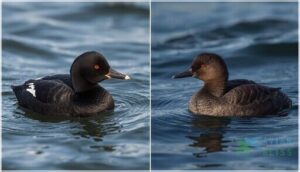
Once you’ve clocked that white wing patch, the next move is sexing the bird.
Males wear velvety black plumage with a sharp white comma behind the eye — clean, bold, unmistakable. Females run chocolate brown with softer, smudged facial patches and a plain dark bill.
These beak shapes and head profiles are your most reliable duck identification clues for separating whitewinged scoter sexes in any light.
To learn more about their range and seasonal habits, review this guide to Pacific Coast wintering patterns.
Juvenile and Immature Identification
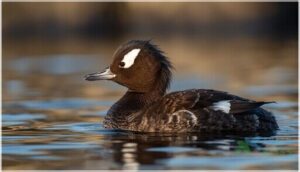
Young birds throw a curveball at even experienced observers. Plumage development in immature white-winged scoter unfolds across roughly three years, with age progression written in bill shapes, wing patterns, and facial markings:
- Juveniles show chocolate-brown overall with smudgy pale face patches
- Bill shapes stay flat and knobless through year one
- Wing patterns flash white secondaries from day one
- Facial markings sharpen gradually in second-year males
- Avian biology and ornithological research confirm darker eyes in young females
Differences From Similar Scoter Species
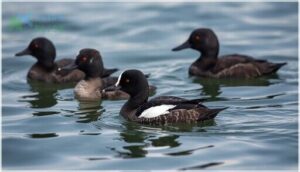
Once you’ve nailed immature plumage, separating Melanitta deglandi from other scoter species becomes your next frontier.
Timing your field outings to coincide with prime spring migration windows will dramatically increase your chances of encountering multiple scoter species in varied plumages.
Three sea duck relatives share its offshore world — here’s how they break apart:
| Feature | White-winged vs. Others |
|---|---|
| Wing Pattern | Bold white speculum; Surf and Black Scoters show nearly dark wings |
| Bill Shape | Smooth sloping forehead; Surf Scoter angles sharper |
Size comparison and plumage color seal the deal.
Habitat and Range of The White-winged Scoter

The White-winged Scoter doesn’t stay put — it moves across an impressive stretch of North America depending on the season. Where you find one says a lot about the time of year and what it’s after.
Here’s a look at the key places this bird calls home throughout its annual cycle.
Breeding Grounds and Nesting Sites
If you want to understand white-winged scoter breeding habitat, think remote boreal wilderness — far from roads and people. Breeding grounds span interior Alaska through central Canada, where nest site selection favors upland nesting zones tucked into dense shoreline vegetation near large lakes.
Key nesting features include:
- Lakes of at least 125 acres with sheltered shorelines
- Concealed nests set back up to 0.5 miles from water
- Dense shrubs like wild rose and raspberry for cover
- Island locations within lakes for added predator protection
Lake shore ecology and avian biology intersect powerfully here — waterfowl conservation starts with protecting these nesting sites.
Migration Routes and Patterns
Migration patterns for this species break into four distinct spring routes — coastal, overland, James Bay, and Great Lakes — each reflecting strong route fidelity among returning females.
Flight patterns shift from low sea-skimming lines to high overland legs, with median departure around May 15 and arrival near June 8.
Total spring avian migration averages 24 days across roughly 3,000 kilometers.
Wintering Locations Across North America
From Alaska’s Aleutians down the Pacific Coast to San Francisco Bay, and along the Atlantic Coast from Newfoundland south through the Mid-Atlantic, White-winged Scoters claim some of North America’s most productive wintering grounds.
Chesapeake Bay and southern New England alone host roughly 70% of the Atlantic population.
Inland, the Great Lakes — particularly Lake Ontario — now see growing numbers, drawn by invasive zebra mussels reshaping these freshwater marine ecosystems.
Behavior and Diet of White-winged Scoters

Watch a White-winged Scoter long enough and you’ll realize this bird has a whole life happening just beneath the surface—literally. From the way it hunts to the company it keeps, every habit is shaped by the water it calls home.
Here’s what you need to know about how this sea duck eats, forages, and moves through the world.
Diving and Foraging Techniques
You’ll witness white-winged scoters tip forward and disappear almost straight down, propelling themselves with strong webbed feet while partly spreading their wings for steering. These benthic feeders usually stay submerged 20 to 30 seconds, swimming along the bottom to grasp mussels and clams from rocks or sediment.
During herring spawn events, their dive patterns shift dramatically—duration increases by 60 to 70 percent as they capitalize on dense prey patches through synchronized group foraging.
Diet Throughout The Year
If you’re tracking waterfowl through the seasons, you’ll notice white-winged scoters shift from marine mollusks in winter to freshwater insects and amphipods in summer—classic examples of dietary flexibility.
Foraging strategies pivot with habitat, illustrating avian ecology and behavior at work.
That adaptability is a cornerstone of wildlife biology and ecological conservation, keeping these birds resilient year-round.
Social and Flocking Behaviors
You’ll see white-winged scoters shift from solitary pairs to dense coastal rafts depending on the season—a textbook example of adaptive flock dynamics in avian ecology and behavior. Their social learning and group displays illustrate wildlife conservation’s need to protect both individuals and flocks:
- Migration patterns feature low-flying ribbons of hundreds along shorelines, sometimes mixing with surf scoters.
- Winter foraging strategies cluster birds over mussel beds, diving in loose synchrony.
- Courtship group displays on wintering grounds involve aerial acrobatics and competitive posturing.
- Breeding pairs scatter across boreal lakes, abandoning their gregarious habits temporarily.
These shifts in avian biology reveal how bird species conservation must address year-round social needs.
Breeding and Life Cycle

If you want to understand how White-winged Scoters bring the next cohort into the world, you need to know their breeding timeline runs like clockwork across the northern lakes. Pair formation happens long before they reach nesting grounds, with females shouldering most of the parenting work while males slip away to molt.
Here’s what happens from courtship through the moment those downy chicks leave the nest.
Mating and Nesting Habits
You’ll notice pair bonding happens well before these scoters reach northern breeding grounds, with courtship displays kicking off during migration or on coastal wintering sites. Males perform steep aerial climbs and splashy surface rushes to win over females, who select nesting sites hidden under dense shrubs near freshwater lakes.
Parental roles split sharply: females handle brood care alone after males depart for molting areas.
Egg Laying and Incubation
Once males leave for molting areas, females of Melanitta delaglandi settle into egg formation and nesting behavior. Clutch size averages nine to ten creamy buff eggs, laid at roughly thirty-four to thirty-six hour intervals, each weighing about eighty-two grams.
The incubation period spans twenty-five to thirty days, with females maintaining steady brooding patterns alone. They cover eggs in down during brief feeding trips to preserve warmth and shield against predators.
Chick Development and Fledging
Ducklings of Melanitta deglandi hatch with eyes open, leave the nest within twenty-four hours, and travel up to half a mile overland to reach water. Growth patterns extend from sixty-three to seventy-seven days to fledging age, far longer than most ducks. Brood dynamics shift as females abandon young after two to three weeks, forming crèches of fifteen to one hundred ducklings. Chick mortality ranges from ninety to ninety-eight-point-six percent across breeding habitats, driven by:
- Predation by gulls and raptors during long overland movements and surface foraging
- Feather development delays that prolong vulnerability in cold northern waters
- Extended growth period requiring sustained energy reserves before first flight
- Limited female attendance once scoters merge into independent crèches on brood-rearing lakes
This survival bottleneck influences migration patterns and shapes wildlife conservation priorities for the species.
Conservation Status and Threats

You’ll find the White-winged Scoter listed as Least Concern on the IUCN Red List, with a global population estimated around 400,000 individuals scattered across North America’s boreal regions and coastal waters.
Despite this relatively stable status, the species faces mounting pressures from oil spills, coastal pollution, and climate-driven habitat shifts that threaten wintering concentrations along both the Atlantic and Pacific coasts.
Understanding these challenges—and the conservation work underway—gives you a clearer picture of what this scoter needs to thrive in the decades ahead.
Current Population and IUCN Status
You’ll find the white-winged scoter listed as Least Concern under the IUCN status framework, though that global estimate masks troubling population trends.
While conservation status reports suggest roughly 500,000 to 800,000 birds worldwide, threat assessment data from Ducks Unlimited indicates numbers may have dropped 50 percent since the 1950s, highlighting urgent gaps in wildlife conservation monitoring and species conservation priorities.
Major Threats and Environmental Challenges
Despite the reassuring conservation status label, you’re watching white-winged scoters face a gauntlet of stacked environmental threats that wildlife habitat preservation efforts can’t ignore.
Oil spills sink entire rafts through hypothermia, habitat loss fragments nesting lakes across boreal forests, pollution effects accumulate toxic metals in their shellfish prey, and climate change drains breeding wetlands while disrupting coastal food webs—each challenge compounding ecosystem disruption and demanding urgent habitat conservation action.
White-winged Scoters face compounding threats—oil spills, habitat loss, pollution, and climate change—that demand urgent conservation action across their entire range
Conservation Efforts and Research Initiatives
You’ll find the Alberta White-winged Scoter Conservation Management Plan driving habitat restoration and species monitoring across key nesting lakes, while the Sea Duck Joint Venture coordinates wildlife protection and waterfowl conservation at continental scales.
Conservation planning now relies on satellite telemetry research initiatives that map migration corridors, identify critical molting sites, and guide avian research and management actions where ecological conservation efforts matter most.
Frequently Asked Questions (FAQs)
Are White-winged Scoters rare?
You won’t find this species on any endangered list—White-winged Scoters hold Least Concern status globally, with populations numbering between 500,000 and 800,000 across North America despite measurable regional declines.
Are White-winged Scoters good to eat?
You can eat White-winged Scoters, though their meat carries a strong, marine-influenced flavor from their mollusk-heavy diet.
Proper preparation—skinning, trimming fat, and brining—greatly improves palatability, transforming dark, gamey breast meat into surprisingly acceptable fare.
How can I identify a White-winged Scoter?
You can identify Melanitta deglandi by watching for the bold white secondary patch visible in flight, the male’s small teardrop mark near the eye, and a heavy bill with a subtle knob at the base.
What is a white-winged scoter?
Think diving duck royalty—the white-winged scoter, Melanitta deglandi, reigns as North America’s largest sea duck scoter, distinguished by bold white wing patches and specialized waterfowl biology adapted for coastal avian ecology and marine foraging.
Where do white winged scoters live?
You’ll find white-winged scoters across a striking geographic range, breeding on freshwater lakes in Alaska and Canada’s boreal forests.
Then migrating to coastal habitats along both Pacific and Atlantic shores for winter.
What kind of bird is a white-winged scoter?
Waterfowl conservation starts with understanding scoter species—diving ducks that thrive in water yet breed on land.
You’re looking at Melanitta deglandi, North America’s largest scoter, a sea duck in family Anatidae with distinctive white wing patches.
What is the difference between Stejneger’s scoter and white wing scoter?
Stejneger’s scoter shows a long Roman nose head profile with a tall bill knob and yellow-orange bill, while the white-winged scoter displays a stepped forehead, subtler knob, and pinkish-red bill coloration.
How big do white winged scoters get?
White-winged scoters (Melanitta deglandi) reach 19 to 24 inches in body length, spanning 5 inches across their wings, with males weighing 0 to 7 pounds and females averaging 1 to 3 pounds.
Are white winged scoters benthic?
Yes, Melanitta deglandi are benthic feeders. You’ll spot these sea ducks diving 5 to 20 meters deep in coastal ecology zones, targeting bottom-dwelling mussels and clams—their muscular gizzard crushes thick shells.
Habitat conservation protects critical marine habitat.
What does a white winged scoter look like?
You’ll spot a large, chunky sea duck, Melanitta deglandi, with blackish plumage patterns and distinctive white wing structures.
Males display orange bill shapes and a teardrop eye patch, while females show dark brownish feather colors with paler body proportions.
Conclusion
Knowing the white-winged scoter means knowing the water it commands, the mollusks it hunts, the migrations it completes without fanfare. You’ve traced its wing patches through coastal fog, followed its dive paths to rocky bottoms, charted its seasonal movements across hemispheric distances.
Now you understand what this species requires—cold currents, abundant shellfish beds, undisturbed breeding lakes stretching across boreal wilderness. Conservation hinges on protecting those elements, not sentiment. The scoter’s survival depends on preserving the ecological architecture that made it possible.
- https://seaduckjv.org/meet-the-sea-ducks/white-winged-scoter/
- https://www.allaboutbirds.org/guide/White-winged_Scoter/overview
- https://nhpbs.org/wild/whitewingedscoter.asp
- https://www.audubon.org/field-guide/bird/white-winged-scoter
- https://www.outdooralabama.com/swans-geese-and-ducks/white-winged-scoter