This site is supported by our readers. We may earn a commission, at no cost to you, if you purchase through links.
 When exploring bird species by size, you’ll discover fascinating extremes from tiny hummingbirds to massive ostriches weighing over 300 pounds.
The common ostrich tops the charts as the world’s heaviest bird at 346 pounds, followed by cassowaries and emus.
Flying birds like the great bustard and Andean condor represent the upper limits of airborne giants, while prehistoric species like Argentavis magnificens dwarfed today’s largest fliers.
Size varies dramatically across families—from 2-gram bee hummingbirds to quarter-ton ratites.
Understanding these classifications reveals nature’s incredible diversity and the evolutionary trade-offs between flight capability and body mass that have shaped avian development across millions of years.
Table Of Contents
- Key Takeaways
- Largest Bird Species
- Heaviest Flying Birds
- Largest Prehistoric Flying Birds
- Bird Size Categories
- North American Large Birds
- Seabirds With Large Wingspans
- Large Bird Species Profiles
- Sandpipers – Family Scolopacidae
- Owls – Family Strigidae
- Woodpeckers – Family Picidae
- Tyrant Flycatchers – Family Tyrannidae
- Vireos – Family Vireonidae
- Chickadees and Titmice – Family Paridae
- Thrushes, Including Bluebirds and Robins – Family Turdidae
- Wood Warblers – Family Parulidae
- Tanagers – Family Thraupidae
- Towhees and Sparrows – Family Emberizidae
- Cardinals, Certain Grosbeaks, Certain Buntings – Family Cardinalidae
- Blackbirds, Including Meadowlarks, Blackbirds, Grackles, Orioles – Family Icteridae
- Size Comparison Of
- Frequently Asked Questions (FAQs)
- What is the top 10 biggest bird?
- What is the largest species of a bird?
- What is the largest bird to ever exist?
- What is the largest bird on our earth?
- How many bird species are there?
- What is the largest species of bird measured by mass?
- What is the largest bird in the world?
- What is a large bird?
- Which seabird has the largest wingspan?
- What are the different categories of bird sizes?
- Conclusion
Key Takeaways
- You’ll find that bird sizes range from 2-gram bee hummingbirds to 346-pound ostriches, demonstrating nature’s incredible evolutionary diversity across 18,000+ species worldwide.
- You can’t overlook the flight-versus-size trade-off—while flightless birds like cassowaries reach massive proportions, the heaviest flying birds max out around 40 pounds due to physical flight limitations.
- You’ll discover that prehistoric giants like Argentavis magnificens with 23-foot wingspans once dominated skies, showing how ancient species pushed the boundaries of what’s possible in avian flight.
- You should understand that size classifications help scientists identify ecological niches, with four main categories spanning tiny hummingbirds to massive ratites, each adapted for specific survival strategies and habitats.
Largest Bird Species
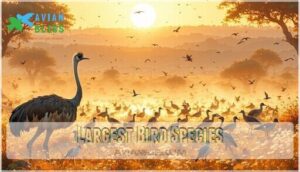
When you’re looking at the world’s largest birds, you’ll find that size isn’t just about height – it’s about weight, wingspan, and overall mass.
From the towering ostriches that can outrun a horse to the extinct giants that once dominated prehistoric landscapes, these massive species showcase the incredible diversity of avian evolution.
Ostrich
You’ll encounter the common ostrich as Earth’s largest bird species, standing up to 9.2 feet tall and weighing 346 pounds.
Towering nearly ten feet and weighing as much as three average adults, the ostrich redefines what we consider "big bird.
These flightless birds dominate African savannas with remarkable bird speed—sprinting 43 mph across their ostrich habitat.
Their powerful legs cover 16-foot strides while escaping predators. Feather care involves dust baths for parasite control.
During egg laying season, females produce massive 3-pound eggs in communal nests. This size comparison showcases nature’s most impressive avian giants among largest birds worldwide.
Somali Ostrich
Following the common ostrich, you’ll find the Somali ostrich thriving in Africa’s harshest landscapes. This magnificent bird conservation success story stands 2.7 meters tall and weighs 130 kilograms despite facing habitat loss challenges.
It has several notable features, including:
- Survives scorching desert temperatures exceeding 120°F daily
- Uses specialized feather structure for thermal regulation
- Displays unique ostrich behavior patterns during mating seasons
Unfortunately, this endangered species requires immediate protection to prevent extinction in Somalia’s changing ecosystems.
Emu
After exploring Africa’s towering Somali Ostrich, you’ll find Australia’s Emu standing proudly at 1.9 meters tall.
These lightning-fast runners sprint at 50 km/h across diverse Emu Habitat from grasslands to scrublands.
Weighing 60 kg, their omnivorous Emu Diet includes plants, insects, and fruits.
Their impressive bird size comparison ranks them among large birds, showcasing remarkable Emu Behavior and adaptability that defines this iconic bird species.
Southern Cassowary
You’ll find Australia’s Southern cassowary prowling dense rainforests, weighing up to 83 kg and standing 1.7 meters tall.
This endangered species sports razor-sharp claws and a distinctive casque atop its head.
Australian wildlife experts emphasize cassowary habitat preservation is vital for bird conservation.
Their cassowary behavior includes aggressive territorial defense, making them one of the world’s most formidable largest birds in bird size comparison studies.
Northern Cassowary
You’ll discover the Northern Cassowary (Casuarius unappendiculatus) standing up to 1.8 meters tall in New Guinea’s rainforests.
Weighing up to 70 kg, this endangered species displays a brilliant blue neck and razor-sharp claws.
Northern cassowary behavior includes sprinting at 50 km/h through dense cassowary habitat.
Wildlife preservation efforts focus on protecting these largest birds from deforestation threats affecting bird conservation across their limited range.
Understanding the large bird species is essential for effective conservation strategies.
Vorombe Titan
You’ll encounter Vorombe Titan as Madagascar’s most colossal bird species, weighing up to 860 kg and standing 3 meters tall.
These giant birds dominated prehistoric Vorombe Habitat until extinction causes like human activity eliminated them around 1200 CE.
Fossil records reveal Vorombetitan as potentially the heaviest bird ever, showcasing remarkable avian diversity in bird size categories and largest bird species comparisons.
Aepyornis Maximus
Aepyornis maximus represents Madagascar’s most spectacular extinct birds, towering nearly 10 feet tall and weighing up to 730 kilograms.
These prehistoric giants produced the largest bird eggs ever recorded, measuring 34 centimeters long with circumferences reaching one meter.
Bird fossils reveal these elephant birds dominated Madagascar wildlife until 1000-1200 CE, when human activity accelerated their extinction.
Their massive size makes them essential for bird species comparison studies, showcasing how island gigantism created these remarkable prehistoric giants among largest bird species.
Dromornis Stirtoni
When you examine Dromornis stirtoni, you’re looking at one of Australia’s most impressive prehistoric giants.
These colossal birds dominated late Miocene landscapes around 8-6 million years ago, showcasing remarkable Dromornis Anatomy adapted for their massive size.
Fossil Discoveries reveal fascinating bird size records:
- Standing 3 meters (9.8 feet) tall with robust leg bones
- Weighing 450-650 kilograms, rivaling modern bird species measurements
- Possessing 50-centimeter skulls with powerful, herbivorous beaks
Habitat Reconstruction shows these flightless giants browsed tough vegetation in open woodlands.
Their Evolutionary Relationships link them to waterfowl rather than ratites, making Dromornis stirtoni a unique bird measurement marvel.
Extinction Causes included increasing aridity and ecosystem changes across ancient Australia.
Dinornis Maximus
Towering majesty defined the giant moa (Dinornis maximus), New Zealand’s tallest bird species reaching 3.6 meters high.
These flightless giants dominated diverse habitats until extinction causes including hunting eliminated them by 1500 CE.
Skeletal remains reveal extraordinary bird size records, with females substantially outweighing males.
Their evolutionary history showcases remarkable adaptations before habitat loss sealed their fate.
These birds, belonging to family Dinornithidae, were unique to New Zealand.
Heaviest Flying Birds
You’ll find that some birds defy gravity despite weighing as much as a small dog, with species like the Great Bustard tipping the scales at over 40 pounds while still managing powered flight.
These heavyweight champions of aviation showcase remarkable adaptations that allow them to overcome the physical challenges of lifting such massive bodies into the sky, making them true heavyweight champions of aviation.
Great Bustard
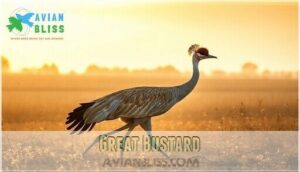
The Great Bustard holds the title as the world’s heaviest flying bird, with males reaching up to 18 kg (40 lbs).
These impressive birds showcase remarkable adaptations for life in grassland environments across Europe and Asia. Researchers study Great Bustard product information to better understand their behavior and habitat needs.
- Massive wingspan spans 2.1-2.7 meters, supporting their considerable weight
- Sexual dimorphism reveals males averaging 2.7 times heavier than females
- Habitat specialization thrives in open grasslands and agricultural areas
- Conservation challenges face habitat loss and hunting pressures, earning "Vulnerable" status
Kori Bustard
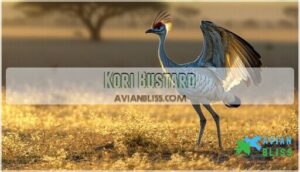
You’ll find the Kori bustard strutting across African grasslands, weighing up to 18 kg as one of the heaviest flying birds.
Males average 1.2-1.5 meters long with wingspans reaching 2.75 meters.
Their feeding habits include plants, insects, and small vertebrates.
Habitat loss threatens populations, earning them "Near Threatened" conservation status.
These impressive bird species showcase remarkable average bird size among Africa’s avifauna.
The Kori bustard’s unique characteristics are often studied in relation to bird product research.
Dalmatian Pelican
When you encounter the Dalmatian Pelican, you’re witnessing Europe’s largest freshwater bird in action.
This impressive species demonstrates remarkable adaptations for aquatic life across southeastern European wetlands.
Key characteristics include:
- Massive wingspan reaching 3.6 meters (nearly 12 feet)
- Substantial weight averaging 10-13.6 kg with exceptional specimens approaching 15 kg
- Specialized feeding habits targeting fish in large inland water bodies
The Dalmatian pelican’s bird size makes it among the heaviest flying bird species globally. Their average bird size and bird length of 1.6-1.8 meters support extensive bird migration patterns across their range.
Pelican habitat requirements center on vast wetland nesting sites where these giants can efficiently hunt. Unfortunately, their conservation status remains "Near Threatened" due to habitat drainage and human disturbance affecting traditional breeding areas.
The study of Dalmatian Pelican wildlife products can provide valuable insights into their behavior and habitat needs.
Andean Condor
You’ll spot the Andean condor gliding effortlessly above South American peaks, its 3.3-meter wingspan catching mountain thermals.
Weighing up to 15 kg, this scavenger masters flight patterns that conserve energy across vast territories.
Their nesting sites perch on remote cliff faces, while conservation status remains vulnerable due to habitat loss and poisoning threats.
Trumpeter Swan
You’ll find North America’s heaviest waterfowl in the Trumpeter Swan, weighing up to 13.6 kg with wingspans reaching 3 meters.
These magnificent bird species showcase remarkable Swan Behavior during Swan Migration, traveling vast distances between breeding and wintering grounds.
Their Trumpeter Diet consists primarily of aquatic vegetation, supporting their impressive bird size.
Thanks to dedicated Bird Conservation efforts, populations have recovered from near-extinction, making bird identification easier as they reclaim their natural Swan Habitat across wetlands.
The study of biggest birds helps researchers understand the unique characteristics of various species and their adaptations to different environments.
King Penguin

King penguins dominate subantarctic waters, weighing up to 16 kg with their distinctive orange-yellow neck markings.
These flightless giants showcase remarkable Antarctic Life adaptations through specialized King Feathers and efficient Penguin Diet strategies.
Three fascinating king penguin facts:
- Colony dynamics – Thousands gather in massive breeding colonies across South Georgia
- Foraging prowess – Dive 300 meters deep hunting fish and squid
- Parental dedication – Incubate eggs for 54 days using specialized brood pouches
Domesticated Turkey

Domesticated Turkey’s impressive bulk results from centuries of Bird Domestication focused on maximizing bird size.
Modern Poultry Farming produces turkeys weighing up to 86 pounds through selective breeding and specialized Turkey Nutrition.
You’ll notice their significant Turkey Behavior changes compared to wild relatives, with enhanced Fowl Health supporting their massive frames in commercial operations.
Greater Rhea
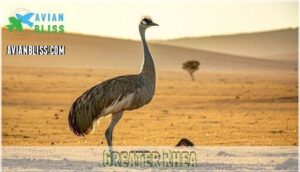
Beyond South America’s vast grasslands, you’ll find the Greater Rhea dominating as the continent’s largest bird species.
These flightless birds reach impressive weights up to 40 kg with heights of 1.5 meters, making size comparison with other large birds remarkable.
Their Rhea Diet consists of plants, insects, and small animals, while their powerful legs enable swift movement across diverse Rhea Habitat ranges, supporting essential Rhea Conservation efforts.
Largest Prehistoric Flying Birds

While today’s birds showcase incredible diversity, you’ll be amazed by the prehistoric giants that once ruled ancient skies with wingspans that dwarf modern aircraft.
These massive flying birds, including species like Pelagornis sandersi with its 21-foot wingspan, demonstrate how evolution pushed the boundaries of flight to extraordinary limits millions of years ago, showcasing incredible diversity.
Pelagornis Sandersi
Imagine soaring through ancient skies alongside Pelagornis sandersi, whose massive 21-foot wingspan dominated prehistoric oceans.
These remarkable ancient species lived 25 million years ago, using tooth-like projections to snatch fish while gliding efficiently across vast distances.
Fossil records reveal these avian dinosaurs weighed up to 40 kilograms, showcasing incredible flight patterns that influenced bird evolution and phylogeny before extinction causes ended their reign.
The study of largest wingspan bird species provides valuable insights into the adaptations of these prehistoric creatures.
Argentavis Magnificens
While Pelagornis soared across ancient oceans, Argentavis magnificens dominated South American skies as the heavyweight champion of prehistoric flight.
This colossal bird pushed the boundaries of what seemed possible for avian dinosaurs.
You’re looking at one of the most impressive ancient species in fossil records. Argentavis magnificens lived roughly 6 million years ago in Argentina’s Miocene epoch, representing a pinnacle of bird evolution.
Here’s what made these Argentavis wings so remarkable:
- Wingspan reached 6-7 meters (20-23 feet) – nearly twice a modern condor’s spread
- Body weight hit 70-72 kilograms – making it the heaviest confirmed flying bird species
- Flight patterns required thermal currents for takeoff due to massive size
- Phylogeny shows relation to New World vultures and modern condors
These giants couldn’t simply flap their way skyward like smaller birds. Instead, they needed strong updrafts and thermals to become airborne, then soared efficiently across vast distances. Their impressive bird size represented nature’s experiment with the upper limits of powered flight.
Quetzalcoatlus Northropi
You’ll discover Quetzalcoatlus northropi wasn’t technically a bird, but a colossal pterosaur that dominated Late Cretaceous skies.
This azhdarchid pterosaur boasted an incredible 33-36 foot wingspan and weighed 200-250 kilograms.
Fossil records from Texas reveal sophisticated flying mechanics that challenged prehistoric habitat limits.
Unlike avian dinosaurs, Quetzalcoatlus likely stalked terrestrial prey when grounded, until extinction theories suggest climate shifts ended their reign.
Bird Size Categories
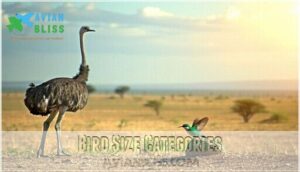
You can organize birds into four main size categories based on their body dimensions and weight.
Understanding these classifications helps you identify species and appreciate the incredible diversity that spans from tiny hummingbirds weighing less than a penny to massive ostriches that tower nearly ten feet tall, showcasing the incredible range of bird sizes.
Largest Birds
These towering largest birds dominate landscapes worldwide, with ostriches reaching nearly 10 feet tall and weighing over 300 pounds.
Their impressive bird size reflects specialized adaptations for ground-dwelling life, from powerful legs enabling high flight speed on foot to unique feather structure for temperature regulation.
Here are three fascinating facts about these giants:
- Ostrich eggs weigh 3 pounds each – equivalent to 24 chicken eggs combined
- Cassowaries sport razor-sharp claws and distinctive helmet-like casques for forest navigation
- Emus can sprint 30 mph using their powerful legs and streamlined body design
These big birds showcase remarkable beak shapes adapted for varied diets, from seed-cracking to fruit-eating, while their ground-based nesting habits reflect their flightless nature.
Medium Birds
Between tiny songbirds and towering giants, medium-sized birds occupy nature’s sweet spot.
You’ll find these adaptable species—measuring 30-70 centimeters and weighing 500-3,000 grams—thriving across diverse habitats.
Raptors, corvids, and waterfowl showcase remarkable avian behavior through their bird migration patterns.
Medium sized species excel at bird nutrition efficiency, balancing flight demands with feather care needs perfectly.
Small Birds
Small birds measuring 10-20 centimeters represent nature’s most adaptable survivors.
These species showcase incredible diversity in bird song patterns, feather structure, and nesting behaviors across varied habitats worldwide.
- Sparrows master complex small bird migration routes spanning thousands of miles
- Finches demonstrate remarkable hummingbird habitat adaptation skills
- Warblers exhibit intricate territorial bird song patterns during breeding seasons
Small birds like chickadees and wrens prove that compact size doesn’t limit ecological impact, with many smallest bird species thriving in urban environments alongside their woodland cousins.
Very Small Birds
When you study very small birds, you’ll encounter nature’s most remarkable miniaturization feats.
These tiny species showcase extraordinary adaptations that defy their microscopic proportions.
- Bee hummingbirds measure just 5.5 centimeters and weigh 1.95 grams, making them the world’s smallest bird species
- Hummingbird habitat requirements include dense vegetation and abundant nectar sources for their high-energy lifestyle
- Small wings beat up to 80 times per second, enabling precise hovering and rapid directional changes
Their tiny beaks access flowers other birds can’t reach, while specialized feather care maintains aerodynamic efficiency.
Despite their size, some very small birds undertake impressive bird migration journeys, proving that determination trumps dimensions in the avian world.
North American Large Birds

When exploring North America’s diverse avian landscape, you’ll encounter several impressive large bird species that dominate their respective habitats.
From the iconic Red-tailed Hawk soaring overhead to the Great Horned Owl‘s commanding presence in woodlands, these species showcase remarkable size adaptations for hunting, territory defense, and survival across varied ecosystems, highlighting their ability to thrive in different environments with remarkable size adaptations.
Northern Cardinal
You’ll discover the Northern Cardinal (Cardinalis cardinalis) stands out among North American bird species through its striking feather color variations.
Males display brilliant crimson plumage year-round, while females showcase warm brown tones with reddish highlights—perfect for bird identification enthusiasts.
Their medium-sized songbirds measure 8.5-9 inches, making bird species comparison straightforward.
Their cardinal diet includes seeds, fruits, and insects, adapting seasonally within their northern habitat range.
Unlike many bird species, cardinals don’t participate in bird migration, remaining year-round residents.
Their distinctive song patterns feature clear whistles like "birdy-birdy-birdy," making them easily recognizable backyard visitors throughout eastern North America’s woodlands and suburban areas.
Barred Owl
Barred Owls rule nocturnal territories with distinctive hoots echoing through eastern woodlands.
These skilled hunters excel in bird identification challenges, using feather camouflage to blend seamlessly with tree bark patterns.
Their hunting tactics include patient perching and swift strikes.
Key characteristics defining this bird species:
- Wingspan reaches 42 inches, making them substantial among North American bird size categories
- Nesting patterns favor tree cavities in mature forests, though habitat loss threatens breeding success
- Owl behavior includes territorial calling during both day and night hunting sessions
These adaptable predators demonstrate remarkable bird species comparison traits, thriving from swamplands to suburban edges.
Blue Jay
You’ll find Blue Jay (Cyanocitta cristata) among North America’s most recognizable medium-sized songbirds.
These intelligent birds measure 11-12 inches with striking blue plumage and white underparts.
Their Bird Songs include harsh calls and mimicked hawk sounds.
Blue Jay Habitat spans eastern woodlands and suburban areas.
Nesting Habits involve building stick platforms in tree forks.
Migration Patterns vary – some populations migrate while others remain year-round residents.
The blue jay’s behavior is influenced by its complex social bonds.
Red-tailed Hawk
Red-tailed Hawks reign as North America’s most adaptable raptors, showcasing incredible versatility across diverse landscapes.
You’ll spot these impressive hunters from coast to coast, demonstrating remarkable hawk migration patterns and exceptional bird vision capabilities.
- Wingspan reaches 3.5-4.8 feet with distinctive russet tail feathers
- Powerful talon strength enables capture of prey weighing several pounds
- Keen eyesight provides eight times sharper vision than humans
- Nesting habits include building stick platforms in tall trees
- Feather care involves regular preening for peak flight performance
Their bird size comparison places them among medium-large raptors, making bird identification straightforward through their iconic silhouette and coloring.
Great Horned Owl
You’ll recognize the Great Horned Owl by its impressive two-foot height and five-foot wingspan, making it North America’s largest owl species.
These apex predators use exceptional night vision and silent feather camouflage to execute precise hunting tactics across diverse owl habitats.
Their aggressive nesting behavior and formidable bird size distinguish them in bird species comparison studies.
Seabirds With Large Wingspans

Picture yourself gliding above the open sea, where seabird migration turns the sky into a living highway.
Seabirds with massive wingspans rule these ocean habitats, thanks to unique feather adaptations and specialized wing structures. Their flight patterns aren’t just for show—these large birds ride wind currents for days, barely flapping their wings.
Here are five seabird species that truly push the limits of bird size and aerial mastery:
- Wandering Albatross – 3.7 m wingspan
- Southern Royal Albatross – 3.2 m
- Andean Condor – 3.3 m
- Giant Petrel – up to 2.5 m
- Amsterdam Albatross – 3.1 m
Their wingspan is nature’s answer to long-haul travel—no airline ticket required!
Large Bird Species Profiles

You’ll discover twelve major bird families arranged by their typical sizes and distinctive characteristics.
These taxonomic groups showcase the incredible diversity found within avian species, from tiny warblers to massive raptors, highlighting the incredible diversity.
Sandpipers – Family Scolopacidae
Although these shorebirds appear small, Sandpipers within the Scolopacidae family include surprisingly large bird species.
The Eurasian Curlew stretches 66 cm, making it the family’s giant, while Far Eastern Curlews boast 110 cm wingspans.
During Sandpiper Migration, these substantial waders navigate Wetland Ecology systems using specialized Feather Adaptation for diverse climates.
Bird Flocking behavior helps with bird identification across Shorebird Habitat ranges.
Long-billed Curlews showcase 20 cm bills for deep probing, demonstrating how bird size varies dramatically within this adaptable family of coastal travelers.
Owls – Family Strigidae
You’ll encounter incredible diversity within the Strigidae family, from compact screech owls to imposing eagle-owls that dominate their territories.
These nocturnal hunters showcase remarkable adaptations for their specialized lifestyle and hunting tactics.
Key characteristics of Strigidae owls include:
- Eurasian Eagle-Owl – Reaches 75 cm in length, weighing up to 4.2 kg with piercing orange eyes
- Great Horned Owl – Displays 91-153 cm wingspans across diverse American owl habitat ranges
- Snowy Owl – Weighs up to 2.9 kg with dense feather adaptation for Arctic survival
- Barred Owl – Measures 63 cm with distinctive hooting calls in North American forests
- Silent flight technology – Specialized wing feathers enable stealthy nocturnal behavior during hunts
Woodpeckers – Family Picidae
Moving from the silent hunters of the night, you’ll find woodpeckers creating nature’s soundtrack through their distinctive Drumming Patterns. These Picidae family members showcase remarkable Pecking Mechanics that let them excavate tree cavities with surgical precision.
- Tree Selection expertise for ideal foraging sites
- Specialized skull reinforcement prevents brain damage
- Nesting Habits include creating multiple cavity options
- Tongue apparatus extends up to 10 centimeters for insect capture
Woodpecker Behavior varies dramatically across bird species, with the Great Slaty Woodpecker reaching 58 centimeters while smaller relatives measure under 15 centimeters, demonstrating impressive bird size diversity within this remarkable bird classification.
Tyrant Flycatchers – Family Tyrannidae
Tyrant flycatchers showcase impressive Flycatcher Behavior through their aerial hunting mastery, with the Great Kiskadee reaching 28 cm as the family’s largest representative.
These bird species demonstrate remarkable Tyrant Migration patterns across the Americas, while their distinctive Bird Song and aggressive territorial displays define Tyrannidae classification.
Their specialized Feather Structure supports precise flight maneuvers, and diverse Nesting Habits reflect successful adaptation within this extensive bird families group.
Vireos – Family Vireonidae
Despite their modest size, Vireos pack remarkable vocal power into their compact frames. These bird species excel at Vireo Songs that guide bird identification tips across diverse habitats.
- Vireo Diet consists primarily of insects and small arthropods
- Feather Care involves thorough preening for peak flight performance
- Nesting Habits feature cup-shaped structures suspended between branches
- Bird Migration patterns vary substantially among different Vireo species
- Bird Size typically ranges from 4-6 inches within bird families
Chickadees and Titmice – Family Paridae
You’ll find that Chickadee Behavior showcases remarkable adaptability among Passerines.
These Paridae family members store thousands of seeds daily, displaying impressive memory skills for winter survival.
Their distinctive calls help with bird species comparison, while their acrobatic Feather Care routines and mixed-flock feeding strategies demonstrate why these small bird species excel in Titmouse Habitat across North America’s forests.
Thrushes, Including Bluebirds and Robins – Family Turdidae
You’ll find the Turdidae family represents some of nature’s most adaptable songbirds.
American Robins reach 28 cm and showcase complex Robin Behavior, while Common Blackbirds hit 29 cm with distinctive Song Patterns.
These bird species excel in Thrush Migration over 3,000 km annually, adapting their Turdidae Diet from insects to fruits across varied Bluebird Habitat ranges, making Thrushes remarkable for their size-to-stamina ratio in bird species comparison.
Wood Warblers – Family Parulidae
Wood Warblers captivate you with their vibrant Feather Colors and melodic Bird Songs throughout Woodland Habitat.
These tiny Parulidae family members showcase remarkable Breeding Patterns and Warbler Migration journeys spanning thousands of miles. Despite their small bird size, Wood Warblers demonstrate extraordinary endurance during seasonal movements.
- Yellow Warblers breed across North America’s forests and shrublands
- Black-throated Blue Warblers prefer dense understory vegetation for nesting
- American Redstarts display distinctive tail-fanning behavior while foraging
Their compact dimensions make bird comparison studies fascinating, revealing how these species thrive in diverse environments.
Tanagers – Family Thraupidae
You’ll discover that tanagers showcase nature’s most striking feather colors and diverse beak shapes across their widespread tanager habitat.
These Thraupidae family members display remarkable bird species comparison opportunities, from compact 13-centimeter species to larger 19-centimeter variants that navigate extensive bird migration routes.
| Species | Length (cm) | Notable Features |
|---|---|---|
| Blue-gray Tanager | 13-14 | Adaptable urban dweller |
| Scarlet Tanager | 16-19 | Brilliant red breeding plumage |
| Paradise Tanager | 13-14 | Rainbow-colored crown |
| Silver-beaked Tanager | 17-19 | Metallic bill coloration |
| Western Tanager | 16-19 | Distinctive song patterns |
Their varied bird size reflects specialized feeding strategies and complex song patterns that define successful territorial behavior across diverse ecosystems.
Towhees and Sparrows – Family Emberizidae
Within the Emberizidae family, you’ll discover remarkable diversity among sparrows and towhees spanning various habitats.
These bird species showcase distinct feather colors and specialized Emberizidae diet preferences.
Sparrow migration patterns vary substantially between species, while towhee habitat selection influences their distinctive bird nesting behaviors across different ecosystems.
Cardinals, Certain Grosbeaks, Certain Buntings – Family Cardinalidae
You’ll discover Cardinalidae species showcase remarkable Cardinal Behavior through territorial displays and distinctive Song Patterns.
These bird species feature diverse Grosbeak Diet preferences, seasonal Bunting Migration routes, and specialized Nesting Habits.
Their vibrant plumage and sturdy bills make bird size comparison within this family fascinating for bird species comparison studies.
Blackbirds, Including Meadowlarks, Blackbirds, Grackles, Orioles – Family Icteridae
Moving beyond cardinals, you’ll encounter the diverse Icteridae family, where bird species showcase remarkable variety.
Blackbird migration patterns span continents, while Icteridae diet ranges from insects to seeds.
Meadowlark songs fill grasslands with melody, grackle behavior demonstrates intelligence, and oriole habitat preferences vary widely.
These blackbirds excel in bird species comparison studies, highlighting nature’s adaptability.
Size Comparison Of

After exploring various large bird species profiles, you’ll want to understand how scientists actually measure and categorize these magnificent creatures.
Bird Measurements involve standardizing techniques that account for size variations across species, making accurate bird size comparison possible through systematic approaches.
Professional ornithologists use silhouette recognition to quickly assess Wing Spans, Beak Shapes, and overall proportions.
You can master this technique by observing a bird’s outline against the sky, which reveals essential size relationships without getting distracted by colorful plumage or Feather Length details.
| Size Category | Weight Range | Common Examples |
|---|---|---|
| Tiny Birds | 2-10 grams | Hummingbirds, Kinglets |
| Small Birds | 10-50 grams | Wrens, Chickadees |
| Medium Birds | 50-500 grams | Cardinals, Blue Jays |
| Large Birds | 1-10+ kg | Hawks, Geese, Ostriches |
Understanding bird size ranges helps you quickly classify unknown species during field observations.
Bird size classification systems account for environmental context, posture variations, and distance perception challenges that can fool even experienced birders into misjudging actual dimensions.
This knowledge is crucial for accurate bird identification and systematic approaches to understanding bird species.
By mastering these techniques, you can become proficient in bird measurements and species categorization.
Frequently Asked Questions (FAQs)
What is the top 10 biggest bird?
Like towering giants among feathered kingdoms, nature’s largest birds command respect through sheer size.
You’ll find the common ostrich leading at 346 pounds, followed by Somali ostrich, southern cassowary, northern cassowary, and emu.
What is the largest species of a bird?
The common ostrich (Struthio camelus) stands as the largest bird species on Earth, reaching heights up to 2 feet and weighing over 346 pounds with impressive speed.
What is the largest bird to ever exist?
Absolutely mind-blowing! You’d discover Vorombe Titan ruled prehistoric skies, weighing up to 860 kilograms and standing 3 meters tall. This Madagascar giant dwarfed today’s ostriches completely.
What is the largest bird on our earth?
The common ostrich (Struthio camelus) stands as Earth’s largest living bird, reaching heights up to 2 feet and weighing over 346 pounds, making it a true giant.
How many bird species are there?
Like a vast library with countless volumes, you’ll find approximately 18,000 bird species worldwide according to the American Museum of Natural History.
This incredible diversity spans from tiny bee hummingbirds to towering ostriches, each perfectly adapted.
What is the largest species of bird measured by mass?
The common ostrich (Struthio camelus) holds the heavyweight championship among living birds, tipping the scales at up to 346 pounds.
You’ll find these massive, flightless giants roaming African savannas with impressive speed.
What is the largest bird in the world?
While you’d expect massive creatures to rule the sky, the common ostrich (Struthio camelus) claims the title as Earth’s largest bird.
You’ll find these flightless giants reaching 2 feet tall and weighing up to 346 pounds in African savannas.
What is a large bird?
A large bird typically weighs over 20 pounds and stands taller than two feet.
You’ll find species like ostriches, emus, cassowaries, and swans fitting this category, with ostriches being the largest at nearly 350 pounds.
Which seabird has the largest wingspan?
You’ll find the wandering albatross (Diomedea exulans) soaring with the largest wingspan among seabirds, stretching an impressive 5 feet across.
These magnificent ocean gliders effortlessly ride wind currents for hours without flapping their wings.
What are the different categories of bird sizes?
With over 18,000 bird species globally, you’ll find they’re classified into distinct size categories: tiny hummingbirds weighing under two grams, small songbirds, medium raptors, large waterfowl, and massive flightless giants.
Conclusion
Picture a bee hummingbird perched next to an ostrich – the weight difference equals 173,000 hummingbirds to one ostrich, showcasing nature’s incredible range.
Understanding bird species by size reveals fascinating evolutionary adaptations across Earth’s diverse avian families.
You’ve discovered how flight constraints limit aerial giants while flightless species reach massive proportions.
From prehistoric titans to today’s soaring condors, size classifications help scientists understand ecological niches and survival strategies.
These measurements continue guiding conservation efforts worldwide.
- https://earthlymission.com/visual-comparison-55-bird-species-size-infographic/
- https://www.discoverwildlife.com/animal-facts/birds/biggest-birds
- https://planetofbirds.com/largest-flying-birds-in-the-world/
- https://factanimal.com/animal-facts/largest-flying-birds-in-the-world/
- https://www.birdspot.co.uk/bird-brain/what-is-the-smallest-bird-in-the-world