This site is supported by our readers. We may earn a commission, at no cost to you, if you purchase through links.

The wandering albatross (Diomedea exulans) stretches its wings to 3.63 meters—wider than a car is long—and still doesn’t claim the largest wingspan ever recorded among birds. That title belongs to Pelagornis sandersi, an extinct seabird whose wings spanned up to 7.4 meters, making every living flier look modest by comparison.
Wingspan isn’t vanity in the bird world; it’s survival engineering, dictating whether a species glides effortlessly across ocean wind gradients or burns precious energy flapping against gravity.
The birds carrying the largest wingspans today each solved that equation differently, through hollow bones, specialized feather geometry, and behaviors honed across millions of years.
Table Of Contents
- Key Takeaways
- Birds With Largest Wingspans
- Top 10 Largest Wingspans
- Largest Wingspan Bird Species
- Birds of Prey With Largest Wingspans
- Adaptations for Long-Distance Flight
- Record-Breaking Wingspans
- Bird Flight Capabilities
- Wingspan and Body Size
- Unique Bird Adaptations
- Evolution of Bird Wingspans
- Frequently Asked Questions (FAQs)
- What is the biggest flying bird in the world?
- Which bird has the longest wingspan?
- What is a large flying bird?
- What bird has a wingspan of 5 feet?
- What bird has a 24 foot wingspan?
- Is an albatross bigger than a California Condor?
- Is a condor bigger than a golden eagle?
- Is a condor the biggest flying bird?
- What bird has an 8 foot wingspan?
- Which bird has the largest wingspan?
- Conclusion
Key Takeaways
- The wandering albatross (Diomedea exulans) holds the largest wingspan of any living bird at 3.63 meters, using narrow, high-aspect-ratio wings to glide thousands of kilometers over the Southern Ocean without a single wingbeat.
- The extinct Pelagornis sandersi dwarfs every living flier with an estimated wingspan of up to 7.4 meters — more than double the albatross — making today’s record-holders look modest by comparison.
- Wingspan isn’t just size: shape of a bird’s wings — broad for thermals, narrow for ocean winds — reflects millions of years of evolutionary pressure tied directly to habitat, diet, and survival strategy.
- Conservation threats including longline fishing bycatch, lead poisoning, and habitat loss now endanger many of the world’s largest-winged species, from the vulnerable wandering albatross to the endangered Blakiston’s fish owl.
Birds With Largest Wingspans

Some birds don’t just fly — they own the sky in a way that stops you in your tracks. The wandering albatross holds the record for the longest wingspan of any living bird, stretching up to 3.63 meters, while ancient species like Pelagornis sandersi pushed those limits even further.
With an average wingspan of 3.1 meters, the wandering albatross truly redefines scale — explore more record-breaking birds with extraordinary wingspans to see how they stack up.
Here’s how today’s largest-winged birds stack up against each other.
Wandering Albatross Wingspan
The wandering albatross (Diomedea exulans) holds the largest wingspan of any living bird, with verified wing span measurements reaching approximately 3.5 meters (11.5 feet). Its maximum recorded wingspan reaches 3.6 meters, showcasing its status as the longest‑winged living bird.
Its remarkable aspect ratio — long, narrow wings with low wing loading — allows vigorous soaring across the Southern Ocean, exploiting oceanic wind shear gradients to glide for hours without a single wingbeat. Specialized feather structure minimizes turbulence‑induced drag, while a two‑year breeding cycle reflects the immense energy demands this lifestyle requires.
Pelagornis Sandersi Wingspan
If the wandering albatross feels impossibly large, meet Pelagornis sandersi — an extinct giant that makes today’s record‑holders look modest. Fossil wing reconstruction from a single Oligocene specimen places its largest wingspan between 6.06 and 7.38 meters (roughly 20 to 24 feet), more than double the living albatross. That’s not a rounding error — that’s a different category of flight entirely.
Pelagornis sandersi’s wingspan of up to 7.38 meters wasn’t a record — it was a different category of flight entirely
What made this ancient seabird so exceptional:
- Pseudoteeth morphology — serrated bony projections lined the beak, gripping slippery fish and squid mid‑glide
- Wing loading estimates suggest high‑efficiency soaring with glide speeds reaching 17 m/s
- Oligocene oceanic soaring carried it across vast pelagic zones with minimal energy expenditure
- Argentavis comparison confirms P. sandersi’s wingspan surpassed even that massive South American soarer
These flight adaptations of giant birds pushed energy‑efficient flight to its absolute biological ceiling.
Comparison of Largest Bird Wingspans
From ancient giants to living record-holders, the contrast is striking. Here’s how today’s largest flying birds by wingspan worldwide compare:
- Wandering Albatross — 3.63 m; largest wingspan of any living species of bird, with high aspect ratio wings built for active ocean soaring
- Great White Pelican — 3.6 m; broad wings reflect habitat influence across African wetlands
- Southern Royal Albatross — 3.5 m; low wing loading allows easy migratory range across southern oceans
- Andean Condor — 3.3 m; record wingspan measurements among birds of prey, with notable sexual dimorphism
- Marabou Stork — 3.2 m; this bird size comparison reveals savanna-shaped soaring efficiency
Longest Wingspans in Bird Species
Beyond the fossil record, living species still inspire awe. Wing Morphology shapes how each bird navigates its environment — long, slender wings deliver aerodynamic efficiency over open oceans, while broader shapes suit thermal soaring inland. Migration patterns and habitat influences drive these designs over millennia.
The Wandering Albatross holds the largest wingspan of any living species of bird at 3.63 m (11 ft 10 in), while record wingspan measurements confirm the Andean Condor as the largest flying bird in the Western Hemisphere.
Conservation challenges now threaten many of these remarkable species.
Top 10 Largest Wingspans
Some birds don’t just fly — they command the sky in ways that stop you mid-step. The wingspan measurements below reveal just how wide nature’s engineering can stretch, from storm-battered ocean wanderers to mountain giants riding invisible thermals.
Here are the top 10 largest wingspan birds on Earth.
Wandering Albatross

With a wingspan stretching up to 3.63 meters (11 ft 10 in), the Wandering Albatross (Diomedea exulans) holds the record for the largest wingspan of any living bird. Its high aspect ratio wings are engineered for Wind Gradient Exploitation through active soaring — gliding thousands of kilometers with barely a wingbeat.
Salt Gland Physiology regulates oceanic salinity during lifelong Oceanic Foraging.
Pair Bond Fidelity keeps mates together across decades, with Longevity Records exceeding 50 years.
Yet despite these marvels, it remains classified as vulnerable.
Great White Pelican

Few soaring birds command the sky quite like the Great White Pelican (Pelecanus onocrotalus), whose large wingspan spans up to 3.6 meters — placing it firmly among the largest wingspan holders of any living bird. Adults measure 140 to 180 cm in length, and males are noticeably larger than females, a clear expression of Sexual Dimorphism across the species.
What really sets them apart is Social Feeding Behavior: coordinated groups herd fish into shallow water using synchronized movement, maximizing every dive. Throat Pouch Function is equally impressive — that expandable gular sac holds several liters per scoop.
- Nest Construction occurs on isolated islets using reeds and vegetation
- Migratory Routes connect southeastern Europe, Africa, and western Asia seasonally
- Conservation status remains Least Concern globally, though wetland pressures persist
Southern Royal Albatross

The Southern Royal Albatross (Diomedea epomophora) ranks among the largest wingspan birds alive today, stretching up to 3.5 meters tip to tip. It masters fluid soaring across Oceanic Foraging Routes spanning thousands of kilometers, extracting energy from wind gradients without a single wingbeat.
Breeding Site Fidelity is notable — pairs return annually to Campbell Island and the Auckland Islands in New Zealand’s subantarctic zone.
- Salt Gland Physiology allows the species to excrete excess oceanic salt efficiently
- Conservation status remains vulnerable, threatened by longline fisheries bycatch and introduced predators
- Predator Control Strategies on Campbell Island have stabilized key breeding colonies
Andean Condor

Andean Condor (Vultur gryphus) commands South America’s open skies with a wingspan reaching 3.3 meters — securing its place among the largest flying birds by wingspan.
Riding thermal updrafts for hours without effort, it nests at Cliff Nesting Sites along sheer Andean faces.
Its Mating Display Ritual and Cultural Symbolism run deep across Indigenous traditions, yet Lead Poisoning Threat continues undermining Population Monitoring efforts.
Marabou Stork

Few birds blur the line between beautiful and unsettling quite like the Marabou Stork (Leptoptilos crumenifer).
Standing up to 1.5 meters tall with its largest wingspan reaching 3.0 meters, this species holds a firm place in bird size records across sub‑Saharan Africa.
Feeding Ecology is strikingly broad:
- Carrion from large mammal carcasses
- Fish, frogs, and small reptiles
- Insects and opportunistic prey
- Refuse from landfills and urban waste sites
This Urban Scavenger Behavior, combined with impressive Habitat Flexibility, lets it thrive from open savannas to city outskirts.
The Inflatable Gular Sac signals breeding readiness, while colonial Nesting Site Selection in tall trees maintains stable populations.
Its conservation status currently remains of least concern.
Steller’s Sea Eagle

Haliaeetus pelagicus, or Steller’s Sea Eagle, commands Asia’s coastal skies with a wingspan reaching 2.5 meters — ranking it among the most formidable large avian raptors worldwide. Its habitat range spans Russia’s Kamchatka Peninsula into Japan’s winter coastlines.
- Dietary Specialties: Salmon and trout dominate its diet
- Nesting Behavior: Cliff and tall-tree nests near water
- Conservation Threats: Lead poisoning and habitat loss pressures its vulnerable population
Trumpeter Swan

From peak raptors like Steller’s Sea Eagle, we shift to a very different kind of giant — one built for glacial lakes rather than rocky coastlines. Cygnus buccinator, the Trumpeter Swan, holds the title of North America’s largest native waterfowl, stretching up to 1.8 meters in length and spreading wings that can reach 2.5 meters — placing it firmly among the largest wingspans among bird species on the continent.
With wing loading adapted for sustained soaring flight over open water, some individuals weigh up to 13 kilograms.
Their Aquatic Diet of submerged vegetation fuels notable Migration Patterns spanning thousands of kilometers.
Pair Bonding in this species is lifelong, with Nest Construction happening on vegetation mounds near wetland margins.
Their unmistakable Trumpet Call carries across entire lake systems. Conservation status has improved substantially through targeted restoration programs.
Secretarybird
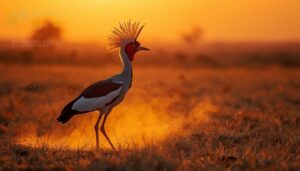
From the icy lakes of North America, we move to the sun‑scorched savannas of sub‑Saharan Africa — home to Sagittarius serpentarius, the Secretarybird. Standing roughly 1.3 meters tall with a wingspan reaching 2.1 meters, this savanna dweller is unlike any other large bird you’ll encounter.
What sets it apart:
- Ground stalking through tall grasses using keen eyesight to detect prey
- Leg kicking strikes powerful enough to stun venomous snakes instantly
- Bare facial skin around orange‑tinted eyes, reducing heat and glare
Monogamous pairing guides its nesting behavior, with both parents sharing incubation duties across clutches of two to three eggs. Though its soaring flight capability exists, this raptor’s identity belongs firmly to the ground. Conservation status remains a growing concern as grassland habitats shrink.
Dalmatian Pelican

Leaving Africa’s sun-baked savannas, Pelecanus crispus — the Dalmatian Pelican — commands freshwater wetlands from southeastern Europe to Central Asia. Its maximum wingspan reaches 3.2 m (10.5 ft), and its ornamental crest and distinctive breeding bill make it unmistakable among large flying birds.
| Maximum Wingspan | Detail | Significance |
|---|---|---|
| 3.2 m (10.5 ft) | 3.2 m (10.5 ft) | Among the longest wingspans recorded |
| Throat Pouch Mechanics | Holds several liters | Allows rapid Feeding Cooperation |
| Conservation Status | Vulnerable | Habitat loss threatens Breeding Habitat |
Migration Routes follow freshwater corridors — Conservation Threats, including wetland drainage, intensify pressure on this notable species.
Blakistons Fish Owl

From the freshwater expanses of Pelecanus crispus, we turn to the forests of East Asia, where Blakiston’s Fish Owl — Bubo blakistoni — occupies the tenth position among the largest flying birds ranked by wingspan, with a reach approaching 1.9 meters.
This bird of prey thrives through Nocturnal Solitary Behavior, patrolling Old-Growth Forest Habitat along rivers with silent precision. Riverine Nesting sites, situated 20–40 meters up in ancient tree cavities, anchor its territory.
Its conservation status is sobering — populations number only in the thousands. Endangered Conservation Efforts focus on protecting the ecosystems it can’t survive without.
- Hunts salmon and trout through Large Prey Hunting along riverbanks
- Wades into shallow water with formidable, fish-gripping talons
- Spans nearly two meters — wingspan rivaling much heavier species
- Nests exclusively within old-growth corridors near reliable water
- Faces extinction pressure from logging and riverine habitat loss
Largest Wingspan Bird Species

Every large-winged bird has its own story — shaped by where it lives, what it eats, and how it moves through the sky. Albatrosses, condors, and storks each carry distinct traits that set them apart far beyond just wingspan.
Here’s a closer look at what makes each species genuinely impressive.
Characteristics of Albatrosses
Few birds reshape what flight actually means the way the Wandering Albatross (Diomedea exulans) does. With a wingspan reaching 3.63 meters, its high aspect ratio wings — long, narrow, and rigid — are built for active soaring, harvesting energy from ocean wind gradients without a single wingbeat for hours. A specialized wing locking joint holds those wings extended without muscular fatigue.
Monogamous pairing and oceanic breeding on remote Antarctic islands define their life history.
Conservation status remains a pressing concern, as longline bycatch continues driving population decline.
| Trait | Detail | Significance |
|---|---|---|
| Wingspan | Up to 3.63 m | Longest of any living bird |
| Soaring mechanics | Active soaring | Near-zero energy expenditure |
| Wing structure | High aspect ratio | Minimizes induced drag |
| Breeding strategy | Monogamous pairing | Strengthens reproductive success |
| Primary threat | Longline bycatch | Drives conservation urgency |
Unique Features of Condors
Where the Andean Condor (Vultur gryphus) and California Condor (Gymnogyps californianus) truly distinguish themselves is in a cluster of interlocking adaptations that reward close examination. Bald head hygiene isn’t cosmetic — exposed skin resists bacterial contamination from carrion immersion. Wingtip slot efficiency reduces turbulent drag, optimizing soaring mechanics across thermal columns reaching 3,000 meters. High‑altitude thermoregulation is managed through skin coloration and posture. Males display a pronounced caruncle courtship display during breeding. Specialized scavenger gut flora neutralizes pathogens efficiently. Both species carry a vulnerable conservation status, with wing loading characteristics that demand vast, undisturbed Andean airspace:
- Wingspans approaching 3.3 meters enable near‑effortless thermal soaring across rugged terrain
- Broad, slotted primaries increase lift at low flapping frequencies, conserving energy across extensive foraging ranges
- Long-term pair bonds, reinforced through elaborate wing presentations, support a slow two-year reproductive cycle
Distinguishing Traits of Storks
Storks are unmistakable once you know what to look for. Their bill morphology — long, dagger-straight, and precisely scaled to body size — pairs with a signature neck S-curve that allows explosive prey strikes in shallow wetlands.
Bare facial skin signals breeding status, while stark plumage contrast aids species recognition across open habitats.
The Marabou Stork (Leptoptilos crumenifer) masters scavenging behavior with impressive wing loading efficiency, its broad wings optimizing soaring mechanics across African savannas.
Comparison of Bird Species Wingspans
Wingspan doesn’t lie — it’s evolution’s blueprint drawn in bone and feather, shaped entirely by where a species lives and how far it needs to travel. Consider how habitat influence sculpts each design:
- Wandering albatross (Diomedea exulans) — 3.7 m maximum wingspan, built for open‑ocean active soaring
- Great white pelican (Pelecanus onocrotalus) — 3.6 m, optimized for coastal thermal soaring
- Southern royal albatross (Diomedea epomophora) — 3.5 m, shaped by subantarctic wind gradients
- Andean condor (Vultur gryphus) — 3.3 m, engineered for mountain thermals
- Trumpeter swan (Cygnus buccinator) — 2.8 m, balancing migration distance with wetland maneuverability
Aspect ratio differences and wing loading variance among these species directly reflect ecological pressure — ocean gliders need large wing spans; forest raptors prioritize agility. Sexual dimorphism further complicates comparison, as males frequently exceed female measurements across multiple families.
Birds of Prey With Largest Wingspans

Regarding raw aerial power, birds of prey take things to a whole different level. You’re about to see how wingspan translates directly into hunting range, soaring endurance, and sheer dominance of the sky.
Here are the raptors that truly rule the open air.
Andean Condor Wingspan
Few birds command the sky quite like Vultur gryphus, the Andean Condor, whose wingspan stretches between 2.7 and 3.3 meters — placing it firmly among birds with the largest wingspan on Earth. Sexual dimorphism is evident, with males averaging broader wingspans than females. Its impressive lift-to-drag ratio and low wing loading make high‑altitude flight over cliff nesting sites virtually easy.
- Soaring ability: Condors ride thermal columns for hours without a single wingbeat, conserving energy across vast Andean scavenging territories.
Harpy Eagle Wingspan
Unlike the albatross built for open skies, Harpy Eagle (Harpia harpyja) masters a different kind of power. Its wingspan spans 176–224 cm, and Forest Flight Mechanics here favor broad, rounded wings that navigate dense canopy with precision.
Wing Loading Impacts are significant — high wing loading allows explosive acceleration during Prey Capture Dynamics, targeting sloths and monkeys. Sexual Dimorphism wings are pronounced; females reach up to 9 kg versus males at 4–5 kg.
| Trait | Measurement |
|---|---|
| Wingspan Range | 176–224 cm |
| Female Body Mass | Up to 9 kg |
| Male Body Mass | 4–5 kg |
| Body Length | 89–104 cm |
Habitat Influence shapes every aspect of this raptor’s bird morphology.
Secretarybird Wingspan
From the Harpy Eagle’s canopy mastery, we move to an entirely different kind of raptor. The Secretarybird (Sagittarius serpentarius) carries a wingspan of 1.9–2.15 meters, yet its avian anatomy is built for the ground, not the sky.
Its flight mechanics serve territory crossings and brief thermal glides — savanna flight dynamics at their most economical.
Leg hunting adaptations dominate its predatory strategy, delivering lethal strikes to snakes and lizards.
Wing loading balance enables quick takeoffs, while mating display feathers signal dominance.
Ground stalk efficiency defines this bird morphology completely.
Comparison of Bird of Prey Wingspans
From the Secretary bird’s terrestrial efficiency, shifting focus to wingspan comparisons across raptors reveals something profound about evolutionary tradeoffs. Hunting strategy, habitat influence, and flight muscle investment each sculpt a species’ span differently.
- Andean Condor (Vultur gryphus): up to 3.3 m — thermal soaring champion
- California Condor (Gymnogyps californianus): up to 3.0 m — North America’s largest raptor
- Himalayan Griffon (Gyps himalayensis): up to 3.1 m — high‑altitude ridge specialist
- Cinereous Vulture (Aegypius monachus): up to 3.0 m — Europe’s broadest‑winged scavenger
- Steller’s Sea Eagle (Haliaeetus pelagicus): up to 2.5 m — coastal power hunter
High aspect ratio wings favor scavengers covering vast distances; lower wing loading allows eagles to punch with precision over shorter spans. The comparison of wingspan and weight among bird species makes one thing clear — bigger doesn’t always mean stronger.
Adaptations for Long-Distance Flight

These birds don’t just have big wings — they know exactly how to use them. A few key adaptations separate casual fliers from nature’s true long-distance masters.
Here’s what makes their flight so remarkably efficient.
Gliding Flight Techniques
Energetic soaring is where the wandering albatross (Diomedea exulans) becomes something almost mythological. By exploiting wind gradients above ocean waves, it achieves glide ratio optimization that sustains flight across thousands of kilometres without a single wingbeat.
Its high aspect ratio wings enable wing loading balance through precise pitch‑roll coordination, minimizing induced drag at every altitude shift.
Ground effect utilization near the ocean surface further reduces sink rate—aerodynamic adaptations for soaring flight refined over millions of years of open‑ocean selection pressure.
Thermal Soaring in Scavengers
Where the albatross commands the ocean wind, continental scavengers play a different game entirely. The Andean condor (Vultur gryphus) and Marabou Stork (Leptoptilos crumenifer) have mastered thermal soaring with impressive precision — exploiting Thermal Updraft Sources generated by sunlit terrain to climb at 1.0–2.5 meters per second with virtually no flapping.
Wing Loading Dynamics favor their broad, low-aspect wings, which maintain lift during tight Circling Bank Angles within the thermal core. Social Soaring Cues help identify productive columns fast. The Energy Savings Metrics are striking — thermal soaring cuts metabolic costs by over 60%, extending soaring performance and energy efficiency across hundreds of foraging kilometers daily.
- Thermals peak mid-day, aligning perfectly with peak scavenger activity windows
- Condors circle 10–30 meters from the thermal core to increase lift
- Broad, fingered wingtips reduce drag during sustained circling flight
- Social cues from circling neighbors signal productive updrafts worth joining
Conservation of Energy in Flight
Consider what it means to fly thousands of kilometers without breaking a sweat—or in this case, without a single wingbeat.
Through High Aspect Ratio wings and Wing Loading Optimization, large soaring birds achieve impressive Metabolic Efficiency, slashing energy costs by over 60% during sustained flight.
Active Soaring and Thermal Utilization transform wind and rising air into free propulsion, maximizing glide ratio across vast distances.
The result: superb energy efficiency that lets these giants cover continents on almost nothing.
Unique Features of Pelagic Birds
Few birds command the open ocean like the Wandering Albatross and Southern Royal Albatross — masters of active soaring who extract free energy from wind gradients without a single wingbeat. Salt Gland Physiology lets them drink seawater freely, while Waterproof Feather Structure keeps them airborne through brutal seas. Oceanic Navigation Cues — wave patterns, solar angles, chemical traces — guide their long-distance migration across hemispheres.
- Active Soaring Mechanics slash energy costs over vast open water
- Pelagic Foraging Strategies target prey along productive oceanic fronts
- Salt tolerance allows continuous offshore survival without freshwater
- Waterproof plumage maintains aerodynamic integrity through storm and spray
Record-Breaking Wingspans

Some wingspans don’t just impress — they rewrite what you thought was physically possible for a flying creature. From living giants still soaring today to ancient species that make modern birds look modest, the records span millions of years of evolution.
Here’s a look at the numbers, the comparisons, and what actually drives wings to grow that large.
Largest Wingspan Ever Recorded
Among birds with the largest wingspan ever measured, the Wandering Albatross (Diomedea exulans) holds the verified record — males reaching an impressive 3.63 meters. Historical records and modern measurement techniques confirm these extremes reflect genuine extreme wing morphology, not myth:
- Wandering Albatross: up to 3.63 m (11 ft 10 in)
- Great White Pelican: up to 3.6 m (11.8 ft)
- Southern Royal Albatross: approximately 3.5 m (11.5 ft)
- Dalmatian Pelican: roughly 3.2 m (10.5 ft)
These aerodynamic limits define how far wings can evolve while sustaining powered flight.
Comparison of Extinct and Living Bird Wingspans
When you hold the wandering albatross’s 3.63-meter wingspan in your mind, it feels enormous — until you learn that Pelagornis sandersi, an extinct Miocene flyer, stretched an estimated 5.2 to 6.1 meters tip-to-tip. Argentavis magnificens pushed even further, toward 6 to 7 meters.
These extinct prehistoric giant flyers achieved impressive fossil wing morphology: elongated primaries, strong shoulder girdles, and wing aspect ratios optimized for slope soaring mechanics and glide efficiency.
Living birds with the largest wingspan can’t match those dimensions, but their lower wing loading tradeoffs deliver greater maneuverability and sustained oceanic endurance — advantages extinct giant birds, for all their scale, never fully mastered.
Factors Influencing Wingspan Evolution
Wingspan evolution isn’t random — it’s a conversation between physics, ecology, and deep ancestral history. Phylogenetic constraints inherited from common ancestors set the blueprint, while habitat wind patterns and food resource availability perfect it across generations.
Albatrosses, for instance, evolved high-aspect-ratio wings precisely because active soaring over open ocean demands narrow, stiff surfaces that shed induced drag efficiently. Condors followed a different path — broader wing morphology built for thermal columns above Andean terrain.
Three forces consistently drive these outcomes:
- Sexual dimorphism impact — larger wing loading in one sex often signals reproductive fitness
- Juvenile growth rates — rapid wing elongation before skeletal maturity locks in final proportions
- Energy requirements of massive birds — bigger species need aerodynamically efficient shapes to stay airborne economically.
Bird Flight Capabilities

A bird’s wingspan tells you more than just how wide it spreads its wings — it shapes everything about how that bird moves through the air.
Size, wing shape, and body weight all work together to determine whether a species glides effortlessly for thousands of miles or relies on rising thermals to stay aloft.
Here’s a closer look at what actually drives flight capability in the world’s largest-winged birds.
Relationship Between Wingspan and Flight
Think of a wingspan as nature’s flight contract—every centimeter earned through millions of years of evolutionary pressure. Longer wings reduce wing loading, allowing birds like Diomedea exulans to exploit active soaring across the Southern Ocean without a single wingbeat for hours.
Higher aspect ratio effects mean less induced drag, better lift generation, and dramatically lower energy requirements for massive birds. Thermal exploitation becomes simple when broad wings catch rising air columns efficiently.
| Wingspan Range | Primary Flight Strategy |
|---|---|
| Above 3.0 m | Active soaring, open ocean |
| 2.5–3.0 m | Thermal soaring, continental |
| 2.0–2.5 m | Mixed flapping and gliding |
| 1.5–2.0 m | Powered flight, short soaring |
| Below 1.5 m | Active flapping, maneuvering |
Factors Affecting Bird Flight
Wing loading—body mass divided by wing area—sits at the heart of every flight decision a bird makes. Lower wing loading frees species like Diomedea exulans to master active soaring across open oceans; higher loading pushes condors toward thermal currents for altitude gain.
What makes flight truly work is how these forces align:
- Aspect ratio determines induced drag and gliding range
- Muscle power drives sustained flapping in heavier species
- Wind shear allows energy harvesting without wingbeats
- Aerodynamic efficiency shapes long-distance endurance
- Flight mechanics balance lift, thrust, and body weight
Comparison of Bird Flight Techniques
Each species solves the same problem—staying airborne—through remarkably different means. Diomedea exulans perfects efficient soaring mechanics, harvesting energy from ocean wind gradients without a single wingbeat across thousands of kilometers. Condors master soaring and thermal updraft mechanisms, riding invisible columns of warm air over Andean ridges. Wing morphing strategies and ridge lift utilization give broader-winged species an edge at lower speeds.
- Albatrosses exploit efficient soaring over open water
- Condors circle thermals using low aspect ratio wings
- Smaller raptors combine flap bounding patterns with hovering flight mechanics for precision hunting
Wing loading effects ultimately determine which strategy wins.
Wingspan and Body Size

Wingspan tells only part of the story — body size shapes everything from how a bird hunts to how long it stays aloft. The relationship between the two is surprisingly complex, and the numbers don’t always follow the logic you’d expect.
Here’s a closer look at what drives size differences across the world’s largest flying birds.
Relationship Between Wingspan and Body Size
Body mass and wingspan don’t scale evenly—allometric scaling means wings grow faster than overall body length as birds get heavier, driving real differences in mass-wing ratio and avian morphology. Wing loading (weight divided by wing area) stays remarkably low in long-winged species, making sustained gliding possible. Aspect ratio—wing length relative to width—directly shapes how much energy a bird burns in flight, linking avian size and bone length correlation to the relationship between wingspan and flight energy efficiency.
| Species | Wingspan (ft) | Body Weight (lbs) |
|---|---|---|
| Wandering Albatross | 12.1 | 17 |
| Andean Condor | 10.8 | 33 |
| Trumpeter Swan | 10.0 | 33 |
| Marabou Stork | 9.5 | 20 |
| Kori Bustard | 8.1 | 42 |
Notice how the Kori Bustard, outweighs everyone yet has the shortest wingspan—wing loading effects and species size comparison reveal that raw mass without proportional wing area makes sustained soaring nearly impossible.
Comparison of Bird Body Sizes
Raw mass alone doesn’t tell the whole story. Skeletal scaling, ontogenetic growth patterns, and regional size variation all shape how birds develop proportionally. Consider the Great White Pelican—its 15 kg frame pairs with a 3.6 m wingspan, while the Wandering Albatross achieves similar reach at nearly half that weight. Sexual dimorphism adds another layer: female raptors routinely outmass males considerably.
- Mass vs Wingspan: Albatrosses span 3.6 m yet weigh roughly 7 kg
- Sexual Dimorphism: Female raptors outweigh males by 20–50%
- Skeletal Scaling: Bone density and limb proportions shift across ecological niches
- Regional Size Variation: Ocean species prioritize span; terrestrial birds favor muscular bulk
Factors Influencing Bird Body Size
interlocking forces set the biological limits to avian flight size, and understanding them reshapes how you see these giants.
Metabolic rate scales with body mass — larger birds burn more fuel and demand richer returns from their environment.
Food availability during critical growth windows is decisive: protein-heavy diets build the skeletal mass needed to support the energy requirements of massive birds in flight.
Temperature effects alter hormone-driven growth pathways, while genetic heredity establishes hard ceilings on achievable size within any lineage.
Life history strategy matters too — long-lived species invest in size for survival advantages.
Habitat requirements for soaring birds favor expansive open terrain, and wing loading ultimately determines whether avian size and weight records translate into functional, efficient flight.
Unique Bird Adaptations

Birds don’t just have big wings — they’ve evolved some genuinely surprising tools for surviving in wildly different worlds. From standing in freezing oceans to stalking prey through dense forest canopies, each species has its own set of tricks that make it impressive.
Here’s a closer look at four birds whose adaptations tell that story best.
Marabou Stork Adaptations
The Marabou Stork (Leptoptilos crumenifer) doesn’t win beauty contests, but evolution rarely favors aesthetics over function. Its bald head thermoregulation system keeps exposed skin cool in sub‑Saharan heat while preventing bacterial contamination during scavenger feeding mechanics at carcass sites.
Wing morphology efficiency—broad, high‑loading wings built for thermal soaring—powers energy efficient flight across vast savannas.
Leg strength and carcass stability allow extended standing at feeding sites.
Social nesting behavior in dense colonies reinforces scavenger ecology through coordinated resource access.
- Bare head and neck minimize feather contamination during carrion feeding
- Acidic digestive enzymes neutralize dangerous pathogens in decomposing matter
- Broad wings enable fluid soaring with minimal energy expenditure
- Powerful legs provide stability at competitive, crowded carcass sites
- Colonial nesting structure establishes hierarchy and coordinated foraging access
Harpy Eagle Adaptations
Few raptors command attention like Harpio harpyja, whose vision mechanics and talon strength reshape what powered flight and ambush predation can achieve. Hallux claws exceeding 12 cm deliver crushing force, securing sloths and primates with lethal precision. Short broad wings enhance canopy maneuverability, reducing energy expenditure in flight through dense forest structure.
Stealth hunting from elevated perches precedes swift vertical strikes, while reinforced nest construction facilitates seasons of reuse.
| Adaptation | Feature | Function |
|---|---|---|
| Vision Mechanics | Binocular overlap, rod-dense retina | Precision targeting, low-light hunting |
| Talon Strength | Hallux claw >12 cm | Grips arboreal prey securely |
| Canopy Maneuverability | Short, broad wing loading | Navigates dense forest efficiently |
Cassowary Adaptations
Cassowaries (Casuarius spp.) traded flight adaptation for something altogether different — survival through specialization. As a flightless species traversing Australia and New Guinea’s dense rainforests, every anatomical feature fulfills a precise ecological function, shaped by habitat specialization over millions of years.
- Claw Defense — The inner toe claw reaches 5 cm, delivering lethal force against predators.
- Casque Thermoregulation — Blood‑vessel‑rich casques regulate head temperature and enable Vocal Resonance through low‑frequency calls.
- Low Light Vision — Large eyes support twilight foraging with minimal energy conservation trade‑offs.
- Fruit Diet — Seed dispersal through ingestion regenerates rainforest structure continuously.
Emperor Penguin Adaptations
Emperor penguins (Aptenodytes forsteri) don’t soar on thermal lift or active soaring — they’ve traded wingspan entirely for survival mastery in one of Earth’s harshest environments.
Feather Insulation from interlocking barbules and dense plumage maintains core temperature below −60°C. Huddling Thermoregulation reduces metabolic loss across thousands of rotating individuals.
Their Sleek Body minimizes drag at depth, while Dive Physiology allows 500-meter descents through bradycardia and elevated myoglobin.
A synchronized Molting Cycle preserves waterproofing continuously.
Regarding energy conservation and thermoregulation in large birds, few species match their precision.
Evolution of Bird Wingspans

Bird wingspans didn’t get this impressive by accident — they’re the result of millions of years of evolutionary pressure shaping every feather and bone.
What drove some species toward 11-foot spans while others stayed compact comes down to survival, habitat, and flight strategy.
Here’s a look at the key forces and features that explain why wingspan evolution unfolded the way it did.
Evolutionary Pressures on Bird Wingspans
Wingspan didn’t evolve by accident—it was shaped by survival, one generation at a time.
Four key pressures drove these significant transformations:
- Habitat openness selects for longer, high aspect ratio wings in species traversing unobstructed ocean and mountain environments.
- Predation pressure favors shorter, more maneuverable wings where rapid escape outweighs soaring efficiency.
- Resource scarcity pushes pelagic foragers toward active soaring mastery, exploiting wind gradients over featureless seas.
- Mating competition can reinforce wing morphology through selection on endurance and display flight capability.
The role of wing morphology in habitat specialization, combined with evolutionary adaptations for long-distance flight, explains why flight mechanics of giant birds remain nature’s most precise engineering solutions.
Comparison of Bird Wingspan Evolution
Evolutionary pressures don’t operate in isolation — Genetic Constraints and Atmospheric Influence work together to carve wing anatomy across deep time. Paleo-Wingspan Evidence from pelagornithids, with estimated spans near 5 meters, confirms that Biomechanical Scaling once reached extremes that are now impossible under modern metabolic limits.
Today’s Morphological Trade-offs are visible everywhere:
- Ocean gliders: Albatrosses evolved narrow, high-aspect wings — the role of wing morphology in habitat specialization made real.
- Thermal riders: Vultures developed broad, slotted wings for efficient updraft capture.
- Mountain soarers: Condors refined wide wingspans for Andean ridge-lift corridors.
- Speed specialists: Swifts traded wingspan for compact agility.
Comparison of albatross and pelican wing morphology reveals how evolutionary adaptations for long-distance flight shaped birds with the largest wingspans differently across lineages.
Unique Features of Bird Wingspans
Each wing design tells a distinct story about survival. The wandering albatross’s high aspect ratio wings — long, slender, built for swift soaring across thousands of ocean kilometers — depend on several interlocking adaptations. Pneumatic bone structure lightens the frame without sacrificing strength, while wing loading reduction allows sustained gliding on minimal energy. The dihedral wing angle stabilizes flight through crosswinds, keeping the bird level across open seas.
Feather slot design and primary feather overlap work together like precision engineering: stiff primaries lock airflow during long glides, flexible secondaries fine-tune lift. Condors and pelicans deploy broader wings — lower aspect ratios suited for thermal columns rather than ocean corridors.
Gliding efficiency, then, isn’t one solution. It’s dozens, each shaped by habitat, body mass, and millions of years of refinement in the flight mechanics of birds with extreme wingspans.
Frequently Asked Questions (FAQs)
What is the biggest flying bird in the world?
Like a ship’s sail unfurling across the Southern Ocean, the wandering albatross (Diomedea exulans) reigns as the record holder — its 63 m wingspan, agile soaring mastery, and vast habitat range make it the undisputed king of the skies.
Which bird has the longest wingspan?
The Wandering Albatross holds the record among living species, with wingspans reaching 7 meters — built for oceanic endurance through impressive wing morphology factors, shaped by evolutionary trade-offs across its vast geographic range.
What is a large flying bird?
A large flying bird combines significant body mass with large flight surfaces — think wingspans exceeding 2 meters and wing loading ratios tuned for active soaring, thermal riding, or sustained migration across vast, habitat-specialized territories.
What bird has a wingspan of 5 feet?
At roughly 10ft 6in, both the Andean Condor and Great White Pelican claim this wingspan standard.
Their wing morphology, built for thermal soaring, perfectly suits each species’ ecological niche across vastly different continents.
What bird has a 24 foot wingspan?
To find a bird with a 24-foot wingspan, you’d need a time machine.
Pelagornis sandersi, a Mesozoic giant bird with impressive fossil wing structure, holds the prehistoric wing record—an extinct avian giant surpassing every living species alive today.
Is an albatross bigger than a California Condor?
Yes — the Wandering albatross generally edges out the California Condor in wingspan, stretching to 5 m versus the condor’s 5–0 m, though condors can outweigh them due to their stockier build.
Is a condor bigger than a golden eagle?
Condors absolutely dwarf golden eagles. The Andean condor’s wingspan stretches up to 3 meters versus the golden eagle’s 3 meters, and its mass comparison tells the same story — nearly triple the weight.
Is a condor the biggest flying bird?
Not quite. While the Andean condor dominates Andean thermals with wingspans reaching 3 meters, the wandering albatross surpasses it, stretching to 63 meters — making it the true wingspan record-holder among living birds.
What bird has an 8 foot wingspan?
Several birds carry wingspans near 8 feet — the Kori Bustard, Sarus crane, and Trumpeter Swan among them.
These mid-size soaring birds showcase habitat-specific adaptations, with regional wing lengths shaped by flight speed estimates and wing loading analysis.
Which bird has the largest wingspan?
The wandering albatross (Diomedea exulans) holds the record, with wingspan measurements confirmed up to 63 m (11 ft 10 in) — a figure that aerial morphology studies and historical records consistently validate across Southern Ocean populations.
Conclusion
Every outstretched wing is a blueprint written by time—a living equation between bone, feather, and wind. The largest wingspan bird species didn’t simply grow bigger; they became specialists in survival, each adaptation a precise answer to an unforgiving sky.
Studying them reveals something quietly profound: nature doesn’t waste engineering.
The wandering albatross, the condor, the pelican—they don’t just fly. They demonstrate, with every smooth glide, exactly how far elegant design can carry a creature.