This site is supported by our readers. We may earn a commission, at no cost to you, if you purchase through links.
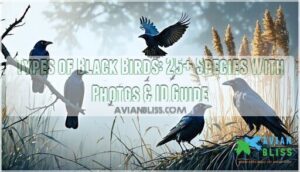 You’ll find over 25 types of black birds across North America, from massive Common Ravens with diamond-shaped tails to smaller European Starlings that shimmer with iridescent speckles.
The brainy American Crow dominates urban areas, while Red-winged Blackbirds flash scarlet shoulder patches in marshes.
Common Grackles strut with boat-shaped tails and piercing yellow eyes, and sneaky Brown-headed Cowbirds practice brood parasitism.
Each species reveals its identity through distinct features—beak shapes hint at their diet, while unique calls help you distinguish a crow’s harsh "caw" from a raven’s rolling "gronk-gronk."
Size, behavior, and habitat preferences create a fascinating identification puzzle that’s easier to solve than you’d think, with distinct features and unique calls being key to understanding these birds.
Table Of Contents
- Key Takeaways
- Black Bird Species
- Black Bird Identification
- Large Black Birds
- Small Black Birds
- Black Bird Conservation
- Frequently Asked Questions (FAQs)
- What are the different types of blackbirds?
- Where do black birds live?
- What does a blackbird look like?
- What are black birds?
- What birds look like blackbirds?
- What are the most fascinating black birds in the United States?
- What are those common black birds called?
- How many different types of black birds are there?
- What is a black bird that is not a crow or raven?
- What bird is similar to a blackbird?
- Conclusion
Key Takeaways
- You’ll identify black birds more easily by focusing on size, tail shape, and distinctive calls rather than just color—ravens have wedge-shaped tails and deep "gronk-gronk" calls, while crows show square tails and harsh "caw" sounds
- You can distinguish species through unique field marks like Red-winged Blackbirds’ scarlet shoulder patches, Common Grackles’ piercing yellow eyes and boat-shaped tails, and European Starlings’ iridescent plumage that changes seasonally
- You’ll find these birds aren’t actually just "black"—most display stunning iridescent colors ranging from purple-green sheens on grackles to bronze bodies on starlings, revealing hidden beauty when light hits their feathers properly
- You’ll encounter over 25 black bird species across North America with vastly different behaviors, from Brown-headed Cowbirds‘ sneaky brood parasitism to American Crows’ remarkable problem-solving intelligence that rivals primates
Black Bird Species
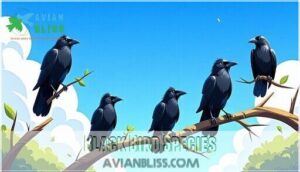
You’ll encounter over 25 black bird species across North America, from the familiar American Crow to the iridescent Common Grackle.
Learning to identify these birds becomes easier when you understand their key features like size, calls, and distinctive markings.
Master the art of black bird identification by focusing on size, calls, and key field marks that make each species unique.
American Crow Features
Recognizing American Crows becomes easier when you understand their distinctive Corvidae family traits. These Black Birds showcase remarkable Crow Intelligence through problem-solving abilities and complex Social Behavior within their communities.
American Crow identification features include:
- All-black plumage with glossy sheen that catches sunlight beautifully
- Robust, straight beak perfect for their diverse Foraging Strategies
- Square-shaped tail feathers visible during their characteristic Flight Patterns
Their Nesting Habits involve building stick platforms in tree forks, while their intelligence rivals that of primates. You’ll spot these adaptable Black Bird Species thriving everywhere from urban parks to rural farmlands, making Bird Identification straightforward once you know what to look for.
Common Raven Traits
Common Ravens display extraordinary Bird Intelligence through sophisticated problem-solving that rivals primates in Intelligence Studies.
These Corvidae members feature robust builds with Iridescent Plumage and distinctive wedge-shaped tails.
Raven Behavior includes complex Social Structure with lifelong pair bonds and cooperative parenting.
Their Adaptive Abilities shine through diverse Foraging Tactics – from cracking nuts to scavenging roadkill, making them nature’s ultimate opportunists among Black Birds.
European Starling Appearance
You’ll spot European Starlings by their feather color transformation throughout seasons.
Their iridescent plumage shimmers with purple-green hues during breeding season, creating stunning iridescence patterns that catch sunlight beautifully.
Winter brings white spots across their black bird species plumage, resembling scattered stars.
Their pointed beak shape turns bright yellow in spring, contrasting sharply with dark eye color.
The plumage texture appears glossy and smooth, making European Starling identification straightforward.
These adaptable black birds showcase nature’s artistry through their ever-changing bird plumage displays.
Red-Winged Blackbirds
Red-winged blackbirds showcase brilliant scarlet shoulder patches that make identification effortless across North America’s diverse landscapes. You’ll find these adaptable black bird species thriving everywhere from cattail marshes to suburban parks, with populations reaching an impressive 190 million birds.
Males perform spectacular territorial displays during breeding season, flashing their vibrant red wing coloration while belting out their signature "konk-la-ree" calls. This aggressive bird socialization helps secure prime red wing habitat for their brown-streaked mates.
- Nesting behavior involves females weaving intricate cups among marsh vegetation
- Blackbird migration patterns shift them from wetlands to agricultural fields seasonally
- Massive winter flocks create mesmerizing aerial displays across farmlands
- Their RedWinged Blackbird calls echo through wetlands, announcing territorial boundaries
These black birds represent one of North America’s most successful blackbirds, adapting remarkably well to human-modified landscapes while maintaining their wild essence.
Common Grackles
In backyard battlegrounds, Common Grackles strut with unmistakable swagger. These Iridescent Feathers shimmer purple-blue on heads, bronze on bodies, creating nature’s oil-slick effect. You’ll recognize their piercing yellow eyes and wedge-shaped tails instantly.
Grackle Behavior showcases remarkable intelligence—they’ll crack tough seeds by dunking them in water. Their Foraging Strategies include ground-walking with deliberate steps, flipping leaves methodically. During Migration Patterns, massive Flock Dynamics create thunderous clouds of thousands.
These black bird types adapt everywhere from wetlands to parking lots, making them essential entries on any black birds list.
| Feature | Details |
|---|---|
| Size | 11-13 inches, larger than robins |
| Signature Look | Iridescent head meets bronze body |
| Voice | Harsh "chack" calls, squeaky notes |
| Habitat | Everywhere—fields, cities, marshes |
Common Grackles dominate feeders with confident attitudes, earning spots among North America’s most recognizable black feather birds.
Brown-Headed Cowbirds
Throughout North America, Brown-Headed Cowbirds revolutionize reproduction through their sneaky brood parasitism strategy, freeing themselves from traditional nesting duties.
Males display glossy black bodies with distinctive brown heads, while females wear subtle gray-brown feather patterns that help them blend in during their covert operations.
- Brood parasitism experts – they’ll drop eggs in over 220 different host species’ nests
- Cowbird behavior includes following grazing animals to catch stirred-up insects
- Song variations range from liquid gurgles to mechanical squeaks and whistles
- Ground-feeding specialists who forage alongside cattle and other livestock
- BrownHeaded Cowbird flocks often mix with Common Grackle and other black bird types during migration
Their ability to adapt to various habitats is influenced by their parasitic breeding strategies, making them a unique species.
Black Bird Identification
You’ll find black bird identification easier when you focus on five key features: size, shape, calls, habitat, and plumage details.
Start with overall body size and tail length, then listen for distinctive vocalizations that often reveal species identity before you even see the bird clearly, using calls to help with identification.
Size and Shape Differences
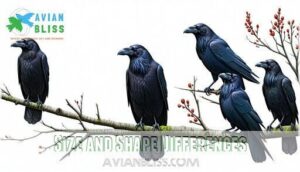
Size matters when identifying black bird species. Common Ravens measure 22-27 inches with massive 46-60 inch wing spans, dwarfing American Crows at 16-21 inches.
European Starlings stay compact at just 8-9 inches, while Red-winged Blackbirds reach 7-9 inches. Body proportions tell the story too – Ravens sport wedge-shaped tails and sturdy beaks, Crows show rounded tails, and Grackles flash impressively long rudders.
Feather length varies dramatically across species. Understanding blackbird species is vital for accurate identification and conservation efforts.
Distinctive Calls and Songs

While physical features help identify black birds, their bird vocalizations reveal even more.
American Crows deliver straightforward "caw-caw" call patterns, but European Starlings showcase vocal versatility through complex mimicry.
Listen for Red-winged Blackbirds’ territorial "konk-la-ree!" or Common Ravens’ intricate gurgles.
These distinctive vocalizations and melodic variations serve as audio fingerprints, making identification easier when you can’t see the bird clearly.
Understanding bird call recordings is essential for identifying species based on their unique sounds.
Habitat and Distribution
Black bird distribution reveals fascinating patterns across diverse ecosystems.
Wetland Habitats support red-winged blackbirds from Alaska to Guatemala, with millions gathering in winter roosts.
Forest Ecosystems shelter ravens throughout the Holarctic, reaching 20,600 feet in mountain terrain.
Common grackles dominate Grassland Distribution east of the Rockies, thriving where forests meet farmland.
Urban Environments welcome adaptable crows and starlings, who’ve mastered city living from parks to rooftops.
Migration Patterns vary dramatically—northern populations head south while southern birds stay put year-round.
Black bird habitats overlap substantially, creating identification challenges.
Ravens avoid deserts but embrace tundra, while starlings stick to lowlands.
Understanding bird distribution helps you predict which species you’ll encounter.
These urban habitats and wetland habitats shape viewing opportunities, making location your best identification tool.
The common grackle’s omnivorous diet plays a vital role in its ability to thrive in various environments.
Plumage and Coloration
You’ll notice dark feathered birds reveal stunning diversity beyond their shadowy appearance.
Iridescence transforms ordinary black birds into living prisms—grackles shimmer with purple-blue heads, starlings flash green highlights.
Feather patterns distinguish species instantly: cowbirds sport chocolate-brown caps, while wing markings help separate ravens from crows.
Tail feathers vary dramatically too.
These black bird characteristics make bird plumage identification surprisingly straightforward once you know what to look for.
Beak and Tail Characteristics
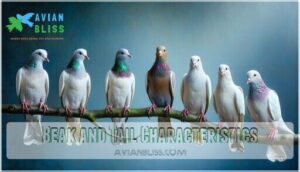
When identifying black birds, their beak shapes and tail length serve as your roadmap to proper classification.
Beak Shapes vary dramatically among species:
- Crows sport straight, multipurpose bills for diverse diets
- Ravens display heavier, curved beaks built for tearing
- Starlings feature pointed bills that spread wide when ground-probing
- Cowbirds show compact, seed-cracking beaks
Black bird characteristics become clearer when you notice tail length differences. Grackles fold their long, keel-shaped tails like boats during flight, while cowbirds keep shorter, squared-off tails. These bird beak and bird tail features reveal identification secrets faster than feather tips alone.
Large Black Birds
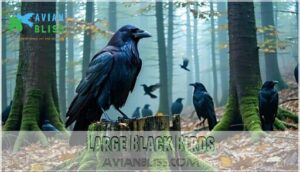
You’ll encounter some of the most impressive and intelligent birds when spotting large black species like American Crows, Common Ravens, and Black Vultures.
These commanding birds showcase remarkable problem-solving abilities and complex social behaviors that’ll surprise you with their crow-like cunning.
American Crow Habitat
American Crow’s adaptability makes them nature’s ultimate survivors.
You’ll spot these intelligent black bird habitats enthusiasts everywhere from bustling cities to quiet farmlands.
Their Urban Adaptation skills are remarkable—they thrive in parks, suburbs, and downtown areas where skyscrapers replace trees.
In rural settings, crows master Forest Ecology dynamics, choosing Nesting Sites in tall trees while foraging in nearby fields.
Unlike Black Vulture or Common Raven species, American Crow populations don’t follow strict Migration Patterns—they’re year-round residents in most areas.
Their Foraging Strategies include everything from roadkill cleanup to backyard birdfeeders.
Supporting bird habitat conservation helps protect these clever corvids from habitat loss.
Common Raven Behavior
While crows stick to familiar territories, ravens break free from routine with their remarkable Raven Intelligence and Adaptive Behavior.
These corvids showcase advanced Problem Solving abilities that’ll surprise you – they’re practically aerial engineers with feathers.
Common Raven behaviors that demonstrate their smarts:
- Social Learning: Ravens teach each other new Foraging Strategies, passing knowledge through generations like feathered professors
- Tool mastery: They bend twigs into hooks and use stones as hammers, showing black bird behaviors that rival primates
- Complex communication: Their varied calls create a "raven language" that coordinates group activities and warns of danger
Ravens don’t just survive – they thrive through bird behavior that adapts to any challenge nature throws their way.
Black Vulture Wingspan
Black vultures soar with impressive 4.5-5.6 foot wingspans, making them unmistakable against the sky.
Their distinctive flight patterns – quick wingbeats followed by steady gliding on flat wings – are a notable characteristic.
Their wing structure creates efficient bird soaring capabilities, though slightly smaller than turkey vultures.
The black vulture’s vulture identification features are essential for distinguishing them from other species.
| Feature | Black Vulture |
|---|---|
| Wingspan | 54-66 inches |
| Flight Style | Quick beats + gliding |
| Wing Position | Flat during soars |
| Size Variation | Larger in North America |
| Identification | Easy due to bird size |
Their black wings and vulture flight mechanics make identification straightforward across diverse habitats, utilizing their efficient bird soaring to navigate through the air with ease, and their quick wingbeats to cover large distances.
Crow and Raven Intelligence
Beyond their impressive wingspans, corvids represent nature’s brainiacs. You’ll witness Avian Intelligence that rivals primates when observing these remarkable Black Birds.
Problem Solving comes naturally—ravens tackle multi-step puzzles involving seven manipulations without prior training. Their Brain Structure contains neuron densities matching primates, despite smaller size. Tool Use reaches sophisticated levels as New Caledonian crows craft hooked implements, boosting foraging efficiency tenfold.
Social Learning defines corvid culture. They recognize human faces for seventeen years and teach offspring who’s dangerous. Innovative Behavior emerges through counting abilities—crows vocally count up to four, planning caws like toddlers learning numbers.
Bird intelligence studies reveal corvids outperform great apes in planning tasks. Black bird intelligence extends beyond survival instincts into abstract reasoning territory.
- Ravens solve puzzles requiring seven sequential steps
- Crows remember individual human faces for decades
- Both species demonstrate numerical cognition abilities
- Tool modification shows cultural transmission patterns
- Social hierarchies involve complex vocal communications
Scavenging and Foraging Habits
Large black birds employ diverse foraging strategies to secure food sources year-round.
You’ll observe scavengers like crows and ravens using remarkable intelligence for bird foraging, switching from insect hunting during summer to carrion feeding in winter.
Their seed consumption varies seasonally too.
These bird foraging behaviors help with black bird identification when you’re spotting different black birds in the field.
Understanding bird feeder options is vital for attracting various species to your backyard.
Small Black Birds
When you’re trying to identify smaller black birds, you’ll find they’re often more colorful than they first appear.
European Starlings sport iridescent green and purple sheens, while Red-winged Blackbirds flash brilliant red shoulder patches that’ll catch your eye from across a field.
European Starling Identification
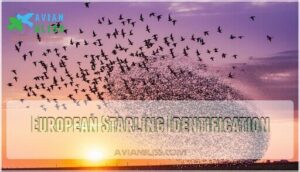
You’ll recognize European Starling by their Beak Shape – slender and pointed, perfect for probing.
These starlings display stunning Feather Patterns with iridescent purple-green plumage that transforms to spotted winter coats.
Watch for their distinctive Starling Behavior and Flocking Habits as they gather in massive groups.
During migration, they create spectacular Murmuration Forms – swirling aerial dances that’ll leave you mesmerized.
For black bird identification, note their chunky build and short tail compared to other black birds.
Brown-Headed Cowbird Nesting

You’ll never catch a Brown-headed Cowbird building its own nest.
These clever brood parasites dump their eggs in other birds’ homes, letting unsuspecting hosts raise their young.
With over 220 host species identified, cowbirds have mastered this nesting strategy.
This egg laying approach frees them to focus on finding mates rather than parenting duties—though it devastates smaller blackbirds and songbird populations.
Red-Winged Blackbird Mating
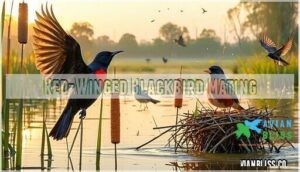
You’ll witness spectacular courtship rituals when redwinged blackbird males flash their crimson shoulder patches during breeding seasons.
These territorial defense displays include aggressive posturing and distinctive mating calls that echo across wetlands.
Females evaluate potential mates based on territory quality rather than flashy colors.
Once paired, both partners collaborate on nesting habits, weaving cup-shaped structures in marsh vegetation.
This bird mating behavior showcases how black birds balance competition with cooperation for reproductive success.
Small Black Bird Migration Patterns
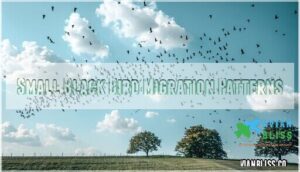
During spring and fall migration seasons, small black birds undertake remarkable journeys along established flyway routes.
You’ll witness these impressive bird migration patterns:
- Red-winged Blackbirds travel up to 2,000 miles, with males arriving first at breeding grounds
- Common Grackles form massive flocks exceeding one million birds during southbound migrations
- Brown-headed Cowbirds make shorter 530-mile trips with highly variable individual routes
Bird tracking reveals fascinating flock dynamics and strategic habitat stops during black bird migration.
Diet and Foraging Habits

You’ll discover that small black birds pack impressive appetites into tiny bodies.
Their bird feeding habits shift dramatically with seasons, making them masters of adaptation.
Black bird diet strategies reveal fascinating survival tactics:
- Seed Consumption – Red-winged Blackbirds crack tough grass seeds with precision beaks
- Insect Hunting – European Starlings probe lawns for grubs and beetles
- Fruit Eating – Brown-headed Cowbirds strip berries from bushes in fall
- Carrion Feeding – Some species scavenge roadkill when protein’s scarce
- Foraging Strategies – Mixed flocks share feeding locations for safety
Bird foraging patterns follow predictable rhythms. You’ll spot these black birds hitting berry patches at dawn, then switching to insect-rich areas by midday.
They’re opportunistic feeders who’ll empty your bird feeder one morning and hunt flies the next. This flexible diet keeps them thriving across diverse habitats year-round.
Understanding bird feeding basics is essential for attracting and supporting these birds in your garden.
Black Bird Conservation

You’ll discover that many black bird species face serious conservation challenges, from habitat loss to population declines exceeding 85% in some cases.
Understanding these threats helps you appreciate why protecting wetlands, forests, and grasslands becomes essential for species like the California Condor and Rusty Blackbird.
Threats to Black Bird Populations
Despite their apparent abundance, black birds face mounting survival challenges that threaten their populations nationwide.
Habitat Loss destroys critical breeding grounds, while Climate Change dries essential wetlands. Pollution Effects contaminate food sources, and building collisions kill millions annually. Fragmentation isolates populations, making recovery difficult.
| Primary Threat | Impact Level | Affected Species |
|---|---|---|
| Habitat Loss | Severe | Red-winged Blackbirds |
| Climate Change | Moderate | Common Grackles |
| Pollution Effects | High | European Starlings |
These combined pressures create a perfect storm for bird population declines, pushing even common species toward threatened status.
Habitat Preservation Efforts
Scientists’ habitat preservation efforts release freedom for declining black bird populations through strategic conservation initiatives.
These targeted approaches restore essential ecosystems:
- Wetland Restoration programs rebuild marshlands where Red-winged Blackbirds and Yellow-headed Blackbirds thrive
- Forest Conservation projects protect nesting corridors for species like American Crows and Common Ravens
- Urban Planning initiatives create green Wildlife Corridors connecting fragmented habitats within city landscapes
Effective Ecosystem Management combines bird habitat preservation with community involvement, ensuring bird conservation efforts address habitat loss systematically across North America’s diverse landscapes.
Conservation efforts often rely on bird conservation products to support their initiatives.
Research and Monitoring Initiatives
Modern technology transforms how you track and monitor black bird populations.
Citizen Science programs like eBird and Project FeederWatch let you contribute observations that scientists use for Species Tracking and population analysis.
GPS units and nanotags reveal migration routes, while Bird Surveys document breeding success.
Habitat Mapping shows critical nesting areas, and color-ring studies track individual birds across seasons.
These bird research initiatives provide data that drives Conservation Efforts and protects vulnerable species like Rusty Blackbirds.
Protected Black Bird Species
Several black bird species receive federal protection under the Endangered Species Act and Migratory Bird Treaty Act.
The California Condor represents one of conservation efforts’ greatest success stories, recovering from near-extinction through dedicated species preservation programs.
Bird sanctuaries across North America shelter vulnerable populations like Tricolored Blackbirds and Rusty Blackbirds.
Habitat protection laws safeguard breeding grounds, while protected black birds benefit from research initiatives monitoring population trends and bird conservation status updates.
Effective bird species preservation requires a thorough approach to conservation, including efforts focused on habitat conservation.
Human Impact on Black Bird Ecosystems
Human activities substantially affect black bird conservation efforts across North America.
Habitat destruction from urban development eliminates nesting sites, while pollution effects reduce insect availability. Climate change disrupts migration timing, creating mismatches with food sources.
Your actions directly influence local populations through three key areas:
- Ecosystem disruption – Window strikes and outdoor cats kill millions annually
- Human fragmentation – Roads and buildings divide territories
- Bird habitat loss – Pesticide use eliminates food webs
Simple changes like native plantings, keeping cats indoors, and reducing chemical treatments support human impact mitigation. These bird conservation efforts help maintain healthy black birds populations despite ongoing environmental pressures.
Frequently Asked Questions (FAQs)
What are the different types of blackbirds?
You’ll find several distinct blackbird species, each with unique characteristics.
Red-winged Blackbirds sport vibrant shoulder patches, while European Starlings display iridescent plumage.
Brown-headed Cowbirds practice brood parasitism, and Great-tailed Grackles showcase remarkable intelligence across diverse habitats.
Where do black birds live?
You’ll discover black birds across diverse habitats worldwide – from wetlands and forests to urban areas and grasslands.
They’ve adapted remarkably well to human environments, thriving in backyards, farms, and cities alongside their natural woodland homes.
What does a blackbird look like?
Blackbirds display glossy, iridescent black plumage that shimmers with blue, green, or purple hues in sunlight.
You’ll notice their sleek bodies, pointed beaks, and bright yellow or orange eyes that stand out against their dark feathers, showcasing their overall iridescent appearance.
What are black birds?
Black birds soar through skies, perch on branches, dive through waters.
You’ll spot these intelligent creatures displaying glossy feathers ranging from coal-black to iridescent purples and greens, adapting across diverse habitats worldwide, showcasing their ability to thrive in various environments with iridescent hues.
What birds look like blackbirds?
You’ll spot several species resembling blackbirds: crows (all-black, intelligent), grackles (iridescent purple-black), starlings (glossy with speckles), ravens (larger, wedge-shaped tails), and cowbirds (males have brown heads, females brownish overall).
What are the most fascinating black birds in the United States?
You’ll find American Crows using tools and recognizing faces, while intelligent Ravens solve complex puzzles.
Pileated Woodpeckers drum dramatically on trees, and murmurating Starlings create mesmerizing aerial dances that’ll leave you speechless.
What are those common black birds called?
Common black birds you’ll spot include American Crows, European Starlings, Red-winged Blackbirds, Brown-headed Cowbirds, Common Grackles, and Dark-eyed Juncos.
These corvids, icterids, and other families dominate backyards nationwide with their adaptable nature.
How many different types of black birds are there?
You’ll find dozens of black bird species worldwide, including crows, ravens, grackles, blackbirds, cowbirds, and starlings. Each family contains multiple species with unique characteristics and habitats.
What is a black bird that is not a crow or raven?
You’ll encounter several beautiful alternatives like the Red-winged Blackbird with striking red shoulder patches.
European Starlings displaying iridescent green-purple sheen, or Brown-headed Cowbirds featuring distinctive brown heads contrasting their glossy black bodies.
What bird is similar to a blackbird?
You’ll recognize European Starlings as blackbird cousins—they’re chunky with iridescent plumage, speckled winter coats, and yellow beaks.
These adaptable birds flock together, mimicking sounds brilliantly while thriving in urban environments.
Conclusion
Ironically, while you’ve spent time learning to identify these types of black birds, you’ll discover they’re rarely just "black"—most shimmer with hidden colors and unique patterns.
From the Common Raven’s diamond tail to the Red-winged Blackbird’s scarlet patches, each species tells its story through size, shape, and behavior.
With practice, you’ll confidently distinguish their calls and habitats, transforming what once seemed like identical dark shapes into a diverse community of remarkable birds.