This site is supported by our readers. We may earn a commission, at no cost to you, if you purchase through links.

American Robin patrolling your yard isn’t wandering — it’s enforcing a boundary you can’t see. Songbirds carve their environment into defended zones with the precision of property surveyors, and most backyard birders never notice the invisible lines.
At Hubbard Brook Experimental Forest in New Hampshire, decades of fine‑scale mapping revealed that territory size shifts dramatically with food density, predator pressure, and neighbor competition — sometimes compressing into a single hedgerow. Backyard songbird territory maps make those hidden patterns visible, turning casual observation into something sharper: a real‑time read of habitat quality, breeding pressure, and long‑term population health right outside your window.
Table Of Contents
- Key Takeaways
- What Are Backyard Songbird Territory Maps?
- How Songbird Territories Are Established
- Key Songbird Species and Their Ranges
- Interpreting Songbird Territory Maps
- Digital Tools for Mapping Songbird Territories
- Behavior Linked to Songbird Territories
- Conservation Insights From Territory Mapping
- Climate and Habitat Impacts on Territories
- Creating Bird-Friendly Backyard Territories
- Tips for Backyard Songbird Observation
- Frequently Asked Questions (FAQs)
- What is the number one killer of songbirds?
- Do House Finches stay in groups?
- What is the best bird database?
- What do birds do to mark their territory?
- How do songbirds respond to neighboring territory intrusions?
- Can multiple songbird species share overlapping territories?
- Do urban environments affect songbird territory establishment?
- How does songbird territory size vary by species?
- What role do juveniles play in territory acquisition?
- Conclusion
Key Takeaways
- Songbird territory maps reveal hidden boundaries in your yard, showing how birds carve out space based on food, predators, and neighbor competition.
- Tracking territory shifts across seasons and species gives you a real-time read on habitat quality, breeding pressure, and population health.
- Digital tools like eBird and YardMap turn your observations into actionable data, connecting backyard sightings to regional conservation and habitat management.
- Creating bird-friendly spaces with native plants, water sources, and safe feeders directly shapes which species claim your yard and how they thrive year-round.
What Are Backyard Songbird Territory Maps?
Backyard songbird territory maps are more useful than most birders realize — they’re not just pretty range graphics, they’re working tools that decode where birds live, move, and defend space.
Tools like this interactive songbird range finder pull from millions of real sightings to show exactly when and where species show up in your area.
Once you understand how to read them, your whole yard starts making more sense. Here’s what you need to know to get started.
Definition and Purpose
Backyard songbird territory maps zero in on fine-scale spaces — hedges, trees, feeders, lawns — rather than broad regional ranges.
Each map captures the defended area one bird or mated pair actively holds during breeding season.
That ecological boundary analysis turns raw sightings into geospatial data visualization you can actually use: understanding habitat quality at a glance, supporting smarter conservation planning, and building real educational value from your own yard.
The insights build on decades of songbird mapping in New Hampshire’s Hubbard Brook Experimental Forest.
Types of Territory Maps
Not all territory maps work the same way. Fixed vs Floating maps reveal whether a species holds a consistent core zone or shifts boundaries with food and neighbor pressure.
Seasonal Shifts maps layer breeding, migration, and wintering zones separately. Fine‑Scale Yard maps track individual birds across single lots. Regional Distribution and Digital Abundance maps scale outward, using spatial analysis and geospatial data visualization to show density patterns across landscapes.
Practicing territory mapping practice helps improve map accuracy.
- Fixed maps anchor to reliable landscape features — fences, treelines, nest trees.
- Floating maps shift unpredictably, sometimes hundreds of meters between seasons.
- Digital Abundance maps reveal suburban yards often hold more territories per square kilometer than nearby forests.
Importance for Birdwatchers
Understanding which map type fits your yard is just the first step — knowing why it matters is what sharpens your eye.
Territory maps turn casual backyard birding into data-driven identification, revealing habitat quality through territory density and gaps. They support community science engagement via eBird submissions, guide seasonal hotspot planning, and build personal biodiversity records that track long‑term change — making songbird territory mapping genuinely practical.
How Songbird Territories Are Established
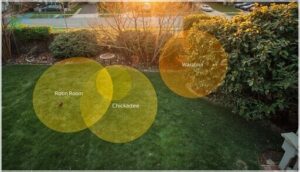
Territory isn’t random — birds claim space through a precise mix of biology, landscape, and timing.
A few key forces shape how large a territory gets, how good the habitat needs to be, and how it shifts across seasons.
Here’s what’s actually driving that process.
Factors Influencing Territory Size
Four forces quietly redraw every territory boundary you’d mark on a map:
- Food Patch Density — richer feeders and insect lawns compress territories noticeably
- Predator Presence — outdoor cats shrink active range toward dense cover
- Noise Levels — urban sound limits how far songs carry
- Neighbor Competition — rival songbirds pack tighter where good cover clusters
Tracking these through songbird territory mapping reveals real population trends fast.
Role of Habitat Quality
Quality is everything to a songbird sizing up your yard.
Food Diversity — seeds, berries, insects from native plants — compresses territories quickly.
Shelter Complexity matters too: layered trees, shrubs, and brush piles lower Predation Risk.
Nesting Sites inside dense vegetation seal the deal.
Native Plant Benefits ripple through all of it, making habitat type and thoughtful habitat management are the real foundation of any bird‑friendly environment.
Seasonal Changes in Territories
Songbird territories aren’t static — they pulse through the year like a living map.
- Spring Territory Expansion kicks off as rising hormones drive males to claim their largest breeding spaces
- Summer Range Contraction follows once eggs hatch and defense tightens around the nest
- Autumn Overlap Zones emerge as territorial behavior relaxes and birds share former nesting grounds
- Winter Core Shrinkage pulls remaining residents toward sheltered feeders and dense cover
Key Songbird Species and Their Ranges
Not every songbird you spot is just passing through — many are staking a claim right in your yard.
Each species has a distinct range shaped by breeding season, migration route, and winter habitat preferences.
Here’s a closer look at the common backyard songbirds you’re likely to encounter, where they breed and overwinter, and how their ranges shift across regions.
Common Backyard Songbirds

Five species show up in most backyard territory maps: American Robin, House Sparrow, Northern Cardinal, Carolina Chickadee, and White‑breasted Nuthatch.
Each locks into a distinct habitat type — open lawn, dense shrub, mature hardwood.
Their feeder preferences, nesting materials, and vocal identification markers make them ideal anchors for eBird logs and species distribution modeling.
Start here, and territory mapping clicks into focus fast.
Breeding, Migration, and Wintering Zones

Each species on your territory map tells a different seasonal story. Cardinals hold year-round, while warblers vanish south by October — their breeding habitat connectivity breaking down as temperatures drop. Zone Climate Shifts push Migration Timing Trends earlier each spring, complicating species distribution modeling.
Watch for these patterns in your yard:
- Stopover Habitat use peaks during March–May and September–October
- Winter Food Sources concentrate birds in shrub-dense microclimates
- Breeding Habitat Connectivity determines which species return reliably
Regional Distribution Patterns

Your backyard’s bird list isn’t random — it’s a product of urban-rural gradient dynamics, east-west divergence, and climate-driven shifts reshaping ranges yearly.
| Pattern | What You’ll See |
|---|---|
| Urban core | House sparrows, starlings dominate |
| Suburban edge | Towhees, thrushes near parks |
| Eastern yards | Wood thrushes, warblers |
| Western yards | Montane, dry-adapted species |
Use species distribution modeling and regional songbird distribution guides to decode habitat mosaic connectivity and barrier-corridor effects shaping your local assemblage.
Interpreting Songbird Territory Maps

A territory map is only useful if you can read what it’s actually telling you. Color blocks, seasonal shading, and scale choices all carry meaning — and misreading any one of them can throw off your whole interpretation.
Here’s focus on when a map lands in front of you.
Map Keys, Legends, and Color Codes
legend is your map’s instruction manual — skip it, and the data turns into noise.
Solid lines mark defended boundaries; dashed ones flag shifting edges.
Point symbols — circles, stars, squares — pinpoint feeders, perches, and nest sites.
Color palettes separate territories instantly, with darker shades signaling higher use intensity.
Interactive toggles, annotation labels, and spatial analysis techniques built into most map toolbars sharpen your read considerably.
Distinguishing Year-Round Vs. Seasonal Use
Once you’ve decoded colors and symbols, the next question is: what do repeated sightings actually mean?
Monthly Observation Patterns tell the real story. Feeder Usage Consistency across every month — year-round residents like Northern Cardinals show up reliably in January and July alike.
Seasonal Song Frequency drops sharply after breeding. Use eBird’s date filters and Behavioral Timing Cues to separate true residents from seasonal movement visitors.
Understanding Map Resolution and Scale
Scale isn’t just a cartography detail — it changes what you can actually see.
At 1:500, your range maps can show individual feeders and hedgerows clearly. Push to 1:10,000 and habitat type boundaries blur into useless blocks.
In geographic information systems, zoom level matching and pixel size impact whether territory lines land on the right side of a fence or the wrong one.
Digital Tools for Mapping Songbird Territories

Mapping songbird territories has never been more accessible, thanks to a growing set of digital tools built around real field data.
Whether you’re tracking a cardinal’s breeding zone or logging daily sightings, the right platform can turn casual observation into something genuinely meaningful.
Here’s a look at the tools worth knowing.
Using YardMap and EBird
Pairing two platforms gives you a complete picture of your yard’s songbird activity. Start here:
- Draw habitat layers in YardMap — lawn, shrubs, tree clusters — to anchor species distribution spatially.
- Log eBird checklists from the same coordinates to capture temporal observation trends.
- Cross‑reference both datasets for neighborhood connectivity analysis across property lines.
- Watch user‑generated heatmaps reveal which habitat type drives territory use.
This data sync workflow turns backyard observations into real geographic information systems science.
Merlin and SGI Web App Features
Once your YardMap layers are set, Merlin adds a sharper lens. Its Real-time Sound ID picks up dawn choruses live — even offline via Regional Pack Management and Offline Species Packs.
Tap any species in Explore Birds to pull range maps built from hundreds of millions of eBird observations. For sagebrush landowners, the SGI Web App’s Abundance Layer Integration and Custom Habitat Overlays reveal exactly where bird migration corridors cross your property.
Integrating Citizen Science Data
Uploading your backyard sightings to eBird does more than log a date — it feeds a global citizen science engine storing over one billion observations.
Each checklist improves spatial accuracy and temporal resolution for species maps. Automated data validation flags outliers before records go public. That community engagement turns private yards into connected data points, directly shaping habitat management and songbird conservation decisions at regional scales.
Behavior Linked to Songbird Territories

Territory behavior is where songbird ecology gets personal — you can watch it play out right in your backyard. Every song, chase, and display ties back to the same core drives: resources, mates, and survival.
Here’s what’s actually happening when a bird claims its space.
Territorial Singing and Displays
Territorial behavior in birds reaches its peak during breeding season, and song is the main tool. The dawn chorus isn’t random noise — it’s a calculated signal. Birds advertise survival, warn rivals, and stake claims before foraging even begins.
Cooler air carries sound farther at dawn, giving each song more range.
Countersinging between neighbors maps shared borders acoustically.
Visual displays — puffed feathers, tail fanning — reinforce what the song already declared.
In some species, sex roles in territory defense are shared, with both partners singing to present a united front during mating season.
Aggression and Boundary Defense
Once a boundary is crossed, bird behavior escalates quickly. Avian territoriality runs on a clear logic:
- Dear Enemy Effect — familiar neighbors get tolerance; strangers trigger sharp aggression.
- Resource Hotspot Defense — feeders and water features spark the fiercest territorial behavior in birds.
- Dominance Hierarchy — larger species displace smaller ones through escalation displays and interspecific aggression.
Territory defense isn’t random. It’s calculated bird communication.
Mating and Nesting Behaviors
Territory isn’t just defended — it’s courted. Males use courtship feeding and whisper songs near shrubs to signal commitment and seal the pair bond before the nesting season begins.
| Behavior | Role in Territory |
|---|---|
| Courtship Feeding | Reinforces pair bond near nest site choice |
| Extra‑pair Copulations | Shape breeding habits despite monogamy |
| Renesting Strategies | Sustain territorial behavior in birds after nest loss |
Conservation Insights From Territory Mapping

Territory maps do more than satisfy curiosity — they generate real conservation intelligence.
Territory maps transform birding curiosity into precise conservation intelligence
When you understand where birds concentrate, breed, and struggle, you can act with precision rather than guesswork.
Here’s what that data actually reveals.
Identifying Critical Habitats
Not every corner of your yard carries equal weight. Territory maps reveal which microhabitat features — dense shrubs, no-mow zones, predator-free refuges — function as genuine anchors for breeding birds.
Edge density and stepping stone corridors show where connectivity breaks down.
Cross-reference your observations with eBird data and a regional songbird distribution guide to pinpoint exactly where habitat protection and targeted habitat management will deliver real songbird conservation gains.
Monitoring Population Trends
Mapping the same yard across multiple seasons turns your observations into longitudinal analysis.
Four data moves that sharpen ecological monitoring:
- Plot occupied territory counts yearly for trend visualization.
- Compare early versus late spring singing males.
- Cross-reference your counts with eBird’s regional citizen data integration.
- Flag vanished territories as early population decline signals.
Citizen science submissions link your habitat correlation work to continental-scale statistical modeling.
Planning Habitat Restoration
Your territory data doesn’t stop at observation — it tells you exactly where to act.
Bare zone birds avoid signal gaps in Vertical Structure Layers.
Replace invasive ornamentals first, following a Seasonal Planting Schedule that phases in Native Shrub Clusters along mapped edges.
Strategic Water Feature Placement near cover completes the picture.
That’s habitat management with real ecological purpose — genuine songbird conservation, not guesswork.
Climate and Habitat Impacts on Territories
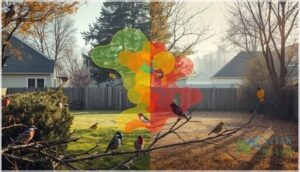
Climate shapes songbird territories more than almost any other force — quietly shifting ranges, shrinking habitats, and severing the connections birds depend on.
What looks like a stable backyard ecosystem can be under real pressure from changes you might not see coming.
Here’s what you need to know about the key forces at work.
Effects of Climate Zones
Climate zones don’t just dictate where songbirds live — they control when and how they show up on your maps. Warmer springs trigger Seasonal Breeding Shifts, with territories appearing 1–2 weeks earlier than in decades past. Urban Heat Island Refugia keep Northern Cardinals wintering farther north than ever.
Key climate‑driven patterns to watch:
- Temperature‑Driven Territory Size expands during drought, as birds forage wider areas
- Precipitation Food Availability clusters insect‑eaters near rain‑fed garden beds
- Elevation Range Migration pushes shrub‑nesting species upslope as habitats warm
- eBird data confirms poleward species distribution shifts across changing climate zones
Habitat Fragmentation and Connectivity
Fragmentation hits backyard songbirds hard. Small patches under 0.1 hectare force birds across open gaps — boosting predator exposure quickly.
Watch your patch size thresholds: forest-dependent species decline sharply without continuous cover. Hedgerow Corridors and Stepping-Stone Gardens fix this by linking isolated yards.
Add Vertical Structure Links and native shrubs for Edge Effect Mitigation, improving species distribution across your neighborhood’s habitat management network.
Adaptation to Environmental Change
Birds don’t wait for us to catch up — they adapt.
Urban Noise Shifts push species to higher‑frequency songs, while Climate‑Driven Range Shifts move breeding territories northward.
Phenology Timing Changes pull nesting earlier by weeks.
Flexible Foraging Strategies let generalists thrive where specialists fail.
Your habitat management choices directly shape local species distribution, supporting environmental monitoring and guiding smarter Habitat Corridor Design through real bird migration data.
Creating Bird-Friendly Backyard Territories

Turning your backyard into songbird territory isn’t complicated — it just takes the right setup. A few targeted choices can make your yard a place birds actually return to, season after season. Here’s where to start.
Selecting Feeders and Birdhouses
Your feeder choice shapes which backyard songbirds show up. Tube feeders suit finches and chickadees; hopper feeders attract cardinals and grosbeaks needing a solid platform.
For birdhouse dimensions, entrance holes around 1.5 inches fit bluebirds perfectly. Apply the 10-5-3 rule for placement safety, and add predator guards on metal poles.
Consistent maintenance hygiene — monthly bleach rinses — keeps your bird-friendly environment healthy.
Native Plantings for Shelter and Food
Your yard is your canvas.
Layered Shrubbery — canopy trees, midstory shrubs, groundcovers — create vertical structure that different backyard songbirds exploit at their preferred heights.
Native black cherry and elderberry deliver Fruit‑Bearing Trees for migrating species in winter.
Oaks and dogwoods drive Insect‑Rich Herbs and caterpillar loads that feed nestlings.
Seasonal Seedheads from native grasses extend natural birdseed through fall.
Evergreen Roosts like Eastern red cedar anchor a truly bird‑friendly environment.
Providing Water and Safe Spaces
Keeping water fresh and accessible is the quiet backbone of a bird-friendly environment.
Set out a non-metal basin material — ceramic or concrete — no deeper than 2–5 centimeters, with sloping sides for secure footing.
Follow cover proximity guidelines: position it 6–10 feet from shrubs.
Add predator-free perches like flat stones, refresh water every two days for seasonal water rotation, and you’ll see backyard birding transform overnight.
Tips for Backyard Songbird Observation

Watching songbirds in your backyard is part patience, part knowing what to look for. Focused habits can sharpen your eye and deepen what you actually take away from each session.
Three practical areas to focus on.
Mapping Bird Sightings
Every sighting you log is a data point — and data points, stacked over time, reveal something impressive. Start with these three steps:
- Use eBird’s GPS-based checklist to confirm spatial accuracy and temporal resolution in your records.
- Validate entries with photos for data validation and species distribution confidence.
- Log consistently to boost ecological monitoring — your user engagement directly shapes hab migration models.
Recognizing Territorial Boundaries
Territorial boundaries aren’t invisible — birds draw them in behavior.
Watch for Perch Markers along rooflines and fence posts where males repeat songs, and listen for Countersinging Patterns between neighbors. Patrol Routes trace the same hedge-to-hedge loops daily. Edge Aggression flares near feeders and nest boxes. Seasonal Boundary Shifts make spring the sharpest window for reading songbird behavior.
| Boundary Signal | What to Watch For |
|---|---|
| Perch Markers | Repeated songs from fixed high points |
| Countersinging | Alternating calls along shared lines |
| Patrol Routes | Fence-to-fence flight loops |
| Edge Aggression | Chases starting at the same spots |
| Seasonal Shifts | Intensified defense in early spring |
Ethical Birdwatching Practices
Good birdwatching starts with knowing when to back off. Distance Guidelines matter — stay 10–20 meters from active nests, and use binoculars instead of creeping closer.
Noise Reduction keeps cycles intact; sudden sounds flush adults off eggs. Playback Limits should be followed: a few bursts maximum.
Nest Etiquette means hands off fledglings entirely. Habitat Respect and BirdFriendly Gardening turn your backyard into a genuinely Bird-friendly environment.
Frequently Asked Questions (FAQs)
What is the number one killer of songbirds?
Free-ranging and feral cats are the number one killer of songbirds — responsible for up to 4 billion bird deaths annually in the U.S. alone. Cat predation hits ground-feeding species hardest.
Do House Finches stay in groups?
Yes — House Finches are highly social birds. Outside breeding season, Flock Size Variation can reach hundreds.
Dominance Hierarchy favors females year-round. Feeder Interaction at backyard feeders usually draws groups of 5 to
What is the best bird database?
eBird is hard to beat — it combines billions of observations, real-time species distribution maps, and citizen science contributions into one freely accessible platform, making it the exemplar for data coverage and mapping accuracy.
What do birds do to mark their territory?
Birds mark their territory by staking their claim loud and clear — through vocal displays, visual postures, perch patrol, nest anchoring, and occasional scent marking. Songbird behavior rarely leaves rivals guessing.
How do songbirds respond to neighboring territory intrusions?
When a neighbor crosses the line, vocal aggression kicks in first — shorter, sharper phrases replace full songs. Visual displays follow.
Territory defense rarely needs a fight; most disputes resolve through escalating signals alone.
Can multiple songbird species share overlapping territories?
Multiple songbird species often share overlapping territories, especially where habitat patchiness concentrates resources.
Niche partitioning reduces competition—some forage at different heights or specialize in food types.
Seasonal overlap, interspecific aggression, and mixed‑species flocks shape songbird distribution and ecological monitoring.
Do urban environments affect songbird territory establishment?
Urban environments reshape songbird territory establishment through Noise‑Driven Territory Shifts, Light‑Pollution Timing Effects, and Habitat‑Structure Density.
—while Predator Pressure Impacts and Species‑Specific Urban Adaptations drive habitat fragmentation, bird habitat loss, and changes in backyard songbirds’ environmental sustainability.
How does songbird territory size vary by species?
Picture a Savannah sparrow shrinking its plot to 57 square meters in high‑density years—body size, habitat type effect, and seasonal density shifts all drive territory size.
Migration stopover needs and urban vs rural contrast shape species distribution and territoriality.
What role do juveniles play in territory acquisition?
Juveniles drive territory turnover through natal dispersal, prospecting behavior, and competition dynamics. Most settle within 100–200 km of their birthplace, using social networking to locate vacancies before claiming their first range.
Conclusion
Like a compass guiding you through unseen trails, backyard songbird territory maps reveal the pulse of your local ecosystem—each boundary marking a story of survival, competition, and adaptation. When you trace these lines, you’re not just mapping birds; you’re decoding the landscape’s hidden rhythms.
Every observation sharpens your understanding, connecting habitat shifts to real-world change. With practice, your yard transforms from static scenery to a living archive, where every song and flight signals the health of your wild neighbors.
- https://digitalcommons.usf.edu/cgi/viewcontent.cgi?article=11732&context=condor
- https://vogelhaus-mit-kamera.com/en/blogs/guide-for-bird-lovers-tips-on-feeding-observation-and-more/how-birds-establish-their-territory
- https://www.birdful.org/do-birds-get-territorial/
- https://awaytogarden.com/mapping-yard-habitat-networks-rhiannon-crain/
- https://www.wlfw.org/new-online-tool-shows-songbird-abundance-sagebrush/