This site is supported by our readers. We may earn a commission, at no cost to you, if you purchase through links.
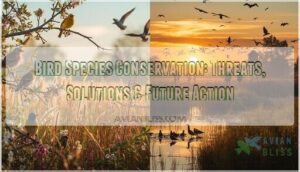
North America has lost 3 billion birds since 1970—a staggering 25% decline that represents one of the most dramatic ecological shifts in recent history. These aren’t just numbers on a conservation report. They’re the warblers that once filled spring mornings with song, the grassland sparrows that vanished along with native prairies, and the shorebirds that no longer crowd coastal mudflats.
Today, nearly half of all bird species show downward population trends, with over one-third requiring urgent conservation action to prevent further collapse. The drivers behind these declines—habitat loss, climate disruption, and human development—interconnect in ways that demand all-encompassing solutions.
But there’s reason for hope: targeted conservation efforts, community partnerships, and strategic habitat restoration have delivered measurable victories for threatened species, proving that bird species conservation works when backed by adequate resources and collective action.
Table Of Contents
Key Takeaways
- North America has lost 3 billion birds since 1970—a 25% decline driven by habitat destruction, climate disruption, and agricultural intensification—with nearly half of all species now showing downward population trends and over one-third requiring urgent conservation action.
- Targeted conservation strategies deliver measurable results when properly funded: habitat restoration increased waterbird populations by 42–159%, private lands partnerships protected habitat for 4.5 million grassland birds, and every federal dollar invested leverages $36 from collaborative partners.
- Bird conservation generates substantial economic returns, with birding activities producing $279 billion in annual economic output, creating 126,000 green jobs through restoration projects, and providing mental health benefits including stress reduction and cognitive restoration lasting up to eight hours.
- Closing the $711 billion global biodiversity finance gap requires redirecting harmful subsidies, expanding private investment in protected areas, and scaling innovative tools like remote sensing and citizen science programs that enable real-time conservation decisions across continents.
Current Status of Bird Species
The picture isn’t pretty when you look at what’s happening to bird populations right now. Recent conservation reports paint a clear picture of widespread decline, with hundreds of species hanging on by a thread.
Let’s break down what the latest science tells us about which birds are in trouble and why we need to act fast.
Key Findings From Recent Conservation Reports
The 2025 U.S. State of the Birds report paints a sobering picture: more than one-third of bird species need urgent conservation action, with 112 “Tipping Point” species having lost over half their populations since 1970. You’ll find 42 red-alert species facing perilously low numbers.
These key findings reveal downward trends across all habitats, highlighting critical funding gaps despite documented conservation outcomes.
Global Trends in Bird Population Decline
The U.S. decline is part of a global pattern: nearly half of all bird species now show downward trends in birds. Since 1970, North America lost 3 billion individual birds—a 25% drop in avian decline. Europe faces similar losses, with agricultural areas hit hardest. This declining bird abundance stems primarily from habitat degradation impacts, threatening species extinction rates across continents.
Since 1970, North America has lost 3 billion birds—a 25% decline mirrored across Europe as habitat destruction drives nearly half of all species toward extinction
- Grassland birds have lost 53% of their population since 1970
- Europe’s farmland birds declined 42% between 1990 and 2023
- Migratory bird biomass dropped 13% in just one decade
- One in eight bird species globally faces extinction risk
Species at Greatest Risk and Urgent Conservation Needs
Among these declining populations, you’ll find three categories of bird species facing the highest risk. Red-alert species like Allen’s hummingbird and saltmarsh sparrow need immediate action, while 112 tipping-point species have already lost half their numbers.
Island endemics remain especially vulnerable—small ranges mean habitat loss threatens entire populations.
Forest insectivores in tropical areas show alarming declines, and the H5N1 outbreak recently killed hundreds of thousands of seabirds, pushing already-stressed populations closer to extinction.
Major Threats to Bird Populations
Bird populations don’t decline on their own—they’re pushed to the brink by forces we’ve set in motion. From disappearing forests to shifting weather patterns, the pressures on birds today are interconnected and complex.
Understanding these threats is the first step toward reversing the damage and protecting the species that need our help most.
Habitat Loss and Environmental Degradation

Habitat loss and environmental degradation sit at the heart of bird declines you’re witnessing across landscapes. When forests fragment and grasslands convert to other uses, birds lose the spaces they need to survive. Consider three powerful numbers:
- 40% decline in grassland birds since 1970, driven by habitat modification
- 1 billion birds lost from North American forests alone
- 75% of species now experiencing population drops tied to climate impacts and ecosystem resilience erosion
These environmental stressors reshape avian habitats faster than species can adapt. Extreme weather further threatens bird populations.
Impacts of Agriculture, Logging, and Development
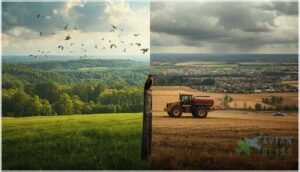
Farming intensification drives the steepest bird declines you’re seeing today. European farmland birds dropped 57% between 1980 and 2016, largely from pesticide and fertilizer use. Deforestation effects ripple across migratory routes, while urban sprawl fragments agricultural habitats at rural edges.
These cumulative impacts from land management practices create environmental stressors that outpace species’ ability to adapt, demanding urgent habitat conservation action. Since 1980, Europe has seen 800 million fewer birds due to these factors.
Effects of Climate Change and Extreme Weather

Rising temperatures are pushing birds toward the poles and higher elevations, triggering range shifts that disrupt ecosystems. Phenological mismatches now strand chicks without food as insects peak earlier than arrivals.
Two-thirds of North American species face extinction risks from climate change, while tropical declines hit one-third of populations. Extreme weather events—storms, droughts, heat waves—compound these environmental stressors on wildlife, demanding immediate habitat conservation action.
Invasive Species, Hunting, and Pollution

Beyond climate, invasive predators like rats have driven over 70% of bird extinctions, especially on islands where they decimate nests. Meanwhile, plastic ingestion now affects 90% of seabirds, and chemical contaminants including oil pollution, environmental toxins, and insecticides accumulate in tissues, threatening survival across coastal and inland populations alike.
Hunting pressure—both legal and illegal—claims millions annually across migration routes.
Conservation Strategies and Solutions
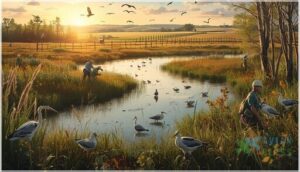
The good news is that conservation works when we apply the right strategies at the right scale. From restoring critical habitats to building partnerships across private lands, proven solutions exist to reverse bird population declines.
Let’s look at the approaches that are making a real difference for bird species across the country.
Habitat Restoration and Management Projects
You can turn the tide for struggling birds through targeted habitat restoration projects that repair damaged wetlands, grasslands, and forests. Restoration monitoring shows real species response: waterbird numbers jumped 42–159% after wetland work, while management practices like controlled flooding and woody-vegetation control delivered measurable restoration outcomes.
Landscape connectivity matters too—when you protect habitat networks, you increase benefits across entire ecosystems.
Private Land and Community-led Conservation
Most bird habitat sits on private lands—about 60% of U.S. land area—so conservation hinges on landowners taking action. Private lands programs and land trusts partner with communities to restore wetlands and grasslands, creating measurable wins: conservation ranching protected habitat for 4.5 million grassland birds.
Indigenous conservation in Bolivia’s Apolo region shows how community-based restoration, economic incentives, and collaborative governance deliver results for threatened species.
Collaborative Conservation Partnerships
You can’t protect birds alone—that’s where conservation partnerships shine. Since 1986, Migratory Bird Joint Ventures have brought together over 5,700 partners, conserving 33 million acres through cross-sector governance and science partnerships.
Every federal dollar leverages 36 dollars from others, proving funding effectiveness. These collaborative investment efforts in habitat conservation strategies deliver real results: wetlands restored, grasslands protected, and community engagement driving conservation efforts that work.
Policy Initiatives and Federal Investments
Federal bird funding translates partnerships into action. The US Fish and Wildlife Service directed $426.6 million toward habitat management in FY2023, while conservation policy instruments like the Endangered Species Act empower federal agencies to protect at-risk species.
Budget advocacy secured $54 million for waterfowl habitat and $102.9 million in wetlands grants—federal sector investment that turns conservation action into measurable recovery across landscapes.
Economic and Social Benefits of Bird Conservation

Bird conservation isn’t just about protecting species—it’s also about protecting our economy and our well-being. From generating billions in revenue to creating jobs across the country, birds play a surprisingly important role in our financial and social landscape.
Here’s how investing in bird conservation returns real benefits to communities and individuals alike.
Economic Impact of Birding and Wildlife Tourism
When you watch birds, you’re not just enjoying nature—you’re helping power a massive economic engine. Birding activities generate $279 billion in economic output across the United States annually, with visitor spending reaching nearly $108 billion in 2022 alone.
This tourism revenue flows into local economies through lodging, equipment purchases, and guide services, demonstrating the substantial economic benefits of bird watching while funding conservation efforts.
Job Creation Through Conservation Efforts
Beyond tourism impact, conservation efforts create tangible green jobs across rural communities. Ecological restoration in the US directly employs 126,000 people, with the restoration economy generating $9.5 billion in economic output.
Habitat restoration projects support 15 jobs per $1 million invested, demonstrating how strategic investments in conservation deliver substantial economic benefits while reversing bird population declines.
Mental Health and Well-being Benefits From Birds and Nature
Conservation also delivers profound ecosystem services for mental health. When you hear birdsong or spend time birdwatching, your brain experiences measurable stress reduction and cognitive restoration—benefits lasting up to eight hours.
Urban greening projects that support bird populations strengthen nature connectedness, reducing anxiety and depression across communities.
These mental health benefits of nature make protecting birds essential for human well-being, not just ecological balance.
Future Directions for Bird Species Protection

We’ve seen what birds mean for our communities, our health, and our economy, but protecting them requires real action moving forward.
The good news is that solutions exist—if we invest in them. Here’s where conservation efforts need to head next to give bird populations a fighting chance.
Funding Needs and Biodiversity Finance Gaps
You can’t protect what you can’t afford to manage. Global biodiversity conservation faces a massive finance gap—roughly $711 billion annually—between current funding and what’s needed to safeguard bird habitats and other wildlife. Closing this shortfall requires subsidy redirection away from harmful practices, private investment in protected areas, and creative funding mechanisms.
Without collaborative investment in habitat conservation, the conservation needs of birds will outpace our ability to respond, and the challenges facing bird populations will intensify despite the importance of conservation efforts for the conservation of bird species.
Innovative Conservation Tools and Technologies
Digital tools are reshaping avian research and monitoring bird populations. Remote sensing with satellite imagery now predicts bird occupancy with over 80% accuracy, while bioacoustic monitoring systems like BirdNET identify nearly 1,000 species from audio recordings. Tracking networks such as Motus capture migration patterns across continents.
These innovations enable science-based planning through:
- Automated detection processing thousands of birds in hours versus days
- Integrated assessment combining movement data with risk maps
- Platforms like eBird supporting real-time conservation decisions
Community Engagement and Citizen Science
You can join a growing movement of citizen scientists tracking bird populations worldwide. The 2023 Great Backyard Bird Count brought together over 555,000 participants across 202 countries, with data quality strong enough to inform conservation outcomes.
Community engagement in conservation through educational programs on conservation builds stewardship effects, improves equity access to monitoring bird populations, and helps protect species through global participation in critical research.
Action Steps for Supporting Bird Conservation
You can start protecting bird populations right now—no special training needed. Install window decals and plant native species to support habitat protection at home.
Join citizen science programs like eBird to monitor local birds.
Advocate for bird-friendly practices through policy advocacy in your community. Support funding conservation by donating to habitat restoration projects or volunteering with community programs dedicated to bird conservation efforts.
Frequently Asked Questions (FAQs)
How do birds contribute to pollination and seed dispersal?
You’d think birds just sing and look pretty, but they’re secret workhorses—pollinating thousands of plant species and carrying seeds hundreds of meters, quietly holding ecosystems together through remarkably specialized relationships.
What role do birds play in controlling insect pests?
Birds suppress crop pests naturally, reducing insect damage by up to 74%. You’ll see yield improvements and economic value in pest reduction, with regional variation across ecosystems.
Avian species maintain ecological balance through consistent predation.
Which bird species have successfully recovered from near extinction?
California condors climbed from 22 wild birds to over 410 through captive breeding programs. Bald eagles quadrupled since Whooping cranes reached 557 birds—up from just 14 adults in
How do different cultures incorporate birds into traditional practices?
Around the world, you’ll find avian species woven into ceremonies, stories, and daily life. Indigenous knowledge systems recognize ritual bird use—from ancestor offerings to deity symbols—linking cultural tourism with conservation efforts for birds.
Conclusion
Every bird that vanishes takes with it a thread in the intricate web that sustains ecosystems—and us. The collapse we’re witnessing didn’t happen overnight, and reversing it won’t either.
But bird species conservation has proven itself: strategic action saves species. Your choices matter—whether you protect habitat, support policy, or simply pay attention.
What happens with birds rests not on hope alone, but on what you do next.
- https://phys.org/news/2025-11-global-bird-reveals-declining-ecosystem.html
- https://www.audubon.org/magazine/sweeping-new-report-shows-us-birds-declining-sharply-across-range-habitats
- https://www.birds.cornell.edu/home/bring-birds-back/
- https://www.science.org/doi/10.1126/science.adn4381
- https://pmc.ncbi.nlm.nih.gov/articles/PMC9177422/