This site is supported by our readers. We may earn a commission, at no cost to you, if you purchase through links.
You don’t need a trip to the rainforest to start bird watching. Right now, there’s probably a cardinal perched in your neighbor’s tree or a sparrow hopping across your windowsill. These everyday moments are where most birders discover their passion—not on exotic expeditions, but in backyards, city parks, and morning commutes.
The beauty of bird watching for beginners is its accessibility. You can start with nothing more than curiosity and a willingness to slow down. Once you learn what to look for, you’ll notice winged neighbors you’ve walked past for years.
All it takes is knowing where to look, what gear actually helps, and how to turn fleeting glimpses into lasting connections with the birds around you.
Table Of Contents
- Key Takeaways
- How to Start Bird Watching
- Finding The Best Bird Watching Locations
- Essential Gear for Beginner Birders
- Easy Bird Identification Techniques
- Tips for Responsible and Enjoyable Birding
- Frequently Asked Questions (FAQs)
- What are the 5 S’s of birding?
- How do I start watching birds?
- What is the best bird watching for beginners?
- What to get a beginner bird watcher?
- How to start birdwatching for beginners?
- How do you build your bird-watching skills?
- How to start birdwatching outside the backyard?
- Where should I start bird watching?
- Is birdwatching easy to learn?
- When should I start birdwatching?
- Conclusion
Key Takeaways
- You can start bird watching right now without any special gear or training—just look out your window, notice the birds already in your backyard or neighborhood, and build your skills through daily observation.
- The essentials for beginners are surprisingly simple: 8×42 binoculars, a regional field guide or app like Merlin Bird ID, and a notebook to track what you see, hear, and learn over time.
- Effective bird identification relies on observing field marks (wing patterns, beak shapes, size comparisons), listening to calls and songs, and noting plumage details rather than just color alone.
- Responsible birding means staying quiet, keeping your distance from wildlife, sticking to trails, and connecting with local birding clubs or online communities to accelerate your learning while protecting habitats.
How to Start Bird Watching
You don’t need a PhD or expensive equipment to start birding—just curiosity and a willingness to pay attention. The beauty of this hobby is that you can begin right now, wherever you’re, by simply tuning into the world around you.
If you’re ready to take that first step, starting a backyard birding practice can be as simple as choosing a good viewing spot near your home.
Bird watching requires no credentials or gear—just curiosity and attention to the world around you
Here’s how to take those first steps and build a foundation that’ll serve you for years to come.
Noticing Birds in Everyday Environments
You don’t need a wilderness trek to start bird watching—urban bird habitats are right outside your door. Window birding lets you spot robins, sparrows, and blue jays from your couch, often for several minutes in the morning.
Focus on these everyday locations for neighborhood birding:
- Backyard feeders and shrubs within 5 to 15 feet
- City street trees hosting pigeons and warblers
- Park benches near ponds or fountains
- Quiet garden corners with native plantings
- Mailboxes and hedges where birds forage
Yard bird diversity surprises most beginners—you’ll notice local bird migration patterns just by watching consistently.
For tips on observing and describing birds, check out these key bird identification basics.
Practicing Observation Skills
Once you spot birds regularly, sharpen your sensory training with quick exercises. Set a five-minute timer and list every new detail—colors, shapes, movements. Practice alternating between wide view and close focus every sixty seconds to build nature awareness.
Listen for three distinct calls, then match them to species in your field guide. These observation techniques transform casual bird watching into confident bird identification without binoculars.
Strong help birders catch key details and improve both safety and overall enjoyment outdoors.
Setting Realistic Birding Goals
Strong observation skills help birders catch key details, but goal-setting strategies turn those skills into measurable progress. Start with 20 to 50 species in a season—realistic for birding basics.
A well-chosen bird identification book for backyard birding can help you narrow your focus to the most common species in your region.
Track sightings with a simple checklist, then adjust targets each month based on seasonal planning and habitat selection. This progress monitoring keeps birding for beginners focused and fun.
Finding The Best Bird Watching Locations
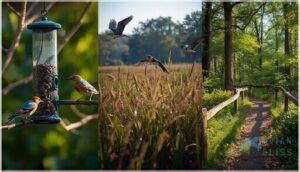
You don’t need to travel to exotic destinations to find marvelous birds. The truth is, marvelous birding opportunities are probably hiding in places you pass every day—you just need to know where to look.
Let’s explore three types of locations that’ll get you started, from your own backyard to the best local hotspots.
Backyard and Urban Birding
You don’t need wilderness to start birding—your backyard is already buzzing with life. Set up feeders 10 to 15 feet from windows to watch chickadees and cardinals without leaving home.
Urban bird habitats thrive in street trees and hedges, attracting migrants during spring and fall.
Grab your binoculars, scan garden birds daily, and you’ll discover suburban birding tips that turn any space into a conservation hotspot.
Exploring Local Parks and Nature Reserves
Beyond your fence, park trails reveal habitat variety most backyards can’t match—woodland edges meet wetlands in a single morning walk.
Nature reserves and national parks deliver serious wildlife observation, with boardwalks connecting you to waterfowl and wading birds during migration.
Seasonal access shifts with breeding cycles, so check hours before you go. These outdoor activities fuel nature conservation and make birding feel like an expedition.
Discovering Birding Hotspots Near You
Local bird clubs post monthly hotspot lists packed with seasonal tips, and eBird filters birding hotspots by recent visits in your area. Mobile maps route you to wetland exploration sites and wildlife refuges where bird migration peaks, while online forums flag fresh sightings at national parks and local refuges.
Urban birding meets backyard habitats when community checklists reveal what’s flying overhead right now.
Essential Gear for Beginner Birders
You don’t need much to start birding, and that’s the beauty of it. A few key tools will make identifying birds easier and help you keep track of what you see.
Let’s look at the essentials that’ll set you up for success without breaking the bank.
Choosing The Right Binoculars
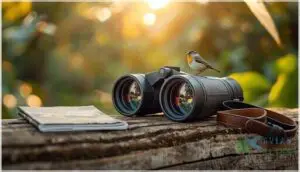
You don’t need fancy binoculars to start birding, but the right pair transforms your experience. Here’s what actually matters:
- Magnification Power: 8x or 10x works best for handheld viewing without shaky images
- Optical Quality: Look for BaK-4 prisms and multi-coated lenses that reduce glare
- Eye Relief: 14-18mm lets you see clearly, even with glasses
- Lens Coatings: Better coatings mean brighter birds at dawn
- Prism Types: Roof prisms are compact; porro prisms offer depth perception
Models around 8×42 balance brightness with portability beautifully.
Using Field Guides and Birding Apps
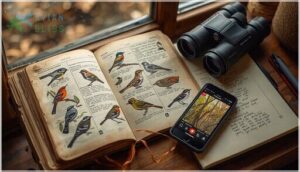
Field Guide Basics start with a printed book that fits your pocket—look for region-specific options like Kaufman or Sibley.
But wait, apps like Merlin Bird ID and the Audubon Bird Guide App let you filter by color and habitat, then play calls on demand. Digital Resources sync with eBird to track sightings anywhere.
Cross-reference both for confident Bird Identification every time.
Notebooks and Journals for Bird Records

A waterproof Rite in the Rain Birders Journal turns chaotic field notes into organized treasure! Record date, location, species count, and weather for each sighting—this data tracking feeds the eBird database while sharpening your bird identification techniques.
Sketch quick plumage details alongside your field guide observations.
Structured bird journaling reveals patterns you’d miss otherwise, transforming notebook organization into your secret weapon for record keeping that actually sticks.
Easy Bird Identification Techniques
You’ve got your binoculars and you’ve found a bird—now comes the fun part: figuring out what you’re actually looking at.
The good news is that you don’t need to memorize every species to start identifying birds with confidence. Focus on a few straightforward techniques, and you’ll be calling out species like a seasoned birder before you know it.
Observing Plumage, Size, and Shape
When you spot a bird, start with the big picture—what’s its overall silhouette telling you? Note plumage patterns like bars, spots, or scaled feather structures across the wings and back. Compare size to familiar bird species (sparrow-sized or crow-sized?).
Check beak shapes and wing forms, since seed-eaters have thick conical bills while insect-hunters sport thin pointed ones. These bird identification techniques make birding click fast!
Listening to Bird Calls and Songs
Your eyes can only catch so much, but your ears? They’re a birding superpower. Bird Song Basics reveal hidden species tucked in branches or brush. Focus on Vocalization Patterns—does it trill, buzz, or whistle? Here’s your quick-start Sound Identification toolkit:
- Learn three local Bird Species songs first
- Use Audio Recording Tips: capture clips on your phone
- Match rhythm and pitch for Bird Call Recognition
Birds sing their IDs loud and clear!
Using Field Marks for Quick ID
But wait—there’s a shortcut! Field marks are instant ID clues: Wing Patterns, Color Markings, Beak Shapes, and Bird Silhouettes you can spot through Binoculars in seconds. Your Field Guide labels these Feather Identification details for each Bird Species.
Check the eyebrow stripe, wing bars, or tail bands first. Match three marks, and you’ve nailed your bird—no guessing required!
Tips for Responsible and Enjoyable Birding

You’ve got your binoculars and a few birds under your belt—now it’s time to bird like a pro. That means respecting the wildlife you’re watching, connecting with fellow birders, and keeping yourself safe in the field.
These three principles will help you enjoy birding for years to come while protecting the birds and habitats you love.
Practicing Quiet and Respectful Observation
Great birding starts with a quiet approach—birds notice everything. Keep your voice low, movements slow, and footsteps gentle so you won’t interrupt natural behaviors.
Respect wildlife by staying on trails and maintaining comfortable distances. If you’re into silent photography, skip the flash and use a longer lens.
Good bird etiquette protects habitats while sharpening your observation skills, making every outing more rewarding.
Joining Birding Clubs and Online Communities
You don’t have to bird alone—clubs and online forums turn a solo hobby into a shared adventure. Local chapters like the American Birding Association offer club benefits such as monthly events, mentorship programs, and group walks where seasoned birders share advice on gear and resources.
Online forums keep you connected between outings, building community engagement that accelerates your learning and deepens your love for birds.
Staying Safe and Protecting Wildlife
Respecting birds means protecting their world while you explore it. Safe viewing practices—like staying 25 meters from shorebirds and keeping noise low—support wildlife conservation and habitat protection in real time.
Your bird-friendly choices fuel conservation efforts that matter:
- Stay on trails to avoid trampling nests and feeding areas
- Never feed wildlife; human food disrupts natural foraging
- Support eco-tourism that funds wildlife preservation strategies
Birding safety protects you and the species you love. Bird conservation starts with every respectful observation.
Frequently Asked Questions (FAQs)
What are the 5 S’s of birding?
The five S’s—Shape, Size, and Shade—form your core identification toolkit. Shape reveals silhouettes, Size Comparison anchors observations against familiar birds, and Shade Identification captures color patterns for Species Distinction during every birding adventure.
How do I start watching birds?
Your morning rituals can transform into birding adventures—just notice birds from your window or porch first.
Start observing nearby habitats for 10 to 20 minutes daily, building confidence before exploring further afield.
What is the best bird watching for beginners?
Start with local parks and backyard feeders—they’re your birding basics training ground. Grab 8×42 binoculars and a bird guide, then practice observing plumage and behavior during early morning hours when nature exploration rewards beginner tips with active bird species.
What to get a beginner bird watcher?
Lightweight 8×42 binoculars and a regional field guide make perfect starter gifts. Pair them with a birding app like Audubon for offline IDs, plus a waterproof notebook to track sightings and fuel their growing passion.
How to start birdwatching for beginners?
You can launch your birding journey right now—step outside for ten minutes, watch movement and shape, then jot down what you see.
That simple practice builds the foundation for everything else.
How do you build your bird-watching skills?
You’ll sharpen your observation techniques by revisiting the same habitats weekly, tracking bird behavior patterns in a notebook, and practicing species recognition through size, shape, and field marks before relying on color alone.
How to start birdwatching outside the backyard?
Picture yourself stepping into a sunlit park at dawn. Beyond your yard, local nature reserves and urban green spaces offer diverse birds.
Grab a field guide, explore mixed habitats, and let curiosity lead your outdoor observation techniques.
Where should I start bird watching?
Start birding right in your backyard—hang a simple feeder near shrubs to attract chickadees and finches.
Then explore local trails, urban parks, and nature reserves where habitat edges reveal the most species.
Is birdwatching easy to learn?
The learning curve isn’t steep. Birding for beginners means you’ll recognize a few yard species within your first week, building skill naturally through consistent practice and developing a lasting nature connection.
When should I start birdwatching?
You can begin right now—no waiting required. Morning birding near dawn offers peak bird activity and dawn chorus, while seasonal migration windows in spring and fall bring exciting variety to any habitat timing you choose.
Conclusion
Binoculars, bird books, and backyard benches—bird watching for beginners is a bold blend of curiosity and calm. You’ll spot secretive sparrows, hear harmonious hawks, and build a bond with the world right outside your window.
Every outing offers fresh feathers and new notes, proof that adventure isn’t reserved for distant jungles.
Trust your eyes, tune your ears, and treasure the thrill of discovery. The sky’s always shifting, so your next favorite bird could be just a glance away.