This site is supported by our readers. We may earn a commission, at no cost to you, if you purchase through links.
A scarlet macaw’s wings don’t just show red—they flash crimson, electric blue, and sunshine yellow in a single sweep. That explosion of color isn’t random. Birds evolved some of the most intricate color systems in nature, from pigments that soak up light to feather nanostructures that bend it into iridescent blues and greens.
You’ll find these living rainbows everywhere: parrots screaming through Amazonian canopy, tanagers flitting across cloud forests, kingfishers diving into tropical streams.
But the brightest species face serious threats. Habitat loss and wildlife trafficking chip away at their populations while climate change scrambles the food sources they depend on. Here’s what makes colorful bird species so visually stunning, how they produce those eye-popping hues, and why protecting them matters more than ever.
Table Of Contents
- Key Takeaways
- Most Colorful Bird Species Worldwide
- Parrots and Exotic Tropical Birds
- Unique Songbirds and Waterbirds
- How Birds Get Their Colors
- Conservation of Colorful Bird Species
- Frequently Asked Questions (FAQs)
- What are the world’s most colorful birds?
- Which animal is the most colorful?
- What bird has a bright plumage?
- What is the brightest bird in the world?
- What does a Bluebird look like?
- What bird has a pink color?
- What is the world’s most colourful bird?
- What is the 8 Coloured bird?
- What is the name of the colorful bird?
- What bird is a rainbow?
- Conclusion
Key Takeaways
- Bird coloration comes from two main systems working together—pigments like melanin and carotenoids that absorb light, and nanostructured feather layers that bend it into iridescent blues and greens without any pigment at all.
- The brightest species face a triple threat from habitat loss (tropical forests declining 3.7 million hectares yearly), illegal pet trade (generating $20 billion annually with 40-66% mortality rates for captured parrots), and climate shifts that disrupt the timing of food availability.
- Sexual selection drives the most dramatic color differences, with males in over half of studied bird populations displaying UV patterns and bright plumage invisible to humans but critical for mate choice, while females stay camouflaged.
- Birdwatching and ecotourism pump $11.7 billion into conservation efforts each year, funding ranger salaries and habitat restoration while giving local communities economic alternatives to logging and wildlife trafficking.
Most Colorful Bird Species Worldwide
When you think of birds, you probably picture browns and grays—but nature has some feathered rebels that throw the rulebook out the window. These species wear colors so bold they look like they’ve been hand-painted by someone who got a little too excited with the palette.
Let’s look at seven of the most striking birds on the planet.
Scarlet Macaw Plumage
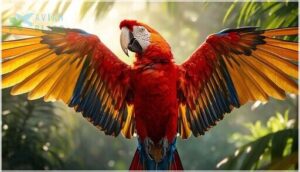
The scarlet macaw is a rock star of colorful bird species, turning heads across Central and South America with a fiery red body and tricolored wings. You’ll spot this parrot species flaunting plumage pigments called psittacofulvins—not dietary carotenoids—that create those intense reds, plus:
- Bright yellow wing coverts
- Dark blue flight feathers and tail tips
- Metallic gold iridescence underneath
- Subtle green gradient zones
Ornithology reveals that feather structure and psittacofulvin production stay remarkably consistent across the scarlet macaw’s range, proving that macaw evolution favored bold color variation. Bird characteristics like these make them icons of the tropics.
The species’ presence in Costa Rica is often associated with scarlet macaw habitats, which play a vital role in their survival.
Paradise Tanager Bright Colors
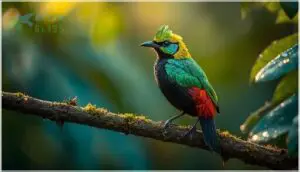
If the scarlet macaw is a rock star, the paradise tanager is the entire neon rave. You’ll find this Amazonian jewel flashing at least four saturated hues—neon green head, turquoise back, black mantle, and red or yellow rump—all on one tiny body.
Feather structure amplifies brightness through hidden white layers beneath carotenoid patches, while keratin nanostructures create those electric blues without pigment. The paradise tanager’s survival depends on its tropical forest habitat.
Hyacinth Macaw Cobalt Feathers
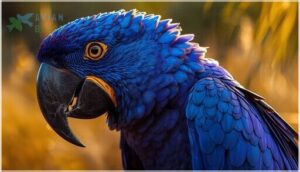
While tanagers dazzle with neon variety, the Hyacinth Macaw commits entirely to one breathtaking shade. At 100 cm long, it’s the largest parrot species, cloaked in cobalt feathers that result from structural color—keratin nanostructures scatter blue wavelengths while melanin absorbs the rest. You’ll spot these Brazilian giants across Pantanal wetlands and Cerrado savannas, where roughly 4,300–6,500 individuals remain.
- Cobalt feather structure creates blue through light scattering, not pigment
- Macaw habitat preservation focuses on palm-rich savannas and wetlands
- Feather color genetics involve nanoscale keratin–air matrices for structural hues
- Parrot nutrition science links high-fat palm nuts to ideal plumage condition
- Avian conservation biology tracks three genetically distinct population strongholds
Painted Bunting Rainbow Hues
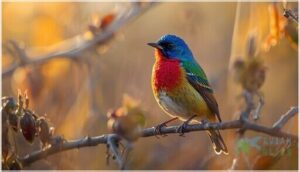
No single bird packs more hues into 13 cm than the Painted Bunting. Males flash blue heads, red underparts, and green backs—a spectrum driven by carotenoid dietary influences and structural feather color.
You’ll find these songbirds across brushy edges from Kansas to Florida, where plumage coloration signals mating rituals despite a 33% population drop since 1966, underscoring threats to colorful birds and avian diversity.
Gouldian Finch Multicolored Patterns
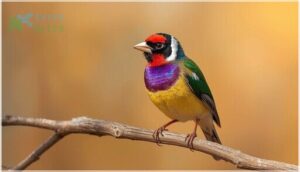
You’ll spot the Gouldian Finch wearing a jewel-like ensemble—black, red, or yellow head atop a purple breast band and yellow belly—that rivals any colorful birds in avian diversity.
Wild finch habitats across northern Australia shelter just 2,500 mature individuals displaying these plumage pattern evolution marvels.
Finch color genetics reveal sex-linked head variants and structural color shifts, making the Lady Gouldian Finch a keystone for bird feather structure and avian vision research.
King Vulture Vibrant Head Markings
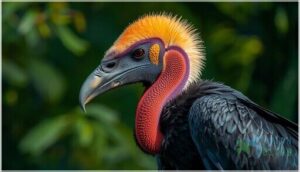
You’ll find the King Vulture flaunting one of nature’s wildest head coloration schemes—bare skin splashed with orange, red, yellow, blue, and purple hues, plus a prominent orange caruncle perched above its bill.
These facial markings serve as visual signals across 14 million square kilometers of tropical habitat, distinguishing this scavenger from darker-headed relatives while showcasing striking ecological adaptation in colorful birds.
Mandarin Duck Distinctive Plumage
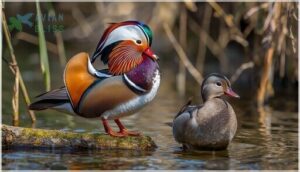
Male Mandarin Ducks show off some of the most elaborate feather coloration among bird species diversity—orange “sail” feathers, purple breast bars, and iridescent green on the head. Sexual dimorphism is dramatic: females wear mottled grey-brown with a white eye-ring, while males display bright plumage development each breeding season.
Molting patterns shift males into drab eclipse plumage afterward, highlighting cyclical changes in beak morphology and ornamentation tied to colorful birds’ mating displays.
Parrots and Exotic Tropical Birds
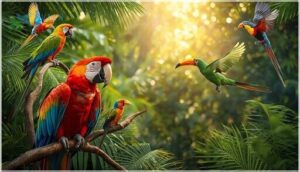
Parrots and tropical birds bring some of the wildest color combinations you’ll find in nature. From the iconic macaws to lesser-known species like tanagers and aracaris, these birds showcase bold contrasts and unexpected hues.
Here’s a look at six species that push the boundaries of what you’d expect from bird plumage.
Blue-and-Yellow Macaw Vibrant Colors
You can’t miss a blue-and-yellow macaw—its electric cobalt back and sunny yellow belly make it one of the most recognizable parrot species. What’s the secret? The blue comes from nanostructured keratin that scatters light, not pigment, while the yellow relies on psittacofulvin pigments unique to parrots.
Together, they form striking macaw color patterns:
- Vivid turquoise wings and upper body
- Vivid yellow chest extending to the belly
- Facial blushing on bare white cheek skin during social moments
This combo of blue feather structure and yellow chemistry creates visual signaling that stands out even in dense forest canopies, helping these colorful birds communicate across distances. Like the hyacinth macaw and green-winged macaw, this species shows how bird species diversity includes both fixed plumage and variable facial displays—a layered approach to color that keeps scientists studying parrot color evolution.
Lilac-Crowned Amazon Unique Markings
The lilac-crowned amazon boasts a distinctive three-tone head pattern rarely seen among parrots—a lilac crown blending into a deep maroon forehead, set against vibrant green cheeks. This endangered Mexican native is further identified by its reddish beak and a striking flash of red in its wings during flight.
| Feature | Adult Color | Juvenile Color |
|---|---|---|
| Crown coloration | Vivid lilac-purple | Dull, patchy lilac |
| Facial markings (forehead) | Deep reddish-maroon | Muted brownish-red |
| Iris tone | Orange to red-brown | Dark brown |
Unlike macaws, which display bold facial markings on bare skin, this parrot species integrates its plumage patterns into a compact and unique identification package. This combination is invaluable for wildlife conservation efforts, as fewer than 5,106 square kilometers of prime habitat remain along Mexico’s Pacific slope. As a result, field sightings of these colorful birds are increasingly precious for researchers studying bird behavior and habitat use.
Green-Winged Macaw Color Contrasts
You won’t see a more dramatic three-way split than on the green-winged macaw—bright red body, emerald mid-wing, and cobalt flight feathers create bold plumage patterns visible across rainforest clearings. Those striking beak contrasts, with a horn-colored upper mandible against black lower, plus red feather lines crossing white facial skin, function as visual signals for mate recognition.
At up to 95 cm long, these colorful birds dominate the canopy in their tropical range across northern South America, making them key targets for wildlife conservation efforts studying bird behavior and habitat shifts in fragmented forests.
Curl-Crested Aracari Striking Features
You’ll spot the curl-crested aracari’s glossy, ribbon-like crest instantly—those hard black curls cover the head plumage like nothing else among tropical birds. Its oversized beak displays a striking blue-to-orange-to-maroon pattern across the upper mandible, while yellow underparts contrast with a red-and-black breast band.
At 42–46 cm long, this colorful bird’s feather texture and tail structure make it a birdwatching favorite. However, wildlife conservation efforts closely monitor populations as forest habitat shrinks.
Scarlet-Chested Parrot Red Accents
Male scarlet-chested parrots show off a blazing red chest that develops fully by 15–18 months—a visual knockout driven by psittacofulvin pigments they synthesize internally. Females skip the red entirely, staying green across the breast. You’ll find these scrubland nomads across southern Australia, where parrot color genetics and red accent evolution create one of nature’s most striking examples of sexual dimorphism.
- Cobalt blue face framing the scarlet chest
- Bright green upperparts contrasting with yellow underparts
- Soft twittering call instead of loud squawks
- Nomadic movements tracking food and water
- Secretive behavior despite vivid plumage
Emerald Tanager Lime Green Feathers
From scarlet chests to emerald plumage—tanagers own the spectrum. The emerald tanager, measuring 11–12 cm, inhabits the foothill forests of Costa Rica through Ecuador, at elevations of 500–1,500 m. Its lime green color and black streaking provide effective camouflage among the leaves. Males display brighter yellow crowns compared to females. These birds are often spotted in mixed flocks, foraging in the mid-canopy for fruit and insects. They share tropical bird habitats with their paradise tanager cousins, contributing to the rich diversity of bird studies worldwide.
| Feature | Description |
|---|---|
| Plumage Pattern | Emerald to lime green body with black streaks on back and wings; yellow crown and rump |
| Habitat Range | Humid foothill and montane forest, 500–1,500 m elevation across Central and South America |
| Foraging Behavior | Mid to upper canopy, mixed diet of small fruits and arthropods in mixed-species flocks |
Unique Songbirds and Waterbirds
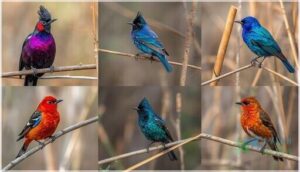
Beyond parrots and tropical exotics, you’ll find some of the most stunning colors among songbirds and waterbirds. These species show off everything from deep iridescent reds to shimmering purples that change with the light.
Here are six birds that prove you don’t need to visit a rainforest to see nature’s boldest palettes.
Azure Kingfisher Blue and Orange Highlights
The Azure Kingfisher brings a jewel-like flash of cobalt and orange to Australia’s waterways. You’ll spot this small hunter perched low over creeks and rivers, where its deep blue back contrasts sharply with a warm orange chest. Here’s what makes this bird special:
- Azure Habitat: Vegetated riverbanks and mangroves in northern and eastern Australia
- Kingfisher Diet: Small fish, aquatic insects, and crustaceans caught in shallow plunge-dives
- Bird Behavior: Nests in riverbank burrows, with breeding peaking September to January
Conservation efforts focus on protecting riparian zones, since river ecology directly impacts this species’ survival. Though globally listed as Least Concern, the Azure Kingfisher’s population is declining due to habitat deterioration and water pollution. Blue plumage paired with orange underparts makes it one of the most striking colorful birds you’ll encounter near tropical bird habitats and temperate waterways alike. Bird conservation efforts now emphasize water quality monitoring to guarantee these iridescent hunters keep lighting up Australia’s streams.
Crimson Sunbird Iridescent Red Plumage
A living jewel flashing through Southeast Asian gardens, the Crimson Sunbird showcases iridescent feathers that shift from metallic green to radiant red depending on the angle you catch it. Males display vivid crimson heads and breasts during courtship displays, while females wear more subdued olive tones.
You’ll find these nectar-feeding specialists in tropical habitats from India to Indonesia, where their plumage coloration makes them standouts among avian species studied in ornithological research on bird diversity.
Red-Necked Tanager Colorful Neck and Body
You’ll recognize the red-necked tanager by its show-stopping contrast: a scarlet collar blazing against a cobalt-blue head and lime-green body. This Atlantic Forest native pulls off one of nature’s boldest plumage patterns among tropical bird habitats in southeastern Brazil.
- Red neck feathers come from carotenoid pigments, the same compounds creating bright yellows and oranges across colorful bird species
- Males and females show similar intensity, unusual for avian species where dichromatism usually dulls female tones
- The rednecked tanager survives in forest fragments, though habitat loss threatens long-term bird diversity across its range
Violet-Backed Starling Shimmering Feathers
The violet-backed starling’s shimmering feathers showcase iridescence at its finest. Photonic crystals in the feather structure bend light through melanin layers just nanometers thick, creating an optical performance that doubles color diversity compared to thicker arrangements. Males flash vivid violet upperparts, while females wear cryptic brown streaks—a dimorphism pattern common among colorful birds facing wildlife conservation challenges across African habitats.
| Feature | Males | Females |
|---|---|---|
| Upperparts | Iridescent violet | Brown, streaked |
| Underparts | Bright white | Buff with streaks |
| Melanosome type | Hollow, complex | Solid rods |
| Function | Sexual display | Camouflage |
Wood Duck Eye-Catching Patterns
When you spot a male wood duck, you’ll notice nature’s boldest color-blocking strategy. Iridescent feathers on the head shift between green, blue, and purple depending on the light angle—a visual signaling evolved for colorful courtship displays in shaded wetlands.
The chestnut breast with white spots, golden flanks, and blue wing speculum create sharp contrasts that make this bird species unforgettable during bird-watching excursions.
Roseate Spoonbill Pink Plumage
The roseate spoonbill’s pink plumage pigmentation comes entirely from dietary influence—specifically carotenoid sources like shrimp and crustaceans. Young bird species start with pale feathers, building pink intensity over years as they forage in tropical bird habitats.
This feather coloration makes them standout colorful birds, but also easy targets for hunters, highlighting why wildlife conservation efforts matter in coastal wetlands.
How Birds Get Their Colors
You’ve probably wondered how birds pull off those jaw-dropping colors—neon blues, fiery reds, and shimmering purples that seem almost unreal. The secret lies in a mix of pigments, light tricks, and evolutionary strategies that work together in fascinating ways.
Let’s break down the science behind what makes these feathered showstoppers so visually stunning.
Melanin and Carotenoid Pigments
Birds get their most eye-catching hues through two main pigment types working in concert. Melanin functions like nature’s ink, producing everything from jet black to warm rusty browns through eumelanin and pheomelanin—the same pigments that toughen feathers against wear. Carotenoid metabolism paints the spectrum’s brighter half:
- You’ll find yellows, oranges, and reds only when birds consume carotenoid-rich foods
- Diet directly controls intensity—better nutrition means bolder color
- These pigments strengthen immune response alongside visual impact
- Plasma levels rise measurably within weeks of dietary shifts
- Colorful birds signal health status through carotenoid-based plumage
This pigment synthesis creates avian colors across feathered creatures, driving bird diversity with ecological importance beyond mere aesthetics. Feather structure amplifies both types through layered deposition and strategic contrast.
Porphyrin and Structural Colors
Beyond melanin and carotenoids, porphyrin pigments generate reds and pinks through tetrapyrrolic compounds—though you’ll rarely see them, since sunlight bleaches these fragile molecules within minutes. Bustard and owl feathers lose their salmon-pink hues in under an hour of daylight exposure.
Meanwhile, feather nanostructures create structural hues without pigments at all: layered keratin and air pockets scatter light into vivid blues and greens, expanding avian colors across tropical birds and beyond through pure physics.
Iridescence and Ultraviolet Patterns
Structural optics kick into high gear when feather nanostructures arrange hollow melanosomes into photonic crystals—this setup boosts color brilliance and iridescence effects you see flashing across resplendent quetzals and violet-backed starlings. Those angle-dependent shifts aren’t paint; they’re light bending through layered barbules.
Even wilder, ultraviolet signals invisible to you guide mate choice in starlings and rainbow lorikeets, proving avian colors operate beyond human vision.
Sexual Dimorphism in Plumage
All that ultraviolet flash ties straight into sexual dimorphism—males in 58.7% of sampled patches show dichromatism invisible to you but clear to avian vision. Sexual selection drives rapid color evolution in paradise tanagers, resplendent quetzals, and scarlet tanagers, pushing carotenoid reds and yellows into crown and breast displays.
Meanwhile, crimson rosellas and many others keep females duller, balancing mating signals with camouflage through distinct plumage coloration and avian behavior.
Conservation of Colorful Bird Species

The world’s most colorful birds are facing serious threats that put their survival at risk. Habitat destruction, illegal wildlife trade, and shifting climate patterns are reshaping the prospects of these vibrant species.
Let’s look at the main challenges these birds face and how conservation efforts are working to protect them.
Threats From Habitat Loss
Deforestation impacts colorful birds harder than you might expect—tropical forest loss has averaged 3.7 million hectares yearly since 2002, and forest bird populations have dropped roughly 25–38% over seven decades. Habitat fragmentation, wetland destruction, and ecosystem disruption accelerate biodiversity loss:
- Tropical clearance removes closed-canopy conditions many species need
- Edge effects expose interior-dwelling birds to predators and human activity
- Wetland surface water declined 27–49% in key refuges
- Australian cockatoos lost 90% of nesting trees to logging
- Habitat preservation remains critical for endangered bird species‘ survival
Impact of Pet Trade and Hunting
Wildlife trafficking pulls millions of birds from the wild each year—illegal trade generates roughly $20–23 billion annually, hitting parrots hardest. African Grey mortality reaches 40–66% from trap to export, while Southeast Asian songbird populations have crashed over 80% in fifteen years.
Wildlife trafficking drags millions of birds from the wild annually, fueling a $20 billion trade that hits parrots hardest with staggering mortality rates
Pet market demand, bird smuggling networks, and inadequate enforcement keep endangered bird species under pressure despite conservation efforts and habitat preservation gains.
Climate Change and Food Sources
Rising temperatures are scrambling the timing of insect booms and fruit ripening—creating phenological shifts that leave colorful birds arriving when food scarcity is already setting in. Migration patterns now demand extra stopovers, putting tropical ecosystems and temperate breeding grounds under strain.
Climate impacts hit hard: mismatches between hatching dates and peak prey reduce chick survival, accelerating habitat loss and threatening conservation status across bird watching hotspots worldwide.
Role of Birdwatching and Ecotourism
Birdwatching and tourism funnel roughly $11.7 billion annually into conservation status improvements and wildlife management strategies you can witness firsthand. Your visits to bird sanctuaries generate ecotourism benefits through three critical pathways:
- Funding ranger salaries and habitat restoration in protected areas
- Supporting local economies that replace logging with ecofriendly practices
- Incentivizing landowners to maintain intact forests for sustainable tourism
Bird conservation thrives when wildlife tourism pays.
Frequently Asked Questions (FAQs)
What are the world’s most colorful birds?
From parrots sporting blazing scarlet and cobalt to finches wearing turquoise and yellow patches, the world’s most colorful birds include scarlet macaws, painted buntings, Gouldian finches, hyacinth macaws, and mandarin ducks.
Which animal is the most colorful?
There’s no single winner—colorful mammals, fish, and insects all compete—but birds dominate.
Hummingbirds, Rainbow Lorikeets, and Resplendent Quetzals occupy extreme color space through feather structure, animal iridescence, and visual systems that perceive ultraviolet patterns we can’t see.
What bird has a bright plumage?
Ever wondered why some birds look like flying jewels? Take the Paradise Tanager or Violetbacked Starling—both flaunt dazzling plumage patterns thanks to clever feather structure and pigments. These bright species turn every migration into a colorful spectacle.
What is the brightest bird in the world?
Hummingbirds claim the title—their feathers reflect light across more of the avian color spectrum than any other family.
This is thanks to nanostructured iridescence that creates extreme brightness in bird vision beyond what you can see.
What does a Bluebird look like?
You’ll recognize a bluebird by its compact size—around 7 inches long—and stunning blue upperparts. Males sport bright blue backs with warm orange-red chests, while females show softer, grayer tones.
What bird has a pink color?
You’ll find pink in the roseate spoonbill’s plumage, the pink robin’s bright breast in Australian forests, and Major Mitchell’s cockatoo—often called the pink cockatoo—with its rose-colored chest and distinctive banded crest.
What is the world’s most colourful bird?
Picture a Gouldian finch—six vivid colors dancing across one tiny body. No single species owns the crown, but this rainbow finch and the Scarlet Macaw consistently top lists for sheer color diversity.
What is the 8 Coloured bird?
The “eight-colored bird” refers to the Fairy Pitta, a migratory passerine found across East Asia.
Its plumage displays green, blue, red, buff, and black patches, earning this nickname in Taiwan, Korea, and Japan.
What is the name of the colorful bird?
You’ll hear scarlet macaw most often—it’s the poster child for vivid plumage.
But painted bunting, Gouldian finch, mandarin duck, and paradise tanager all rank as top contenders in rainbow bird species worldwide.
What bird is a rainbow?
The Gouldian finch earns the “rainbow finch” nickname, wearing at least five distinct hues—green backs, purple breasts, yellow bellies, and variable face colors—creating a living spectrum of iridescent wings and plumage patterns.
Conclusion
Like Noah preserving life in the ark, protecting colorful bird species today means securing tomorrow’s natural heritage. You’ve seen how pigments and light-bending structures create their radiant displays, and why their survival hangs in the balance.
Support habitat conservation, choose ecotourism over pet trade, and spread awareness in your community. These living rainbows don’t just brighten forests—they signal ecosystem health.
When their colors fade from the wild, we all lose something irreplaceable.
- https://en.wikipedia.org/wiki/International_parrot_trade
- https://worldrainforests.com/03birds.htm
- https://www.konkoit.com/2024/04/08/endemic-birds/
- https://wildsidenaturetours.com/notes-from-the-wilds/endemics-of-the-united-states-lower-48/
- https://www.allaboutbirds.org/news/summertime-in-the-united-states-of-hummingbirds/