This site is supported by our readers. We may earn a commission, at no cost to you, if you purchase through links.
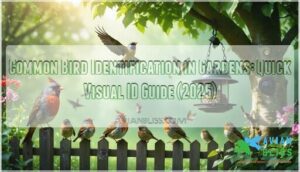 You’ll identify common bird identification in gardens by observing size, shape, and color patterns first. Start with obvious features: a robin’s red breast, cardinal’s bright crest, or wren’s curved bill.
Notice behaviors too—woodpeckers tap bark, finches flock at feeders, and hawks soar overhead. Size comparison helps: sparrows are thumb-sized, robins are tennis ball-sized, and crows are pigeon-sized.
Pay attention to habitat preferences—some birds prefer ground feeding while others stick to treetops. Seasonal changes affect which species you’ll spot, with some migrating while others remain year-round.
The key lies in combining visual cues with behavioral observations for accurate identification. Master these fundamentals and you’ll discover advanced techniques that transform casual birdwatching into precise field identification.
Table Of Contents
- Key Takeaways
- Garden Bird Identification
- Common Garden Birds
- Bird Habitat and Behavior
- Identifying Birds by Season
- Effective Bird Identification Tips
- Frequently Asked Questions (FAQs)
- What is the most common bird in your garden?
- How do I identify a bird I found?
- Is it good to have birds around your garden?
- How to find out what kind of bird from a picture?
- What time of day are birds most active?
- How do weather conditions affect bird visibility?
- What attracts specific birds to garden feeders?
- How far can you hear different bird calls?
- Why do some birds visit gardens seasonally?
- Conclusion
Key Takeaways
- Focus on size and shape first – You’ll identify birds faster by comparing them to familiar objects (sparrow = thumb-sized, robin = tennis ball-sized) and noting body proportions, beak shapes, and tail lengths before worrying about colors.
- Watch their behavior patterns – You’ll crack identification by observing how birds move and feed: robins hop on lawns hunting worms, nuthatches spiral down trees, and cardinals travel in pairs while crows form large flocks.
- Learn seasonal patterns – You’ll spot different species throughout the year as summer brings breeding residents like Indigo Buntings while winter attracts visitors like Dark-eyed Juncos and hardy year-round species like Northern Cardinals.
- Use field guides and apps together – You’ll improve accuracy by combining digital tools like Merlin Bird ID for instant photo identification with traditional field guides for detailed reference and offline study.
Garden Bird Identification
When you spot a bird in your garden, you’re looking at clues that work like a natural ID card.
Every feather, beak, and hop is a clue waiting to reveal your garden visitor’s true identity.
Start with size and shape—these features stay constant whether the bird is a tiny sparrow or a crow-sized visitor, giving you the most reliable foundation for identification.
Size and Shape Matters
You’ll master bird identification faster when you focus on Body Proportions first.
Bird Silhouettes reveal more than colors ever will. A robin’s plump chest differs dramatically from a cardinal’s compact build.
- Bird size comparison: Sparrow-sized, robin-sized, or crow-sized categories
- Beak Shapes: Seed-crackers have thick bills, insect-eaters sport thin pointed beaks
- Tail Lengths: Short and stubby versus long and forked variations
- Wing Forms: Broad rounded wings for woodland species, narrow pointed for aerial hunters
Color Patterns and Markings
When identifying bird species, you’ll often spot distinct color patterns that serve as reliable field marks.
Look for contrasting feather colors, distinctive beak patterns, and prominent wing bars that help distinguish similar species.
Notice how tail spots and plumage variations create unique identification signatures for common garden birds.
| Body Part | Key Markings | Example Species |
|---|---|---|
| Head | Black face mask, white eyebrow stripe | Northern Cardinal, Carolina Wren |
| Wings | White wing bars, black spots | Mourning Dove, Northern Flicker |
| Tail | White outer feathers, reddish patches | Dark-eyed Junco, Gray Catbird |
| Breast | Orange-red coloring, streaked patterns | American Robin, White-throated Sparrow |
Behavioral Traits and Habits
Beyond size and shape, you’ll crack the bird identification code by watching how they behave.
Watch their moves—a bird’s behavior tells its story better than any field guide ever could.
Foraging habits reveal identity – robins hop on lawns hunting worms while nuthatches spiral down tree trunks.
Flock dynamics matter too: cardinals travel in pairs, but crows form large, noisy groups.
Feeding strategies differ dramatically between species, from hummingbirds hovering at flowers to woodpeckers hammering bark for insects.
Common Garden Birds
You’ll encounter these three species in nearly every Virginia backyard, making them perfect starting points for building your bird identification skills.
Learning their key features helps you quickly distinguish between similar-looking species and builds confidence for spotting more challenging birds, which is crucial for developing your overall identification abilities.
Northern Cardinal Characteristics
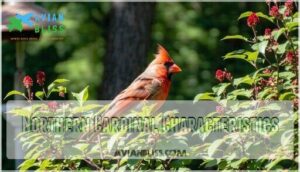
When you spot a Northern Cardinal, Cardinal Plumage stands out—males flash vibrant red, while females wear muted brown with red highlights.
That chunky Beak Shape is perfect for cracking seeds. Listen for their bold Song Patterns, heard year-round.
Their Nesting Habits favor dense shrubs. Feather Color, crest, and song make this bird species identification easy for garden bird watching enthusiasts.
The Northern Cardinal’s diet consists of seeds, including those found in high quality bird seed mixes.
American Robin Identification
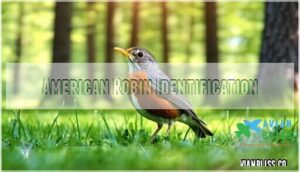
Around your backyard, the American Robin stands out with its distinctive orange-red breast and gray-brown back.
You’ll spot this common bird species identification favorite hopping across lawns, tilting its head to hunt earthworms.
Robin habitat includes gardens, parks, and woodland edges.
Their robin songs feature cheerful "cheer up" phrases.
Bird plumage differs between sexes—males show more vivid coloration.
Notice their yellow beak shapes and white throat markings for reliable garden bird watching identification.
Carolina Wren Recognition
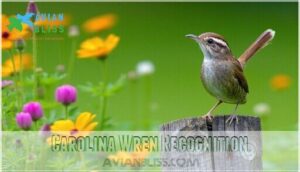
When you’re watching for Carolina Wrens in your backyard, you’ll quickly recognize their distinctive rusty-brown feather patterns and energetic personality that makes them stand out among garden birds.
- Size and shape: Small songbird (4.7-5.5 inches) with slightly curved beak shapes perfect for insect hunting
- Key markings: Dark brown back, light brown belly, and prominent white eyebrow stripe for easy bird identification
- Wren songs: Loud, musical "teakettle-teakettle" bird calls that carry surprisingly far for such a small bird species recognition
- Behavior: Active climbers that explore every nook and cranny, often cocking their tails upward during backyard birdwatching
- Nesting habits: Creative cavity nesters that’ll use anything from mailboxes to flower pots for raising young
Understanding their nesting site preferences is essential for attracting these birds to your garden.
Bird Habitat and Behavior
Where you spot birds tells you as much about their identity as their appearance does.
Each habitat attracts specific species with unique behaviors that make identification easier once you know what to look for.
Woodland and Park Habitats

After learning about common garden birds, let’s wander into woodlands and parks.
Here, you’ll find Park Birds and Woodland Species thriving under dense Tree Canopy and on leafy Forest Floors.
Habitat Diversity boosts bird species recognition, so pay attention to bird habitat preferences.
Bird identification in these settings often means spotting woodland bird species using garden birdwatching skills in wilder territory.
To attract these birds, consider installing bird feeder systems that cater to their specific needs in woodland areas with dense foliage.
Grassland and Meadow Habitats

The wide open spaces of grassland and meadow habitats offer excellent opportunities for meadow birds and grassland species identification.
These open land environments with wildflowers support diverse bird communities you won’t find in dense forests.
Habitat diversity here includes ground-nesters like sparrows and overhead hunters like hawks, making grassland birds particularly rewarding to observe and identify.
Understanding native grassland habitats is essential for effective conservation and identification of these species.
Shore and Marsh Habitats
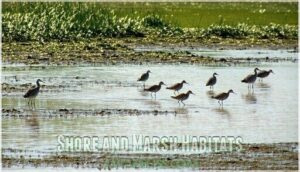
Shore birds thrive where water meets land, creating dynamic ecosystems that support diverse species.
These coastal and wetland environments offer rich feeding grounds where shorebirds probe mudflats for invertebrates while water fowl paddle through shallow channels.
Your bird identification guide improves when you recognize these critical wetland habitats:
- Mudflats teeming with sandpipers – watching them dart between waves searching for marine worms
- Herons standing motionless – their patience rewarded with quick strikes at fish
- Ducks dabbling among marsh plants – their synchronized feeding creating ripples across still water.
Wetland conservation protects these irreplaceable habitats from coastal erosion.
Identifying Birds by Season
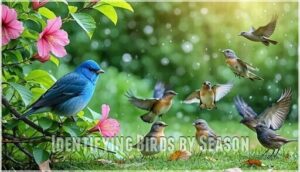
Understanding seasonal bird patterns helps you identify which species to expect in your garden throughout the year.
Virginia’s bird population shifts dramatically between summer breeding residents like Indigo Buntings and winter visitors such as Dark-eyed Juncos.
Summer Bird Species
During summer’s peak activity, you’ll spot vibrant species like Indigo Buntings with their brilliant blue feather patterns and melodic bird songs.
American Robins increase their presence, hopping across lawns while exhibiting distinctive nesting habits.
Common Grackles display iridescent plumage during summer feeding sessions.
Gray Catbirds deliver their characteristic "mew" calls from dense shrubs.
This bird identification guide helps distinguish these summer birds through their unique behaviors and seasonal bird migration patterns in your backyard birding experience.
Winter Bird Species
During winter’s frosty grip, your garden transforms into a haven for cold-weather specialists.
Dark-eyed Juncos appear in large flocks—nature’s snow forecast.
Northern Cardinals brave snowy landscapes with their striking red plumage, while White-breasted Nuthatches cache seeds in bark crevices.
Winter feeding attracts these hardy bird species, making winter migrants easier to spot than summer visitors.
To support these birds, understanding their need for high energy diets is essential for effective winter bird care.
Migration Patterns and Timing
Most garden birds follow predictable seasonal shifts, with spring migration peaking in April when males arrive first to claim territories.
Autumn movements begin in July, continuing through November as cold fronts trigger departures.
Climate change has advanced spring arrivals by 1.7 days per decade, altering traditional flyway patterns and timing variations across migration routes, which is a result of climate change.
Effective Bird Identification Tips

You’ll spot birds more easily if you focus on bill shape, tail length, and use a field guide or app for quick reference.
It’s a bit like solving a puzzle—get the main pieces right, and you won’t mistake a sparrow for a crow.
Using Field Guides and Apps
Digital tools revolutionize bird identification.
Field Guides offer portable species lists with detailed illustrations, while Bird Apps like Merlin Bird ID provide instant mobile identification through photos and sounds.
Online Resources combine both approaches—apps deliver real-time results, guides offer thorough reference materials.
Birdwatching apps excel at quick species identification, but traditional birdwatching guides remain invaluable for detailed study and offline use.
Effective birders rely on a good bird identification guide to improve their skills over time, utilizing digital tools and traditional methods for a comprehensive approach.
Observing Bill Shape and Size
Bird bills reveal feeding habits like nature’s toolbox.
Short, thick beaks crack seeds—think Northern Cardinals with their cone-shaped bills perfect for sunflower seeds.
Slender bills probe for insects, while curved bills extract nectar.
Observing bill length helps distinguish similar bird species during backyard bird watching.
Each beak type matches specific bird behavior and diet preferences.
Understanding the bird bill guide helps in identifying various species based on their bill shape characteristics.
Noting Tail Length and Wing Shape
After you’ve checked the bill, take a good look at Tail Length and Wing Shape. These features help you spot unique bird silhouettes and flight styles.
Think of a swallow’s long, pointed wings or a wren’s stubby tail.
Keep an eye out for:
- Fan-shaped versus forked tails
- Broad versus tapered wings
- Distinct feather patterns on wings and tail
Frequently Asked Questions (FAQs)
What is the most common bird in your garden?
You’re not limited to just one!
Northern Cardinals top Virginia’s backyard bird charts, appearing in 64% of summer observations.
These bright red males with black masks are year-round residents you’ll easily spot.
How do I identify a bird I found?
Start by noting the bird’s size, shape, and bill type—think of it as a detective sketch.
Jot down colors, markings, and behavior.
Compare your notes with a field guide or bird ID app for a match.
Is it good to have birds around your garden?
Studies show a single bird can consume over 1,000 insects daily, making them nature’s pest control team.
You’ll enjoy natural bug management, beautiful songs, and pollination services.
Birds reduce garden damage while creating a vibrant ecosystem that’s both practical and delightful.
How to find out what kind of bird from a picture?
Use bird identification apps like Merlin Bird ID or eBird, which let you upload photos for instant species identification.
You can also compare your picture to field guides or online databases using key features like size, colors, and bill shape.
What time of day are birds most active?
Picture the soft light of dawn or the gentle hush before dusk—these are prime times for bird activity.
You’ll catch birds feeding, singing, and socializing then, as they avoid midday heat and predators.
How do weather conditions affect bird visibility?
Weather dramatically impacts bird visibility through light conditions, precipitation, and wind patterns.
You’ll spot more birds during overcast mornings when they’re actively foraging.
Rain drives them to shelter, while strong winds keep them grounded and hidden, affecting their visibility.
What attracts specific birds to garden feeders?
Ever wonder why some gardens buzz with birds while others stay empty?
You’ll attract Northern Cardinals with sunflower seeds, Carolina Wrens with suet feeders, and American Robins with mealworms and berry-producing plants nearby.
This approach can help create a thriving bird-friendly environment, by offering the right food sources.
How far can you hear different bird calls?
You’ll hear most bird calls within 100-300 feet, though larger species like crows can carry over half a mile in ideal conditions while tiny warblers barely reach 50 feet.
Why do some birds visit gardens seasonally?
Birds don’t pull a disappearing act – they’re simply following nature’s rhythm.
Different species migrate based on food availability, breeding cycles, and temperature tolerance.
You’ll see insect-eaters like warblers vanish when bugs disappear, while seed-lovers stick around year-round, illustrating the concept of temperature tolerance.
Conclusion
Like ancient mariners using stars for navigation, you’ll find common bird identification in gardens becomes second nature once you’ve mastered the basics.
By combining size comparisons, color patterns, and behavioral observations, you’ve developed the essential skills for accurate species recognition.
Remember that consistent practice with field guides and observation apps will sharpen your identification abilities throughout the seasons.
Your garden will transform from a simple outdoor space into a dynamic wildlife observatory where every bird encounter becomes an opportunity to expand your ornithological knowledge and deepen your connection with nature.