This site is supported by our readers. We may earn a commission, at no cost to you, if you purchase through links.
Two species of Empidonax flycatcher can share the same forest edge, look nearly identical, and confound even experienced ornithologists—until the songs start. The alder produces a snappy "fee-BEE-o"; the willow answers with a flat "fitz-BEW." Same genus, same habitat, completely distinct acoustic signatures once you know what to hear.
Bird song operates on a hierarchical architecture of notes, syllables, and phrases sweeping across 1,000–10,000 Hz, and buried within that spectrum are the precise cues that separate lookalike species.
Learning to distinguish similar bird songs isn’t passive appreciation—it’s a disciplined skill built on pitch recognition, temporal pattern analysis, and behavioral context that transforms every walk into a readable acoustic landscape.
Table Of Contents
- Key Takeaways
- Key Differences Between Bird Songs and Calls
- Why Similar Bird Songs Occur
- Step-by-Step Bird Song Identification Techniques
- Enhancing Field Skills for Song Distinction
- Best Tools and Apps for Bird Song Recognition
- Frequently Asked Questions (FAQs)
- How can I identify a bird noise?
- Is there an app that can identify bird songs?
- What birds mimic other bird songs?
- What distinguishes avian songs from calls?
- Can weather affect how bird songs carry?
- How do juvenile birds develop their songs?
- Do birds sing differently at various altitudes?
- Can stress or illness alter a birds song?
- How do urban noise levels impact bird vocalizations?
- Conclusion
Key Takeaways
- Distinguishing similar bird songs relies on recognizing pitch, rhythm, and phrase structure across a frequency range of 1,000–10,000 Hz, with songs exhibiting complex, hierarchical patterns compared to the brevity and simplicity of calls.
- Evolutionary divergence, habitat adaptation, mimicry, and seasonal changes all drive acoustic overlap between species, making context and regional variation critical for accurate identification.
- Mastery of bird song identification demands disciplined listening—focusing on acoustic cues, using mnemonics, and practicing with local species—combined with the deliberate use of recording and spectrogram analysis for confirmation.
- Modern birding apps like Merlin Bird ID and BirdNET, featuring real-time identification, spectrograms, and offline capabilities, have become essential tools but require field note integration and critical listening to overcome their limitations.
Key Differences Between Bird Songs and Calls
Most beginners lump bird songs and calls together — but they’re acoustically and functionally distinct in ways that actually change how you identify species in the field. Understanding those differences sharpens your ear faster than almost any other skill.
Once you train your ear to tell them apart, resources like this bird song identification guide make the learning curve feel a lot less steep.
Here’s what separates them.
Song Structure Vs. Call Simplicity
Songs aren’t just longer than calls—they’re architecturally different. A song stacks notes into syllables, syllables into phrases, phrases into repeating motifs; a call delivers one quick burst and it’s done. That hierarchical syllable structure is your first diagnostic tool.
Frequency analysis reveals this fast: songs sweep broad pitch-and-tone contours across 1,000–10,000 Hz, while calls hold narrow, stable ranges. Recognizing these acoustic cues sharpens your bird song identification techniques immediately.
Understanding bird sound patterns is essential for distinguishing between similar songs.
Behavioral Functions of Songs and Calls
Beyond structure, function separates the two sharply. Territorial defense drives male songbirds to broadcast from prominent perches—loud, far-carrying vocalizations that claim space without constant patrols. Mate attraction layers in phrase variety and delivery rate, cues females actively assess. Alarm signals flip short and sharp.
Flock coordination and parental communication rely on calls—immediate, instinct-driven bird vocalizations governing moment-to-moment survival decisions. Understanding bird communication types is vital for distinguishing between similar bird songs.
Frequency Ranges and Acoustic Patterns
Acoustic signatures don’t just differ in complexity—they differ in measurable frequency. Songs sweep across 1,000–10,000 Hz with shifting frequency modulation and rich harmonic stacks visible in spectral analysis. Calls stay compressed, usually within 500–5,000 Hz, with stable pitch and tone.
Those temporal patterns and rhythms—how notes rise, fall, and repeat—are what your ear learns to track before your brain catches up.
Why Similar Bird Songs Occur

Similar-sounding birds aren’t just a coincidence—there are real biological and environmental forces driving those acoustic overlaps. Once you understand what’s behind them, distinguishing one species from another starts to make a lot more sense. Here are the three main reasons it happens.
Evolutionary and Regional Variations
Regional variations in bird songs aren’t random—they’re evolution made audible. Four forces drive this divergence:
- Song Dialects — White-crowned Sparrows develop distinct acoustic signatures across just a few yards of coastal California.
- Geographic Isolation — Siberian greenish warblers show measurable genetic variation tied directly to spatial separation.
- Habitat Adaptation — Forest species evolve lower-frequency vocalizations for better transmission through dense vegetation.
- Phylogenetic Signals — Cardinals link song structure to body size, precipitation, and altitude.
Mimicry and Learning in Birds
Imitation is the engine behind some of the most confusing overlaps in bird vocalizations. Vocal learning depends on precise Learning Windows—zebra finches, for instance, absorb tutor songs between days 25–65 post-hatching. Miss that window, and the song fractures.
Beyond timing, the songs birds learn vary wildly in structure—exploring types of bird songs and calls reveals just how much evolution shapes what gets imitated in the first place.
| Mechanism | Effect on Song Patterns |
|---|---|
| Song Tutoring | Juveniles mirror tutor rhythms closely |
| Brain Circuits (HVC/RA) | Control timing and sequence accuracy |
| Mimicry Functions | Expand repertoires across species boundaries |
Seasonal and Habitat Influences
Seasonal variations reshape what you hear more than most birders expect. Testosterone surges in late winter drive longer, more complex songs; by late summer, that same species barely sings. Habitat acoustics compounds the challenge—dense forest favors lower-pitched songs, while open grasslands reward higher frequencies.
Environmental factors worth tracking include:
- Dawn chorus intensity dropping post-territory establishment
- Bird migration timing shifting individual song onset
- Urban sonic landscapes pushing frequencies upward
- Vegetation density filtering which frequencies survive
Step-by-Step Bird Song Identification Techniques
Identifying bird songs gets easier once you have a reliable method to follow. The real skill isn’t just hearing the sound—it’s knowing exactly what to listen for and how to break it down.
These four techniques will sharpen your ear faster than any field guide can.
Noticing Pitch, Tone, and Rhythm

Pitch is your first filter. A Blackburnian Warbler pushes song pitch to 8–9 kHz—near the ceiling of human hearing—while a Great Gray Owl anchors the opposite extreme. Use this table to anchor your listening:
| Acoustic Cue | What to Notice |
|---|---|
| Song Pitch | High vs. low register |
| Tone Quality | Clear whistle vs. buzzy rasp |
| Rhythm Patterns | Pace, pauses, note spacing |
| Spectral Analysis | Rising, falling, or level contour |
These acoustic cues reveal bird song recognition techniques instantly.
Analyzing Song Length and Complexity
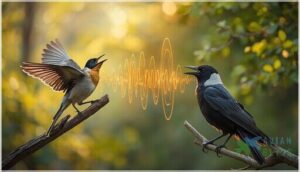
Duration separates species faster than you’d think. Skylark males sustain continuous song for 2–5 minutes; crows average just 0.32 seconds. That contrast in bird song length and complexity is a legitimate field marker.
Track syllable variation—some species pack dozens per second—and run basic rhythm analysis against what you’re hearing. Spectrogram metrics confirm phrase complexity when your ears need backup.
Using Mnemonics and Pattern Recognition
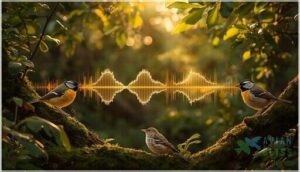
Language is your sharpest field tool. Match songs to phrase mnemonics—"witchity, witchity, witchity" for Common Yellowthroat, "teacher, TEACHER" for Ovenbird—and Mnemonics Training locks recall immediately.
Apply Pattern Hooks by chunking songs into opening, middle, and closing phrases. Spectrogram Analysis reveals visual Rhythm Identification cues your ear misses.
Bird sound mnemonics, rhythm and repetition, and chunking songs together make bird song identification precise and durable.
Practicing With Common Regional Examples
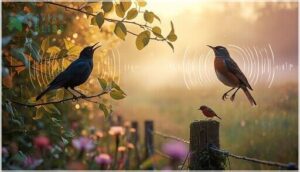
Start where you live. Regional birding sharpens species identification faster than any textbook—your local habitats are a free, endlessly repeating classroom. Compare the blackbird’s fluted 2 kHz melodies against the robin’s 4–6 kHz high warbles; notice the song thrush’s signature three-to-five phrase repetitions versus the blackbird’s continuous improvisation. Practicing bird song recognition this way builds real fluency.
- Spot vocalization patterns in birds you already hear daily
- Notice song variation between species sharing the same hedgerow
- Map regional dialects and bird song identification becomes second nature
Enhancing Field Skills for Song Distinction

Knowing what to listen for is only half the battle—the other half is training yourself to actually hear it in the field. Your ears, like any instrument, need regular calibration through deliberate practice and honest self-correction.
Knowing what to listen for means nothing until your ears are trained to actually hear it
Here’s what sharpens that instinct most effectively.
Improving Active Listening Abilities
Most birders underestimate how much active listening transforms sound recognition. Try this: stand still for several minutes, lock onto one voice, and let your ears map its vocal patterns before moving on.
This ear training strategy—focusing on a single bird rather than the full chorus—sharpens your ability to isolate audio cues, analyze bird calls, and improve bird song identification through deliberate, systematic listening strategies.
Leveraging Habitat and Time of Day
Knowing when and where to listen is half the battle. Habitat Acoustics shapes everything—forest species favor pure tones around 2,200 Hz, while grassland birds push buzzy, rapid-modulation calls across open wind.
Use Environmental Cues and time of day strategically:
- Dawn Chorus peaks 4–7 AM for territorial songs
- Dusk Singing resurfaces near sunset for boundary reinforcement
- Seasonal Variations shift song complexity through breeding months
- Habitat influence determines frequency range and song structure
Avoiding Common Mistakes in Identification
Even sharp acoustic analysis can go sideways when you lean too hard on apps—Merlin Sound ID, which covers 1,300+ species, stumbles on individual song variations and background noise. Frequency bias toward dominant sounds masks quieter calls.
Song overlap during dawn choruses scrambles single-species identification. Don’t let vocal learning nuances fool you; audio filtering through patient, focused listening consistently beats algorithm dependency in messy field conditions.
Recording and Reviewing Bird Songs
Your ears catch the moment; your recorder locks it in. Handheld audio recorders like the Zoom H5 capture bird songs in uncompressed WAV at 24-bit depth—preserving every acoustic signature for spectrogram analysis later.
Point the mic directly at the bird, stay still, record 30+ seconds. In spectrogram software, rising whistles and trill patterns become visible, turning ambiguous field calls into confirmed identifications.
Best Tools and Apps for Bird Song Recognition

The right tools can make all the difference between a confident identification and a frustrating guess in the field.
In 2026, birding technology has matured to a point where apps and devices genuinely extend what your ears alone can catch.
Here’s what’s worth knowing before you start building your kit.
Top Bird Song Identification Apps in 2026
Your best ally in digital fieldwork? Merlin Bird ID — 10 million downloads, 2,066 species, 90% accuracy. This isn’t casual birding software; it’s a machine learning app backed by eBird’s vast data architecture.
For sound analysis in dense, overlapping soundscapes, BirdNET delivers 80–90% precision on clean recordings. These birding apps have fundamentally transformed audio recognition and bird song identification in the field.
Features to Look for in Birding Technology
Not all birding apps are equal — what separates useful tools from noise comes down to five core capabilities:
- Real Time ID — instant species suggestions as birds vocalize
- Spectrogram Analysis — visual frequency mapping for precise bird song identification technology
- Noise Reduction — filters isolating clean vocalizations from wind and ambient chatter
- Location Filtering — GPS-driven acoustic monitoring prioritizing regionally probable species
- Audio Quality — machine learning performance scales directly with recording clarity
Offline Capabilities and Community Contributions
Deep in a signal-dead canyon, offline capability separates productive birders from frustrated ones. Merlin’s downloadable regional packs cover 10,000-plus species—Sound ID runs completely without internet after setup. BirdNET captures recordings offline for later processing.
Meanwhile, citizen science contributions to ornithology power everything behind the scenes: over 100 hours of community audio, 100 million-plus eBird sightings annually, and 4,000-plus Xeno-Canto contributors validate bird song identification data regionally.
Integrating Recordings With Field Observations
Timestamps anchor everything. Synchronize your audio recorders with GPS tracks and field notes the moment you deploy — spoken deployment details embedded directly into WAV files eliminate guesswork later.
Spectrogram matching in Audacity overlays acoustic signatures against your written observations, while playback techniques confirm species identity through territorial responses.
Disciplined field note methods, combined with post-session audio data analysis, sharpen bird species recognition and advance birding by ear beyond guesswork.
Frequently Asked Questions (FAQs)
How can I identify a bird noise?
You can identify a bird noise by tuning into its acoustic signature—pitch, rhythm, and tone are your primary species cues. Amplitude modulation and behavioral context sharpen bird song recognition considerably.
Is there an app that can identify bird songs?
Yes—several bird song apps deliver impressive results. Merlin Sound ID, BirdNET Features, and ChirpOMatic Review all offer real-time audio analysis, with Merlin Bird ID achieving over 90% app accuracy on clear recordings.
What birds mimic other bird songs?
Northern Mockingbirds, Brown Thrashers, Gray Catbirds, Superb Lyrebirds, and European Starlings are master avian mimics. Each weaves stolen vocalizations into vast song repertoires through vocal learning and advanced bird imitation techniques.
What distinguishes avian songs from calls?
Bird songs are acoustic marathons compared to calls—complex vocalizations built on avian syntax, spanning 1,000–10,000 Hz through vocal learning.
Meanwhile, calls deliver brief acoustic cues within seconds, serving immediate avian communication needs.
Can weather affect how bird songs carry?
Absolutely. Atmospheric Conditions shape how far bird songs travel. Temperature Effects, Humidity Impact, Wind Patterns, and Rain Interference all distort acoustic signatures—humid air carries high-pitched bird calls farther; rain can shrink audible soundscapes dramatically.
How do juvenile birds develop their songs?
Juvenile birds don’t inherit songs—they copy them. Through vocal learning, young birds form neural templates by listening to tutors, then perfect output via subsong development and sensorimotor integration before crystallizing stable bird song patterns and rhythms.
Do birds sing differently at various altitudes?
Yes. High elevation mountain chickadees compress their vocalizations—shorter notes, tighter intervals, shifted frequencies—adapting acoustic signatures to cut through wind and thin vegetation.
Altitude effects on bird song patterns and rhythms are measurable and real.
Can stress or illness alter a birds song?
Stress and illness absolutely reshape a bird’s vocalizations. Elevated corticosterone doubles song output while slashing call duration—classic acoustic changes signaling vocal stress signs.
Illness effects like aspergillosis introduce hoarseness, while song suppression further degrades acoustic signatures entirely.
How do urban noise levels impact bird vocalizations?
Urban noise reshapes bird vocalizations through frequency shift and noise adaptation. Great tits alone push minimum frequencies above 2 kHz, a measurable acoustic evolution rewriting the rules of urban singing and bird communication entirely.
Conclusion
The quieter you become, the more the forest speaks. That paradox sits at the heart of every advancement in learning to distinguish similar bird songs—silence sharpens perception far more than effort alone.
Pitch, rhythm, and phrasing aren’t abstract concepts; they’re a living language encoded in milliseconds of sound. Master the architecture, trust your trained ear, and what once sounded like noise resolves into something precise, readable, and endlessly revealing with every step into the field.
- https://www.sibleyguides.com/bird-info/the-basics-of-identifying-bird-sounds/pitch-and-bird-song-identification/
- https://www.audubon.org/magazine/how-tell-apart-sound-alike-warblers
- https://pmc.ncbi.nlm.nih.gov/articles/PMC5884127/
- https://www.bentonswcd.org/2021-04-02-the-dirt-birdsongs-101-tips-on-how-to-identify-birds-by-song
- https://www.rspb.org.uk/birds-and-wildlife/identifying-birds/bird-song-identifier