This site is supported by our readers. We may earn a commission, at no cost to you, if you purchase through links.

Every autumn, over 10 billion birds funnel through the Americas along invisible highways in the sky, creating one of nature’s most impressive shows. If you know where to look, you can watch tens of thousands of raptors stream past a single viewpoint in a day, or witness entire wetlands transform into a churning mass of snow geese.
The fall bird migration best viewing spots aren’t random—they’re geographic bottlenecks where mountains, coastlines, and water bodies concentrate millions of travelers into predictable paths. From the rocky outcrops of Cape May to the volcanic Sky Islands of Arizona, these locations offer front-row seats to journeys that span continents and have occurred for millennia.
Table Of Contents
- Key Takeaways
- Eastern Bird Migration
- Western Bird Hotspots
- Midwest Bird Migration
- Pacific Flyway Spots
- Prime Viewing Times
- Frequently Asked Questions (FAQs)
- What state has the best bird watching?
- Where do birds fly to in the fall?
- What is the BIRDIST rule 10?
- What equipment enhances birdwatching during fall migration?
- How can beginners identify birds by sound?
- What safety tips are important for birdwatching?
- Which apps help track migration patterns reliably?
- How can I attract migratory birds to my yard?
- What equipment do beginner birders need?
- How does weather affect migration patterns?
- Conclusion
Key Takeaways
- Over 10 billion birds migrate through the Americas each fall along predictable geographic bottlenecks—like Cape May’s Delaware Bay crossing, where 40,000+ raptors concentrate in a single season—making these natural funnels your best bet for witnessing massive migration spectacles.
- Timing matters more than you’d think: hawk watching peaks mid-morning and mid-afternoon when thermals lift birds along ridges, while warbler diversity hits its stride in the first three weeks of September, especially after cold fronts push through with northwest winds.
- Western wetlands like Bosque del Apache and Great Salt Lake support mind-boggling numbers—14,000 sandhill cranes, 32,000 snow geese, and up to 12 million birds annually—but water level decline from climate change threatens these critical stopover habitats that birds have depended on for millennia.
- You don’t need fancy gear to start: quality 8×42 binoculars, a field guide or Merlin app, and knowledge of local peak seasons will get you 90% of the way there, whether you’re counting raptors at Hawk Mountain or tracking shorebirds at Point Reyes.
Eastern Bird Migration
The East Coast has earned its reputation as a birding powerhouse, especially when fall migration kicks into high gear. From the legendary hawk flyways of New Jersey to Pennsylvania’s mountain ridges, this region offers front-row seats to one of nature’s greatest spectacles.
Here are three spots where you can watch thousands of raptors, warblers, and songbirds make their journey south.
Cape May Point in New Jersey

Each autumn, Cape May Point in New Jersey becomes one of North America’s leading fall birding destinations, where the peninsula’s unique geography creates remarkable raptor concentration along the Atlantic Flyway. When migrating hawks, eagles, and falcons hesitate before crossing the 19-kilometer-wide Delaware Bay, they funnel into impressive numbers—over 40,000 recorded during a typical season at the Cape May Bird Observatory’s Hawkwatch platform.
Here’s what makes Cape May unmissable for coastal birding hotspots:
- Daily hawk counts from September through November track thousands of raptors during peak October flights
- Nearly one million waterbirds pass the Avalon Seawatch between late September and December
- The world’s longest-running Monarch Migration study operates here, documenting seasonal shifts as climate change delays peak passage into October
Cape May is also known as gull breeding habitat, hosting the largest colony of Laughing Gulls in the world. You’ll witness visitor impact firsthand—on busy days, over 1,000 birders gather at Cape May Point State Park, where cold fronts trigger breathtaking migration waves.
Hawk Mountain Sanctuary in Pennsylvania
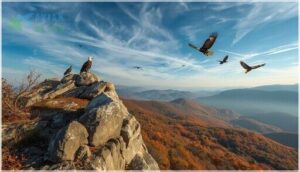
If Cape May draws you to the coast, Hawk Mountain Sanctuary pulls you inland to Pennsylvania’s Appalachian ridges—home to the world’s longest continuous raptor migration count since 1934. As the world’s first refuge for birds of prey, it has set a high standard for conservation.
You’ll spot up to 16 species soaring past rocky lookouts, with the 2024 season logging 12,526 raptors, including a record 653 bald eagles. Peak viewing hits mid-September when broad-winged hawks funnel through by the thousands, often exceeding 3,000 birds on northwest wind days following cold fronts.
| Species | Peak Month |
|---|---|
| Broad-winged Hawk | September |
| Red-tailed Hawk | October |
Conservation efforts and citizen science keep this birding hotspot thriving.
Cape May Autumn Birding Festival

Every October, the 2025 Cape May Fall Festival brings thousands of birders together for America’s leading fall bird migration celebration. Running October 16th-19th, you’ll join field trips tracking the 30,000 raptors passing through Cape May Point each season.
The Avalon Seawatch logs up to 800,000 seabirds annually, while Higbee Beach reveals 20 warbler species after cold fronts.
With keynote speaker Kenn Kaufman and daily hawk counts exceeding 2,000 birds, this birding festival delivers unforgettable visitor experiences at one of North America’s top bird migration hotspots.
Western Bird Hotspots
The western United States offers some of the most dramatic bird migration spectacles you’ll find anywhere in the country. From desert wetlands to remote lagoons, these hotspots attract millions of birds each fall as they follow ancient flyways south.
Here are three western destinations where you can witness migration on a massive scale.
Bosque Del Apache in New Mexico
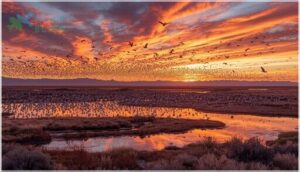
Bosque del Apache National Wildlife Refuge in New Mexico stands as a leading fall bird migration destination along the Rio Grande. Over 57,000 acres of managed wetlands and farmland create an oasis for arriving waterfowl. You’ll witness up to 14,000 sandhill cranes and 32,000 snow geese during peak November viewing conditions, thanks to refuge management that carefully floods impoundments and maintains roost sites.
The annual Festival of the Cranes celebrates this spectacle with guided tours and workshops, generating significant economic impact for Socorro County.
Water availability varies yearly, but dawn and dusk flights remain consistently breathtaking at Bosque del Apache NWR.
Izembek Lagoon in Alaska
Far north along the Pacific Flyway, Izembek Lagoon in Alaska hosts more than 250,000 migratory birds each fall. Wildlife refuges like this offer unparalleled waterfowl concentrations during peak fall migration.
You’ll find virtually the entire Pacific brant population staging here between September and November, feeding on 42,000 acres of eelgrass. Half the world’s emperor geese pass through, joined by cackling geese and over 78,000 shorebirds.
Great Salt Lake in Utah
Nestled at the center of the West, Great Salt Lake ranks among the most critical birding hotspots in North America. You’ll encounter 10–12 million birds using this migration stopover annually, drawn by saline food webs rich with brine shrimp and brine flies. Peak fall bird migration runs July through October, when shorebirds and waterfowl dominate.
Explore these prime viewing locations:
- Antelope Island State Park for 250+ species across varied habitats
- Bear River Migratory Bird Refuge hosting 500,000 ducks and geese
- Northeastern wetlands where 30,000 Tundra Swans arrive mid-October
- Exposed mudflats supporting critical shorebird foraging
However, water level decline threatens this ecological dependence, putting wildlife refuges at risk.
Midwest Bird Migration
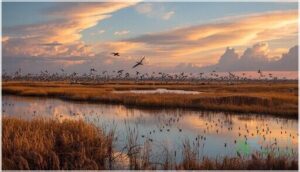
The Midwest mightn’t grab headlines like coastal hot spots, but it holds some serious surprises for anyone tracking fall migration. Wetlands and refuges across this region become temporary homes for thousands of ducks, geese, and shorebirds making their way south.
Here are three Midwest locations where you can catch the migration spectacle in full swing.
Montezuma Wetlands Complex in New York
When you’re watching nearly a million waterfowl funnel through New York’s Finger Lakes Region, you’ll understand why Montezuma Wetlands earns its Audubon Importance. This 50,000-acre waterfowl haven welcomes over 300 bird species during the fall bird migration viewing season, with tens of thousands of geese staging here in mid-November.
The complex’s wetland restoration efforts and eagle reintroduction legacy make it a premiere Eastern bird migration destination.
Visitor access includes a 3.5-mile Wildlife Drive and observation towers, perfect for catching those dramatic cold-front arrivals at these birding hotspots.
Squaw Creek National Wildlife Refuge in Missouri
More than 400,000 snow geese transform Loess Bluffs National Wildlife Refuge—formerly Squaw Creek National Wildlife Refuge—into one of fall’s most dramatic Midwest bird migration spectacles. You’ll spot up to 476 bald eagles alongside 100,000 ducks during the peak fall migration viewing season.
The refuge’s 10-mile auto loop lets you experience this wetland ecosystem’s seasonal changes from your car, with Conservation Efforts maintaining 7,440 acres of critical habitat.
Visit during Eagle Days (first December weekend) for remarkable Refuge Birdlife displays and Visitor Activities designed for all skill levels.
Magee Marsh Wildlife Area in Ohio
Lake Erie’s coastal wetlands create a natural funnel that concentrates migrating songbirds at Magee Marsh Wildlife Area, making it one of North America’s leading fall bird migration viewing spots. You’ll walk the famous mile-long boardwalk through swamp forest where warbler migration unfolds at eye level each autumn. This Midwest bird migration hotspot documents 348 species—over 80% of Ohio’s birds—and draws thousands of birders whose visits generate more than $26 million annually. The economic impact bolsters nearly 300 jobs while protecting critical habitat for fall migration.
- Thirty-six warbler species use the coastal wetlands during migration seasons
- Peak boardwalk birding occurs when Lake Erie’s barrier effect concentrates migrants
- More than 156 songbird species refuel here before continuing south
Pacific Flyway Spots

The Pacific Flyway stretches along the West Coast, offering some of the most dramatic bird migration spectacles in North America. From California’s fog-draped coastlines to Arizona’s mountain oases, these locations attract millions of birds each fall.
Here are three standout spots where you can witness this remarkable seasonal movement.
Monterey Bay in California
Monterey Bay transforms into a pelagic birding paradise each fall, where the submarine canyon pulls nutrient-rich water from the depths and creates one of the Pacific Flyway’s most productive upwelling ecosystems.
You’ll witness an astonishing shearwater migration spectacle—millions of sooty, pink-footed, and Buller’s shearwaters converge in these waters between August and November.
Millions of sooty, pink-footed, and Buller’s shearwaters converge in Monterey Bay’s waters each fall, creating an astonishing migration spectacle
Head to Elkhorn Slough to watch tens of thousands of shorebirds refuel in mudflat habitats, or launch from Moss Landing for offshore trips where parasitic jaegers and Sabine’s gulls pass through on their journey south.
Point Reyes National Seashore in California
Point Reyes National Seashore stands out as a geographic magnet along the Pacific Flyway, where nearly 490 species—over half of North America’s avian diversity—have been recorded across 70,000 acres of coastal habitats. Fall bird migration peaks from mid-October through December, when seabirds, shorebirds, and songbirds funnel through in striking migrant abundance.
You’ll want to explore:
- Outer Point locations like Chimney Rock and the lighthouse for concentrated fallout events
- Abbotts Lagoon for prime waterfowl viewing in September
- Cypress groves where vagrant warblers accumulate during peak migration phenology shifts influenced by climate impacts
Sky Islands in Arizona
Heading inland from California’s coast, southeastern Arizona’s Sky Islands rise as vertical refuges for some of the nation’s most striking fall bird migration events. Over 400 species use these isolated mountain ranges between September and November, making them leading birding locations along important migratory corridors.
You’ll spot 16 hummingbird species darting through oak woodlands and canyon riparian zones—the highest diversity in the United States. Species from Mexican and Rocky Mountain realms converge here, but conservation threats like wildfire and climate change pose risks to these fragile habitats that generate $1.4 billion annually in birding tourism.
Prime Viewing Times

Timing is everything for catching the best fall bird migration moments. Different birds move through at different times, so knowing when to watch can make all the difference.
Here’s what you need to look out for this season.
Peak Migration Seasons
As fall settles in, migration timing becomes the heartbeat of seasonal birding opportunities. Northern flyway peaks often arrive early, with flocks surging south in August and September, while southern hotspots—like Bosque del Apache—hit their stride in October and November.
Species turnover is rapid; many birds stop for just a few days before moving on, so each visit brings fresh faces. Annual variability is part of the magic, with cold fronts sparking dramatic migrations.
If you’re chasing unforgettable bird migration moments, watch for shifts in weather and food—nature’s cues for peak migration patterns.
Best Times for Hawk Viewing
Hawk watching reaches its prime when timing aligns with weather patterns. At Hawk Mountain Sanctuary, the majority of raptor migration viewing happens between 8:00 a.m. and 5:00 p.m., with peak flight days usually one to two days after cold fronts pass through.
Here’s when you’ll see the most hawks:
- Late morning (9:30–11:30): Thermals strengthen, lifting raptors along ridges
- Mid-afternoon (2:30–4:00): Another surge as winds sustain hawk flights
- Coastal vs. inland sites: Dawn and dusk movements dominate shorelines, while inland ridges peak midday
Weather influence can’t be overstated—northwest winds following storms concentrate thousands of hawks along flyways, delivering impressive species diversity.
Warbler and Songbird Migration Peaks
Your best window for warbler and songbird migration opens during the first three weeks of September, when peak migration delivers the highest diversity. Yellow, Chestnut-sided, and Tennessee warblers lead early fall passage, while vulnerable populations of juveniles—making their first journey south—face considerable mortality during these critical weeks.
Weather patterns, especially cold fronts with north winds, trigger major movements across stopover ecology sites.
Species variation matters: Yellow-rumped and Palm warblers linger through October, but most songbirds vanish by early October, so timing your visit right makes all the difference.
Frequently Asked Questions (FAQs)
What state has the best bird watching?
California claims the crown with 706 recorded species and 43 wildlife refuges, offering unparalleled habitat variety.
Texas and Florida follow close behind, but California’s birding access and conservation efforts make it North America’s leading destination.
Where do birds fly to in the fall?
During fall bird migration, you’ll see southward migration along four major migration flyways—Atlantic, Mississippi, Central, and Pacific—as birds seek warmer wintering grounds with abundant food, driven by habitat needs and climate impacts.
What is the BIRDIST rule 10?
You’ll crack the code of successful birdwatching when you understand BIRDIST Rule 10: track seasonal patterns month by month to predict which species appear when, making every outing more rewarding and productive.
What equipment enhances birdwatching during fall migration?
You’ll spot more with quality binoculars—8×42 models balance field of view and brightness. Digital ID apps like Merlin simplify identification on the go.
Pack a sturdy tripod for steady scopes, weatherproof clothing, and audio recording gear for capturing calls.
How can beginners identify birds by sound?
You can learn bird identification using Sound ID Apps like Merlin Bird ID, which achieves 93% accuracy rates.
Practice with Mnemonic Devices, Visual Aids, and Auditory Training to master avian species identification through birding equipment and safety protocols.
What safety tips are important for birdwatching?
Before heading out for wildlife observation, check cell coverage maps and pack birding equipment like binoculars, first-aid supplies, and water.
Watch for trip hazards, maintain proper wildlife distance, practice tick awareness, and keep group size manageable.
Which apps help track migration patterns reliably?
eBird accuracy reaches 90% for tracking migration patterns, while BirdCast forecasts deliver real-time alerts from 143 radar stations. Merlin ID and RadarScope analysis help you pinpoint migratory birds during peak birding seasons.
How can I attract migratory birds to my yard?
Before GPS and smartphones, birders relied on almanacs to predict arrivals.
Now you can attract migratory birds with native plants for shelter, clean water features, diverse bird feeders, and habitat corridors—while eliminating pesticides.
What equipment do beginner birders need?
You’ll need quality binoculars—8×42 specifications work best for beginners—a field guide or birding app like Merlin, comfortable waterproof boots, and weather-appropriate clothing.
Don’t forget a notebook for recording your birdwatching discoveries.
How does weather affect migration patterns?
Weather patterns steer migration like invisible highways—wind influence helps birds fly 37% faster in spring, while temperature cues and cold fronts trigger mass departures.
Precipitation impacts timing, and Rossby waves shape seasonal differences coast to coast.
Conclusion
Think of migration as nature’s annual reunion—and you’ve just been handed the guest list. These fall bird migration best viewing spots transform ordinary autumn days into front-row seats for one of Earth’s oldest traditions.
Whether you’re watching raptors ride thermals over Hawk Mountain or counting thousands of geese settling onto marshlands, you’re witnessing journeys that predate human civilization.
Pack your binoculars, check the forecast, and join the show.
- https://www.audubon.org/magazine/fall-migration-hot-spots
- https://www.fws.gov/story/migratory-bird-annual-status-reports
- https://www.hawkmountain.org/conservation-science/resources/migration-data
- https://intobirds.com/top-5-best-places-to-experience-fall-bird-migration-in-the-u-s/
- https://www.nature.org/en-us/get-involved/how-to-help/find-your-connection/find-your-connection-stories/conservation-takes-flight/