This site is supported by our readers. We may earn a commission, at no cost to you, if you purchase through links.

Most backyard birdhouses sit empty for years while their owners assume everything is fine. The birds know better. A box that looks perfect to you might have the wrong entrance hole, face the wrong direction, or sit too close to the neighbor’s cat—and the birds will simply fly past without a second glance.
Knowing how to know if birds are using your birdhouse means reading the easy-to-miss signs: a worn rim around the entrance hole, a tuft of grass poking out at dawn, a chickadee making the same low branch its personal lookout post. Each clue tells a clear story once you know what to look for.
Table Of Contents
- Key Takeaways
- Birds Are Using Your Birdhouse: Key Signs to Look For
- What Nesting Materials Tell You About Occupancy
- Choose The Right Birdhouse Before Monitoring Begins
- Place Your Birdhouse for Maximum Bird Activity
- How to Visually Observe Your Birdhouse Without Disturbing Birds
- Tools That Help You Monitor Nest Activity Safely
- How to Perform a Safe Physical Nest Check Step by Step
- When and How Often to Check Your Birdhouse
- Record Your Observations and Contribute to Bird Conservation
- Frequently Asked Questions (FAQs)
- How do you know if a bird is in a house?
- How do I set up a birdhouse?
- How far apart should a birdhouse be?
- Are all birdhouses the same?
- What time of year do birds move into birdhouses?
- Can birds reuse the same birdhouse next year?
- How do I clean a birdhouse between broods?
- What predators most commonly raid birdhouses?
- How long does a typical nesting cycle last?
- Should I remove old nests after birds leave?
- Conclusion
Key Takeaways
- A worn rim around the entrance hole, visible nesting material, regular adult visits, and chirping from inside are four clearest signs that a birdhouse is actively occupied.
- Matching the entrance hole size to your target species — 1.5 inches for bluebirds, 1 to 1.125 inches for wrens — is the single most important factor in attracting the right birds and keeping unwanted ones out.
- Checking your birdhouse once every five to seven days, only in mild afternoon weather, and skipping visits when temperatures drop below 50°F protects nesting birds without leaving problems undetected.
- Consistent nest monitoring — logging species, nest stage, and conditions each visit — pushes fledgling success rates from around 65% to over 90%, turning casual backyard birdwatching into meaningful conservation.
Birds Are Using Your Birdhouse: Key Signs to Look For
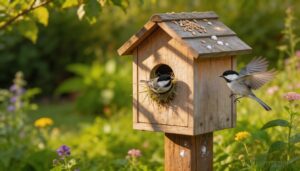
You don’t need to open the box to know something’s happening inside. Birds leave plenty of clues right at the surface if you know what to look for.
Watch for feather patterns, posture shifts, and activity timing — a solid breeding plumage identification guide can help you decode exactly what those signals mean.
Here are the four clearest signs your birdhouse has found a tenant.
Dusty or Worn Rim Around The Entrance Hole
One of the easiest rim wear indicators to spot is right at the entrance hole. Look for a slightly lighter, rubbed ring where birds grip the edge — that’s bill contact wearing the wood down over time.
Dust accumulation patterns along the outer lip, edge fraying effects from repeated beak contact, and faint odor residue clues all quietly confirm regular visits without you ever opening the box.
Nesting Material Visible at or Near The Entrance
Beyond the worn rim, the materials birds bring tell an even clearer story. Bark chip accumulation at the threshold, fiber looping around the entrance hole, and mud pellets tucked into gaps all signal active nest building.
- Fresh grasses and pine needles appear first
- Seasonal color shift from green to dry brown follows
- Soft down and feathers signal egg-laying is close
Transport frequency increases daily as construction peaks. safe nesting options help guarantee healthy nest construction.
Frequent Bird Visits and Territorial Behavior Nearby
Once nesting material is in place, watch the birdhouse itself. Visit frequency patterns shift noticeably — birds usually arrive 2 to 3 times daily during peak breeding, with increased activity after rainfall when insects surge nearby.
Daily observations also reveal territorial perch zones: a bird hovering 5 to 15 meters out, chasing intruders, signals active occupancy as clearly as any nest inside.
Vocalizations and Chirping Sounds Coming From Inside
After you spot territorial behavior, listen for morning chirp patterns and volume cues inside the birdhouse. Soft rustling sounds or distinct species calls—like bluebird cheeps or wren trills—signal feeding and nestling activity.
Vocal timing peaks between 6 and 9 am.
For birdwatching or bird behavior tracking, nest cameras and remote monitoring make using technology for nest monitoring easier than ever.
What Nesting Materials Tell You About Occupancy
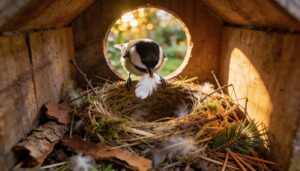
What’s inside a birdhouse tells a story, and the nesting material is the first chapter. Before you ever spot an egg or hear a nestling, the stuff birds carry through that entrance hole gives you real clues about where things stand.
Here’s what to look for and what each material means.
Grasses, Pine Needles, and Twigs as Early Indicators
Early nest building tells a clear story if you know what to look for.
Natural materials like grasses, pine needles, and twigs are your first real clues:
- Grass Blade Height of 1–3 cm above the nest frame signals fresh occupancy within 3–7 days
- A Needle Color Shift from green to yellow‑brown confirms recent pine needle collection
- The Twig Lattice Pattern — interlocked 2–6 mm twigs — forms the structural base first
- Early Build Timing peaks mid‑April in temperate yards near conifers
- A shifting Material Mix Ratio (more grass early, more needles pre‑incubation) tracks nest progress
These identifying signs of active nests reward patient visual observation techniques for nesting and birdwatching alike.
Feathers and Soft Lining Signaling Egg-laying is Near
Once soft feathers start appearing inside the nest cup, egg laying is usually just days away. Watch for a Lining Density Rise as the shallow Egg Cup Formation takes shape — fine grasses and moss combine with feathers to improve Nest Temperature Stability.
Feather Deposition Sequence, from coarse base to fluffy lining, is one of the most reliable identifying signs of active nests you’ll find.
How Material Type Helps Identify The Nesting Species
The materials inside your birdhouse are basically a species signature.
Bluebird Pine Needle clusters line the outer cup, while Wren Grass Weave creates a tight, woven mat you can spot right away.
Tracking these distinctive details becomes even more rewarding through NestWatch backyard bird monitoring, where your observations contribute to real nesting data.
Chickadee Feather Density runs higher — sometimes 25 feathers per nest. Sparrow Twig Diameter stays small and structural. Thrush Plant Down adds a fluffy, cloud-like layer.
It’s natural species identification without ever seeing the bird.
Choose The Right Birdhouse Before Monitoring Begins
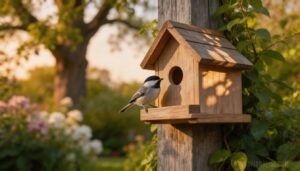
Before you start watching for birds, birdhouse itself needs to be the right fit. A box that doesn’t match your target species will sit empty no matter how well you place it.
Here’s what to get right right from the start.
Entrance Hole Sizes by Species (bluebirds, Wrens, Chickadees)
Getting the entrance hole right is the first real line of defense. Bluebird hole diameter sits at 1.5 inches — snug enough to block starlings. Wren entrance size drops to 1–1.125 inches, while chickadee opening dimensions are around 1.125 inches.
- Bluebirds: 1.5-inch round entrance holes
- Wrens: 1 to 1.125-inch entrance holes
- Chickadees: 1.125-inch opening
This competition reduction design keeps the right birds in and the wrong ones out.
Interior Dimensions and Cavity Depth Requirements
Think of the cavity as a cozy apartment — size really does matter.
For small cavity nesting birds like wrens and chickadees, a 3.5–4 inch interior width with 6–8 inches of depth works well.
Bluebirds need a roomier 5–6 inches wide and up to 12 inches deep.
A circular interior shape prevents nestlings from wedging into corners as they grow.
Ventilation, Drainage, and Removable Panel Features
A well-built birdhouse does more than look good — it keeps eggs warm, dry, and safe.
- Vent Size Standards: Small holes placed high on side panels follow a minimum 20mm² cross-section, promoting airflow without inviting rain.
- Drainage Hole Placement: Corner floor holes channel moisture away from nesting materials.
- Panel Latch Mechanisms: Quick-release hinged top-opening box designs use stainless hardware for tool-free seasonal cleaning and maintenance of birdhouses.
- Moisture-Resistant Materials with Thermal Insulation Integration: Cedar’s natural oils plus breathable finishes keep cavities sheltered from elements, supporting the selection of an appropriate birdhouse design alongside predator guards for complete protection.
Place Your Birdhouse for Maximum Bird Activity
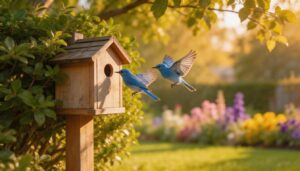
Even the best-built birdhouse won’t attract a single visitor if it’s hung in the wrong spot. Where you place it — and how you mount it — can make all the difference between an empty box and a thriving nest.
Here are the key placement factors to get right before the breeding season begins.
Ideal Mounting Height and Pole Placement
Height matters more than most people realize. For most species, aim for 5 to 10 feet off the ground — that’s your practical Height Range Guidelines sweet spot.
Pole Diameter Selection also counts: a 1½ to 2-inch pole stays stable in wind. Sink it at least 2 feet deep for solid Ground Anchor Depth, then add a baffle to keep climbers out.
Directional Facing to Avoid Wind and Direct Sun
Once the pole is set, direction is your next move. Entrance Orientation shapes how comfortable the nest stays all season.
four steps for smart Windbreak Placement and Sunshade Buffer protection:
- Face the entrance southeast for Seasonal Sun Alignment — morning warmth, afternoon shade.
- Use evergreen shrubs behind the box for natural windbreak placement.
- Apply a slight Microclimate Tilt forward to shed rain.
- Avoid reflective surfaces nearby when choosing best birdhouse location.
Distance From Feeders, Cat Pathways, and Other Houses
Direction manages wind and sun — now let’s talk about neighbors.
Keep feeders at least 10–15 feet away using smart Feeder Buffer Zones, especially where cats roam. Cat Deterrent Strategies, like motion-activated devices along known pathways, support solid Predator Trail Management.
Follow House Spacing Guidelines of 30+ feet between boxes.
Seasonal Distance Adjustments — pulling feeders farther in spring — round out choosing the best birdhouse location.
How to Visually Observe Your Birdhouse Without Disturbing Birds
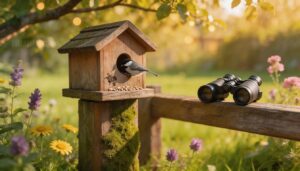
watching your birdhouse doesn’t have to mean getting close enough to spook the birds inside. few simple habits go a long way toward keeping things calm while still giving you a clear picture of what’s happening.
Here’s what to look for when you’re observing from a comfortable distance.
Best Times of Day for Observation (morning Vs. Afternoon)
Timing your visits matters more than most people realize. Light quality and temperature influence both bird behavior and how clearly you can observe activity. Here’s the data suggests:
- Monitor nests in the afternoon (1–4 PM) to avoid disrupting early morning egg‑laying.
- Avoid monitoring in early morning when eggs are most vulnerable to cold.
- Species timing varies — bluebirds feed near dawn, chickadees peak mid‑morning.
- Predator patterns increase midday, so quieter human activity early helps birds stay calm.
- Visual observation techniques work best in clear afternoon light for entrance visibility.
Watching for Adult Feeding Trips and Food Deliveries
Watch for adults arriving with food tucked in their beaks — delivery timing patterns usually cluster in short bursts, several trips within minutes. Arrival interval patterns tighten as nestlings grow hungrier.
Food type identification helps too: soft insects signal young chicks nearby.
These feeding behavior cues and food transfer mechanics are easy to track through simple birdwatching or nest cameras without disturbing anyone inside.
Recognizing Fledgling Presence Near The House in Late Spring
Fledglings don’t hide well — and that works in your favor. Look for small birds with short tail feathers making wobbly hops near the entrance, and listen for soft begging calls when parents return.
Insect remains scattered below the box signals active feeding. Parents ramp up territorial posturing too.
Birdhouse cameras capture all this fledgling development clearly, supporting fledgling survival without interrupting their natural fledging rhythm.
Tools That Help You Monitor Nest Activity Safely
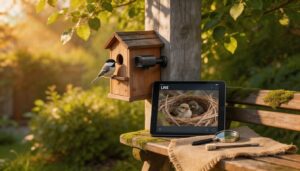
Keeping an eye on your birdhouse doesn’t have to mean constant trips out to the yard. The right tools let you check on nest activity without putting birds on edge.
Here are three options that work well for most backyard setups.
Wireless Nest Cameras With Night-vision and Motion Alerts
A wireless nest camera might be the closest thing to a front-row seat at nature’s most private show. Install one before breeding season starts — birds like bluebirds tolerate them well.
- Night vision uses infrared illumination without disturbing birds
- Motion-activated alerts send clips straight to your phone
- Motion zone settings filter out swaying branches
- Weatherproof housing survives spring rain and cold
- Cloud storage and flexible power options keep footage accessible
Borescope and Inspection Cameras for Interior Views
A borescope slips into your birdhouse like a quiet visitor — seeing everything without disturbing a thing. Modern inspection cameras offer 1080p to 4K Camera Resolution, LED Illumination with adjustable brightness, and Probe Articulation that bends around tight corners.
| Feature | Benefit |
|---|---|
| Wireless Connectivity | View footage on your phone instantly |
| Antimicrobial Housing | Reduces contamination near active nests |
These noninvasive monitoring techniques for birdhouses follow best practices for nest monitoring without opening the box.
Car-mechanic Mirrors and Pen-lights for Low-disturbance Checks
Sometimes the simplest tools work best. A car-mechanic mirror with anti-fog mirror coating and stainless steel housing slips into a birdhouse entrance cleanly, giving you a clear view without opening the panel.
Pair it with a pen-light using low-heat illumination and adjustable LED brightness settings — keep a magnetic pocket clip handy for easy access.
- Extend mirrors and poles to reach the entrance without crowding the box
- Use noninvasive observation to practice best practices for low-impact birdhouse monitoring
- These visual observation techniques for nesting support low-impact wildlife research with zero stress to nesting birds
How to Perform a Safe Physical Nest Check Step by Step
Opening a birdhouse for a quick check doesn’t have to stress the birds — it just takes a little care and the right approach. Done well, a physical nest check gives you details no camera or mirror can fully capture.
Here’s how to do it without causing harm.
Tap The Box and Wait Before Gently Opening The Panel
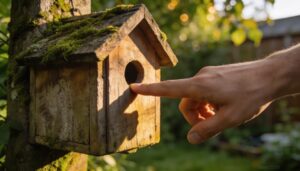
Before you open that panel, tap the side of the box gently with one fingertip. That soft knock is your tap timing signal — listen for a hollow sound, then pause 10 to 15 seconds.
This disturbance minimization step lets any bird inside settle. If the box feels warm, repeat the sequence.
Calm, deliberate movement is the foundation of noninvasive monitoring techniques for birdhouses.
Using a Mirror and Light to View Eggs or Nestlings
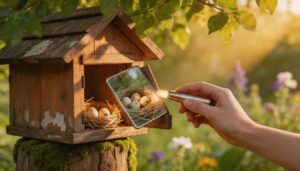
Once the box is open, slide a five-inch handheld mirror inside using the Quick-View Technique — steady, slow, no sudden moves. Adjust the Mirror Tilt Angle slightly downward to get Glare-Free Illumination from a low-heat LED penlight held to the side.
This pairs mirror use with noninvasive monitoring techniques for birdhouses, giving you a clear look at eggs or nestlings without touching a thing.
What to Record — Nest Type, Egg Count, Nestling Count
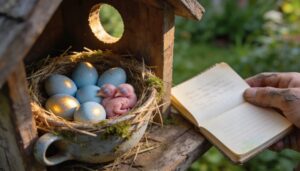
Once you’ve got a clear view, write down exactly what you see. Note the nest type — cup, platform, or cavity — then your egg count for Clutch Size Tracking and any nestling details for Nestling Age Estimation. Are they pink and bare, or already feathered?
That quick Nest Condition Scoring — damp, dry, intact — feeds your nesting activity journal and sharpens your Seasonal Occupancy Patterns over time.
Keeping Each Inspection Under One Minute
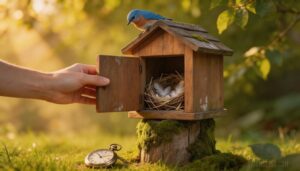
Speed matters here. Every second the panel stays open adds stress. That’s why one-minute timing isn’t a suggestion — it’s a rule.
- Run your pre-check checklist before approaching.
- Practice rapid panel opening to under 5 seconds.
- Log quick data using a drop-down mobile form.
- Observer training builds the muscle memory that makes this feel easy.
Limit nest checks to less than one minute, every time.
When and How Often to Check Your Birdhouse
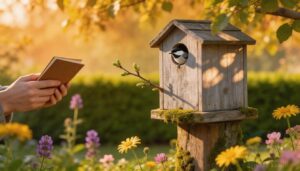
Knowing how often to check your birdhouse matters just as much as knowing how to check it. Too many visits can stress nesting birds, while too few leave problems undetected until it’s too late.
Here’s what a smart checking schedule actually looks like.
Recommended Frequency: Once Every Five to Seven Days
Checking your nest box once every five to seven days hits a sweet spot most experienced monitors rely on. That rhythm maintains microclimate stability inside the cavity, tracks egg development milestones without crowding the timeline, and keeps predator activity near the box low.
Build your observer scheduling around a reliable weather window — dry, mild afternoons work best. Nest monitoring once or twice a week is genuinely enough.
Avoiding Checks During Early Incubation and Near Fledging
Two windows in the nesting cycle demand extra caution: early incubation and the days just before fledging.
Incubation disturbance during the first few days can cause parents to abandon eggs entirely.
Fledging stress is equally real — nestlings nearly ready to leave will bolt prematurely if startled. Follow a Minimal Contact Protocol during both stages, relying on disturbance-free nest observation tools instead of opening the box.
Skipping Inspections in Cold, Wet, or Low-light Conditions
Bad weather is a signal to step back. Wet, cold weather raises real weather risk assessment concerns — condensation prevention matters because opening a box in damp conditions chills eggs fast. low-light safety makes accurate counts nearly impossible.
Instead, lean on remote monitoring alternatives like infrared nest cameras.
Follow seasonal monitoring guidelines: avoid checking nests during bad weather, and monitor nests in the afternoon on clear days only.
Suspending Checks When Ambient Temperature Drops Below 50°F
When the thermometer dips below 50°F, pause your nest checks entirely — this is your Cold Weather Protocol in action. Temperature Pauses aren’t laziness; they’re Thermal Stress Management.
Opening a box in cold air exposes eggs and nestlings to dangerous drafts.
Instead, follow these Weather Based Scheduling priorities:
- Switch to Remote Monitoring Options like wireless cameras
- Log weather-based suspensions in your nest records
- Resume checks only when conditions stabilize above 50°F
Record Your Observations and Contribute to Bird Conservation
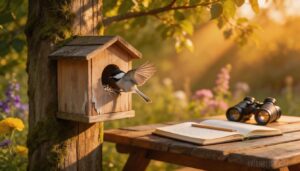
Every visit to your birdhouse holds information worth keeping. A few quick notes — written down consistently — can reveal patterns you’d never catch otherwise.
Here’s what to track and how your records can actually matter beyond your own backyard.
Logging Date, Time, Species, and Nest Stage Each Visit
Every visit tells a story — but only if you write it down. Keeping a nesting activity journal transforms casual birdwatching into real citizen science.
Log the date, exact time, species observed, and current nest stage each visit using consistent Timestamp Standardization and a simple Species Coding System.
| Field | What to Record | Example |
|---|---|---|
| Date & Time | Exact local time, AM/PM | April 9, 2:15 PM |
| Species & Nest Stage | Common name + Nest Stage Taxonomy | Eastern Bluebird – Incubation |
| Conditions & Duration | Weather Context Logging + Visit Duration Tracking | 62°F, sunny, 45 seconds |
Submitting Data to Citizen-science Platforms Like NestWatch
Your notes don’t have to stay in a notebook. NestWatch turns backyard observations into citizen science data that researchers actually use.
The Submission Workflow is simple — log your visit details through the website or app, and Data Validation happens automatically before your record enters the national database.
Community Feedback keeps your data reliable, and Privacy Protection ensures exact nest locations stay off public posts.
Using Observation Records to Improve Future Birdhouse Placement
Your observation journal is more than a record — it’s a decision-making tool.
Data-driven site selection gets sharper each season as you spot seasonal occupancy trends, like which months see the most bluebird visits or where wren activity clusters.
Habitat adjacency analysis and predator activity correlation help you shift underperforming boxes to better spots.
Species-specific success metrics show what’s working — and what isn’t.
How Monitored Boxes Achieve Over 90% Fledging Success Rates
That jump from 65% to over 90% fledging success isn’t magic — it’s what consistent nest monitoring actually delivers.
Consistent nest monitoring transforms fledgling success from 65% to over 90% — no magic required
Here’s what makes monitored boxes outperform:
- Predator Guard Effectiveness blocks ground and climbing threats before they reach eggs.
- Camera Disturbance Minimization through early nest camera setup, keeps adults calm and on schedule.
- Temperature Humidity Control via sensor data integration, flags dangerous microclimates fast.
Best practices for nest monitoring turn good intentions into real results.
Frequently Asked Questions (FAQs)
How do you know if a bird is in a house?
Look for worn entrance rims, visible nesting materials, frequent adult flight patterns, and chirping sounds from inside.
These acoustic monitoring cues and visual observation techniques are your clearest identifying signs of active nests.
How do I set up a birdhouse?
Start with the right box, mount it 5–10 feet high on a pole with a predator guard, face it away from wind, and use untreated wood for lasting weatherproofing.
How far apart should a birdhouse be?
Spacing depends on the species. Bluebirds need 100–200 feet between boxes, while wrens and chickadees do fine with just 3–10 feet apart. Match species-specific spacing to avoid territorial aggression zones.
Are all birdhouses the same?
Not even close. Entrance hole size, cavity depth, materials, and mounting style all vary by species. What works for a bluebird won’t suit a wren.
What time of year do birds move into birdhouses?
Like clockwork, birds follow nature’s calendar. Most cavity nesters arrive in early spring — March in temperate regions — driven by migration arrival timing, rising temperatures, and insect abundance cues.
Regional climate variation shifts this window earlier or later.
Can birds reuse the same birdhouse next year?
Yes, birds can absolutely reuse the same birdhouse next year.
Cleanliness Protocol and seasonal maintenance are the deciding factors — a clean, well-kept box with solid Predator Guard Effectiveness gives cavity nesters every reason to return.
How do I clean a birdhouse between broods?
Think of each brood as a new chapter — the old one needs clearing before the next begins.
Remove nesting material, scrub with hot water, disinfect with bleach solution, repair cracks, then let it dry completely.
What predators most commonly raid birdhouses?
Raccoons, cats, corvids, snakes, and squirrels are the most common culprits.
Each poses a different threat — from raccoon night raids and corvid egg theft to snake climbing threats and squirrel chewing damage.
How long does a typical nesting cycle last?
A nesting cycle runs about 3–4 weeks from egg laying to fledging. Incubation duration lasts 11–14 days, nestling development another 10– Species cycle variability means bluebirds may take 34 days; wrens finish closer to
Should I remove old nests after birds leave?
Absolutely — seasonal cleaning is essential. Removing old nests after fledglings leave helps parasite management, disease prevention, and habitat renewal.
Clean and maintain your nest box each fall, wearing gloves and a mask for safety.
Conclusion
You’ve now got the inside scoop on how to know if birds are using your birdhouse. It’s time to put your newfound knowledge to the test and become a birdhouse detective!
By following these simple signs and tips, you’ll be well on your way to creating a bird-friendly haven. Remember, monitoring your birdhouse is key to understanding how to know if birds are using your birdhouse effectively, and with practice, you’ll be a pro in no time, attracting birds like a magnet.