This site is supported by our readers. We may earn a commission, at no cost to you, if you purchase through links.

A single dropped feather can tell you more about a bird than hours of watching binoculars-up in the field. The asymmetric vanes on a primary feather reveal whether it came from a hawk or a heron. The microscopic barbs show how a bird makes its living. Each pattern of color and structure functions as a species signature waiting to be decoded.
Most birders rely on field marks like plumage and song to identify birds by feather patterns. But the feathers themselves hold diagnostic details that persist long after the bird has flown. Learning to read these clues transforms a walk through the woods into a detective story where each fallen feather points toward its owner.
Table Of Contents
- Key Takeaways
- Feather Types Explained
- Feather Color Patterns
- Feather Shapes Identify
- Feather Observation Techniques
- Feather Identification Tools
- Legal Feather Collection
- Frequently Asked Questions (FAQs)
- Can damaged feathers still be accurately identified?
- How do juvenile feathers differ from adults?
- What causes feathers to fade or discolor?
- Do hybrid birds show mixed feather patterns?
- Which feathers are easiest for beginners to identify?
- Can feather patterns reveal a birds age?
- How do regional variations affect feather identification?
- What seasonal changes impact feather appearance most?
- Do male and female birds share patterns?
- Conclusion
Key Takeaways
- Feather structure reveals species identity through asymmetric vanes on flight feathers, microscopic barb patterns, and distinct shapes that persist long after the bird has flown, making fallen feathers more diagnostic than field observations alone.
- Four feather types serve specific functions: flight feathers generate thrust and lift with measurable primary extension and growth bars, contour feathers create waterproof outer layers, down feathers trap air for insulation, and filoplumes act as sensory instruments detecting airflow changes above 600 Hz.
- Color identification depends on three mechanisms: melanin pigments produce blacks and browns while strengthening feathers, dietary carotenoids create yellows and reds that explain 32-51% of color variation, and nanostructures scatter light at 150-300 nanometer scales to produce iridescent blues without pigments.
- Legal possession of most native bird feathers requires federal permits under the Migratory Bird Treaty Act, with violations reaching $15,000 fines, though digital tools like Feather Atlas and Featherbase provide legal access to 1,994+ high-resolution scans for identification without collecting physical specimens.
Feather Types Explained
Birds carry four distinct feather types that serve different roles in flight, protection, and survival. Each type has unique structural features that you can learn to recognize in the field.
Understanding these categories will help you identify species and interpret what you find on the ground.
Flight Feathers
Flight feathers are the workhorses of avian movement. You’ll find primary feathers attached to the hand bones, usually 10 per wing, with pointed tips and strong shaft curvature that generate lift at angles above 10 degrees. Secondary feathers connect to the forearm, offering broader, rounded tips for increased wing surface.
When identifying birds, examine these key Structural Features:
- Primary extension measurements reveal Migration Distance capabilities
- Growth bars document Molt Patterns and nutritional history
- Notches on outer primaries create distinctive aerodynamic slots
Feather Atlases provide reference scans for comparing feather patterns across species. These structures influence aerodynamic lift and drag.
Contour Feathers
Contour feathers form the visible outer layer you’ll examine during identification. These feather types consist of a central rachis with barbs creating symmetrical vanes that overlap like shingles. Their feather structure provides both aerodynamic function and waterproofing while insulation properties trap air through barb arrangements.
You’ll notice structural variations across species—northern populations show denser, shorter feathers than southern ones. During molt patterns, contour feathers replace last to preserve breeding displays.
These feather patterns enable species recognition through distinctive coloration and body silhouettes unique to each bird. Noticing the markings on key body parts can help narrow down possible species.
Down Feathers
Beneath contour feathers, you’ll discover down feathers—the hidden insulation layer that separates winter survivors from those struggling in the cold. This feather structure lacks a central rachis. Instead, barbules radiate loosely from the base, creating a three-dimensional network that traps static air near the skin.
Down microanatomy reveals barbules thinner than human hair with specialized prongs that interlock neighboring fibers. In waterfowl, this design provides both down insulation and down buoyancy on water surfaces. Hatchling down covers precocial chicks at hatching, while altricial species emerge nearly naked. Commercial down from geese achieves fill power exceeding 800 cubic inches per ounce.
Feather identification requires recognizing these structural differences across feather types and feather patterns.
Filoplumes
Filoplumes, hidden among contour feathers, function as sensory instruments. These hair-like structures are not easily visible, lacking broad vanes and instead featuring a slender shaft tipped with minimal barbs. Their morphology is directly connected to mechanoreceptors that respond to vibration frequencies exceeding 600 Hz. Distribution clusters around wing feathers provide real-time feedback on airflow changes during flight.
| Filoplume Feature | Identification Value |
|---|---|
| Slender rachis with terminal tuft | Distinguishes from contour feathers in feather identification |
| Dense clustering at feather bases | Indicates mechanosensory zones in feather structure |
| Asynchronous molt relationship | Maintains continuous monitoring during feather replacement cycles |
This sensory function detects incipient flow separation on wings, with implications extending beyond aerodynamics. Filoplumes also guide preening and feather arrangement across multiple feather types and patterns.
Feather Color Patterns
Feather color isn’t just about aesthetics—it’s one of your most reliable identification tools in the field. Different pigments and structural features create the patterns you see, and understanding these mechanisms helps you distinguish between similar species.
The following sections break down the main color types you’ll encounter when examining bird feathers.
Melanin Colors

Birds deposit two melanin pigments—eumelanin and pheomelanin—to generate the blacks, browns, and russets you’ll use for identification. Eumelanin variations produce darker tones with higher heritability than many color patterns. Pheomelanin production creates warmer rufous shades.
These melanin pigments don’t just add color; structural correlates like calcium enrichment strengthen flight feathers, while photoprotection roles shield skin beneath light plumage in high-UV habitats.
Carotenoid Colors

Unlike melanin’s earth tones, carotenoid pigments deliver nature’s most electric hues—the yellows, oranges, and reds that define goldfinches, flamingos, and scarlet tanagers. You’ll notice these dietary carotenoids aren’t manufactured by birds themselves. Instead, they’re absorbed from plant sources and deposited during molt. Feather color analysis reveals fascinating coloration variation across species, with carotenoid content explaining 32–51% of chroma and hue differences in yellow feathers.
Pigment conversion matters for identification. Birds metabolize basic dietary forms into specialized compounds—canthaxanthin creates flamingo pink while lutein and zeaxanthin produce yellows. Watch for these patterns:
- Over 2,900 bird species display carotenoid-consistent feather color patterns worldwide
- Evolutionary origins trace back 66 million years to the Palaeocene Epoch
- Blood pheasants exhibit bloody red feathers via concentrated carotenoids
- Pink-eared ducks show distinctive pink ear spots from carotenoid pigmentation
Structural Colors
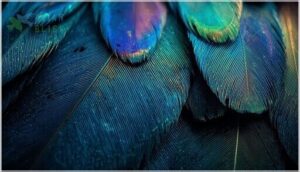
You won’t believe how structural colors in feather patterns work. Nanostructure mechanisms inside feather barbs scatter light through keratin-air interfaces at 150–300 nanometer scales. These self-assembly processes create iridescent blues and greens without pigments.
Structural colors emerge when nanostructures inside feather barbs scatter light at microscopic scales, creating iridescent blues and greens without any pigments
Optical properties show reflectance peaks around 50–100 nanometers wide. Pigment interaction with melanin layers boosts color saturation.
Color evolution produced these photonic architectures across multiple bird lineages for feather identification.
Color Variations

Geographic variation in feather color follows predictable climate rules. You’ll find darker plumage in cool, rainy regions, while warmer areas produce lighter birds.
Color polymorphism creates multiple morphs within single populations—like Black Sparrowhawks showing both dark and light forms. Sexual dichromatism drives faster male color evolution in many species.
Pollution effects dim carotenoid-based yellows and reds near urban areas. These plumage variations arise from genetic bases controlling pigment distribution, giving you reliable identification markers across populations.
Feather Shapes Identify

Feather shape tells you as much about a bird’s identity as its color patterns do. The contour of a feather reveals where it sits on the body and what role it plays in flight or display.
You’ll learn to recognize four major shape categories that make identification straightforward and reliable.
Primary Feathers
You’ll recognize primary feathers by their asymmetric vanes and rigid shafts—they’re the workhorses of flight function. Most flying birds carry 9 to 11 primaries per wing, while flightless species pack up to 62. These outer wing feathers generate thrust and bear the highest aerodynamic loads, which explains their enhanced mechanical properties.
During molt patterns, primaries replace sequentially from innermost to outermost. Associated sensory structures called filoplumes detect air movement, making primary feathers essential tools for identifying birds by feathers.
Secondary Feathers
Secondary feathers attach to your bird’s forearm bone and create the inner wing surface that keeps it aloft. You’ll spot these broader feathers generating lift rather than thrust during flight performance. Their aerodynamic function becomes clear when examining:
- Number variation – hummingbirds carry just 6 secondaries while albatrosses pack 40, reflecting species variation in wing design
- Molt patterns – replacement starts innermost and moves outward
- Color patches – duck speculums offer instant feather identification techniques for bird species identification
Count and photograph these feather patterns for reliable field identification.
Tail Feathers
Tail feathers—called rectrices—are your best tools for bird identification because shape reveals flight style and habitat. Most flying birds carry 10 to 12 rectrices that create the braking and steering surface you’ll observe during flight.
Tail shape categories include rounded, square, notched, forked, graduated, and pin configurations. Deeply forked tails often signal sexual dimorphism in males with elongated feathers.
Molt patterns help you age raptors by tracking which rectrices show replacement versus retention across plumage cycles.
Specialized Feathers
Beyond basic feather types, you’ll find specialized structures that reveal striking adaptations. Sensory filoplumes cluster around flight feathers—about 8 to 12 per shaft—transmitting airflow data to nerve endings. Rictal bristles near the mouth help aerial insectivores like flycatchers capture prey.
Look for these specialized feather patterns:
- Wing sounds in manakins through modified secondaries
- Courtship plumes in birds-of-paradise
- Flight specialization shown by primary asymmetry ratios
Feather Observation Techniques

Identifying feathers accurately requires more than just looking at color and shape. You need to understand the timing of molts, take precise measurements, and document what you find through careful observation.
The following techniques will sharpen your identification skills and help you build a systematic approach to studying feathers in the field.
Molts and Plumages
Throughout the year, you’ll observe distinct seasonal plumage changes as birds follow annual molt strategies tied to breeding and migration. Most songbirds complete one full molt post-breeding, replacing nearly all feathers in 30 to 60 days. Nonbreeding plumage appears subdued for camouflage, while breeding colors intensify for display.
You can age birds by comparing juvenile feathers—often duller and worn—against fresh adult plumage. Understanding these plumage cycle stages and molt-migration patterns reveals how energetic molt costs and feather quality survival shape identification clues across seasons.
Beak Shapes
After you’ve studied molt cycles and plumage stages, turn your attention to beak shapes—they reveal feeding ecology clues that strengthen bird identification. A raptor’s sharp hooked bill reveals predation, while a finch’s thick conical beak reflects seed-cracking mechanics. Beak morphology connects directly to diet: nectar-feeders sport long thin bills, ducks show flat filtering beaks.
Genetic basis determines much of this variation, with heritability near 0.74 for width in some species. Environmental change can shift beak dimensions over decades, making these structures changeable indicators alongside feather patterns and structure you’re learning to recognize.
Feather Measurement
Precise feather measurement transforms casual observation into scientific identification. You’ll measure feather length from tip to base along the rachis, recording vane width at the broadest point—usually around 39% of total length. Rachis thickness matters too, peaking in primaries P5–P8.
Check asymmetry ratios by comparing leading versus trailing vane widths. Primary feathers in flying birds show ratios averaging 3.84, while flightless species measure only 1.61. These feather characteristics reveal species identity and flight capability.
Photography
Quality feather photography turns your finds into identification tools. You’ll want macro feather imaging that captures barb and barbule structure—a 90 mm to 105 mm lens works best. Lighting techniques matter. Use diffused light to avoid harsh shadows that hide subtle patterns. Photograph each feather from dorsal and ventral sides plus one close-up of the vane. These feather photography techniques feed database photography collections used for automated analysis.
Field photography demands neutral backgrounds and perpendicular camera alignment to preserve accurate color bands. Your images then match against digital atlases containing over 1,500 species for reliable feather identification through feather pattern recognition.
- Shoot at multiple angles to capture iridescent colors
- Keep white balance consistent across all shots
- Fill the frame with sharp feather detail
- Use plain backgrounds for pattern clarity
- Document discovery location for habitat cross-reference
Feather Identification Tools

You don’t have to identify feathers on your own. Several digital tools and databases make the process faster and more accurate.
Here’s a look at the most reliable resources you can use right now.
Feather Atlas
The Feather Atlas provides access to 1,994 high-resolution scans from 438 North American species. You can filter by pattern, color, and size to match feathers against documented specimens. Each scan includes a centimeter grid for measurement plus specimen metadata from the U.S. Fish and Wildlife Service’s forensics laboratory.
Wildlife officers rely on this database for law enforcement cases. The system continually expands as new species documentation becomes available.
Featherbase
Germany’s team of feather specialists built Featherbase, the world’s largest online feather library, now covering 1,513 species—far more than the Feather Atlas. You’ll find high-definition scans with measurement scales that enable precise morphometric analysis. Research shows these measurements match traditional wing area data with 98% accuracy.
The database pools international citizen science contributions, and as museums digitize their collections, you can expect rapid future expansion.
Unlike Browse Scans or Search Scans tools, Featherbase excels at delivering the detailed feather measurements serious identification work demands.
Puget Sound Wing Collection
The Puget Sound Museum’s wing collection digitization provides you with 1,500 searchable records featuring dorsal and ventral views from 7,500 specimens. You’ll master feather pattern identification through standardized imagery that reveals flight feather characteristics analysis across North American species.
Research applications include:
- Filtering by taxonomic order and family
- Searching partial common names like “warbler”
- Comparing seasonal molt patterns by collection month
- Measuring wing morphology with photographic scales
The database’s search functionality enables recognizing feather patterns essential for field identification.
Feather Library
India’s first online repository dedicated to bird feathers provides access to over 270 documented specimens from Gujarat’s diverse avifauna. The Feather Library combines high-resolution scans with detailed metadata on wingspan, feather counts, and collection locations. Complete wing spreads and tail fans are photographed in both dorsal and ventral views for accurate identification and study.
| Feature | Description |
|---|---|
| Digital feather archives | Open-access platform at featherlibrary.com |
| Coverage | Indian avifauna database with 500+ regional species |
| Sourcing | Ethical feather sourcing from rescue centers only |
| Conservation applications | Aids wildlife forensics and protection enforcement |
This resource mirrors the U.S. Feather Atlas approach while focusing exclusively on Indian bird species.
Legal Feather Collection

You can’t just pick up any feather you find and take it home. Federal and state laws protect most bird species in North America, and their feathers fall under strict regulations.
Understanding these legal boundaries and ethical practices will help you enjoy feather identification while respecting wildlife protection efforts.
Federal Laws
Under federal law, you can’t legally possess most native bird feathers without authorization. The Migratory Bird Treaty Act protects over 1,000 species, making even a single feather from protected birds illegal to keep.
MBTA penalties reach $15,000 per violation, while Eagle Protection laws impose fines up to $100,000. Native exemptions allow enrolled tribal members to obtain eagle feathers for ceremonies.
Legal possession requires permits for scientific work, though you can keep feathers from non-native domestic birds and legally hunted game species.
Migratory Bird Treaty
The Migratory Bird Treaty Act implements four international agreements dating back to treaty origins in 1916 that revolutionized species protection. You’ll find over 1,100 birds now shielded under these enforcement mechanisms, which prevented millions of deaths through agency responsibilities like mandating covered oil pits.
Conservation outcomes include recovered waterfowl populations and a $100 million BP settlement after Deepwater Horizon. Feather possession laws make legal feather collection nearly impossible without permits, though ethical feather collection practices emphasize observing birds undisturbed in nature.
Ethical Considerations
Legal possession under the Migratory Bird Treaty Act extends beyond simple compliance to deeper ethical practices. You’ll respect Indigenous rights by leaving culturally significant feathers untouched, particularly eagle and hawk plumes.
Research ethics demand that sampling live birds carries welfare impacts—stress responses and behavioral changes make plucking comparable to blood draws.
When you practice ethical feather identification, you’re minimizing conservation risks that threaten already vulnerable populations through habitat disturbance and repeated handling stress.
Responsible Feather Handling
Beyond ethical practices and legal feather collection under the Migratory Bird Treaty Act, you need to protect yourself from zoonotic risks. Found feathers carry bacteria and viruses—studies show 100% of wild bird feathers harbor cultivable microbes.
Before handling any specimen, use PPE: disposable gloves block pathogens, and masks prevent inhaling contaminated dust. Practice decontamination methods by isolating feathers in sealed containers and washing hands thoroughly afterward.
Never handle feathers from visibly sick birds, as they carry higher pathogen loads. Cover any cuts before contact to prevent infection through broken skin.
These ethical collection practices minimize harm while advancing your identification skills responsibly.
Frequently Asked Questions (FAQs)
Can damaged feathers still be accurately identified?
You can identify damaged feathers through microscopic analysis of remaining characteristics. Fragmented samples retain diagnostic barb patterns and shaft features.
Tool limitations reduce identification accuracy from 85% to under 50% when damage is severe, but specialized techniques still yield results.
How do juvenile feathers differ from adults?
Juvenile feathers show greater abrasion and structural wear than adult plumage. You’ll notice duller coloration in juvenile birds because carotenoid pigments intensify after the first molt.
Plumage variations include spotted patterns that fade through ontogenetic shifts during seasonal plumage changes.
What causes feathers to fade or discolor?
Before photography existed, naturalists struggled to record fleeting plumage hues. UV degradation strips carotenoid pigments, while dietary deficiencies, metal pollutants, wear abrasion, and physiological stress all fade feather color through environmental factors on plumage.
Do hybrid birds show mixed feather patterns?
Hybrid birds show blended feather patterns combining traits from both parents. You’ll see intermediate colors, mixed markings, and structural variations like modified crest heights or altered gorget nanostructures that complicate species identification.
Which feathers are easiest for beginners to identify?
Think of feather identification as pattern matching. Your eye catches bold markings first.
Flight feathers from raptors and large waterfowl show unmistakable barring and color contrast that beginner identification guides highlight for good reason.
Can feather patterns reveal a birds age?
Yes, you can determine age through molt limits where older retained juvenile feathers contrast with newly replaced ones.
Post-juvenile molt extent and plumage color variations also help distinguish juvenile birds from adults in many species.
How do regional variations affect feather identification?
Birds don’t always wear the same outfit everywhere they go. Plumage clines shift across latitude, while environmental wear from climate dulls colors.
Molt timing varies by habitat. Altitude effects and subspecies limits complicate matching isolated feathers to species.
What seasonal changes impact feather appearance most?
Photoperiod effects drive molt cycles through hormonal regulation, while climate warming advances seasonal plumage changes.
Breeding plumage shows brighter colors than worn migration wear, creating distinct plumage variations that complicate feather identification throughout the annual cycle.
Do male and female birds share patterns?
Surprisingly, about half of waterfowl and gamebird species show males and females sharing the same broad plumage pattern category.
Pattern sharing drivers include ecological pressures and shared parental roles that favor similar feather patterns despite dichromatism evolution.
Conclusion
Sure, you could keep guessing species from silhouettes and songs alone. Or you could pick up that fallen feather and read the story written in its barbs.
When you learn to identify birds by feather patterns, every molt season becomes a masterclass in aerodynamics and camouflage. The evidence literally drops at your feet. You just need to know what you’re looking at. Those diagnostic details don’t require binoculars—just attention.