This site is supported by our readers. We may earn a commission, at no cost to you, if you purchase through links.
Walk into any forest at dawn and you’ll hear it before you see anything—a layered chorus of whistles, chips, and warbles rising from every shrub and canopy above. Most people register it as pleasant background noise.
Experienced birdwatchers hear something closer to a conversation, one where species, territory, and behavior are announced in real time. The gap between those two experiences comes down to one skill: the ability to decode what birds are actually saying. Learning songbird call recognition doesn’t require perfect pitch or years in the field—it requires the right framework, consistent practice, and a few tools that didn’t exist even a decade ago.
Table Of Contents
- Key Takeaways
- Why Learn Songbird Call Recognition?
- Key Features of Songbird Vocalizations
- Essential Tools for Learning Bird Calls
- Step-by-Step Guide to Recognizing Songbird Calls
- Overcoming Common Challenges in Call Recognition
- Advancing Your Skills With Technology and Community
- Frequently Asked Questions (FAQs)
- Conclusion
Key Takeaways
- Your ear can be trained to read bird vocalizations like a live map of species, territory, and behavior — rhythm, pitch, and repetition are the three core signals to focus on first.
- Apps like Merlin Bird ID and BirdNET put real-time, AI-powered call identification in your pocket for free, making field practice faster and more accurate than ever before.
- Short daily listening sessions beat weekend study marathons — pairing mnemonics like “tea kettle, tea kettle” with spectrogram visuals lock calls into long‑term memory far more effectively.
- Joining birding groups and contributing to citizen science platforms like eBird turns a personal skill into meaningful conservation data, while also accelerating your learning through mentorship and real‑world feedback.
Why Learn Songbird Call Recognition?
Learning to recognize songbird calls opens up a whole new layer of the natural world—one that’s always been there, just waiting for you to tune in.
A great place to start is this guide on learning bird calls and songs, which breaks down the process in a way that actually sticks.
Whether you’re a casual hiker or a dedicated birder, understanding bird vocalizations sharpens your awareness and deepens your connection to the outdoors.
Here’s why it’s worth your time.
Benefits for Birdwatchers and Nature Lovers
Bird call recognition isn’t just a party trick — it genuinely reshapes how you experience the outdoors.
Mastering bird sound analysis sharpens your attention, boosts cognitive function, and deepens emotional well-being through regular exposure to birdsong.
Real community connection can be found through birding by ear groups and citizen science projects.
The more you hear, the more you care about conservation.
Learning from experienced birdwatchers and using sound identification features can accelerate your skill development.
Enhancing Bird Identification Skills
Sound takes your identification skills further than sight alone ever could. When you layer habitat cues, time‑of‑day patterns, and behavioral context onto what you’re hearing, bird call recognition stops feeling like guesswork. Here’s what sharpens the skill fastest:
- Short daily birding by ear sessions build faster recall than weekend marathons.
- Spectrogram analysis reveals pitch differences invisible to untrained ears.
- AI probability scoring confirms field guesses instantly.
The free Merlin Bird ID app offers AI‑powered bird call identification.
Connecting With Birds Through Sound
Recognition goes beyond naming species — it builds a real connection. Through mindful listening, you start noticing a robin’s individual quirks, its pauses and repetitions, until that bird feels less like background noise and more like a neighbor.
Mindful listening transforms birdsong from background noise into the voice of a neighbor
Many sound‑guided meditation sessions use live birdsong for exactly this reason. Call‑response exchanges and personal bird signatures deepen that emotional bonding, turning bird call recognition into something genuinely rewarding.
That deeper connection is also why many artists draw on fascinating bird song facts and behaviors to fuel their creative work.
Key Features of Songbird Vocalizations
Every bird has its own vocal fingerprint, and once you know what to listen for, identification becomes much more natural. Songbird vocalizations follow recognizable patterns that your ear can actually be trained to detect.
Here are the three core features worth understanding first.
Rhythm and Tempo in Bird Calls
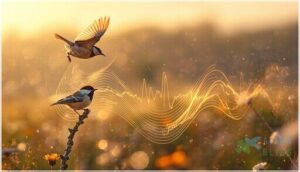
Rhythm is one of the most reliable clues in bird vocalization analysis. Each species carries its own species signature rhythms — chickadees tighten their gap timing when a predator is near, while skylarks sustain rapid note rate variation for minutes mid‑flight.
Meter patterns shift with season and context too. Once you start hearing these tempo signatures, you’ll recognize birds before you even think about it.
Pitch and Tone Differences
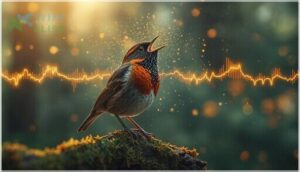
Pitch tells you as much as any field guide. Most songbirds sing between 2 and 8 kilohertz, but pitch range bands shift dramatically by species and habitat — urban birds push higher to cut through traffic noise, while forest thrushes favor fuller, bell-like timbre color variations that carry through dense foliage.
Contour shape patterns, whether a phrase rises, falls, or steps sharply, sharpen your bird call identification instantly. Spectrogram analysis makes these contextual pitch modulation shifts unmistakably visible.
Repetition and Song Patterns
Repetition is one of the most reliable clues in bird song recognition. Many species build songs from short repeated phrases — an Ovenbird’s “teacher-teacher-teacher” follows a clear motif syntax, while a Song Sparrow cycles through an individual song playlist of distinct types.
Phrase repeat counts stay surprisingly consistent per species. Seasonal pattern shifts matter too: spring brings tighter, more intense repetition, especially during dawn chorus.
Essential Tools for Learning Bird Calls
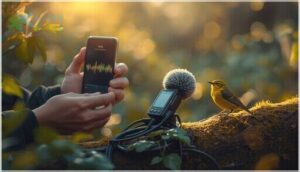
The right tools can make learning bird calls a lot less frustrating.
Whether you’re just starting out or trying to sharpen your ear, having the right apps and recording gear in your kit changes everything.
Here’s what’s worth your attention in 2026.
Best Bird Call Identification Apps (2026)
Your phone can be one of the sharpest ears in the field. The right bird sound identification app turns raw noise into instant answers. Here are three worth having in 2026:
- Merlin Bird ID — exceptional app accuracy, global regional coverage, and free data integration with eBird
- BirdNET — machine-learning-powered bird song apps built for serious listeners
- Smart Bird ID — clean user interface, no steep subscription models required
Sound Recording and Analysis Tools
Good ears need good tools.
Portable recorders like the Zoom H5 capture field audio with low self-noise, while external microphones — shotgun or mid-side — handle frequency calibration in open or dense habitat. Pair those recordings with spectrogram software like Raven Lite for bird sound analysis, and you’ll start seeing songs, not just hearing them.
| Tool Category | Recommended Option | Best For |
|---|---|---|
| Portable Recorders | Zoom H5 | Field audio capture |
| Spectrogram Software | Raven Lite | Bird sound analysis |
| AI Transcription | BirdNET | Audio recognition & logging |
Step-by-Step Guide to Recognizing Songbird Calls

Knowing what to listen for is one thing — building the habit of actually hearing it takes a bit more intention.
The good news is that recognizing songbird calls is a skill you can develop steadily with the right approach.
Here’s a practical breakdown of how to get there.
Active Listening and Field Observation
tuning out distractions — silence your phone, step away from conversation, and let your brain shift into auditory survey mode. Stand still for a minute or two and focus on a single singer at a time.
Perch observation helps: match the call to the bird’s exact position. The dawn chorus is your best classroom for active listening.
Using Mnemonics and Memory Aids
Your brain already knows how to remember patterns — mnemonics just give it a hook. Phrase Pairing works beautifully here: the Carolina Wren (Thryothorus ludovicianus) locks in instantly as “tea kettle, tea kettle, tea kettle.”
Visual Imagery and Rhythmic Mnemonics reinforce bird call rhythm and pitch together. Storytelling Links and Memory Palaces turn bird vocalization tone and repetition into lasting recall — making bird sound recognition feel almost easy.
Practicing With Real-Time Recordings
Mnemonics get the sound into your head — real-time practice keeps it there.
Take your phone into the field and run Merlin’s Live Audio Loop during a dawn session.
Ambient Chorus Isolation means tuning into one bird at a time from the morning chorus.
Instant Feedback Integration confirms your guess in real time, sharpening your ear with every correct hit.
Overcoming Common Challenges in Call Recognition

Even with solid technique, a few stumbling blocks tend to trip up most beginners. Knowing what to expect makes them much easier to work through.
Here are the two most common challenges you’ll run into and how to handle them.
Distinguishing Similar-Sounding Species
Some species sound almost identical—until train your ear on the details. Comparing the Chipping Sparrow’s flat mechanical trill against a Pine Warbler’s upward-slurring version on a spectrogram makes the frequency band gaps instantly visible.
Temporal pattern cues, call signature motifs, and habitat acoustic context all sharpen your bird call recognition methods. Bird vocalization analysis tools like Merlin turn subtle differences into clear distinctions.
Adapting to Seasonal and Regional Variations
Seasonal dialect shifts and migration timing effects mean the song you heard last April might sound subtly different by August. Hormonal song changes drive this — testosterone-fueled spring breeding songs give way to quieter contact calls by fall.
Urban noise adaptation also reshapes bird vocalizations, pushing city birds toward higher frequencies. Cross-reference range maps and bird sound spectrograms to stay calibrated across the seasonal chorus.
Advancing Your Skills With Technology and Community
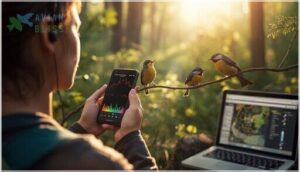
Once you’ve built a solid foundation, the right tools and a good community can take your skills further than solo practice ever will.
Technology has opened up new ways to study birdsong that weren’t available even a decade ago.
Here are three paths worth exploring as you move forward.
Spectrogram Analysis for Birdsong
A spectrogram turns sound into something you can actually see.
Free apps like SpectrumView generate real-time bird sound spectrograms, mapping Frequency Modulation Patterns as rising or falling diagonal lines across the Time-Frequency Resolution grid.
Spectral Color Mapping highlights louder moments in brighter tones, while Noise Reduction Techniques sharpen the signal.
Tools like BirdNETAnalyzer use Automated Call Classification to match spectrogram visualization patterns against thousands of species — bird song identification technology at its most practical.
Joining Birding Workshops and Field Trips
Getting outside with experienced birders accelerates your learning faster than any app alone. Local Club Networks like the Saxon Ornithologists Society publish Seasonal Field Calendars with Birding Workshops and Events open to all skill levels.
Before joining Birdwatching Field Trips, review your Gear Checklist Essentials and understand Group Etiquette Rules — quiet movement matters.
Many groups offer informal Mentor Matching Programs, connecting beginners with seasoned members who sharpen your Bird Sound Identification Techniques, and overall Birding Expertise and Skills within a welcoming Birding Community.
Participating in Citizen Science Projects
Contributing to citizen science takes your bird sound identification skills somewhere meaningful. Platforms like eBird follow strict Project Protocols and Data Quality standards — your recordings actually feed into Impact Monitoring research used by conservationists worldwide.
Some programs use Gamification Rewards and Community Training to keep contributors engaged and improving. Sound libraries grow richer with every submission, and birdwatching apps like BirdNET make participation straightforward, even for beginners.
Frequently Asked Questions (FAQs)
What is the best free bird song identifier?
Merlin Bird ID from Cornell Lab is your best free bird song identifier in Its Sound ID covers 2,066 species, works offline, and outperforms competitors like BirdNET in accuracy benchmarks consistently.
What is the best app to learn bird calls?
Regarding bird call apps, Merlin Bird ID takes the crown — it’s free, boasts impressive App Accuracy Comparison results, and offers Offline Pack Availability for regional species wherever you roam.
How does weather affect songbird vocalization frequency?
Weather shapes bird vocalization frequency in real ways.
Temperature‑Driven Pitch shifts, Humidity‑Frequency shifts, and Wind‑Induced Modulation all influence when and how birds sing, directly affecting bird behavior and avian acoustics across seasons.
What role does habitat play in bird calls?
Habitat quietly shapes every note a bird sings.
Dense forests favor lower-frequency bird acoustics, while open fields push bird vocalization higher.
Forest acoustic filtering, urban noise adaptation, and edge habitat blending all influence how species communicate.
How do birds learn their songs from birth?
Birds learn their songs through a sensitive period early in life, using tutor imprinting, genetic bias, and social feedback to shape neural circuitry — building their voice long before they ever sing a note.
Are nocturnal bird calls different from daytime songs?
Yes — day and night songs differ greatly.
Nocturnal flight calls are brief, often under a second, while daytime songs stretch longer with richer complexity.
Think of it as a whisper versus a full conversation.
Conclusion
What if the next walk you take through the woods becomes something entirely different—not just a stroll, but a live field session where every call carries meaning?
When you learn songbird call recognition, you’re not memorizing sounds—you’re building a new way of perceiving the natural world.
The forest doesn’t change. Your ability to read it does.
Start with one species, one call, one morning.
The conversation has always been happening. Now you’re ready to join it.
- https://apps.apple.com/us/app/merlin-bird-id-by-cornell-lab/id773457673?utm_source=chatgpt.com
- https://play.google.com/store/apps/details?hl=en-US&id=com.labs.merlinbirdid.app&utm_source=chatgpt.com
- https://search.macaulaylibrary.org/catalog?mediaType=audio
- http://biology.allaboutbirds.org/features/bird-song-hero/bird-song-hero-challenge
- https://smartbirdid.com/