This site is supported by our readers. We may earn a commission, at no cost to you, if you purchase through links.
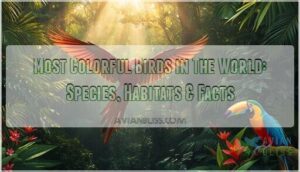
A scarlet macaw streaks across the rainforest canopy like a flying sunset, its crimson wings blazing against emerald leaves. That shock of color isn’t just beautiful—it’s a masterpiece of evolutionary engineering, built from pigments stolen from fruit and microscopic structures that bend light itself.
The most colorful birds in the world don’t just wear pretty feathers; they’re living billboards advertising genetic fitness, territorial claims, and mating prowess. From the iridescent plumes of paradise tanagers to the rainbow-hued bills of keel-billed toucans, these avian showstoppers have turned themselves into nature’s most extravagant works of art.
Understanding what makes them so vibrant reveals the fascinating interplay between diet, genetics, habitat, and survival.
Table Of Contents
- Key Takeaways
- What Makes Birds So Colorful?
- The World’s Most Colorful Birds
- Colorful Birds by Region
- Unique Features of Colorful Bird Species
- Conservation of Colorful Birds
- Frequently Asked Questions (FAQs)
- What are the most colorful birds?
- Which animal is the most colorful?
- Are birds the most colorful animals on Earth?
- Which bird has the most colorful head?
- What is the most flamboyant bird in the world?
- What are the world’s most colorful birds?
- What is the most colorful pigeon in the world?
- What bird has a bright plumage?
- What is the most beautiful bird in the world?
- What are some examples of colorful big birds?
- Conclusion
Key Takeaways
- Bird coloration comes from two sources: carotenoid pigments (which create reds and yellows from diet) and microscopic feather structures that bend light to produce iridescent blues and purples, with tropical species showing roughly 30% more vibrant colors than temperate birds.
- Bright plumage evolved primarily through sexual selection—brighter males win mates 44% more often—but there’s a survival trade-off since conspicuous colors increase predation risk, which is why females typically stay camouflaged while males display.
- The world’s most colorful birds cluster in tropical rainforests, which cover just 6-7% of Earth’s land but harbor over half of all vertebrate species, with the Amazon Basin alone hosting over 1,300 bird species facing threats from habitat loss that’s reduced survival rates by up to 75% for some species.
- Conservation efforts backed by birdwatching and citizen science are making real impacts—the activity generated $279 billion in economic activity in 2022 while programs like eBird collected over 1 billion observations that directly inform habitat protection and species recovery strategies.
What Makes Birds So Colorful?
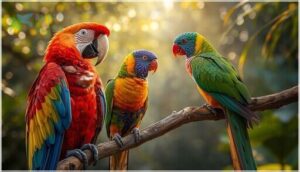
When you spot a scarlet macaw or a rainbow lorikeet, it’s hard not to wonder how nature came up with such electric colors. The answer lies in a fascinating mix of chemistry, evolution, and survival strategy.
Let’s look at what’s really happening beneath those vivid feathers.
The Science Behind Bird Plumage
Behind every dazzling feather lies a chemical masterpiece. Two main players are involved: pigments like carotenoids that paint yellows and reds, and structural colors—those iridescent blues and violets—created when light bounces off microscopic feather nanostructures. A single gene, BCO2, can flip yellow coloration on or off.
Microstructures in feathers are responsible for the diverse colors seen in birds. Pigment-based and structural mechanisms together account for nearly all bird plumage colors worldwide.
Evolutionary Reasons for Bright Colors
Sexual selection drives much of this brilliance—bright plumage evolved at least 150 times across passerines as males competed for mates. But evolution of bird coloration isn’t just about courtship.
Habitat influence matters too: tropical species are roughly 30% more colorful than their temperate cousins, thanks to dense forests favoring vivid signals. Dietary pigments like carotenoids fuel reds and yellows, while predation pressure and signal function shape who dares to dazzle.
The study of bird colour trends provides valuable insights into the factors influencing bird coloration.
The Role of Color in Mating and Survival
Color isn’t just flashy—it’s functional. Brighter males win mates 44% more often, while vivid females signal better clutch size. But there’s a trade-off: conspicuous plumage increases predation risk.
That’s why sexual dimorphism exists—males peacock around while females stay camouflaged during nesting.
Habitat matters too: tropical forests favor bold signals for communication. Your favorite colorful birds balance survival with showmanship daily.
The World’s Most Colorful Birds
Now that you know what creates all those stunning colors, let’s meet some of nature’s most vibrant show-stoppers. From the rainforests of Indonesia to the grasslands of Australia, these ten species represent the absolute height of avian color.
Each one brings something completely unique to the table—whether it’s an impossibly bright bill, iridescent feathers that shift in the light, or color combinations that seem almost too bold to be real.
Wilson’s Bird-of-Paradise
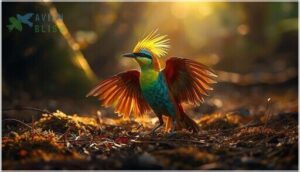
Among colorful birds, Wilson’s bird-of-paradise stands out with its striking display intricacies. This Indonesian species uses structural coloration to produce a stunning baby-blue bare crown, complemented by a yellow nape and crimson back. Males carefully prepare a courtship arena on the forest floor, clearing debris before showcasing their light green breast shield to females—a finale that makes bird plumage and coloration absolutely unforgettable.
Four striking Wilson’s bird-of-paradise traits:
- Males clear a well-lit “arena” by removing leaf litter before performing courtship displays
- The baby-blue crown results from structural coloration rather than pigments
- The finale features a conspicuous light green breast shield presented at close range
- Considered among the most colorful members of the entire bird of paradise family
Scarlet Macaw
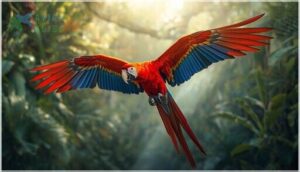
Scarlet macaws are among the most recognizable parrots in South America, with striking red, blue, and yellow plumage that makes them unforgettable. You’ll find these macaws across the Amazon Basin and Central America, where they mate for life and fly side by side through lowland forests.
Their conservation status is currently Least Concern, though habitat loss threatens regional populations—especially in fragmented Central American ranges.
Paradise Tanager
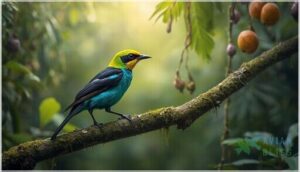
You’ll spot the paradise tanager gliding through the Amazon Basin’s canopy in vibrant mixed flocks of tropical bird species. This South American bird from the Tanager family flashes a lime-green head, sky-blue belly, and black wings—measuring just 13.5–15 cm.
Their diet habits focus on fruit in the outer tree crowns, where their colorful plumage stands out brilliantly against dense foliage.
Mandarin Duck
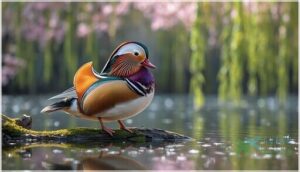
Glimpse a male Mandarin Duck in breeding plumage and you’ll understand why it’s a fidelity symbol across Asia—this exotic bird species dazzles with golden flanks, purple breast, and ornate back sails.
Found in East Asian woodland wetlands, males alternate between vivid courtship colors and duller eclipse plumage twice yearly.
Unfortunately, habitat threats challenge their conservation status despite cultural reverence.
Lilac-breasted Roller
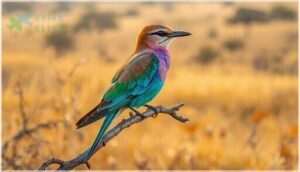
The Lilac-breasted Roller paints the sub-Saharan African sky with three distinct blues across wings and tail, plus that signature lilac throat deepening into a darker breast—truly one of the most exotic birds you’ll encounter.
You’ll spot this species hunting insects and small rodents from open savanna perches, where its vibrant avian plumage creates unforgettable displays during acrobatic courtship flights.
Golden Pheasant
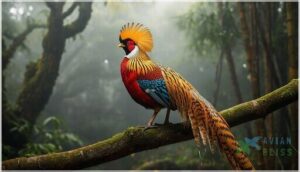
The Golden Pheasant transforms Chinese woodlands with a dazzling golden-yellow crest and crimson body that stretches 35–41 inches, two-thirds of which is a buff-and-black speckled tail. Sexual dimorphism is immediately noticeable—males sport this remarkable exotic birds display while females wear muted buff-brown plumage for camouflage.
This bird species thrives where habitat conservation protects its forest home, maintaining population trends exceeding one million individuals.
Rainbow Lorikeet
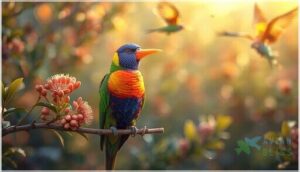
You’ll find rainbow lorikeets wherever Australia’s eastern seaboard blooms with color—from northern Queensland to South Australia, plus introduced populations in Western Australia, Tasmania, and even Auckland. This Australian bird’s standout displays a blue head, green wings, and orange-yellow breast that earns its name.
- Specialized brush-tipped tongues extract dietary nectar and pollen from flowers
- Social behavior drives flocks of 5–20 birds through urban canopies daily
- Urban adaptation lets these exotic birds thrive alongside human development
Their colorful plumage and energetic personality make them unmissable.
Keel-billed Toucan
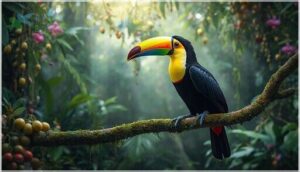
Head south from Australia to the rainforests of Southern Mexico, Venezuela, and Colombia, and you’ll spot the keel-billed toucan’s signature multicolor bill—green, orange, red, and blue stripes accounting for one-third of its body length.
This tropical bird’s diet diversity includes mostly fruit, making it essential for seed dispersal. Their social behavior creates birdwatching magic as groups call loudly through the canopy. Though conservation status remains stable, habitat loss threatens local populations across their range.
| Feature | Details |
|---|---|
| Bill Length | 12–15 cm, rainbow-colored |
| Geographic Range | Mexico to Colombia & Venezuela |
| Primary Diet | Fruit (frugivore) |
| Colorful Plumage | Black body, yellow throat/chest |
| Feather Coloration | Contrasts with vibrant bill |
Resplendent Quetzal
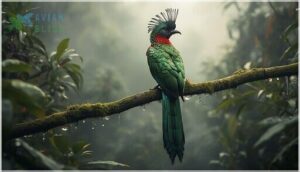
From Central America’s cloud forests comes the resplendent quetzal—a bird so stunning that ancient Maya and Aztec cultures considered it sacred.
You’ll recognize males by their iridescent green tail feathers stretching up to 65 cm, among the longest tail-to-body ratios in the avian world.
Listed as Near Threatened with fewer than 50,000 individuals remaining, this shy species faces ongoing habitat loss across its fragile cloud forest home.
Lady Gouldian Finch
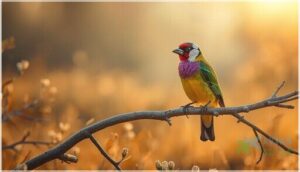
Australia’s tropical savannas showcase the Lady Gouldian Finch, one of the world’s most colorful birds. You’ll notice three distinct color morphs—70% display black faces, 30% red, and roughly one in 1,000 sports yellow heads.
Once numbering hundreds of thousands, habitat loss pushed wild populations below 2,500 by the 1980s. Conservation efforts are now helping Australian birds recover across their fragmented Northern Territory range.
Colorful Birds by Region
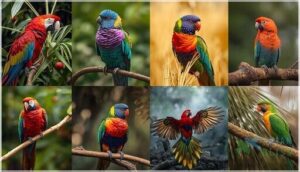
Where you live on the planet makes all the difference regarding spotting brilliantly colored birds. Some regions are absolute hotspots for feathered rainbows, while others offer their own surprising splashes of color.
Let’s break down which stunning species call each corner of the world home.
Tropical Rainforest Birds
Tropical rainforests are the crown jewels of avian diversity, where over 5,000 colorful birds thrive in nature’s richest ecosystems. You’ll discover why these humid forests—covering just 6–7% of Earth’s land—harbor more than half of all vertebrate species and contain 31 bird families found nowhere else.
- Toucans with rainbow bills traversing dense canopy layers
- Birds-of-paradise displaying iridescent plumes in New Guinea’s forests
- Seed dispersal experts carrying forest regeneration on their wings
- Endemic cotingas flashing turquoise against emerald leaves
- Climate refugia protecting species from mounting deforestation threats
Unfortunately, tropical birds face alarming pressures. In Sundaland alone, 89% of forest-dependent species have lost roughly 16% of their habitat, while climate impacts have slashed survival rates by up to 75% for some Amazonian insectivores. Protected refugia remain critically inadequate—only 17% of priority areas for frugivorous birds currently fall within reserves, leaving countless species vulnerable as temperatures rise and canopy cover vanishes.
Tropical birds are losing their forests faster than we can protect them, and many species face extinction as habitats vanish
Colorful Birds of The Amazon
Deep in the Amazon Basin, you’ll encounter over 1,300 bird species—a staggering one-third of South America’s avian diversity. Scarlet Macaws, Paradise Tanagers, and toucans dominate this colorful spectacle, playing essential seed dispersal roles across 5,500-hectare sites that host 575+ species. Unfortunately, habitat loss and climate impacts have slashed survival rates by 63% for some insectivores, threatening this matchless tropical treasure.
| Species | Key Colors | Conservation Status |
|---|---|---|
| Scarlet Macaw | Red, yellow, blue | Declining populations |
| Paradise Tanager | Blue, green, yellow | Stable in intact forest |
| Spix’s Macaw | Bright blue | Extinct in wild |
| Toucan species | Multicolored bills | Fragmentation-sensitive |
| Wattled Curassow | Dark with ornamentation | Endangered |
Vivid Species of Australia and Asia
You’ll find 19 million Rainbow Lorikeets displaying every rainbow hue across Australia—one of the continent’s most abundant colorful birds. The Gouldian Finch captivates with Gouldian genetics producing three facial color morphs, though wild populations dropped below 2,500.
Asian bird species like the Azure Kingfisher and Mandarin Duck—evolved 13-26 million years ago—showcase vivid blues in Pheasant Habitats spanning East Asia’s diverse ecosystems, where Australian Parrots and Asian Kingfishers are preeminent.
Notable North and South American Birds
From Mexico’s cloud forests to Brazil’s Amazon Basin, you’ll witness North American birds and South American birds exhibiting Regional Diversity unparalleled elsewhere. The Scarlet Macaw’s red-yellow-blue plumage extends from southern Mexico through Amazonia, where Macaw Conservation faces critical challenges with fewer than 1,000 Mesoamerican individuals remaining.
- Resplendent Quetzal — Near Threatened status with 20,000–50,000 individuals in fragmented Quetzal Habitat across Central America
- Painted Bunting — Electric-blue crown and red breast Bunting Plumage in males from Georgia to Texas
- Keel-billed Toucan — Rainbow-colored bill comprising one-third its 51-centimeter length showcasing distinctive Toucan Features
- Paradise Tanager — Lime-green head with sky-blue belly throughout the Amazon Basin
- Golden Pheasant — Intense golden-red plumage with populations exceeding 1 million in suitable colorful bird habitats
Unique Features of Colorful Bird Species
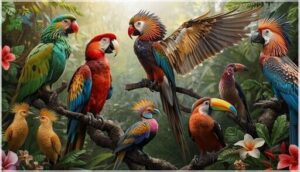
Colorful birds don’t just wear their brilliance on their feathers—they’ve evolved some truly striking features that make them stand out in the avian world. From beaks that look like they’ve been dipped in a rainbow to tail feathers that trail behind like royal robes, these birds have adapted in ways that’ll make you do a double-take.
Let’s look at what makes these species so visually exceptional.
Distinctive Plumage Patterns
You’ll notice that plumage patterns in colorful birds aren’t just random splashes of color—they’re intricate designs shaped by genetics and evolution. Barred patterns appear in 66% of species with regular designs, while spotted patterns show up in 30%. Pattern complexity drives rapid evolutionary diversification, with hummingbirds alone expanding the known color gamut by 56% across their 114 species.
Pattern recurrence happens through parallel evolution—distantly related species independently develop similar bars, streaks, and patches. Geographic variation plays a role too, with island populations showing distinctive regional plumage due to founder effects and reduced gene flow. The genetic basis is surprisingly simple: just two small genomic regions can control distinctive pigmentation patterns, enabling rapid emergence of novel feather patterns across subspecies.
| Pattern Type | Frequency in Birds | Common Locations |
|---|---|---|
| Barred | 66% of patterned species | Underparts of breeding males |
| Spotted | 30% of patterned species | Variable across body regions |
| Scaled | 25% of patterned species | Adult upperparts, juvenile underparts |
| Striped | Rare (43 species globally) | Longitudinal body lines |
Striking Beak and Tail Colors
You can’t miss the Keel-billed Toucan’s rainbow beak—it’s a full 15 cm long, making up one-third of the bird’s length. Genetic factors and carotenoid influence shape these display mechanisms differently across species.
Beaks and tail feathers aren’t just ornamental—they signal dominance and quality, aid in species identification, and help birds compete for territory. Coloration evolution has made bird beak adaptations remarkably diverse across habitats.
Sexual Dimorphism and Color Variation
You’ll notice striking differences between male birds and female birds across species—sexual dimorphism in plumage brightness and coloration. Genetic mechanisms, like the BCO2 gene, control these patterns, while ecological drivers and mating systems shape intensity.
Males in polygynous species flash vibrant blues and blacks; females stay cryptic in browns. Physiological effects, including diet and health, fine-tune these dazzling variations.
Courtship Displays and Behaviors
Beyond those color differences, you’re about to witness some of nature’s most electrifying performances. Courtship displays transform colorful plumage into lively mating rituals—think dance evolution in birds-of-paradise, where males flash iridescent feathers through 12 distinct gestures.
Three standout bird courtship displays:
- Mutual courtship in blue-capped cordon-bleus intensifies when partners watch each other dance
- Lekking manakins coordinate group performances with up to 40 males competing simultaneously
- Duet dancing Java sparrows achieve 2.3 times higher mating success through synchronized moves
The plumage role here? It directly predicts mating success—brighter males in lekking species secure 67% of all matings. Ritual learning starts early, with juveniles rehearsing moves until they’ve perfected their technique.
Conservation of Colorful Birds
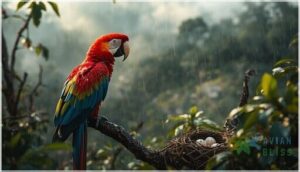
These stunning birds face real challenges in the wild, from shrinking habitats to the illegal pet trade. Some of the world’s most vibrant species are now endangered, and their survival depends on what we do today.
Let’s look at the key threats they’re up against, which species need our help most, and how something as simple as birdwatching can make a difference.
Threats to Colorful Bird Populations
Across continents, habitat destruction slashes forest cover where colorful species thrive—sometimes by 69% in hotspots like the Colombian Andes. Climate extremes now expose tropical birds to ten times more heat days annually, while light pollution drives up to a billion collision deaths yearly in the U.S. alone.
Add invasive predators killing billions and wildlife trade threatening 30% of parrots, and you see endangered bird populations facing a perfect storm.
Endangered Colorful Bird Species
You’re looking at a crisis with real names attached. The yellow-crested cockatoo—down to just 1,200–2,000 birds—tops the critically endangered list alongside Spix’s Macaw and Imperial Amazon.
Habitat loss, illegal trade, and climate change hammer these species hardest in Indomalaya and Australasia, where over 4,300 passerines were assessed and the most colorful faces the steepest population decline.
The Role of Birdwatching in Conservation
Your next trip to spot colorful birds does more than fill a life list—it fuels real conservation. Birdwatching backed $279 billion in economic activity in 2022 while citizen science programs like eBird collected over 1 billion observations, shaping habitat protection and policy outcomes. Consider what you’re enabling:
- Volunteers mapping 495 species’ populations to target declining areas
- $38 billion in tax revenue funding public awareness campaigns
- Protected forests showing 17.8% better retention where birding tourism thrives
Each sighting you log strengthens avian conservation strategies.
Frequently Asked Questions (FAQs)
What are the most colorful birds?
Plumage diversity reaches its peak in hummingbirds and parrots, where vibrant plumage patterns span 34% of avian color space—far surpassing most vertebrates through specialized avian pigments and structural mechanisms that improve visual signaling.
Which animal is the most colorful?
When measuring animal iridescence and color evolution, birds claim the crown.
Paradise tanagers rank highest for vivid bird plumage, but mandrills lead mammal coloration with striking blues, and panther chameleons dominate reptile vibrancy.
Are birds the most colorful animals on Earth?
Regarding a kaleidoscope of color, birds steal the show. Studies confirm they outrank fish, amphibians, reptiles, and mammals in measured color spectrum diversity and feather coloration intensity across global habitats.
Which bird has the most colorful head?
Hummingbird head colors likely win, since structural head coloration on their iridescent crowns and gorgets occupies 34% of avian color space—far surpassing what humans perceive, thanks to avian color perception including ultraviolet wavelengths.
What is the most flamboyant bird in the world?
Wilson’s bird of paradise takes the crown for flamboyance. Its courtship display combines iridescent feathers, a turquoise bare crown, and an elaborate dance—a stunning example of sexual selection driving avian beauty.
What are the world’s most colorful birds?
You might think bright feathers are just for show, but they’re actually survival tools.
The most colorful birds—Wilson’s Bird-of-Paradise, Scarlet Macaw, Paradise Tanager, and Rainbow Lorikeet—use vivid plumage for mating and territorial signals.
What is the most colorful pigeon in the world?
The Nicobar pigeon stands out with its iridescent plumage—glossy blues, greens, and coppers shimmer across its neck and head, while striking white tail feathers complete this stunning bird’s appearance.
What bird has a bright plumage?
You’d think bright plumage would be a liability, but carotenoid sources and structural enhancement actually boost survival.
Scarlet Macaws, Golden Pheasants, and Resplendent Quetzals showcase how dietary influence drives sexual selection in colorful bird species.
What is the most beautiful bird in the world?
Beauty perception in bird plumage coloration is subjective—research shows no single “most beautiful” species exists.
Human attractiveness ratings favor colorful tropical birds with vibrant plumage and complex patterns, though cultural bias influences individual preferences.
What are some examples of colorful big birds?
Standing three feet tall, a Scarlet Macaw’s wingspan can steal your breath.
You’ll find impressive species like the Keel-billed Toucan with its rainbow bill, or the Golden Pheasant with dazzling plumage extending beyond 40 inches.
Conclusion
What would the world lose if these feathered kaleidoscopes vanished tomorrow? The most colorful birds in the world aren’t just ornaments—they’re pollinators, seed dispersers, and ambassadors for the ecosystems they inhabit.
Every conservation effort you support, every habitat you help protect, keeps these living rainbows streaking across our skies. Their brilliance reminds us that nature’s greatest masterpieces aren’t hanging in museums—they’re flying wild, demanding we pay attention before they fade into memory.
- https://factanimal.com/fun-stuff/most-colorful-birds-on-earth/
- https://phys.org/news/2024-07-scientists-figure-birds-tropics.html
- https://www.mpg.de/12739969/the-rules-of-colour-rainfall-and-temperature-predict-bird-colouration-on-a-global-scale
- https://pmc.ncbi.nlm.nih.gov/articles/PMC12364563/
- https://nestboxlive.com/blog/top-15-most-colorful-birds-in-the-world/