This site is supported by our readers. We may earn a commission, at no cost to you, if you purchase through links.
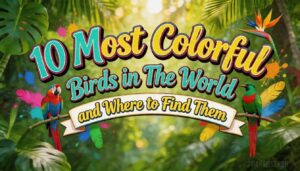
Some birds don’t just catch your eye—they stop you cold.
The Wilson’s Bird-of-Paradise sports a turquoise skull cap so electric, it looks digitally enhanced, yet no pigment creates that color. Tiny keratin structures in its feathers bend light like a prism, producing shades that simply shouldn’t exist in nature.
The most colorful birds in the world pull off this kind of visual wizardry through chemistry, physics, and millions of years of evolutionary pressure—not paint.
From the scarlet-and-cobalt Scarlet Macaw threading through the Amazonian canopy to the Resplendent Quetzal haunting the Central American cloud forests, what you’ll find here will make you want to book a flight.
Table Of Contents
- Key Takeaways
- What Makes Birds So Colorful?
- 10 Most Colorful Birds Worldwide
- Where Colorful Birds Live
- How to Identify Vibrant Birds
- Protecting The World’s Brightest Birds
- Frequently Asked Questions (FAQs)
- What are the most colorful birds?
- Which animal is the most colorful?
- Are birds the most colorful animals on Earth?
- Which bird has the most colorful head?
- What is the most flamboyant bird in the world?
- What are the world’s most colorful birds?
- What is the most colorful pigeon in the world?
- What bird has a bright plumage?
- What is the most beautiful bird in the world?
- What are some examples of colorful big birds?
- Conclusion
Key Takeaways
- Bird colors come from two very different sources — pigments (which birds often get from their food) and nanostructures in feathers that bend light — and together they produce shades that almost don’t seem real.
- The world’s most jaw-dropping species, like Wilson’s Bird-of-Paradise and the Resplendent Quetzal, are packed into biodiversity hotspots like Papua New Guinea, the Amazon, and Central American cloud forests.
- bird’s diet directly shapes how vivid it looks — poor nutrition during molting permanently dulls new feathers, which means a bright bird is basically advertising that it’s healthy and well-fed.
- Several of the most colorful birds on Earth, including the Quetzal and Gouldian Finch, are Near Threatened, with habitat loss and the illegal pet trade doing the most damage — and small personal choices like bird-safe windows and shade-grown coffee actually help.
What Makes Birds So Colorful?
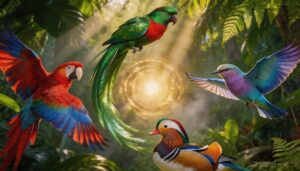
Bird colors aren’t just pretty — they’re the result of some genuinely fascinating biology happening at the feather level.
Behind every splash of blue or iridescent green, there’s a whole world of pigments and light-bending feather structures doing the work.
key mechanisms work together to produce everything from a cardinal’s fiery red to a hummingbird’s shifting, metallic sheen. Here’s what’s actually going on.
Pigment-Based Colors in Feathers
Bird color starts with chemistry. Three pigment types do most of the heavy lifting in pigment-based feather coloration:
- Melanin – builds blacks and browns, and its durability actually protects feathers from UV damage.
- Carotenoids – birds can’t make these themselves, so carotenoid signaling reflects real dietary quality.
- Porphyrins – rare but striking, producing vivid pinks with intense porphyrin fluorescence under UV light.
Diet, health, and pigment distribution all shape what you actually see. Many birds achieve vivid blues through structural blue coloration.
Structural Colors and Iridescence
Not all color comes from pigment. Some feathers pull off something almost magical — they use nanostructure architecture to bend light itself.
Tiny keratin layers, air pockets, and melanosome shape work together to produce structural color.
The result? Angle‑dependent reflectance that makes iridescent plumage flash blue, green, or purple as a bird moves.
Photonic crystal mechanisms in the Resplendent Quetzal create that legendary rainbow plumage — no pigment required.
How Diet Influences Plumage
So pigment and structure explain a lot — but what’s fueling the whole system? Food.
Birds can’t manufacture carotenoids on their own. Every red, orange, or yellow feather traces back to a seed, fruit, or invertebrate they actually ate. Carotenoid Sources matter enormously here.
Three things quietly shape how vivid a bird looks:
- Molt Nutrition — poor diet during feather regrowth dulls new plumage permanently
- Protein Requirements — low methionine and cysteine produce brittle, washed-out feathers
- Vitamin Deficiencies — missing micronutrients interrupt pigment pathways entirely
Seasonal Diet Shifts also push color intensity up or down depending on what’s available.
Why Bright Colors Evolve
Diet sets the table, but evolution decides who gets a seat. Bright feather coloration didn’t just happen by accident — it got selected because it worked.
Think about it: in open habitats with a strong light environment, bold patterns are easier to spot. That visibility drives the real evolutionary drivers of bright plumage, from Predator Avoidance and warning signals to outcompete rivals using structural color.
Color in Mating and Survival
Here’s the real balancing act: vivid feather coloration helps win mates, but it also invites predators.
Sexual dimorphism — where males carry the bolder colors — exists because females prioritize signal honesty when choosing partners.
Carotenoid-based yellows and reds honestly advertise diet quality. UV plumage, invisible to us, adds another hidden layer to courtship display.
Seasonal molt dials colors up during breeding, then back down. Predation risk and camouflage trade-offs shape every feather.
10 Most Colorful Birds Worldwide
Some birds don’t just have color — they look like they were painted by someone showing off.
The ten species below represent nature’s most jaw‑dropping combinations of hue, pattern, and sheer visual audacity.
Get ready, because this list is genuinely hard to believe.
Wilson’s Bird-of-Paradise
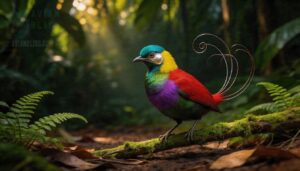
Few birds stop you in your tracks like Wilson’s Bird-of-Paradise (Cicinnurus respublica). This tiny 16 cm gem from Indonesia’s Waigeo and Batanta islands packs red, turquoise, yellow, and violet into one impossibly small body — a masterclass in island endemism.
Males practice courtship architecture, clearing forest-floor stages to show off their curved tail feather morphology. Females stay camouflaged nearby, watching.
Population monitoring keeps this Near Threatened species on conservation radar.
Scarlet Macaw
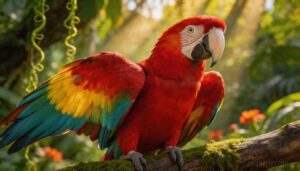
The Scarlet Macaw (Ara macao) is basically the loudest painting in the tropical rainforest habitat. Stretching 33 inches from beak to tail, this bold red bird practices long-term monogamy and nests in tree cavities high in the canopy.
Flock vocal communication carries for miles. Watch them at clay licks, neutralizing toxins — social roosting included.
CITES Appendix I covers their conservation status.
Paradise Tanager
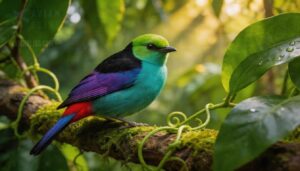
Meet the paradise tanager (Tangara chilensis) — a bird that looks like someone let a toddler loose with a full paint set. This compact songbird (13.5–15 cm) lights up the tropical rainforest habitat across Venezuela, Peru, Colombia, and Brazil.
- Joins mixed-species flocking groups of 5–20 birds while foraging high in the canopy.
- Practices high canopy nesting up to 30 m high, with eggs showing fascinating egg spotting variation across populations.
- Boasts an impressive range distribution spanning six Amazonian countries.
Mandarin Duck
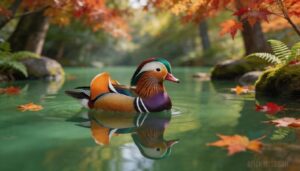
The Mandarin Duck (Aix galericulata) might be the most jaw-dropping waterfowl you’ll ever spot. Its crested coloration — orange face, purple chest, metallic-green crown — looks almost unreal.
Native to eastern Asia, this master of tree cavity nesting hides eggs in forest hollows near water.
Urban introductions across Britain and Europe have expanded its global distribution, and as an avian influenza carrier, it’s closely monitored by scientists worldwide.
Lilac-Breasted Roller
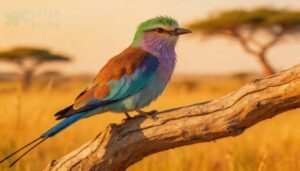
If Africa had a flying jewel, the lilac‑breasted roller (Coracias caudatus) would be it. Spot one on a treetop perch — classic perch preference behavior — and you’ll count eight distinct colors at once.
Those long black tail streamer morphology features clinch the ID instantly. It hunts arthropod prey selection style: diving from height onto insects, lizards, even scorpions. A truly colorful bird species, a worldwide showstopper.
Golden Pheasant
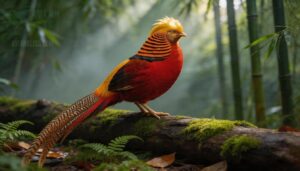
From Africa’s open skies, we head to the mountain forests of western China — and honestly, the Golden Pheasant (Chrysolophus pictus) earns its spot on any birdwatching guide to the world’s most colorful birds. That flared orange-and-black ruff, golden crest, and crimson body are unforgettable.
It’s a ground foraging specialist with yellow leg coloration, territorial displays, and surprisingly successful feral populations across Britain and beyond.
Rainbow Lorikeet
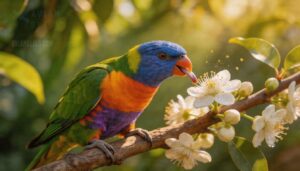
Now, from China’s mountain forests, picture something far more chaotic — a living rainbow screaming past your ear at full speed. That’s the Rainbow Lorikeet (Trichoglossus moluccanus) for you.
This Australian parrot is a staple in any birdwatching guide to the world’s most colorful birds, flashing blue, green, and orange through tropical rainforest and city parks alike.
- Nectar Feeding Adaptations: A brush-tipped tongue collects pollen and nectar like nature’s own paintbrush
- Urban Roosting Behavior: Thousands descend on city trees each dusk in noisy, communal roosts
- Territorial Aggression: Small but fearless — they’ll chase birds twice their size from feeding spots
- Nest Cavity Construction: Pairs chisel into eucalyptus hollows, lining them with chewed, decayed wood
- Lifespan Longevity: Wild individuals regularly reach 20 years — notable for a medium-sized parrot
Keel-Billed Toucan
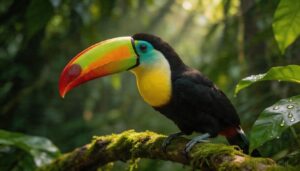
If the Rainbow Lorikeet is chaotic energy, the Keel-Billed Toucan (Ramphastos sulfuratus) is pure spectacle. That banana-shaped bill — 12 to 15 cm of green, orange, and red — looks absurd but works brilliantly for nest cavity selection and seed dispersal ecology across tropical rainforest canopies.
Any birdwatching guide to the world’s most colorful birds owes this species a full page.
Resplendent Quetzal
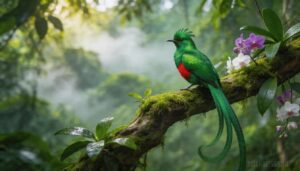
From jaw-dropping bills to jaw-dropping tails — meet The Resplendent Quetzal (Pharomachrus mocinno).
Cloud forest royalty of Central America, it grows tail streamers up to 1 meter long and carries deep Cultural Symbolism for Maya and Aztec civilizations.
It practices Cavity Nesting and plays a critical Seed Dispersal Role for wild avocados.
Habitat loss makes its Near Threatened conservation status a real concern for any serious birdwatching guide to the world’s most colorful birds.
Lady Gouldian Finch
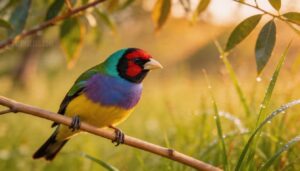
Meet the Lady Gouldian Finch (Erythrura gouldiae) — a tiny masterpiece of tropical color. At just 14–15 cm and 14–15 grams, it packs red, black, turquoise, purple‑blue, and yellow into one small bird.
- Its Stout Beak Adaptation cracks seeds efficiently across Seasonal Seed Preferences — sorghum in wet seasons, fallen grass seeds in dry seasons
- Water Proximity Dependence and Nomadic Movement Patterns shape its habitat preferences in tropical and subtropical regions
- Captive Breeding Success now anchors conservation challenges for brightly colored avian species such as this Near Threatened icon
Any serious birdwatching guide to the world’s most colorful birds owes this species a spotlight, given its shrinking range in Australia’s Northern Territory — a reminder that the global distribution of colorful bird species is fragile.
Where Colorful Birds Live
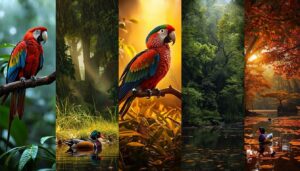
Every bird on that list calls a very different corner of the world home. From dripping rainforests to open savannas, the habitat shapes the bird as much as the bird shapes it.
Here are the five regions where you’re most likely to spot something that stops you in your tracks.
Amazon Rainforest Hotspots
The Amazon is basically ground zero for avian biodiversity hotspots for colorful bird species worldwide.
Places like Yasuní Biodiversity Reserve in Ecuador host nearly 600 bird species. Manu Elevation Zones in Peru stretch from cloud forest to lowland jungle — nearly 1,000 species.
Tambopata Clay Licks draw crowds of scarlet macaws daily.
Upper Purus Endemics and Marañón Dry Forest add even more spangled cotinga and rainforest canopy specialists.
Papua New Guinea and Indonesia
If the Amazon is ground zero, Papua New Guinea and Indonesia are its Pacific twin — together forming some of the planet’s richest avian biodiversity hotspots for colorful species.
The island of New Guinea alone shelters three birds you won’t find anywhere else:
- Wilson’s Bird-of-Paradise — a tiny jewel with a turquoise crown
- Western Crowned Pigeon — a stunning blue giant
- Nicobar Pigeon — an iridescent wanderer of coastal forests
These border biodiversity hotspots thrive partly because shared indigenous traditions have protected mountain forest sanctuaries for generations.
Central American Cloud Forests
Central American cloud forests sit in a cool mist climate where fog clings to mossy branches almost year‑round — and that’s exactly what the Resplendent Quetzal needs. Epiphytic diversity here is staggering, with orchids and bromeliads blanketing every surface.
These forests are textbook avian biodiversity hotspots for colorful species, but elevational banding means fragmentation impacts hit hard. Lose a narrow habitat strip, and microhabitat specialists disappear fast.
African Savannas and Woodlands
Africa’s open skies are basically a living birdwatching guide to the world’s most colorful birds. Fire regime impacts keep tree cover thin, which is exactly why the lilac-breasted roller thrives — it hunts from exposed perches above short grass.
Seasonal water sources pull species together in dry months, giving you front-row seats to:
- Lilac-Breasted Roller flashing turquoise, cinnamon, and violet mid-flight
- Red-Bearded Bee-Eater darting through woodland tree species like miombo and Isoberlinia
- African Purple Gallinule stalking wetland edges where savanna grazing dynamics meet water
Tsetse fly influence, oddly enough, protected many of these habitats by keeping dense human settlements away — a strange conservation gift worth appreciating.
Australia’s Grasslands and Urban Parks
Australia might surprise you as a stop on any birdwatching guide to the world’s most colorful birds. native grassland flora — kangaroo grass, wallaby grass — creates exactly the open, sunny structure that ground‑dwelling birds need.
urban park design matters too: flowering eucalypts fuel the urban adaptation of parrot species like rainbow lorikeets.
| Habitat | Key Colorful Birds |
|---|---|
| Native grasslands | Bush Stone-curlew, Gouldian Finch |
| Urban parks | Rainbow Lorikeet, Magpie |
| Wetland edges | Purple Swamphen |
Community citizen science programs help track these species year‑round.
How to Identify Vibrant Birds
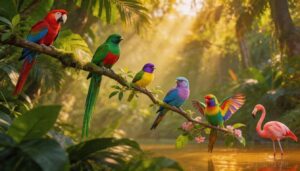
Spotting a colorful bird in the wild is exciting — but knowing what you’re looking at makes it even better.
A few key features can help you tell one species from another surprisingly fast. Here’s what to pay attention to next time you’re out in the field.
Distinctive Plumage Patterns
Think of plumage patterns as nature’s field guide built right into the feathers.
Mottled Camouflage breaks up a bird’s outline with irregular patches, while Barred Wing Patterns alternate light and dark bands, you can spot mid‑flight.
Spotted Juvenile Markings often signal a young bird, and Scaled Feather Edges add a tiled look unique to certain species.
Patterned Body Markings make birdwatching genuinely rewarding.
Beak, Tail, and Crest Features
Beyond plumage patterns, a bird’s beak, tail, and crest tell you just as much — sometimes more.
- Beak Morphology reveals diet instantly; unique beak adaptations in nectar-feeding birds curve precisely for flowers
- Bill Color Patterns on species like the Curl-crested Aracari layers yellow, green, and orange zones
- Tail Ornamentation and bird tail feather morphology signal display fitness
- Crest Display communicates mood in real time
Sexual Dimorphism in Color
Color differences between male and female birds — avian sexual dimorphism in plumage — are one of your sharpest ID tools.
Males often sport male ornamental feathers fueled by carotenoid dimorphism, showing vivid reds and oranges, while females wear female cryptic plumage in muted browns for nest camouflage.
Melanin contrast sharpens male masks and patterns too. Some species even hide UV hidden patterns invisible to human eyes.
Courtship Displays and Seasonal Plumage
Plumage isn’t static — it shifts with the seasons. Hormonal Triggers, like rising testosterone in spring drive Molt Timing, replacing dull winter feathers with vivid breeding colors.
That’s when courtship displays peak. Watch for:
- Goldfinches flipping from olive-yellow to bright lemon
- Quetzals unfurling elongated tail streamers mid-display
- Seasonal Color Fade marking the breeding window’s end
Display Synchronization and UV Signal Visibility make each performance unmistakable.
Habitat Clues for Birdwatchers
Habitat tells you so much before you ever raise your binoculars.
Dense reeds signal marsh species, while tall riparian trees point toward kingfishers. Watch for Vegetation Signposts like willows along streams.
Edge Microhabitats and Water Feature Indicators narrow your search fast. Seasonal Habitat Shifts matter too — a spot that looks empty in winter can explode with color come spring.
Protecting The World’s Brightest Birds
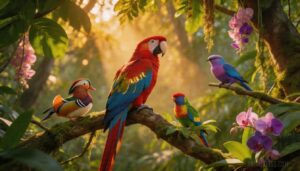
These dazzling birds don’t just need our admiration — they need our action. Habitat destruction, the illegal pet trade, and climate pressure are pushing several of the world’s most colorful species toward the edge.
Here’s what’s threatening them and what’s actually being done about it.
Habitat Loss and Fragmentation
Think of a forest like a puzzle — when you break it into pieces, birds lose more than just trees. Patch isolation effects cut off migration routes and reduce gene flow, weakening populations genetically.
Fragment a forest, and birds lose not just trees but the invisible threads of migration, genetics, and survival
Edge habitat changes make fragments hotter and drier, altering microclimates. These shifts further stress bird populations already struggling with habitat disruption.
Declining food resources shrink further as barriers to migration block access to seasonal feeding grounds. This fragmentation disrupts critical ecological cycles that birds rely on for survival.
Habitat loss and fragmentation quietly dismantle everything colorful birds depend on, eroding biodiversity from within.
Illegal Pet Trade and Hunting
Beyond habitat loss, the illegal pet trade hits colorful birds like a second punch. Capture methods strip millions from the wild — Brazil alone loses an estimated 38 million birds annually.
Smuggling routes hide birds in luggage and parcels. Paperwork fraud disguises wild-caught birds as captive-bred.
Online sales normalize the illegal bird trade. Market pressures mean rarer birds face heavier targeting, accelerating pet trade impact on colorful parrots and entire wild populations.
Endangered and Near-Threatened Species
Some of the world’s most stunning birds are quietly slipping away.
IUCN Red List assessments use strict IUCN criteria — tracking population decline rates, range restriction impacts, and climate change threats — to measure how close a species sits to extinction.
Conservation funding gaps make things worse.
- The Resplendent Quetzal is Near Threatened, squeezed by habitat loss in cloud forests
- Wilson’s Bird-of-Paradise faces shrinking island ranges
- Green Peafowl is fully Endangered, with populations collapsing across Southeast Asia
Birdwatching, Ecotourism, and Conservation
Birdwatching does more than satisfy curiosity — it actively funds conservation. When you join Community Guided Tours or log sightings through eBird’s Citizen Science Contributions platform, that data shapes real protection decisions.
| Practice | Conservation Benefit |
|---|---|
| Ethical Birding Practices | Reduces nest disturbance |
| Citizen Science Contributions | Tracks population trends |
| Community Guided Tours | Benefits local livelihoods |
| Sustainable Lodge Design | Minimizes habitat footprint |
| Education Outreach Programs | Builds long-term conservation awareness |
Ecotourism keeps colorful bird species worldwide worth more alive than caged.
How Readers Can Help Colorful Birds
You don’t need a plane ticket to make a difference. Install bird-safe windows to cut collision deaths, plant native gardens that shelter and feed local species, and maintain clean feeders to curb disease.
Buy bird-friendly coffee to protect tropical habitat. Create cat-friendly yards by keeping cats indoors.
Small choices at home directly support the conservation status of colorful birds everywhere.
Frequently Asked Questions (FAQs)
What are the most colorful birds?
Some birds look like they flew straight out of a painting.
From the Resplendent Quetzal’s emerald shimmer to vivid plumage across global bird species, colorful birds have inspired art, historical feather trade, and modern birdwatching culture.
Which animal is the most colorful?
No single animal wins that crown easily.
From poison dart frogs to mandrill facial colors to butterfly wing patterns, nature spreads vivid color across species — but birds, especially the Scarlet Macaw, consistently steal the show.
Are birds the most colorful animals on Earth?
Honestly, birds wrote the book on color — but they don’t own the chapter. Fish, butterflies, and frogs rival avian biodiversity in sheer brilliance.
So yes, colorful birds dazzle, but Earth’s palette is far more democratic.
Which bird has the most colorful head?
Wilson’s bird-of-paradise wins easily. Its bare turquoise crown — actual skin, not feathers — creates an almost electric blue that no pigment-based head color can match.
What is the most flamboyant bird in the world?
If flamboyance had a face, it’d look like Wilson’s Bird-of-Paradise — turquoise crown, crimson back, electric-yellow mantle.
Those Iconic Male Displays combine Extreme Color Contrast and UV Plumage Patterns into something almost unreal.
What are the world’s most colorful birds?
Picture a living rainbow that actually flies.
From scarlet macaws to birds-of-paradise, colorful bird species worldwide dazzle with pigments, structure, and diet — nature’s most vibrant plumage across global bird species on full display.
What is the most colorful pigeon in the world?
The Nicobar Pigeon (Caloenas nicobar) wins easily. Its metallic feather structure blazes green, blue, and copper — shifting with every angle of light.
Found across island ranges from the Andamans to the Pacific, it’s Near Threatened, but unforgettable.
What bird has a bright plumage?
Some birds practically shout from the treetops — and that’s exactly the point.
Bright plumage, shaped by pigments, structural color, and molting color cycles, signals fitness, aids UV vision perception, and turns every perch into a stage.
What is the most beautiful bird in the world?
That title often goes to the resplendent quetzal. Its emerald feathers and crimson chest have inspired mythical legends, cultural symbolism, and historical art depictions across Mesoamerica for thousands of years.
What are some examples of colorful big birds?
Some birds are big and bold. The Scarlet Macaw stretches nearly 96 cm. The Keel-Billed Toucan sports wild bill coloration. The Victoria Crowned Pigeon wears powder-blue like royalty.
Conclusion
Some birds stop you mid-step. Some rewrite what you thought color could be.
The most colorful birds in the world don’t just look stunning—they are stunning, built feather by feather through millions of years of evolution.
Now you know where to find them, how to spot them, and why protecting them matters.
So grab your binoculars. Whether you’re deep in the Amazon or scrolling field guides at home, the brightest wings on Earth are worth chasing.
- https://www.livescience.com/animals/birds/32-of-the-most-colorful-birds-on-earth
- https://animals.howstuffworks.com/birds/colorful-birds.htm
- https://academy.allaboutbirds.org/wilsons-bird-of-paradise-a-full-spectrum/
- http://m.espacepourlavie.ca/en/biodome-fauna/spangled-cotinga
- https://neotropical.birds.cornell.edu/Species-Account/nb/species/kebtou1/overview