This site is supported by our readers. We may earn a commission, at no cost to you, if you purchase through links.
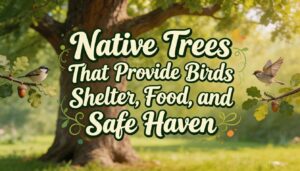
A single oak tree can support over 950 species of caterpillars—and during nesting season, that matters more than almost anything else a yard can offer.
Chickadees and warblers need thousands of caterpillars just to raise one clutch of nestlings, a number no bird feeder will ever match.
What you plant directly shapes what birds can survive.
Native trees provide bird shelter, food, and nesting structure in ways that exotic ornamentals simply can’t replicate, because birds and native plants evolved together over millennia.
The right trees turn a yard into a functioning habitat—and this guide walks you through exactly which ones deliver the most.
Table Of Contents
Key Takeaways
- A single oak tree hosts over 950 caterpillar species, making it the most valuable tree you can plant for nesting birds that need thousands of insects just to raise one clutch.
- Native trees like serviceberry, dogwood, winterberry holly, and eastern red cedar work as a seasonal relay — passing food and shelter from spring migration through the coldest weeks of winter.
- Layering canopy trees, mid-story shrubs, and leaf litter groundcover creates the kind of connected, multi-level habitat that actually keeps birds around, rather than just passing through.
- Matching trees to your local hardiness zone, soil type, and region — using tools like Audubon’s ZIP code search — is what separates a yard that looks good from one that genuinely functions as bird habitat.
What Native Trees Do Birds Like Most?

Not every tree pulls its weight as far as birds are concerned — some are practically invisible to wildlife, while others act like a neighborhood hub. The difference usually comes down to a handful of native species that birds have relied on for thousands of years.
Knowing which species actually deliver — from berry-laden shrubs to caterpillar-rich oaks — makes all the difference, and this guide to best plants for attracting birds to your garden breaks it down beautifully.
Here are the trees that consistently deliver the most value.
Oak Trees and Their Unmatched Caterpillar Support
If you plant just one tree for birds, make it an oak. Quercus species host over 950 caterpillar species in North America — more than any other native genus. Here’s why that matters:
- Host Plant Fidelity — many caterpillars can only survive on oak foliage
- Leaf Surface Area — mature oaks feed hundreds of larvae simultaneously
- Caterpillar Peak Synchrony — hatch timing aligns with nestling season
- Oak Age Benefits — older trees deepen the insect food web yearly
That’s bird habitat you can grow. The importance of oaks is underscored by white oaks support of nearly 600 Lepidoptera larvae species in the Mid‑Atlantic.
Serviceberry for Migrating and Breeding Birds
Oaks carry the season on their branches, but serviceberry (Amelanchier) picks up right where spring begins. Its early fruit surge in May or June pulls cedar waxwings, robins, and orioles in like a stopover diner.
The dense twig nesting structure gives breeding birds real cover, not just a perch. Add its pollinator support chain and edge habitat placement, and you’ve got migration stopover magic in a compact plant.
Dogwood and Holly for Seasonal Berry Supply
Once serviceberry finishes its early run, dogwood bloom carries the relay through late summer and fall.
Flowering dogwood feeds over 28 bird species with its scarlet fruit clusters — then winterberry holly takes over, holding bright red berries through winter when most seasonal food sources for birds have vanished.
Pairing strategy matters here: plant these two together along a yard edge for continuous fruit calendar overlap and reliable bird nesting cover.
Eastern Red Cedar and Hemlock for Year-Round Cover
Where berries leave off, evergreens pick up. Eastern Red Cedar and Eastern Hemlock deliver year-round shelter that deciduous trees simply can’t match.
Cedar’s pyramidal structure and extended lifespan — over 850 years — make it a genuine pioneer species for bird nesting cover.
Hemlock’s dense, moisture tolerant habitat provides thermal insulation during cold snaps, sheltering 26 species through winter in these native trees alone.
Willows and Viburnums for Insects and Nesting Habitat
Few plants pull double duty quite like willows and arrowwood viburnum. Together, they function as both insect host plants and nesting habitat in one layered corner of your yard.
Here’s what that looks like in practice:
- Willow early insects fuel spring warblers before most trees leaf out.
- Viburnum moth larvae feed nestlings through the breeding season.
- Willow flycatcher nests tuck safely 2–5 feet up in dense branches.
- Viburnum insect refuge shelters hidden larvae for foraging birds all season.
Willows also provide willow seasonal food and soft seed fuzz that hummingbirds weave directly into their nests — a quiet detail worth planting for.
Beyond their nesting material, willows attract the gnats and aphids that hummingbirds rely on for protein — much like the insect-rich native plants that keep birds returning to your yard.
What Does a Tree Provide for a Bird?
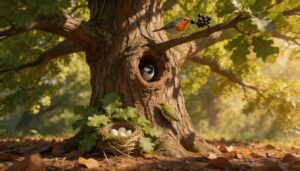
A tree does more for a bird than most people realize. It’s not just a place to land — it’s food, shelter, a nursery, and a lifeline, often all at once.
For a bird, a tree is not just a place to land — it is food, shelter, a nursery, and a lifeline all at once
Here’s a closer look at what native trees actually deliver.
Shelter From Predators and Harsh Weather
A tree isn’t just scenery — it’s a bird’s first line of defense. Dense evergreen canopies act as Winter Needle Canopy cover, blocking wind, rain, and predators year-round.
Thick Branch Shelter from inner pine or spruce boughs keeps sparrows and juncos hidden and warmer. Seasonal Windbreak Plantings and Predator-Deterring Foliage create Snowshielded Shelter where birds can rest, forage, and survive even brutal winters safely.
Nesting Sites in Dense Branches and Cavities
Dense branches do more than hide birds — they hold their homes. Forked Branch Shelter in native trees and shrubs gives birds secure anchor points for nest cups, while Branch Density Benefits reduce wind exposure and block predator sightlines.
Cavity Entrance Size and Nest Height Preference shape which cavity nesting species settle where, and Cavity Competition Dynamics mean natural openings fill fast.
Brush piles extend those options.
Insect-Rich Foliage as a Primary Protein Source
Think of native tree leaves as a slow-release protein factory. Caterpillar abundance on a single oak can top 550 species — soft-bodied, easy to carry, exactly what nestlings need. Seasonal insect peaks align with breeding season, so the larval food webs are humming right when parent birds need them most.
Three reasons native foliage drives bird-friendly landscaping:
- Protein-rich leaves host leaf miner diversity and hundreds of larvae that non-native trees simply can’t match.
- Insect life in native trees and shrubs connects the insect food web from bark to canopy.
- Seasonal timing means caterpillars emerge when nestlings demand the most protein.
Berries, Seeds, and Nuts for Year-Round Nutrition
Beyond insects, native trees run a year-round cafeteria.
Serviceberries offer nearly 95 calories per cup — seasonal fruit that migrating warblers and waxwings strip within days. Dogwood berries attract over 60 species with their bird-friendly fruit and fat content.
Winter berry producers like winterberry holly keep red clusters standing through February.
Add hickory’s nut fat at 64 percent, and you’ve got a genuine year-round mix.
Standing Dead Trees as Natural Cavity Homes
A dead tree isn’t a failure — it’s a promotion.
Snags move through decay stages, starting firm enough for primary woodpecker excavators like pileated and hairy woodpeckers, then softening until secondary cavity nesters such as bluebirds, chickadees, and screech-owls move in rent‑free.
Snag size guidelines recommend at least ten inches in diameter.
In any bird-friendly landscaping or habitat restoration plan, dead wood earns its place.
Native Trees That Attract The Most Bird Species
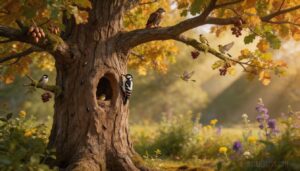
Not every tree pulls equal weight for attracting birds. A handful of native species consistently outperform the rest, offering the right mix of food, cover, and insect life that birds actually need.
Here are the trees worth knowing about.
Oaks Supporting Over 500 Caterpillar Species
Because birds need protein when nests are busiest, oaks stand apart in bird-friendly landscaping.
Their Caterpillar Diversity is unrivaled, with over 500 caterpillar species on many native vegetation plantings. Host Plant Phenology times a Seasonal Caterpillar Peak to spring nesting, while Gall Wasp Interaction broadens food webs.
In any Oak Species Comparison, oaks simply deliver more caterpillars, more consistently overall.
Winterberry Holly Feeding Overwintering Robins and Bluebirds
Oaks feed nestlings in spring, but what carries birds through January? That’s where Ilex verticillata — winterberry holly — earns its place.
This native shrub holds bright red berries deep into winter, making cold weather foraging possible for American Robins, bluebirds, and cedar waxwings.
Plant female and male plants at roughly a 3:1 male plant ratio, in moist soil requirement conditions, and fruit retention stays strong well into late winter.
Native Cherries and Serviceberries Drawing Waxwings and Tanagers
Winterberry carries birds through winter — but come June, the feast shifts to serviceberry and native cherries.
Cedar Waxwings arrive in flocks and strip a serviceberry clean within days, swallowing fruit whole and passing seeds intact. Scarlet tanagers favor black cherry and common chokecherry when insects thin out.
- Serviceberry fruit ripens June–July, matching peak breeding demand
- Cedar Waxwings select small, high-sugar fruits with precision
- Black cherry feeds tanagers, thrushes, and woodpeckers alike
- Common chokecherry provides late-summer tanager berry intake
- Seasonal fruit clustering draws mixed-species feeding groups
Plant these together for maximum pull.
Hickories and Walnuts Providing Cached Winter Food
When summer’s berries are gone, hickories and walnuts quietly take over. Hard Mast Timing matters — walnuts ripen first, hickories follow, giving Blue Jays and Nuthatches a staggered, reliable supply. Blue Jay Utilization and Nuthatch Seed Stashing — Cache Hoarding Strategies both — spread food across dozens of hidden spots, turning your yard into a winter pantry.
| Tree | Bird | Caching Behavior |
|---|---|---|
| Black Walnut | Blue Jay | Buries individually at scattered sites |
| Shagbark Hickory | Nuthatch | Wedges nuts under loose bark |
| Bitternut Hickory | Chickadee | Hides single items in bark crevices |
| Mockernut Hickory | Titmouse | Stores in tree crotches and ground litter |
| Pignut Hickory | Wild Turkey | Forages fallen mast directly |
How to Build a Layered Habitat With Native Trees
A single tree does a lot, but a well-planned mix of trees, shrubs, and groundcover does something closer to magic.
Birds don’t just need one thing — they need a whole system, with layers they can move through, hide in, and feed from at different heights.
Here’s how to build that structure in your own yard.
Canopy Trees as The Top Shelter Layer

Think of canopy trees as your yard’s roof — they intercept wind, rain, and heat before those forces hit anything below.
Oak trees, redcedars, Eastern redbud (Cercis canadensis), and river birch each contribute windbreak protection, moisture retention, and temperature buffering that keeps the whole habitat livable.
Their crowns also create flight path corridors, giving birds habitat connectivity to move safely without crossing open ground.
Mid-Story Shrubs Adding Nesting and Feeding Zones
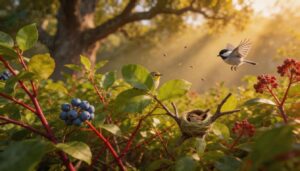
Below the canopy, dense shrub thickets do some of the habitat’s most important work. Multi‑stem nest sites in native viburnums, dogwoods, and spicebush create midstory food corridors where birds move, feed, and hide without exposure.
Shrub‑driven insect pools support nestlings through breeding season, while seedbearing shrubs extend meals into fall.
Using native shrubs for nesting cover and food means staggered bloom periods keep something available almost every week.
Groundcover and Leaf Litter Supporting Insect Food Webs
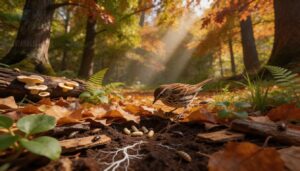
What happens at ground level quietly holds the whole food web together. Leaf Litter Layers — fresh debris, fermenting middle, and rich humus below — create insect overwintering sites and microhabitat moisture that ground-feeding sparrows depend on.
Decomposer diversity keeps nutrients cycling through that insect food web year‑round. groundcover plant mix of native grasses and low perennials adds leaf litter microhabitats and structural habitat diversity that benefits birds at every level.
Grouping Trees in Masses for Microclimate and Cover

Planting trees in isolated spots is fine, but grouping them changes everything. Tree Mass Benefits emerge when crowns knit together — you get Microclimate Stabilization, Wind Reduction, and Humidity Conservation, that a lone tree simply can’t create. That cooler, calmer interior draws more birds and keeps them longer.
- Layering native plants by height creates vertical structure with canopy, shrubs, and groundcover working as one system
- Connected groups build Habitat Corridors, giving birds safe passage between feeding and nesting zones
- Microhabitat complexity increases when mixed native species grow close together, supporting far more insects
- Providing year-round shelter with evergreen natives and habitat connectivity turns a yard into a true refuge
Brush Piles and Fallen Branches as Extra Hiding Spots
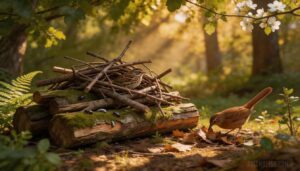
Don’t overlook already fallen. A brush pile built from larger logs at the base, topped with smaller branches, creates Ground Forager Cover that sparrows and brown thrashers genuinely use.
Branch Decay Benefits are real — rotting wood draws beetles, ants, and woodlice. Brush Pile Placement near feeding zones lets birds dart in and out safely, adding microhabitat complexity to your vertical structure with canopy shrubs and groundcover.
Choosing Native Trees for Your Region and Yard
Not every native tree thrives in every yard, and that’s actually a good thing — it means you get to work with what your land already wants to grow. A few practical factors help narrow down your best options.
Here’s what to think about when choosing trees that will genuinely work for your space and your local birds.
Matching Trees to Local Hardiness Zones and Soil Type
Before you fall in love with a tree at the nursery, check its USDA Hardiness Zone first. Zone suitability tells you whether it’ll survive your winters.
Then dig into soil drainage, pH matching, and texture compatibility — clay drains slowly, sand drains fast, and most natives have preferences.
Microclimate considerations matter too. A sheltered corner can shift your effective zone enough to expand your native tree selection considerably.
Small-Yard and Container-Friendly Native Options
A small patio or balcony can still work hard for birds. Compact Inkberry, Dwarf Redbud, and Patio Sweetspire fit containers well — and so do Container Sumac and Balcony Hazelnut.
Small-space gardening for avian wildlife doesn’t require a full yard. Using container-grown native plants for small yards builds real bird-friendly landscaping from the ground up.
- Compact Inkberry — evergreen cover year-round, dense enough to hide nesting birds
- Dwarf Redbud — early spring blooms feeding insects right when birds need protein most
- Patio Sweetspire — fragrant late-season flowers followed by berries and vivid fall color
- Container Sumac — berry clusters lasting into winter, giving birds a reliable cold-weather food stop
- Balcony Hazelnut — nutrient-rich nuts that jays and woodpeckers actively seek out
Replacing Non-Native Plants Gradually With Regional Species
Once your containers are thriving, the next step is bringing that momentum into the ground itself.
Phased Removal works better than clearing everything at once — pull non-natives in stages, practice Early Replanting within days, and lean on Weed Control to hold ground.
Regional plant selection and Local Seed choices speed Habitat Recovery, restoring native tree species that deliver Seasonal Food Resources for Backyard Birds year-round.
Using ZIP-Code Tools and Local Nurseries to Source Natives
Once you’ve started pulling non-natives, knowing what to replace them with is half the battle. A quick Hardiness Zone Lookup through the USDA Hardiness Zones for Plant Selection tool narrows your options fast.
Pair that with a Regional Plant Database like Audubon’s ZIP-code search, and you’re working from real data. Then confirm with local native plant suppliers — Nursery Stock Verification matters, since "native" on a label doesn’t always mean native to your region.
Prioritizing Evergreen Natives for Winter Shelter and Food
Once you’ve sourced your regionally appropriate species, don’t overlook evergreens.
Pyramidal evergreen form trees like eastern hemlock and eastern red cedar deliver evergreen windbreak benefits along exposed yard edges — a smart edge planting strategy that gives birds immediate cover.
Cone seed availability from spruces feeds chickadees and crossbills through February.
Frost-hardy berry shrubs like winterberry round out your native shrubs lineup, providing year-round shelter with evergreen natives for bird-friendly landscaping and genuine bird habitat restoration.
Frequently Asked Questions (FAQs)
What native trees do birds like?
Birds favor oaks for Cavity Formation and caterpillars, serviceberries and cherries for Seasonal Fruit, hollies and cedars for Winter Forage, willows for Pollinator Attraction, and viburnums for Microhabitat Layers—key choices for bird‑friendly landscaping and bird habitat.
What does a tree provide for a bird?
Think about everything tree quietly does in a single day.
It shelters, feeds, and houses the birds around it — offering thermal buffering, perching platforms, mating display sites, and microhabitat diversity all at once.
How do native trees support migrating birds at night?
At night, migrating songbirds drop into tree canopies for Night Navigation Cover, using dense foliage as a Light Pollution Buffer and Nocturnal Food Supply while resting on Night Roosting Perches before continuing their journey.
How long until newly planted trees attract birds?
Most yards see early attraction within the first spring or summer after planting, especially when food availability is already present through berries or insects.
Branch thickening and habitat integration build steadily from there.
Conclusion
Imagine a lush canopy overhead, sheltering a chorus of birdsong. Native trees provide bird shelter, a haven where life thrives.
By choosing species like oak, serviceberry, and eastern red cedar, you create a sanctuary. These trees offer more than just a place to rest; they provide food, nesting sites, and protection.
As you plant, envision a thriving ecosystem unfolding. With native trees, your yard becomes a vibrant habitat, supporting generations of birds to come, naturally.