This site is supported by our readers. We may earn a commission, at no cost to you, if you purchase through links.
You spot an unfamiliar warbler flitting through the canopy, and within seconds your smartphone identifies it from a single photo or song snippet. This transformation didn’t happen gradually. The convergence of artificial intelligence, citizen science networks, and extensive digital archives has created an identification toolkit that ornithologists from just two decades ago would find extraordinary.
Access to 575,000 sound recordings, 37 million wildlife photographs, and over 2 billion documented sightings now sits in your pocket or browser. The challenge isn’t finding online resources for bird identification anymore. It’s knowing which platforms deliver the precision you need for that tricky flycatcher or distant shorebird, and how to leverage multiple tools together for confident field identifications.
Table Of Contents
- Key Takeaways
- Top Websites for Bird Identification
- Best Bird Identification Apps
- Online Bird Sound and Photo Libraries
- Birdwatching Communities and Forums
- Citizen Science and Conservation Platforms
- Frequently Asked Questions (FAQs)
- Where can I find information on bird identification?
- How can I find out more about a bird?
- How can I identify a bird?
- How do I use bird species identification cards?
- Do you need a reference image for bird identification?
- How do I identify a bird on eBird?
- How do I photograph birds for better identification?
- What binoculars work best for beginner birdwatchers?
- How can I attract specific species to my backyard?
- When is the best time of day for birding?
- Conclusion
Key Takeaways
- Modern bird identification combines AI-powered apps like Merlin Bird ID (98% photo accuracy across 10,315 species) with massive citizen science databases including eBird’s 2 billion sightings and Xeno-Canto’s 575,000 sound recordings, creating identification capabilities that surpass traditional field guides.
- Your smartphone now provides instant access to comprehensive identification tools through free platforms like Merlin Bird ID for AI recognition, All About Birds for species accounts, and iNaturalist for community verification, eliminating the need for multiple physical references in the field.
- Every observation you submit to eBird or the Great Backyard Bird Count becomes scientific data that informs conservation decisions, with nearly 700,000 contributors generating population trends and migration patterns that directly support habitat protection efforts worldwide.
- Successful field identification requires combining multiple digital resources—using apps for initial recognition, sound libraries like Xeno-Canto for call verification, and community platforms like BirdForum for difficult species confirmation—rather than relying on any single tool.
Top Websites for Bird Identification
You need reliable websites that give you accurate identification information when you’re trying to figure out what bird you just saw. The right platform can turn a confusing field mark into a confident ID.
Here are the top websites that birders trust for species accounts, range maps, and observation data.
All About Birds Species Accounts
All About Birds offers extensive species accounts for 623 bird species, with 380 featuring detailed identification tips, migration patterns, and conservation status. You’ll find high-resolution photographs, sound recordings, and field marks that support accurate species identification. Each account includes bird habitats and behavior details drawn from ornithological research.
The platform integrates weekly abundance maps from eBird, helping you track species movements throughout North America with precision.
Understanding bird species popularity can also inform conservation efforts and public interest in bird identification.
Audubon Bird Guide’s Explore Section
You’ll encounter over 800 North American species in the Audubon Bird Guide’s Explore Section, each profile containing habitat details, identification features, and seasonal movement data. The platform integrates live eBird sightings and weekly range maps, enhancing your bird ID skills through real-time observation tracking. Offline functionality enables field identification once you’ve downloaded species packs.
Conservation tools display migration patterns and climate impacts, helping you understand threats facing bird species across their ranges. The Audubon Society’s work on bird migration routes provides valuable insights into the complex journeys of these species.
EBird’s Global Observation Database
While guide features provide identification help, eBird transforms your observations into scientific data. This global database tracks over 2 billion bird sightings from 464,542 active contributors worldwide.
You’ll submit checklists that improve data quality and support ornithology research on 11,167 species. Machine learning models analyze your entries alongside high-resolution satellite imagery, creating conservation impact through real-time population trends.
The platform reveals global trends in species tracking and migration patterns.
Fatbirder’s Global Birding Resources
When you need trip planning support or region-specific birding contacts, Fatbirder connects you to over 2,000 resource pages across every country and state. This platform excels at resource curation and community engagement through:
- Tens of thousands of links to clubs, reserves, and trip reports
- 8,700+ photographs covering 2,600 species from 37 countries
- Local expert contributions for authentic regional insights
You’ll find everything from accommodation options to conservation partners.
Animal Diversity Web and Encyclopedia of Life
For taxonomic research and species classification, Animal Diversity Web delivers accounts on approximately 2,150 animal species, including detailed bird entries with habitat and conservation data.
Encyclopedia of Life consolidates information from expert-curated databases, supporting biodiversity mapping and bird identification efforts.
Both online databases improve your understanding of avian taxonomy while complementing tools like eBird and Merlin Bird ID for thorough field identification.
Best Bird Identification Apps
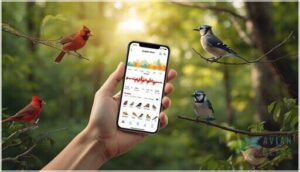
Field identification has never been easier thanks to smartphone apps that fit in your pocket. These tools use AI, curated databases, and community input to help you identify birds from photos, sounds, or simple location data.
Here are the top apps that bring expert-level ID capabilities to birders at any experience level.
Merlin Bird ID Photo and Sound Recognition
Merlin Bird ID uses AI Recognition to match your photos and sounds against 10,315 species worldwide. Photo Matching achieves 98% accuracy under typical conditions.
You can record bird calls for Audio Filtering and Bird Call Analysis. The app’s Species Verification tools help confirm identifications across all regions.
Merlin Bird ID stands as the most extensive free Birding Apps option for Bird Identification Techniques and Bird ID today.
Audubon Bird Guide App Features
The Audubon Bird Guide app offers over 800 North American species with 3,000 photographs and eight hours of audio. You can filter species by location and date through Bird ID Tools, while App Navigation lets you slide between maps and sightings. Life List Management tracks your observations automatically. Conservation Features connect your data to research efforts.
This ranks among the top Birding Apps alongside Merlin Bird ID for extensive Species Filtering and field reference.
INaturalist’s Community-driven Identification
iNaturalist blends Bird Identification with Community Insights through a network that transforms every observation into Species Discovery. You upload photos, and users worldwide contribute identifications backed by Data Validation—97% accuracy for research-grade records as of 2024. This User Engagement model turns birding into collaborative science.
- Global network: 21 national sites managed by local institutions across all continents
- Active community: 150,000 to 375,000 monthly users throughout 2023
- Rapid consensus: Most observations reach research-grade status in under one week
- Conservation Impact: Data flows directly to biodiversity databases supporting worldwide monitoring
- Integration: Works alongside Merlin Bird ID and other Birding Resources and Tools for all-encompassing Bird ID
Sibley and Warbler Guide App Tools
Sibley Guide transforms bird identification through its Smart Search feature, allowing users to filter by size, color, and geographic status to instantly narrow down 930+ North American species. Visual Comparison enables side-by-side examination of two birds, while detailed distribution maps facilitate regional searches.
For Warbler Recognition, the Warbler Guide app offers specialized tools, including 3D rotatable models across 48 species, 277 vocalizations with sonogram visualization, and Audio Analysis at half-speed playback. Species Filtering by plumage, behavior, and song type enhances accuracy beyond what Merlin Bird ID or eBird checklists provide alone.
| Feature | Sibley Guide | Warbler Guide |
|---|---|---|
| Species Coverage | 930+ North American birds | 48 warbler species, 75 views |
| Smart Search | Size, color, pattern, region filters | Plumage, geography, song type |
| Audio Tools | 2,700+ calls and songs | 277 vocalizations, sonogram analysis |
| Visual Comparison | Side-by-side species comparison | 3D rotatable images, multiple angles |
Online Bird Sound and Photo Libraries
When visual clues aren’t enough, you need sounds and images to confirm what you’re seeing in the field. Online libraries give you access to thousands of recordings and photographs organized by species, location, and behavior.
These resources turn guesswork into certainty when you’re trying to separate similar calls or compare plumage details side by side.
Xeno-Canto’s Bird Song Archive
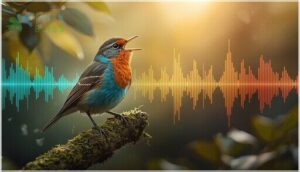
When you need reliable bird song identification, Xeno-Canto stands out as the world’s leading sound library for species recognition. This citizen science platform offers over 575,000 audio recordings covering approximately 93% of known bird species. You’ll benefit from:
- Audio quality ratings ensuring reliable bird song analysis
- Spectrogram visualizations for detailed sounds songs comparison
- Global coverage supporting worldwide bird identification
- Community-driven contributions advancing ornithological research
The archive transforms birdsong into accessible scientific data.
Sonogram and 3D Model Identification Tools

Beyond audio libraries, sonogram analysis and 3D modeling tools transform how you approach species identification. Deep learning classifiers using spectrograms now achieve 98% accuracy on standard datasets, while platforms like Merlin Bird ID apply acoustic classification across hundreds of species.
These bird identification apps convert sound into visual patterns you can study. Meanwhile, 3D modeling aids research-grade bird recognition by manipulating geometric features for precise cognitive testing in ornithological studies.
Cornell’s Illustration and Photo Databases

Cornell Lab of Ornithology oversees over 37 million wildlife photos in its digital archives, covering 98% of known bird species. You can search by location, date, or contributor to find illustrations and photographs that fuel both Merlin Bird ID and eBird platforms.
These database management systems support conservation research through weekly updates, linking visual records to real-time distribution maps and seasonal trends you rely on for accurate identification.
Birdwatching Communities and Forums

You don’t have to identify birds alone. Online communities connect you with experienced birders who can confirm tricky sightings and share local knowledge.
These platforms turn birdwatching into a collaborative experience where every observation becomes part of a larger conversation.
BirdForum Species Discussions
BirdForum hosts thousands of birdwatchers sharing identification tips and species taxonomy updates daily. You’ll find expert-led discussions covering hundreds of new bird sightings globally.
Members contribute observational data that tracks biodiversity patterns while experienced birders assist with difficult identifications through detailed forum engagement. This community insight complements resources like Merlin Bird ID, eBird, and Audubon Bird Guide for accurate species confirmation.
EBird Mobile and Checklist Sharing
The eBird Mobile app lets you document sightings offline and sync data later, even in remote locations. You can share your checklists through the Trip Reports tool, which facilitates group collaboration during organized outings.
- Submit checklists to over 210 countries and regions for global bird tracking
- Attach up to 10 photos per species for verification
- Manage and bulk-share multiple lists with fellow participants
Approximately 90% of eBird data comes from the most active 10% of users.
Facebook and Social Media Birding Groups
Facebook birding groups connect you with tens of thousands of fellow watchers who share IDs, conservation news, and field experiences. Groups range from several hundred to over 20,000 members, supporting both novice and expert participation. Moderation policies guarantee respectful digital engagement and online safety while protecting vulnerable species through careful group management of location data.
| Community Feature | Benefit |
|---|---|
| Rapid photo ID feedback | Real-time species confirmation within hours |
| Conservation discussions | Environmental threat awareness and advocacy |
| Virtual birding events | Photo contests and identification challenges |
| Cross-border networking | Connection across geographic boundaries |
Online ID Challenges and Events
How do you sharpen your identification skills while supporting conservation efforts? Online ID challenges like Audubon’s “Birding the Net” engage thousands in virtual birding competitions that test species recognition across platforms.
The Great Backyard Bird Count invites citizen science participation worldwide, with 2025 observers documenting 8,078 species. These events strengthen your field skills while feeding data into eBird and Merlin Bird ID app databases for research.
Citizen Science and Conservation Platforms
Your bird sightings can do more than build your personal list. They become part of a larger effort to track populations, identify threats, and shape conservation decisions.
The platforms below connect your observations to research teams and organizations working to protect birds worldwide.
Submitting Data to EBird and Great Backyard Bird Count
You can contribute meaningful data to eBird and the Great Backyard Bird Count by submitting complete checklists with accurate species reporting and observation tracking. eBird reached 1 billion observations in 2024, with contributions from nearly 700,000 global users.
Contributing complete checklists to eBird transforms your birdwatching into meaningful data—joining nearly 700,000 observers who logged 1 billion sightings in 2024
Your data submission tips should include location details, count methods, and effort information. These citizen science platforms transform your bird watching into conservation impact, informing research on population trends and migration patterns alongside the Christmas Bird Count.
BirdLife International’s Conservation Resources
BirdLife International acts as the official Red List Authority for all bird species through a global partnership of 123 conservation organizations. Their DataZone platform offers access to detailed information on over 11,000 species, 13,000 Important Bird and Biodiversity Areas, and habitat restoration projects.
Their conservation grants support species protection initiatives worldwide, with forest conservation totaling 1.4 million hectares and direct benefits to 483 threatened species.
American Birding Association Programs
The American Birding Association strengthens your birding journey through targeted programs. With tens of thousands of members nationwide, ABA offers:
- Young Birder initiatives engaging hundreds annually
- Birding 101 sessions with 50+ participants each
- Conservation partnerships exceeding $700,000 yearly
- Community Weekends attracting 400 birders
- Training materials improving eBird data quality
ABA Membership connects you to research grants and bird conservation efforts nationwide.
Using Online Tools to Support Research and Preservation
Your observations power real conservation efforts when you use the right digital tools. eBird aids species monitoring through millions of checklists that inform habitat protection decisions.
Research collaboration flourishes as birding websites like Audubon Bird Guide connect your data to conservation efforts. Digital trends show online courses and data analysis transform sightings into actionable science.
Every bird identification you submit strengthens preservation globally.
Frequently Asked Questions (FAQs)
Where can I find information on bird identification?
The wealth of bird identification resources today is staggering. You can access species guides through eBird’s global database, Audubon Bird Guide, and conservation tools that combine field observations with detailed bird calls for accurate bird ID.
How can I find out more about a bird?
You can study field guides, examine habitat preferences, analyze feather patterns, observe beak shapes, track nesting behaviors, and follow migration routes.
Mobile bird identification resources and birding communities help sharpen your bird species identification skills through shared observations.
How can I identify a bird?
You might think field guides are enough, but modern bird identification combines habitat observation, feather identification, wing pattern recognition, beak shape study, and bird call analysis for precise species identification across diverse North American birding resources.
How do I use bird species identification cards?
Compare the bird’s size, shape, and markings to illustrations on your card. Note habitat details and cross-reference color patterns.
Use the card alongside birding resources like Audubon Bird Guide for species verification and field identification accuracy.
Do you need a reference image for bird identification?
A reference image acts like a field guide page brought to life. You don’t need one, but visual identification becomes far more accurate—97% precision for most species—when comparing your bird photo against verified Audubon Bird Guide images.
How do I identify a bird on eBird?
You can identify a bird on eBird by submitting observations with photos or audio through your eBird Checklist.
Volunteer reviewers perform Species Verification, ensuring accurate records through Photo Analysis and Sound Recognition tools.
How do I photograph birds for better identification?
You need sharp images for bird identification. Use continuous autofocus to track movement.
Shoot at 1/400 sec for perched birds or faster for flight. Keep the bird centered and well-lit for clear photo composition.
What binoculars work best for beginner birdwatchers?
Sharp glass opens windows to feathered worlds. Look for 8×32 or 8×42 magnification options paired with quality optical coatings.
Prioritize lens size, portability features, and budget considerations around $150 for reliable bird identification in birding communities supporting conservation efforts.
How can I attract specific species to my backyard?
Native plantings attract specific species by providing food and shelter. Bird feeders stocked with preferred seeds draw cardinals and woodpeckers. Water features increase visitation.
Habitat design combining vegetation layers accommodates diverse seasonal migration patterns.
When is the best time of day for birding?
You’ll see the most birds within two hours after sunrise, when 71% of species peak in activity.
Weather impacts daily migration patterns and bird circadian rhythms, so choose clear, cool mornings for ideal sunrise observation.
Conclusion
Like a field guide that updates itself with every sighting worldwide, online resources for bird identification evolve alongside our collective observations. You’ve explored platforms spanning AI-powered apps to citizen science networks, each offering distinct advantages for field work.
The question isn’t whether digital tools can replace traditional guides—they already have for most identifications. What matters now is selecting the right combination of resources to transform uncertain glimpses into confident records.