This site is supported by our readers. We may earn a commission, at no cost to you, if you purchase through links.
Every September, roughly 600 million birds funnel through the skies above North America—most of them moving at night, invisible to anyone not paying attention.
A Blackpoll Warbler (Setophaga striata) crosses the Atlantic in one nonstop flight.
A Ruby-throated Hummingbird (Archilochus colubris) fattens up in your backyard before vanishing south.
These aren’t random wanderings—they follow routes shaped by geography, climate, and instinct refined over millennia.
Knowing where to look, and when, separates a blank morning in the field from a sighting that stays with you.
Seasonal songbird location maps make that possible, and the tools available today are sharper than ever.
Table Of Contents
- Key Takeaways
- Where to Find Songbirds This Season
- Best Tools for Tracking Songbird Migration
- Where Are The Hummingbirds Now?
- Where Are All The Songbirds in September?
- How Climate Shapes Songbird Distribution Maps
- Frequently Asked Questions (FAQs)
- Where are all the birds in September?
- What is the number one killer of songbirds?
- How do songbirds navigate during long-distance migration?
- Which songbird species are most endangered today?
- How does urban sprawl affect local songbird populations?
- What role do stopover sites play in migration?
- How can backyard habitats support migrating songbirds?
- Conclusion
Key Takeaways
- Seasonal range maps on eBird use color-coded abundance data at 3 km resolution to show exactly where species like the Blackpoll Warbler (Setophaga striata) concentrate — turning guesswork into precision timing.
- BirdCast’s live NEXRAD radar updates every 5–10 minutes, letting you track nocturnal migration traffic in real time before stepping outside.
- Climate change is pushing North American breeding ranges northward roughly 1.5 km per year, meaning the maps you relied on last decade are already slightly outdated.
- High-quality stopover sites are non-negotiable for migrant survival — birds can double their body mass at prime refueling stops, making habitat protection a direct conservation lever.
Where to Find Songbirds This Season
Songbirds don’t show up randomly — their locations follow patterns tied to season, habitat, and climate.
These patterns become much clearer when you explore songbird habitat range maps by season and region, which show exactly where different species tend to settle and why.
Once you understand those patterns, range map stops being abstract and starts telling you exactly where to look.
Here’s what the data actually shows.
How Seasonal Range Maps Reveal Bird Locations

Range maps aren’t just pretty visuals — they’re precision tools built on species distribution modeling and model validation techniques.
eBird stacks color coding interpretation across seasons, flagging habitat quality at 3 km resolution.
Seasonal abundance metrics reveal exactly where birds concentrate, while dark gray zones flag data gaps needing your reports.
Microhabitat temperature tolerance shapes every boundary line you see.
The platform also provides weekly bird abundance estimates.
Breeding Vs. Wintering Vs. Year-Round Distribution Zones

Those color zones on your range maps aren’t decorative — each one signals a different survival strategy.
- Red zones mark breeding grounds where Seasonal Insect Abundance peaks, fueling nesting success.
- Blue zones reflect wintering areas where Zone Color Coding tracks habitat suitability across milder climates.
- Purple zones confirm year-round residents managing Migration Energy Budgets without long-distance travel.
- Yellow zones flag migratory stopovers where Elevation Niche Shifts occur.
Motus tracking reveals migratory song shifts that influence cultural evolution.
How to Read EBird Seasonal Range Maps

Once you know each color means, eBird range maps reveal real insight into seasonal movement and habitat quality.
| Map Element | What It Shows | Why It Matters |
|---|---|---|
| Color Gradient Meaning | Abundance by season | Identifies peak habitat use |
| Gray Shade Indicators | Absence or data gaps | Defines range boundary limits |
| Frequency Bar Interpretation | Reporting rate over time | Tracks seasonal layer stacking |
Species distribution modeling powers these boundaries — bird migration patterns become readable, not guesswork.
Purple Zones and Year-Round Resident Species

Purple zones on eBird maps signal something worth paying attention to: a bird that doesn’t leave.
These residents show strong territory fidelity, returning to the same patches season after season.
- Carolina Wrens hold eastern territories through winter, proof of strong microclimate tolerance
- Northern Cardinals anchor urban feeders year-round, a textbook case of urban adaptation
- House Finches spread continent-wide, with population density metrics confirming permanent habitat connectivity
Best Tools for Tracking Songbird Migration

Knowing where songbirds are is one thing — knowing how to track them in real time is another. The right tools make the difference between guessing and actually understanding what’s moving, when, and where.
Pair your tracking tools with smart timing — knowing when to put out hummingbird feeders means you’re ready before the first males even touch down.
Here are the four most reliable options birders and researchers rely on today.
EBird Range Maps and Seasonal Layers
eBird range maps give you a full-year picture of species distribution in a single view.
Each color means something specific: red for breeding, blue for non-breeding, yellow for migration, purple for year-round presence.
Dark gray flags data gap mapping zones, where model confidence levels drop due to sparse checklists.
Seasonal abundance animations layer weekly habitat zone overlap, revealing precise timing within broader seasonal movement windows across species distribution modeling outputs.
BirdCast Live Radar Migration Maps
Watching nocturnal migration in real time is now possible with BirdCast live radar. The platform pulls from NEXRAD weather surveillance radars, updating migration maps every 5–10 minutes — that is your Radar Data Refresh window. Here’s what you can track tonight:
- Migration Traffic Rate (MTR): birds per kilometer per hour across a 1‑km transect
- Directional Vectors: arrows showing net flight direction, northward in spring, southward in fall
- Nighttime Alerts: forecasts warning when heavy migration is overhead
- Blind Zones: mountainous regions where radar coverage drops
- Seasonal bird distribution waves: color‑coded bands tied to weather fronts
BirdCast migration maps decode bird migration patterns you’d otherwise miss entirely.
GPS Tagging and Satellite Tracking Methods
Miniaturized GPS tags have transformed what you can know about a single bird’s journey. A PinPoint-10 tag weighs just 1.1 grams — light enough for Ovenbirds, precise enough to map 0.50-hectare winter territories in Cuba.
| Method | Key Advantage |
|---|---|
| Miniaturized GPS | 10-meter location accuracy |
| Satellite PTT | Real-time data, no recapture |
| Leg-loop Harnesses | Safe for birds under 15 grams |
Tag attachment techniques like backpack harnesses and leg-loop designs keep devices under 5% of body mass, protecting survival rates while revealing habitat distribution across full migration maps.
Citizen Science Platforms That Crowdsource Sightings
No satellite tag captures what two billion eBird sightings can do. Citizen science platforms turn everyday observers into a distributed sensor network for bird migration and species distribution.
Two billion eBird sightings do what no satellite tag can: turn everyday observers into a global migration sensor network
- eBird: mobile submission with data validation by regional experts
- iNaturalist: community identification requiring two confirmations for research-grade status
- Project FeederWatch: seasonal participation tracking winter habitat type shifts
- GBIF integration: global integration feeding verified records into biodiversity databases
Where Are The Hummingbirds Now?

If you’re watching the skies and wondering when the ruby-throated hummingbirds (Archilochus colubris) will show up, you’re not alone.
Timing their arrival depends on where you live, what you put out for them, and how you’re tracking the data. Here’s what you need to know.
Ruby-Throated Hummingbird Seasonal Location Map
The Ruby-throated Hummingbird (Archilochus colubris) splits its year cleanly across two continents.
Breeding Range Shifts push the species north each spring across 38 eastern U.S. states into southern Canada.
Wintering Habitat Hotspots concentrate in southern Mexico through Costa Rica.
On eBird, Color Gradient Legends track these Seasonal Changes — green for breeding, orange for Migration Timing Peaks, red marking Wintering zones.
Regional First Arrival dates appear as labeled dots, tracing Bird Migration northward by Habitat Type.
Are Hummingbirds in Your Area or Coming Soon?
By migration front is already moving. Male Arrival usually precedes females by about a week — so if you spot one at your feeder, females aren’t far behind.
Wind-Assisted Migration along the Gulf accelerates timing considerably.
- Gulf Coast sightings signal the leading wave
- Urban Heat islands often attract early arrivals ahead of rural zones
- Nectar Timing from blooming natives reflects local Habitat Suitability
Best Feeders to Attract Hummingbirds During Migration
Once females arrive, feeder choice matters. Red nectar design draws migrants fast — red ports mimic natural blooms.
Opt for multi-port layout feeders holding 20–40 ounces during peak bird migration; smaller 8–12 oz models need constant refilling.
Add ant moat protection above the line. Shade placement slows fermentation.
Habitat type and seasonal changes in nature affect visit frequency — bird watching and conservation both benefit from getting this right.
How to Report Your First Hummingbird Sighting
That first hummingbird at your feeder deserves more than a mental note. Create an eBird account at ebird.org — it takes under ten minutes.
Open the app, start the checklist, and log your location. Record diagnostic features: gorget color, bill shape, tail pattern. Upload media evidence if you have it. Your share of first arrival data feeds real citizen science, helping track bird migration shifts tied to habitat type changes.
Where Are All The Songbirds in September?
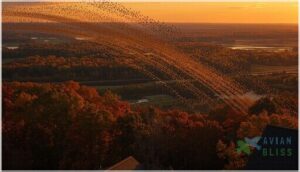
September is when North America’s skies quietly shift — and if you’ve noticed fewer birds at your feeder, you’re not imagining it.
Fall migration is already underway, pulling millions of songbirds southward along routes shaped by geography, weather, and instinct.
Here’s what’s actually happening out there, species by species.
Fall Migration Patterns Across North America
By September, bird migration is already well underway across every major flyway. Flyway timing shifts species from breeding grounds to wintering zones along broad continental corridors. Two-thirds of eastern songbirds attempt Gulf crossing risks nonstop — 1,000 km over open water. Nocturnal stopovers at Cape May and coastal Alabama restore fuel reserves before the next push.
- Weather-driven delays ground thousands when cold fronts stall progress
- Altitude preferences shift nightly based on wind direction and temperature
- Seasonal bird abundance data spikes at key stopover sites
- Habitat type at stopovers determines survival odds
- Seasonal in nature, migration responds dynamically to atmospheric conditions
Species That Depart Early Vs. Late Season
Not every species leaves on the same schedule — and that gap matters.
Orchard Orioles (Icterus spurius) clear breeding grounds before July ends, while Hermit Thrushes (Catharus guttatus) don’t peak until October.
Juvenile migration patterns, distance-driven departure, and timing, sex differences all shape who moves when.
Females often lead males by 2–3 days.
Climate-induced shifts are quietly pushing some of these windows later each year.
Red-Winged Blackbirds and Other Early Fall Migrants
Before the calendar flips to October, Red-winged Blackbirds (Agelaius phoeniceus) are already moving. Flock Formation Timing begins in early September, when birds shift from breeding wetlands into Pre‑Migratory Feeding mode — loading up on seeds and insects across agricultural fields.
Wetland Roosting Sites in dense cattail stands anchor overnight stops.
Migration Corridor Hotspots along the Great Plains channel thousands south, with Early Migrant Species Interactions drawing Common Grackles and American Robins into mixed flocks.
Track it all on eBird.
How Weather Radar Detects Nocturnal Migration Traffic
Most migration happens after dark — and that’s exactly when US weather surveillance radar becomes your best tool.
NEXRAD systems detect nocturnal bird migration through reflectivity thresholds below 20 dBZ, Doppler velocity analysis separating bird airspeeds from wind drift, and echo filtering that strips out rain and clutter.
Altitude profiling and radar beam geometry reveal density peaks around 2,600 feet.
Bird migration patterns emerge as concentric rings expanding outward at sunset.
How Climate Shapes Songbird Distribution Maps

Climate isn’t just background noise for songbirds — it’s the rulebook.
Where temperatures shift, elevations rise, and seasons compress, bird ranges follow with surprising precision.
Here’s how each piece of that puzzle shapes the maps you’re reading.
Climate Zones and Habitat-Driven Range Boundaries
Range maps don’t lie — they reflect the hard logic of climate zones and habitat thresholds.
Where precipitation drops, breeding ranges contract.
Where elevation rises, thermal limits push species out.
- Precipitation Boundaries at the Great Plains ecotone
- Ecotone Shifts driven by drought cycles
- Elevation Limits along alpine gradients
- Linear Feature Impacts on boreal communities
- Buffer Zone Requirements for deciduous interior species
How Climate Change is Shifting Seasonal Maps
Climate change is quietly redrawing every seasonal map you rely on.
North American species are shifting northward roughly 1.5 km per year — Poleward Breeding Shifts you can now measure decade to decade.
Spring Arrival Advances, Elevational Range Moves, Migration Timing Variability, Community Composition Changes — all are reshaping bird migration patterns and seasonal bird lists.
Species distribution is no longer static, and habitat restoration can’t wait.
Species Distribution Modeling for Conservation Planning
Species distribution modeling turns habitat suitability into actionable conservation planning.
Tools like MaxEnt use Climate Variable Selection — temperature, precipitation, elevation — to score every grid cell across a landscape. Model Ensemble Techniques blend multiple algorithms, reducing bias.
Validation Metrics like AUC confirm model accuracy. Uncertainty Mapping flags data‑thin zones.
Habitat Connectivity Indices reveal corridor gaps.
Together, they sharpen bird migration patterns and guide habitat management decisions at every scale.
Priority Regions for Songbird Habitat Protection
Not every landscape carries equal weight. The Prairie Pothole Conservation zone alone produces over 100 duck pairs per square mile in wet years — and it anchors breeding habitat for Baird’s Sparrow and Sprague’s Pipit.
Your regional songbird distribution guide should flag four zones: Grassland Strongholds, Boreal Forest Refugia, Appalachian Habitat Corridors, and Central Flyway Preservation areas. eBird data confirms these regions as non‑negotiable priorities for conservation planning.
Frequently Asked Questions (FAQs)
Where are all the birds in September?
They didn’t disappear — they moved.
September is peak migration, with Warbler Peaks, Thrush Waves, and Flycatcher Timing all converging. Red‑winged Early movers lead billions south through Coastal Hotspots like Cape May.
What is the number one killer of songbirds?
Free-ranging cats are the number one killer of songbirds, wiping out up to 4 billion birds annually in the US.
Feral cat density drives most of that loss — unowned cats cause roughly 69 percent of all cat-related bird mortality.
How do songbirds navigate during long-distance migration?
Songbirds rely on a magnetic compass, sun compass, star patterns, genetic control, and olfactory cues to navigate. Together, these systems guide wildlife migration patterns across continents with impressive precision.
Which songbird species are most endangered today?
Like rare gems buried in shrinking landscapes, the Florida Grasshopper Sparrow — under 200 individuals remaining — and Saltmarsh Sparrow face extinction from endangered habitat loss, invasive predators impact, and sea level rise.
How does urban sprawl affect local songbird populations?
Urban sprawl fractures habitat, spikes nest predation, and amplifies brood parasitism.
Noise pollution and light pollution further destabilize songbird ecology, making habitat management and ecological monitoring essential for sustaining bird population monitoring and population health.
What role do stopover sites play in migration?
Stopover sites are everything. Without them, migration collapses. Fuel deposition, habitat quality, and stopover duration determine survival — birds can gain up to 50% body mass at high-quality refueling stops.
How can backyard habitats support migrating songbirds?
Your backyard can become a genuine refuge.
Plant native oaks and serviceberry for food, add a dripper for water, build brush pile shelter, skip pesticides for insect habitat, and mark windows to prevent fatal collisions.
Conclusion
Picture a warbler riding darkness over open ocean—no landmarks, no margin for error, just instinct and the pull of the earth beneath it. That’s what migration actually looks like.
Seasonal songbird location maps pull that invisible world into focus, putting you exactly where the birds will be, before they arrive.
The tools exist. The data is live.
Step outside with purpose this season—and let the maps lead you somewhere worth remembering.