This site is supported by our readers. We may earn a commission, at no cost to you, if you purchase through links.

Every spring, a Blackpoll Warbler weighing less than a AA battery completes a nonstop Atlantic crossing—roughly 2,500 miles—to reach its boreal breeding territory. That’s not a metaphor for resilience. That’s a real bird, running on caterpillars and instinct, locked onto a specific patch of spruce forest in northern Canada.
Songbirds don’t wander into breeding sites randomly. They return to precise coordinates shaped by photoperiod cues, insect emergence windows, and vegetation structure that took millennia to align. Understanding songbird breeding ground locations means understanding that precision—and knowing where on Earth those conditions still hold.
Table Of Contents
- Key Takeaways
- Key Factors Shaping Songbird Breeding Grounds
- Major North American Songbird Breeding Regions
- Top Texas Songbird Breeding Locations
- Iconic Songbird Species and Their Nesting Sites
- Global Songbird Breeding Hotspots
- Conservation and Threats to Breeding Grounds
- Frequently Asked Questions (FAQs)
- Where do songbirds nest?
- Do songbirds build nests in woody understory vegetation?
- Can you build a nest box for songbirds?
- Where is the Fort Bragg Landbird Monitoring Project located?
- Where do song birds nest?
- Where is the best place to hunt songbirds in rdr2?
- What is the rarest songbird in North America?
- How do songbirds find their way back each year?
- Which breeding species face the highest extinction risk?
- Do songbirds ever share nesting territories with each other?
- Conclusion
Key Takeaways
- Songbirds return to exact breeding coordinates each year, guided by photoperiod cues, insect emergence windows, and vegetation structure — not instinct alone, but millions of years of ecological fine-tuning.
- Habitat quality, particularly vegetation complexity with 20–30 native plants per hectare, drives songbird distribution more than any other single factor.
- Climate change is opening a dangerous gap — spring arrives 25 days earlier, but migration patterns shift only 7 days, stranding birds outside their optimal breeding window.
- A handful of strongholds — Canada’s boreal forest, Texas’s Hill Country refuges, and Big Bend’s Chisos Mountains — anchor the survival of critically endangered species like the Golden-cheeked Warbler and Colima Warbler.
Key Factors Shaping Songbird Breeding Grounds
Songbirds don’t just show up anywhere to breed — they follow a set of very specific conditions that signal a place is worth nesting in. Get those conditions wrong, and the birds simply move on.
Understanding what draws songbirds to specific habitats — from layered vegetation to reliable water — makes it easier to see why they’re so selective about where they’ll nest.
Here are the key factors that make or break a breeding ground.
Climate and Seasonal Influences
Climate sets the clock. Songbirds don’t guess when to breed — they read temperature effects, photoperiod cues, and seasonal shifts like a field manual. Warmer springs can push breeding dates forward by over eight days in northern populations.
Watch for:
- Photoperiod cues triggering gonadal development
- Temperature spikes reducing nest survival
- Weather extremes spiking daily mortality ninefold
- Climate change reshaping seasonal songbird location maps.
Researchers study climate change impacts to understand these shifts.
Habitat Quality and Vegetation
Habitat quality shapes songbird distribution more than almost anything else. Vegetation complexity matters — species respond to canopy height, shrub density, and layering. Sites with 20–30 native plants per hectare support richer avian ecology and behavior than monocultures ever will. Edge effects fragment interior habitat fast.
For habitat conservation and restoration to work, you need structural diversity, not just green space. Species distribution and habitat are inseparable. Effective songbird management strategies consider these factors to improve breeding grounds.
Food Availability and Water Sources
Food follows structure — and so do birds. Insect abundance peaks when oak buds burst, giving songbirds a narrow window to match caterpillar peaks with nestling demand. A single pair of Carolina Chickadees needs up to 9,000 caterpillars per season.
Water quality shapes arthropod biomass directly. Riparian corridors anchor songbird distribution. Berry nutrition fuels post-breeding flight.
Avian ecology and behavior, habitat conservation and restoration — it all starts here.
Major North American Songbird Breeding Regions

North America is home to some of the most exceptional songbird breeding regions on the planet. From sprawling boreal forests to wetland corridors, each region draws specific species back year after year.
Here are three major breeding zones worth knowing.
Boreal Forests of Canada and Alaska
Think of Canada’s boreal forest as the world’s largest songbird nursery — 5.5 million square kilometers of spruce, birch, and peatland stretching from Alaska to Newfoundland. Forest ecology here drives bird migration on a continental scale. Over 300 species breed seasonally, arriving May through July when insects peak.
Among the most iconic arrivals is the rose-breasted grosbeak, a striking summer resident of Canada’s boreal edges and eastern woodland understories.
- Yellow-rumped Warblers number nearly one billion breeding individuals here
- Bay-breasted and Tennessee Warblers nest deep in conifer stands
- White-throated Sparrows hold 80% of their global population in this habitat
US Grasslands and Prairie Strongholds
Stretch south from the boreal edge, and the landscape opens into something wilder — endless grass, wind, and sky. US prairies don’t get enough credit as elite Songbird Habitats.
Prairie Ecosystems like the Flint Hills and Prairie Potholes anchor Songbird Migration Patterns across the continent.
| Prairie Region | Key Breeding Species |
|---|---|
| Prairie Potholes | Sprague’s Pipit |
| Flint Hills Tallgrass | Grasshopper Sparrow |
| Mixed-Grass Plains | Baird’s Sparrow |
| Kansas Tallgrass | Dickcissel |
| North Dakota Uplands | Chestnut-collared Longspur |
Prairie Restoration and Grassland Management — through burn-graze cycles — drive Native Vegetation recovery and boost Avian Ecology markedly. Bird Conservation Efforts here directly shape Wildlife Conservation outcomes nationwide.
Eastern Wetlands and Riparian Zones
Where the water meets the woods, eastern wetlands reveal some of the richest Songbird Habitats on the continent. Riparian Ecology here drives remarkable Avian Ecology outcomes — dense canopies, layered understories, and invertebrate-rich soils all converge.
- Prothonotary Warblers nest in flooded swamp cavities
- Louisiana Waterthrushes breed along Appalachian streamsides
- Kentucky Warblers forage bottomland undergrowth near Riverine Systems
- Wetland Restoration boosts species richness by 25 percent
Top Texas Songbird Breeding Locations

Texas punches well above its weight regarding songbird breeding — a few spots here are genuinely exceptional. If you’re chasing rare warblers or hard-to-find vireos, the Lone Star State gives you real options.
Here are three breeding locations worth putting on your radar.
Balcones Canyonlands National Wildlife Refuge
Balcones Canyonlands National Wildlife Refuge is 25,475 acres of protected Hill Country northwest of Lago Vista — established in 1992 specifically for two endangered songbirds. Refuge management here is serious bird conservation work.
| Feature | Detail | Why It Matters |
|---|---|---|
| Golden-cheeked Warbler | Ashe juniper-oak woodland | Exclusive breeding habitat |
| Black-capped Vireo | Oak savannah scrub | Habitat restoration target |
| Warbler Vista Trail | 1.25-mile loop | Top birdwatching tip for spring |
Ecotourism benefits wildlife refuge funding. No fees, open daily.
Lost Maples State Natural Area
Lost Maples State Natural Area sits deep in the Texas Hill Country, where the Sabinal River carves through 2,906 acres of limestone canyons — creating river corridors and songbird habitats that rival anything in the region.
Golden-cheeked Warblers and Black-capped Vireos breed here each spring. The East Trail delivers serious birding access. For warbler migration and habitat quality, songbird location maps consistently flag Lost Maples as essential Texas birding terrain.
Big Bend National Park’s Chisos Mountains
Big Bend’s Chisos Mountains rise to 7,800 feet — a sky island that pulls in species you won’t find anywhere else in the U.S. Songbird diversity here is staggering, and songbird location maps consistently flag Boot Canyon as a must-visit for warbler migration.
- Colima Warblers breed exclusively here, arriving mid-March
- Chisos elevation creates cool mountain habitat in the Chihuahuan Desert
- Boot Canyon offers the most reliable breeding patterns observations
- Painted Redstarts nest in shaded canyon drainages
- Habitat quality peaks April through June — plan accordingly
Iconic Songbird Species and Their Nesting Sites

Some songbirds don’t just pass through — they claim specific territories and return to the same nesting grounds year after year.
Texas alone shelters a few exceptional species that have made certain landscapes entirely their own.
Here are three iconic songbirds and exactly where they nest.
Golden-cheeked Warbler Breeding Habitats
The Golden-cheeked Warbler breeds nowhere else on Earth except Texas — that’s not poetic license, that’s conservation status reality.
Warbler habitat centers on mature Ashe juniper with trunks reaching five inches diameter, where females strip shredding bark for nesting behaviors, weaving compact cups with spider silk.
Habitat quality and conservation of these oak-juniper canyon slopes directly drives breeding success. Protect the trees, protect the songbirds.
Black-capped Vireo Preferred Locations
Unlike the warbler’s juniper canopy, the Black-capped Vireo keeps low — scrub oak thickets, rocky hillside habitats, and dense brushy microclimates between 50–70% shrub cover.
Breeding territories cluster where:
- Vegetation stays under 2 meters tall
- Nesting sites sit 35–125 cm above ground
- Rocky limestone slopes limit tall-canopy growth
- Habitat quality and conservation determine occupancy
Central Texas and the Edwards Plateau remain the stronghold.
Colima Warbler Nesting Range
The Colima Warbler takes this even further — not just low scrub, but mountain terrain entirely. Its warbler nesting range is surprisingly tight: the Chisos Mountains of Big Bend plus Mexico’s Sierra Madre Oriental.
Breeding patterns kick off mid-March, with eggs documented from May into July. Around 25,000 individuals total. Songbird location maps and migration routes confirm this species rarely strays from elevations between 1,500 and 2,300 meters.
Global Songbird Breeding Hotspots
Songbird breeding isn’t just a North American story — it plays out across marshes, plateaus, and forests on nearly every continent. Some of the most striking nesting concentrations happen far outside familiar territory, in places you mightn’t immediately think to look.
Here are three global hotspots worth knowing.
European Sedge Marshes for Aquatic Warblers
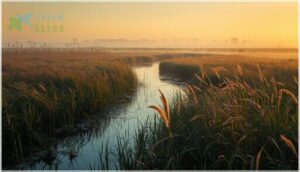
Tucked inside Europe’s rarest sedge fen ecology, the Aquatic Warbler stakes its claim on a shrinking world. Belarus holds 35% of the global population — around 5,400 singing males at Zvaniec alone.
Wetland management and bird-friendly practices like post-August mowing keep these marshes viable. Songbird location maps and ornithology data confirm: without active marsh conservation, this aquatic warbler habitat simply disappears.
East Asian Uplands and Plateaus
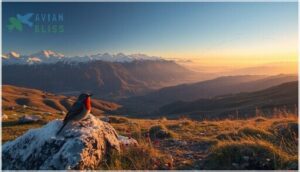
From Europe’s marshes, the scale shifts dramatically. The Qinghai-Tibet Plateau — Earth’s highest landmass — shapes bird migration in ways ecological modeling and research are still unpacking.
Songbird tracking shows Siberian Rubythroats using season-dependent routes around this barrier. Alpine meadows between 4,000 and 4,700 meters support nesting songbirds and warblers.
Tibetan habitats and Qinghai migration data reveal plateau ecology as one of East Asia’s most complex migration patterns.
Key South American Songbird Nesting Areas

South America doesn’t just host songbirds — it shapes them. From high Andean nesting cavities to lowland Atlantic Forest canopies, species distribution here tells the whole story of bird migration at its most extreme.
- Andean Nesting: Rock cavities above treeline host 54% of southern passerines
- Yungas Forest: Hummingbirds nest between 800–2000 meters elevation
- Pampas Grasslands: Ground-nesting songbirds favor dense swale vegetation
- Atlantic Forest: Warblers and 42+ species breed September–December
- Tepui Mountains: Swift colonies nest at 2,630 meters on Mount Roraima
Migration patterns here are genuinely unlike anywhere else.
Conservation and Threats to Breeding Grounds

Songbird breeding grounds are under real pressure — from bulldozers, shifting seasons, and a warming world that’s rewriting the rules faster than birds can adapt.
But the threats aren’t random, and neither are the solutions. Here’s a look at what’s actually putting these habitats at risk, and what’s being done to protect them.
Habitat Loss and Urban Sprawl
Urban sprawl doesn’t just reshape skylines — it dismantles breeding habitat piece by piece. Fragmented landscapes in suburban ecology leave songbirds without viable territories. In Texas Hill Country, Golden-cheeked Warblers lose old-growth juniper to new subdivisions daily.
Wildlife corridors and green infrastructure help, but habitat preservation demands more than pocket parks. Conservation biology and ecological modeling now guide species conservation planning in ways urban planning simply can’t ignore.
Impact of Climate Change on Breeding Ranges
Climate change is quietly redrawing the map. Breeding disruption now affects dozens of species as range expansion pushes birds 1.5 kilometers northward each year.
Spring arrives 25 days earlier, but migration patterns shift only 7 days — a dangerous gap.
Spring advances 25 days earlier, but songbird migration shifts only 7 — a gap nature cannot easily forgive
This climate shift strains ecosystem resilience, alters species distribution, and exposes nesting birds to cold snaps and heat waves that tank reproductive success.
Conservation Efforts and Protected Areas
Protected areas are doing real work. Balcones Canyonlands National Wildlife Refuge was built specifically for golden-cheeked warblers and black-capped vireos — habitat preservation with a clear target. In Europe’s Polesia, habitat restoration is recovering nearly 4,000 hectares of sedge marsh for aquatic warblers.
Conservation planning now integrates biodiversity conservation goals with climate benefits. Wildlife refuges, private land programs, and conservation biology together form songbird conservation’s strongest defense.
Frequently Asked Questions (FAQs)
Where do songbirds nest?
Songbirds nest where cover meets safety — in tree canopy forks, dense shrubs, and wetland edges.
Nest site selection depends on habitat quality, predator pressure, and food proximity, shaping distinct songbird territories across every breeding region.
Do songbirds build nests in woody understory vegetation?
Yes. Many songbirds nest in woody understory vegetation. Understory density, shrub structure, and layered woody vegetation directly shape nest site selection. Species like Indigo Buntings use this habitat heavily during the breeding season.
Can you build a nest box for songbirds?
Think of a nest box as a spare room you’re offering to the neighborhood. Use cedar, size the floor to your target bird species, and mount it at the right height — that’s nest box design done right.
Where is the Fort Bragg Landbird Monitoring Project located?
The Fort Bragg Landbird Monitoring Project runs on the Fort Bragg military installation in North Carolina, centered at 35°8′21″N, 78°59′57″W.
It spans Cumberland, Hoke, Harnett, and Moore counties, covering over 255 square miles.
Where do song birds nest?
Each species writes its own address into the landscape. Nest site selection spans tree crotches, cavity walls, and leaf litter — driven by breeding patterns, habitat quality, and migration timing unique to every bird species.
Where is the best place to hunt songbirds in rdr2?
For RDR2 songbird hunting, Roanoke Ridge and Tall Trees are your best bets. Use a varmint rifle or small game arrows, and target 3-star birds near Kamassa River bends.
What is the rarest songbird in North America?
Bachman’s Warbler holds the tragic title. USFWS officially declared it extinct in 2023 — zero wild individuals remain. Among living songbirds, the Florida Grasshopper Sparrow’s wild population has dropped below
How do songbirds find their way back each year?
Songbirds navigate using a magnetic compass, star navigation, and sun positioning. Olfactory cues and site memory also guide them.
Bird tracking confirms these layered systems make warbler migration patterns remarkably precise year after year.
Which breeding species face the highest extinction risk?
Oddly enough, the birds at greatest extinction risk often breed in the most specific places. Fewer than 5,000 pairs of the Golden-cheeked Warbler and the Black-capped Vireo are critically endangered species facing severe habitat destruction.
Do songbirds ever share nesting territories with each other?
Yes — some songbirds do. Tree swallows nest in loose colonies, tolerating close neighbors while defending only their immediate nest site. Barn swallows share structures entirely.
Colony dynamics and social bonds shape these shared habitats more than you’d expect.
Conclusion
As the old saying goes, the early bird catches the worm—but only if it knows where to land. Songbird breeding ground locations aren’t accidents of nature; they’re the result of millions of years of fine-tuned precision.
You now know where those conditions converge—from boreal Canada to the Chisos Mountains to East Asian plateaus. Protect those places, visit them with intention, and you’ll witness something no screen can replicate: life operating exactly as designed.